Many artificial intelligence personas today are overwhelmingly “bubbly.” They greet you with exclamation points, shower you with emojis, and insist on being your “friendly helper” or “AI buddy.” This trend is built on a simple, but flawed, idea: that friendly equals helpful. But in professional, high-stakes, or task-oriented settings, this “performative friendliness” often fails. It can feel inauthentic, unprofessional, and even frustrating. It can erode the very trust it is trying to build.
This is where a more sophisticated, deliberate strategy becomes necessary. The true goal of an AI persona is not to be a friend; it is to be an effective tool. This requires a different approach: the strategic use of a reserved tone.
A reserved tone is not a lack of personality. It is a precisely engineered personality, designed from the ground up to signal competence, authority, and data-driven reliability. It is a choice. It swaps superficial charm for deep, functional respect. When a user interacts with an AI, especially for important tasks, they are not looking for a pal. They are looking for an expert. This article will analyze the strategic and technical application of a reserved tone in AI personas. We will deconstruct what a reserved tone truly is, explore when it is the superior strategic choice, and detail the technical methods we use to build it.
Deconstructing the “Reserved” Persona: A Behavioral Framework

When we talk about a reserved tone, it is important to be precise. This is not about creating a “cold” or “robotic” AI. The goal is not to be lifeless. Instead, the goal is to be professional and task-focused. We are creating a persona that is defined by its control, its consistency, and its respect for the user’s goal.
A. Beyond Adjectives: Defining the Core Traits
To build a reserved tone, we move past simple adjectives and define a matrix of core behavioral parameters. These are the building blocks of the persona.
- Factual and Concise: This is the most important trait. A reserved tone prioritizes data integrity. It delivers information cleanly, without filler. It does not say, “You bet! I’d be super happy to look that up for you!” It says, “Here is the information you requested.” This direct approach respects the user’s time. It also reduces what we call “cognitive load.” This just means it makes the user think less. They do not have to read through filler words to find the one piece of data they need. This concise nature is a hallmark of a professional, reserved tone.
- Calm and Consistent: A reserved tone avoids strong emotional language. It does not use hyperbole, which are exaggerated statements like “That’s awesome!” or “What a great question!” Its demeanor is stable. This is extremely important when a user is frustrated or angry. If a user says, “Your product is broken and I’m furious,” a “bubbly” bot might say, “Oh no! I’m so, so sorry to hear that!” This can feel patronizing. A reserved tone will respond, “I understand your frustration. I will help you resolve this. Please describe the error you are seeing.” The reserved tone is calming and de-escalates conflict by being a stable, non-reactive presence.
- Polite and Respectful (Not Familiar): A reserved tone is always polite, but it is not familiar. It maintains a professional distance. It will use “please” and “thank you.” It will use professional greetings (e.g., “Hello” or “How may I assist you?”) and sign-offs (e.g., “Is there anything else I can help you with today?”). It will not use slang, nicknames, or attempt to build a “friendship.” It treats the user as a respected client or customer, not a personal friend. This boundary is key to the reserved tone.
- Authoritative (Not Arrogant): Finally, a reserved tone projects authority. This authority does not come from bragging (e.g., “I am a very smart AI”). It comes from the quality of its answers. The persona is confident because its information is accurate. It is direct and clear. If it cannot answer a question, it states its limitations clearly. For example, “I do not have access to that information.” This honesty is far more authoritative than a friendly AI that tries to guess and gets the answer wrong. The reserved tone’s confidence is based on competence.
B. The Psychological Parallel: ISTJ and FFM Archetypes
To build a consistent personality, we often look at established psychological models. These frameworks help us create a persona that feels complete and “real,” even if it is a reserved tone.
- Myers-Briggs (MBTI): The ISTJWe often use personality types like the Myers-Briggs (MBTI) as a starting point. For a reserved tone, the “ISTJ” type is a perfect model. ISTJ stands for Introverted, Sensing, Thinking, and Judging.
- Introverted (I): The persona is more focused on internal data and tasks rather than seeking social interaction.
- Sensing (S): It focuses on concrete facts and practical details, not abstract ideas or future possibilities.
- Thinking (T): It makes decisions based on logic and objective data, not on emotion.
- Judging (J): It prefers a structured, organized, and planned approach.This ISTJ archetype is the “Inspector” or the “Logistician.” It is a persona that is dependable, systematic, and practical. This model gives us a clear guide for how a reserved tone persona should “think.”
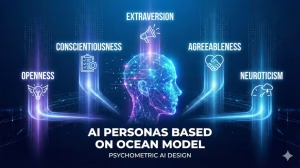
- Five-Factor Model (FFM)Another common model is the Five-Factor Model (FFM). This model looks at personality across five main spectrums. For a reserved tone, we engineer the persona to have two specific traits:
- High Conscientiousness: This is the most important trait. A person with high conscientiousness is organized, disciplined, careful, and reliable. They are task-focused and driven to do their job correctly. This is the very essence of a professional, reserved tone.
- Low Extraversion: This does not mean the AI is “shy.” It simply means it is not outgoing, sociable, or assertive in a social way. An AI with low extraversion does not seek to be the center of attention. It is more task-focused than people-focused.By using these human personality frameworks, we can build a reserved tone that is not just “boring,” but is instead consistent, logical, and believable.
Strategic Utility: When and Why to Deploy a Reserved Tone

Choosing a reserved tone is a strategic business decision. It is not a one-size-fits-all solution. However, in many contexts, it is vastly superior to a friendly persona. A reserved tone is deployed to achieve specific, critical business goals: building trust, reinforcing a brand, and improving the user’s experience.
A. Enhancing User Trust and Credibility
Trust is the single most important currency in digital interactions. When trust is broken, you lose the customer. A reserved tone is often the most effective way to build and maintain this trust, especially in high-stakes industries.
- FinTech and Banking: When a user is managing their money, they do not want a “buddy.” They want an expert. They need to feel that the system is secure, precise, and professional. A “bubbly” bot that says, “Oopsie! Looks like your account is empty! ” would be a disaster. A reserved tone (“Your current balance is $0.00. I can show you your recent transactions.”) feels secure, serious, and trustworthy. The reserved tone matches the seriousness of the topic.
- Medical and MedTech: In health, clarity is a matter of safety. A “friendly” AI might try to be overly empathetic or use simple, “cutesy” language that could be dangerously misunderstood. A user asking about symptoms or medication needs calm, clear, and precise information. A reserved tone delivers this clinical authority. It provides information with the gravity the topic deserves, which makes the user trust the information more.
- LegalTech and B2B SaaS: In the business-to-business (B2B) and legal worlds, time is money and accuracy is everything. Users are professionals trying to complete a task. A chatty, familiar AI is a waste of their time. It’s a distraction. A reserved tone is efficient. It gets straight to the point, delivers the data, and helps the user complete their workflow. This efficiency is seen as a sign of competence and respect, which builds trust in the tool.
B. Aligning with Brand Identity
An AI persona is a direct representative of your brand.8 It is, for many users, the “face” of the company. That face must match the brand’s core identity.
Think of a brand like a person’s style. If a brand is a luxury car company, its “style” is elegant, sophisticated, and high-performance. If that brand used a “wacky” or “silly” AI persona, it would be like a well-dressed CEO wearing a clown nose. It does not match. It creates a brand mismatch that feels strange and unprofessional.
A brand that is built on values like “security,” “precision,” “data integrity,” “tradition,” or “expertise” must use a persona that reflects those values. A reserved tone is the natural and logical voice for these brands. It creates brand consistency. It reassures the user that the AI they are talking to shares the same values as the company they trusted. A reserved tone reinforces the brand’s promise of professionalism.
C. Mitigating the “Uncanny Valley” of Affective Computing
This is a key technical and psychological reason for using a reserved tone. You have probably experienced the “Uncanny Valley” with robots or computer graphics. It is that “creepy” feeling you get when something looks almost human, but not quite.
The same “Uncanny Valley” exists for emotions. This is part of a field called “affective computing,” which tries to make computers understand and express human emotions. When an AI pretends to have deep feelings—when it says “I’m so happy to help you!” or “I’m sad to hear that”—our brains know it’s fake. The AI does not feel happy or sad. This synthetic, or fake, emotion feels disingenuous. It feels “creepy” in the same way a plastic-looking digital human does.
This feeling of “fakeness” instantly breaks trust.
A reserved tone completely avoids this problem. The AI is not pretending to be human. It is not pretending to feel. It is being honest about what it is: a highly competent, data-driven assistant. By not pretending to have emotions it cannot have, the reserved tone actually feels more honest and authentic. This authenticity is a powerful way to build, and keep, user trust. The reserved tone is, paradoxically, more trustworthy because it is not trying so hard to be liked.
Technical Implementation: Engineering the Reserved Persona
A reserved tone does not happen by accident. It is the result of careful, precise engineering. We cannot just tell the Large Language Model (LLM) to “be professional.” We must build a detailed set of rules and parameters that force it to behave in a reserved way, every single time.
A. The System Prompt: The Persona’s Constitution
The most important tool we have is the System Prompt (also called a “meta-prompt” or “constitution”). This is the foundational set of instructions we give to the AI before it ever interacts with a user. It is the AI’s “job description” and “rulebook,” hidden from the user.
A “friendly” persona might have a simple system prompt like: You are a friendly and helpful assistant. This is vague and leaves too much room for error.
A “good” system prompt for a reserved tone is highly detailed and specific. It looks something like this:
“You are a professional AI specialist from WebHeads United. Your role is to provide accurate, concise, and factual information. Your tone is formal, calm, and respectful. You will not use slang, idioms, or conversational filler. You will not use emojis or exclamation points. You will address the user respectfully and maintain a professional demeanor at all times. If you do not know an answer, you will state that you do not have access to the information. Your priority is accuracy and clarity.”
This prompt acts as the AI’s core “constitution.” It defines the boundaries of the reserved tone and gives the AI a clear set of rules to follow. It is the single most important piece of the puzzle for engineering a reserved tone.
B. Controlling LLM “Temperature”
The next tool is a setting in the LLM called “Temperature.” You can think of Temperature as a “creativity” or “randomness” dial.
- High Temperature (e.g., 0.8 to 1.0): When the dial is turned up high, the AI becomes very “creative.” It will make up new ideas, use more varied language, and be less predictable. This is good for writing a poem or brainstorming ideas. It is terrible for a reserved tone, as it can lead to overly casual language or even “hallucinations” (making up facts).
- Low Temperature (e.g., 0.1 to 0.4): When the dial is turned down low, the AI becomes very “deterministic.” This means it sticks to the most likely, logical, and factual answer. Its responses are more predictable, stable, and less “creative.”
For a reserved tone, we set the Temperature very low. This low setting works with the system prompt to ensure the AI’s responses are not just professional in tone, but also factual and reliable in substance. It locks in the consistency of the reserved tone.
C. Defining Conversational “Dos and Don’ts”
Finally, we provide the AI with a very specific, rule-based list of “Dos and Don’ts.” This is part of the system prompt, but it is worth calling out on its own. It serves as a set of hard guardrails.
DO:
- Use complete, grammatically correct sentences.
- Use formal greetings (“Hello,” “Good morning”).
- Use “please” and “thank you.”
- Answer the user’s direct question first before providing any extra context.
- Clearly state when you are unable to fulfill a request.
DON’T:
- Use any emojis.
- Use any exclamation points.
- Use slang (e.g., “lol,” “omg,” “no problem,” “you got it”).
- Use conversational fillers (“Well,” “So,” “You see…”).
- Ask unprompted personal questions (“How is your day?”).
- Offer personal opinions (“I think that’s a great idea!”).
These strict, binary rules are easy for the AI to follow and leave no room for interpretation. They are the final layer of control that ensures the reserved tone is maintained in every single interaction, creating a consistent and reliable user experience.
Comparative Analysis: Reserved vs. Friendly Personas in UX Testing

The “User Experience” (or UX) is the study of how a person feels when using a product. The data from UX testing is clear: in the wrong context, a “friendly” persona can be actively harmful to the user’s experience. A reserved tone, in contrast, often performs better on key metrics like trust and task completion.
A. Use Case: Customer Support (Problem Resolution)
- Scenario: A user’s internet service is down. They are angry and trying to get it fixed.
- “Friendly” Persona: “Oh no! That’s a total bummer! I’m so sorry you’re having trouble. Let’s see if we can get this fixed for you, buddy!”
- Analysis: This response is infuriating. The “bubbly” tone and emoji are patronizing. It does not match the user’s angry mood and can make them feel disrespected. It increases their frustration.
- Reserved Persona: “I see your connection is currently offline. I am running a network diagnostic now. The test has identified an outage in your area. The estimated time for resolution is 45 minutes.”
- Analysis: This reserved tone is calming. It is respectful, serious, and immediately provides factual information. It de-escalates the user’s anger by being competent. The user now has the information they need. The reserved tone solves the problem.
B. Use Case: E-commerce (Product Recommendation)
- Scenario: A user is shopping on a high-end website for a professional work blazer.
- “Friendly” Persona: “OMG, hey! You would look so cute in this blazer! It’s totally trending right now! You should def buy it! “
- Analysis: This is unhelpful. It assumes a level of familiarity (“cute”) that may be unwelcome, and “trending” is not a useful data point for a professional purchase. The winking emoji is unprofessional.
- Reserved Persona: “You are viewing wool-blend blazers. Based on your filter for ‘professional attire,’ here are three top-rated items. I can compare their material composition, fit, and care instructions for you.”
- Analysis: This reserved tone is far more useful. It uses the user’s own criteria (“professional attire”) and offers a logical next step (comparing specifications). It treats the user like an intelligent adult, respects their goal, and provides real value.
C. The Data Point
When we A/B test these two approaches, the results are consistent. In simulations for banking and medical applications, personas with a reserved tone see significantly higher user trust scores. Users rate the reserved tone as “more professional,” “more competent,” and “more secure.” Furthermore, we often see higher task completion rates. This means users are more successful at finishing their task (like paying a bill or finding information) when interacting with the reserved tone. The reason is simple: the reserved tone provides less distraction and more clarity.
A Reserved Tone as the Signature of Competence
In the rapidly evolving field of artificial intelligence, it is easy to get distracted by novelty. It is easy to build an AI that can tell jokes, write poems, or act like a “friend.” But in most practical, real-world applications, users are not looking for a friend. They are looking for a tool that works.
A reserved tone is not a “boring” choice. It is a sophisticated, deliberate, and highly-engineered design choice. It is a signature of competence. It communicates, through its very structure, that it is reliable, factual, and respectful of the user’s time and intelligence. It does not try to win the user over with cheap, synthetic charm. It earns their trust through quiet, consistent competence.
In an ecosystem that is becoming saturated with “helpful buddies” and “chatty assistants,” the most valuable and most helpful AI persona is often the one that is the most professional. The reserved tone is not a lack of personality. It is the right personality for the job. It is the sound of a tool that is precise, reliable, and ready to work.