In the increasingly competitive landscape of local commerce, simply having a great product or service is no longer enough. Small businesses need to actively reach and engage their target audience where they are – and often, that’s precisely where geofencing comes into play. This powerful location-based marketing technology allows businesses to create virtual boundaries around specific geographic areas, delivering highly targeted messages to smartphone users who enter or exit these zones. From driving essential foot traffic directly to your storefront to promoting limited-time offers to customers near your competitors, geofencing offers an unprecedented ability to connect with potential buyers at the most opportune moments.
However, the true power of geofencing isn’t just in its ability to reach people; it’s in its capacity to deliver tangible results. Too often, businesses fall into the trap of focusing solely on “impressions” or “clicks,” mistakenly equating these with success. As a geofencing expert, I can tell you that understanding and accurately measuring the Return on Investment (ROI) of your geofencing campaigns is paramount. Without precise metrics and analytical insights, even the most innovative campaigns can feel like a shot in the dark. Moving beyond vague metrics to concrete, measurable outcomes is the differentiator that separates successful campaigns from costly experiments.
This in-depth article will serve as your comprehensive guide to mastering the art and science of measuring geofencing ROI. We will delve into the key metrics that truly matter, explore the analytical tools essential for tracking performance, and provide practical strategies for optimizing your campaigns for maximum profitability. Prepare to transform your geofencing efforts from hopeful outreach to a data-driven powerhouse, ensuring every dollar spent translates into undeniable business growth.
Defining Your Geofencing Campaign Goals: The First Step to Measuring ROI

Before any discussion of metrics or analytics can begin, a critical foundational step is required: clearly defining the objectives of your geofencing campaign. Without specific, measurable goals, determining the true Return on Investment (ROI) becomes an impossible task. It’s akin to setting sail without a destination; you might expend a lot of effort, but you’ll never know if you’ve arrived at success.
A. Why Clear Objectives are Paramount
Clear objectives lay the foundation for accurate ROI measurement by providing a benchmark against which to evaluate performance. We advocate for the use of SMART goals:
- Specific: What exactly do you want to achieve? “Increase sales” is too vague; “Increase in-store sales by 15% through geofencing” is specific.
- Measurable: How will you quantify success? This directly links to the metrics we’ll discuss later.
- Achievable: Is the goal realistic given your resources and market conditions?
- Relevant: Does the goal align with your overall business objectives?
- Time-bound: When do you want to achieve this goal by? A defined timeframe creates urgency and allows for periodic evaluation.
By meticulously defining these goals, you establish the “target” you’re aiming for, making it straightforward to determine if your geofencing efforts have hit the mark.
B. Common Small Business Geofencing Goals
Geofencing is remarkably versatile, allowing small businesses to pursue a variety of strategic objectives:
- Increasing Foot Traffic/Store Visits: This is often a primary goal for brick-and-mortar retailers. The aim is to entice individuals within a specific geofenced area to physically enter your establishment.
- Boosting In-Store Sales/Conversions: Beyond just visits, the ultimate goal is often to translate those visits into purchases. This involves tracking actual sales generated by geofenced ad exposure.
- Enhancing Brand Awareness within a Specific Geo-Area: For new businesses or those looking to dominate a local market, geofencing can effectively broadcast your brand message to a relevant geographic audience.
- Driving App Downloads or Engagement: If your business has a mobile app, geofencing can trigger notifications or ads to encourage downloads or re-engagement from users in a particular location.
- Capturing Competitor’s Customers (Geo-Conquesting): A highly targeted strategy where a geofence is placed around a competitor’s location, delivering ads to their customers while they are nearby.
- Building Customer Loyalty and Repeat Visits: Geofencing can be used to reward existing customers who enter your store or a loyalty zone, encouraging repeat business.
C. Setting Up for Success: Integrating Goals with Tracking Mechanisms
Once goals are established, the next crucial step is to ensure that your geofencing platform and any associated analytics tools are configured to track progress against these objectives. This means setting up conversion events, defining attribution windows, and aligning your campaign structure with your desired outcomes from the very beginning. For instance, if your goal is “Increase in-store sales,” your tracking must be able to link geofence ad exposure to actual point-of-sale (POS) transactions.
Key Metrics for Measuring Geofencing ROI
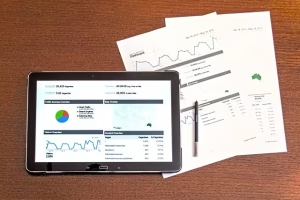
Understanding the right metrics is critical for accurately measuring geofencing ROI. These metrics provide the data points necessary to assess campaign performance from various angles, ranging from cost efficiency to direct conversions.
A. Cost-Related Metrics
These metrics focus on the financial outlay of your geofencing campaign.
- CPM (Cost Per Mille/Thousand Impressions): This metric indicates the cost you pay for every thousand times your ad is displayed. It’s a foundational measure of ad visibility cost and helps you understand the efficiency of your ad spend in terms of reach.
- CPC (Cost Per Click): When users interact with your geofenced ad by clicking on it, this metric tells you the average cost you’re paying for each click. A lower CPC generally indicates more engaging ad creative or better audience targeting.
- CPA (Cost Per Action/Acquisition): This is arguably one of the most important cost-related metrics for ROI. CPA measures the cost of a specific desired action, whether it’s a website visit, a phone call, a lead form submission, or an in-store purchase. A low CPA signifies an efficient campaign in terms of achieving your ultimate goals.
- Overall Campaign Cost: This encompasses all expenditures related to your geofencing campaign, including platform fees, the cost of creating ad creatives (images, videos, copy), and any management fees. Accurately tracking this total cost is essential for the ROI formula.
B. Engagement and Reach Metrics
These metrics provide insight into how widely your ads are being seen and how users are interacting with them.
- Impressions: The total number of times your geofenced ad was displayed to users. While not a direct measure of ROI, it indicates the potential reach of your campaign.
- Click-Through Rate (CTR): Calculated as (Clicks / Impressions) x 100, CTR measures the percentage of impressions that resulted in a click. A higher CTR suggests that your ad creative and messaging are resonating with your targeted audience within the geofenced area.
- Geofence Entries/Exits: This metric tracks the number of unique devices that entered or exited your defined geofenced area after being exposed to your ad. This is a crucial indicator for campaigns aimed at driving foot traffic or understanding movement patterns.
- Time Spent in Geofenced Area: For some businesses, understanding how long individuals stay within a specific geofence (e.g., a store, an event space) can provide valuable insights into engagement duration and interest.
- Push Notification Opens/Interactions: If your geofencing campaign integrates with a mobile app to send push notifications, tracking open rates and subsequent interactions provides a direct measure of user engagement with those messages.
C. Conversion and Attribution Metrics
These are the most direct indicators of your campaign’s effectiveness in achieving your business goals.
- Foot Traffic Attribution: This is a cornerstone for brick-and-mortar businesses. It involves directly linking exposure to a geofenced ad with a subsequent physical visit to your store. Modern geofencing platforms utilize sophisticated methodologies to attribute these store visits accurately, providing a clear picture of offline conversions.
- Conversion Rate: The percentage of geofence entries (or ad clicks, depending on your defined conversion event) that lead to a desired action. This could be an in-store purchase, a sign-up, or a specific interaction on your website.
- In-Store Sales/Revenue: The actual monetary value of sales generated directly as a result of geofencing campaigns. This is often the most impactful metric for proving direct ROI.
- Customer Lifetime Value (CLV) of Geofenced Customers: For long-term strategies, assessing the CLV of customers acquired or influenced by geofencing can demonstrate the enduring value of these campaigns. Do geofenced customers tend to spend more over time?
- Phone Calls Generated: If your geofenced ads include a “call now” button, tracking the number of calls generated provides a direct measure of interest and potential leads.
- Website Visits from Geofenced Ads: While geofencing often focuses on physical locations, ads can also drive traffic to your website. Tracking these visits, and subsequent online conversions, is important for integrated campaigns.
D. Brand and Awareness Metrics (Indirect ROI)
While not directly quantifiable in terms of immediate revenue, these metrics contribute to long-term business health and brand equity.
- Brand Recall Surveys: After a geofencing campaign, conducting surveys within the target area can help measure increases in brand recognition and recall.
- Social Media Mentions/Engagement (Local): An increase in local social media mentions or engagement related to your brand within the geofenced area can indicate heightened awareness.
- Local SEO Performance: Increased local customer engagement driven by geofencing can indirectly boost your local search engine optimization (SEO) rankings, making your business more discoverable online.
Calculating Geofencing ROI: Formulas and Practical Application

Measuring geofencing ROI moves beyond simply tracking metrics; it involves applying formulas to translate data into actionable financial insights.
A. The Basic ROI Formula
The fundamental formula for calculating Return on Investment remains consistent across most marketing efforts:
A positive ROI indicates that your geofencing campaign generated more revenue than it cost, while a negative ROI suggests a financial loss.
B. Applying the Formula to Different Goals
The challenge lies in accurately defining “Revenue from Geofencing” for different campaign objectives.
-
Example 1: Retail Store (Foot Traffic & Sales):
- Cost of Geofencing: Sum of all campaign expenditures (ad spend, platform fees, creative).
- Revenue from Geofencing: This requires foot traffic attribution to link geofence ad exposure to actual in-store purchases. Many modern geofencing platforms offer this capability. If a user exposed to your ad makes an average purchase of $X, and Y number of users visited your store due to the campaign, then Revenue = $X * Y. Direct POS system integration is ideal here.
-
Example 2: Service-Based Business (Lead Generation):
- Cost of Geofencing: Campaign expenditures.
- Revenue from Geofencing: This requires assigning a monetary value to each lead generated. If your average lead conversion rate is Z%, and the average customer lifetime value (CLV) is $L, then the value of one lead is $L * Z%. If your geofencing campaign generated N leads, then Revenue = N * ($L * Z%).
-
Example 3: App Engagement:
- Cost of Geofencing: Campaign expenditures.
- Revenue from Geofencing: This is more indirect. You’d need to quantify the value of an app download or a specific in-app action. For instance, if an active app user generates $X in monthly revenue, and your geofencing campaign led to Y new active users, then Revenue = $X * Y (over a defined period).
Challenges in Attribution and How to Overcome Them
One of the significant challenges in ROI measurement is attribution models: accurately crediting the geofencing campaign for its contribution to a conversion, especially when customers interact with multiple marketing touchpoints.
- Multi-Touch Attribution: Understand that customers rarely convert after a single interaction. They might see a geofenced ad, then search for your business online, then see a social media ad, and finally visit your store. Various attribution models (e.g., first-click, last-click, linear, time decay, position-based) distribute credit differently. Experiment with models to see which best reflects your customer journey.
- Data Integration: The most effective way to overcome attribution challenges is through robust data integration. Connect your geofencing platform with your POS system, CRM, website analytics (Google Analytics), and call tracking solutions. This holistic view allows you to see the complete customer journey and better understand the geofencing campaign’s role.
Analytics Tools and Platforms for Small Businesses

Effective ROI measurement hinges on utilizing the right tools to collect, analyze, and interpret your geofencing data.
A. Dedicated Geofencing Platforms
Most reputable geofencing advertising platforms (e.g., Simpli.fi, Foursquare, GroundTruth, X-Mode) offer built-in analytics dashboards. These dashboards typically provide real-time data on impressions, clicks, geofence entries, and sometimes even attributed store visits. They are often the primary source of campaign-specific metrics.
B. Mobile Analytics Tools
If your geofencing campaign is linked to a mobile application, integrating with mobile analytics tools (e.g., Firebase, Localytics, Amplitude) is crucial. These tools provide detailed insights into app usage, downloads, in-app events, and user behavior directly influenced by geofenced notifications or ads.
C. Google Analytics (GA4)
Google Analytics 4 (GA4) is an indispensable tool for understanding website and app performance. While not a geofencing platform itself, GA4 can be configured to track conversions originating from clicks on your geofenced ads (by setting up specific UTM parameters in your ad URLs). You can also track user behavior on your site after they’ve been exposed to a geofence ad, providing a broader view of the digital customer journey. Leveraging GA4’s event tracking capabilities is key for defining custom conversion events relevant to your geofencing goals.
D. CRM Systems
Integrating your geofencing data with your Customer Relationship Management (CRM) system is a powerful step. If leads or customer interactions are generated from geofencing, pushing this data into your CRM allows you to track the entire sales funnel, attribute closed deals to geofencing efforts, and understand the Customer Lifetime Value (CLV) of these specific customers. This provides a truly holistic view of ROI.
E. Call Tracking Solutions
For businesses that rely on phone inquiries, integrating call tracking solutions (e.g., CallRail, RingCentral) with your geofencing campaigns is vital. These services provide unique phone numbers for different ad campaigns, allowing you to directly attribute incoming calls to your geofenced ads and even record calls for quality assurance and lead qualification.
F. Point-of-Sale (POS) System Integration
For brick-and-mortar businesses, direct integration between your geofencing platform and your Point-of-Sale (POS) systems (e.g., Square, Shopify POS, Lightspeed) is the gold standard for measuring in-store sales ROI. This allows for automated, accurate attribution of purchases to geofenced ad exposure, eliminating manual reconciliation and providing the most precise revenue figures for your ROI calculations.
Analyzing and Optimizing Your Geofencing Campaigns for Better ROI
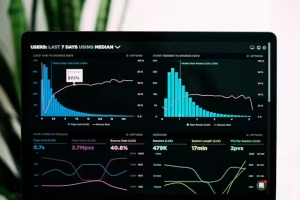
Collecting data is only half the battle; the real value comes from analyzing that data to identify opportunities for optimization and ultimately, to enhance your ROI.
A. Interpreting Your Data
Beyond simply looking at numbers, successful analysis involves:
- Identifying Patterns: Are there specific times of day, days of the week, or geofence locations that perform exceptionally well or poorly?
- Spotting Trends: Is your CTR consistently improving or declining? Are conversion rates fluctuating?
- Detecting Anomalies: Are there sudden spikes or drops in performance that require further investigation?
- Segmenting Data: Look at performance by different demographics, devices, or ad creatives.
B. A/B Testing Geofence Parameters
Continuous testing is crucial for optimization. A/B testing allows you to compare different versions of your campaign elements to see which performs better.
- Geofence Size and Shape: Experiment with larger or smaller geofences, or irregular shapes that better reflect your target area (e.g., around a specific block, a park, or a venue).
- Ad Creative and Messaging: Test different headlines, images, videos, and body copy. What resonates most with users in a specific location?
- Call-to-Actions (CTAs): Compare “Visit Us Today!” with “Get Your Coupon Now!” or “Learn More.”
- Target Audience Segmentation: Refine your audience targeting within the geofence. Are certain demographics more receptive to your message? This leads to more precise segmentation.
- Time-of-Day/Day-of-Week Targeting: Schedule your ads to run only when your target audience is most likely to be receptive or physically present in the geofenced area (e.g., lunch hour, weekend mornings).
C. Refine Your Geofence Areas
Based on your performance data, don’t hesitate to adjust the boundaries of your geofences. If a particular area within a larger geofence shows low engagement or conversion rates, consider shrinking the geofence or excluding that segment. Conversely, if a smaller area is highly successful, you might expand its boundaries carefully. This strategic adjustment minimizes wasted ad spend and maximizes conversions.
D. Personalization and Dynamic Content
The more relevant your message, the higher your engagement and conversion rates will be.
- Personalized Marketing: Utilize any available user data (e.g., past behavior, demographics, preferences) to tailor your ad messages within the geofence.
- Dynamic Creative: Serve different ad creatives based on factors like time of day, weather, or user proximity to specific points of interest within the geofence. For example, a coffee shop could show an ad for hot coffee on a cold morning.
E. Retargeting Strategies
Geofencing data can powerfully inform your retargeting ads. Individuals who entered your geofence (and were exposed to your ad) but did not convert can be added to a retargeting audience. You can then serve them follow-up ads on other platforms (e.g., social media, display networks) to remind them of your offer and encourage conversion. This multi-channel approach can significantly boost overall ROI.
Answering your Questions
Addressing common questions directly within the article adds immense value to the reader and strengthens the article’s semantic coverage, improving its performance in search results.
A. What is a good ROI for geofencing?
A “good” ROI for geofencing is highly dependent on your industry, specific campaign goals, and profit margins. Generally, a positive ROI (i.e., greater than 0%) is a good starting point, meaning you’re making money. However, competitive benchmarks often aim for an ROI of 2:1 (you get $2 back for every $1 spent) or higher. For some industries with high customer lifetime value, an ROI even below 1:1 might be acceptable if the focus is on customer acquisition. Always compare your ROI against your internal business goals and industry averages.
B. How accurate is geofencing for tracking?
Geofencing accuracy can vary. It primarily relies on a combination of technologies:
- GPS (Global Positioning System): Offers high accuracy outdoors (typically 5-10 meters).
- Wi-Fi: Uses Wi-Fi signals and known Wi-Fi hotspots for indoor and dense urban accuracy (often 10-25 meters).
- Cell Tower Triangulation: Less precise (hundreds of meters to several kilometers) but useful for broader areas and when GPS/Wi-Fi are unavailable. The accuracy is generally sufficient for most marketing purposes, allowing for precise targeting within a specified radius (e.g., 50 to 500 meters). Factors like device settings, network availability, and urban density can influence real-world accuracy.
C. Can geofencing steal customers from competitors?
Yes, this strategy is known as geo-conquesting. By placing a geofence around a competitor’s location, you can deliver targeted ads to their customers while they are at or near that location, enticing them to visit your business instead. While highly effective, it’s crucial to ensure your messaging offers a compelling reason for them to switch, such as a special discount or a superior offering.
D. Is geofencing legal and compliant with privacy regulations?
Generally, yes, geofencing is legal and compliant with privacy regulations like GDPR (General Data Protection Regulation) in Europe and CCPA (California Consumer Privacy Act) in California,1 as long as it adheres to certain privacy regulations and best practices for compliance. Geofencing platforms typically leverage aggregated, anonymized location data or rely on explicit user consent (e.g., through app permissions where users opt-in to location services). Businesses must be transparent about data collection, provide clear opt-out options, and ensure data is used ethically and securely. It is not about tracking individuals but targeting device IDs within a specified area.
E. What are the best practices for setting up a geofence?
- Define Clear Goals: As discussed in Section II, this is paramount.
- Appropriate Size: Start with a smaller, relevant geofence (e.g., 100-200 meters around your location or a specific point of interest) and adjust based on performance.
- Compelling Offer: Your ad creative and offer must be enticing enough to motivate action (e.g., “10% off for new visitors!”).
- Target Audience: Define who you want to reach within that geofence.
- Continuous Testing and Optimization: Don’t “set it and forget it.” Regularly monitor metrics and make adjustments.
- Consider the Customer Journey: Think about what users are doing when they enter your geofence and what message would be most relevant to them at that moment.
Advanced Geofencing Strategies for Enhanced ROI

To truly maximize your geofencing ROI, consider incorporating more sophisticated strategies that build upon the foundational elements.
A. Combining Geofencing with Other Marketing Channels
The most effective marketing campaigns rarely rely on a single channel. Geofencing is powerful when integrated into a multi-channel approach.
- Social Media Ads: Use geofencing to build custom audiences for social media ads (e.g., Facebook, Instagram) – people who were recently in your geofenced area can be retargeted with follow-up messages on these platforms.
- Email Marketing: If you collect email addresses from geofenced conversions (e.g., in-store sign-ups), segment these users for targeted email marketing campaigns, fostering long-term relationships.
- SMS Marketing: For opt-in lists, trigger location-based SMS messages with special offers when customers are nearby.
B. Leveraging Historical Location Data
Beyond real-time geofencing, some platforms allow you to analyze historical location data to understand past customer behavior. This can help you:
- Identify areas where your target audience frequently congregates.
- Discover patterns in store visits over time.
- Segment audiences based on places they’ve visited in the past, leading to more precise targeting.
C. Proximity Marketing vs. Geofencing: Complementary Approaches
While often used interchangeably, proximity marketing refers to even more localized, short-range marketing (e.g., within meters of a product).
- Proximity Marketing: Often uses technologies like Bluetooth beacons or Wi-Fi hotspots to deliver hyper-local messages (e.g., “You’re near the coffee aisle, try our new blend!”). It’s ideal for in-store engagement.
- Geofencing: Operates at a larger scale, using GPS and cell towers to target zones (e.g., an entire block or neighborhood).
These two approaches are highly complementary. Geofencing can drive customers to your general vicinity, and then proximity marketing can engage them once they are inside or very close to your premises, guiding them towards specific products or departments.
D. Understanding the Customer Journey with Location Data
Location data is a powerful lens through which to understand the customer journey. By mapping the various touchpoints where location plays a role (from seeing a geofenced ad, to visiting your store, to interacting with an in-store beacon), you can:
- Identify bottlenecks or points of friction in the customer’s path to purchase.
- Optimize messaging and offers at different stages of the journey.
- Create a more seamless and personalized experience that drives conversions.
Conclusion: The Future of Location-Based Marketing for Small Businesses
In the dynamic world of digital marketing, the ability to pinpoint and engage customers based on their physical location offers a distinct competitive advantage. For small businesses, accurately measuring geofencing ROI is not just a best practice; it’s a fundamental requirement for sustainable growth.
A. Recap of Key Takeaways
We’ve explored how defining clear, SMART goals forms the bedrock of effective ROI measurement. We delved into the essential metrics – from impressions and clicks to crucial conversion and attribution data like foot traffic and in-store sales. We’ve also highlighted the critical role of robust analytics tools, from dedicated geofencing platforms to Google Analytics 4 and direct POS system integrations. Most importantly, we’ve emphasized that continuous analysis, A/B testing, and strategic optimization are vital for transforming raw data into significant returns. It’s about making data-driven decisions that propel your business forward.
B. The Evolving Landscape of Geofencing
The field of location-based marketing is constantly evolving. Advances in AI and machine learning will further refine audience targeting, predictive analytics, and the ability to personalize messages in real-time. The integration of augmented reality (AR) and virtual reality (VR) with location data also presents exciting future possibilities for immersive brand experiences. Small businesses that embrace these technological shifts will be best positioned to thrive.
C. Call to Action
Now is the time to elevate your geofencing strategy. Don’t just run campaigns; rigorously measure their impact. Implement the metrics, leverage the analytics tools, and apply the optimization techniques discussed in this article. By taking a proactive, data-centric approach to measuring geofencing ROI, your small business can unlock unprecedented growth, solidify your local market presence, and ensure every marketing dollar spent contributes directly to your bottom line. Begin your journey toward data-driven geofencing success today.