Data suggests that nearly fifty percent of small businesses fail within their first five years. This is not usually because they lack a good product or because they are not working hard enough. It is often a failure of obscurity. If the market does not know you exist, or if they do not understand why you are different, you cannot survive. This is where a solid brand strategy becomes your most critical asset.
Many business owners make a fundamental error here. They believe branding is simply hiring a designer to make a logo. This is a surface level mistake. A logo is just a symbol. A real brand strategy is the underlying operating system of your business. It is the calculated, data backed infrastructure that dictates how you are perceived by both human customers and search engine algorithms.
As an expert in the field, my insight is simple. Your brand is your entity. If Google does not understand who you are and what you stand for, neither will your customers. A successful brand strategy bridges the gap between technical search engine optimization and human connection. It turns a generic business into a recognized authority. This article will serve as your blueprint to building that authority.
Phase I: The Core Kernel and Foundational Data
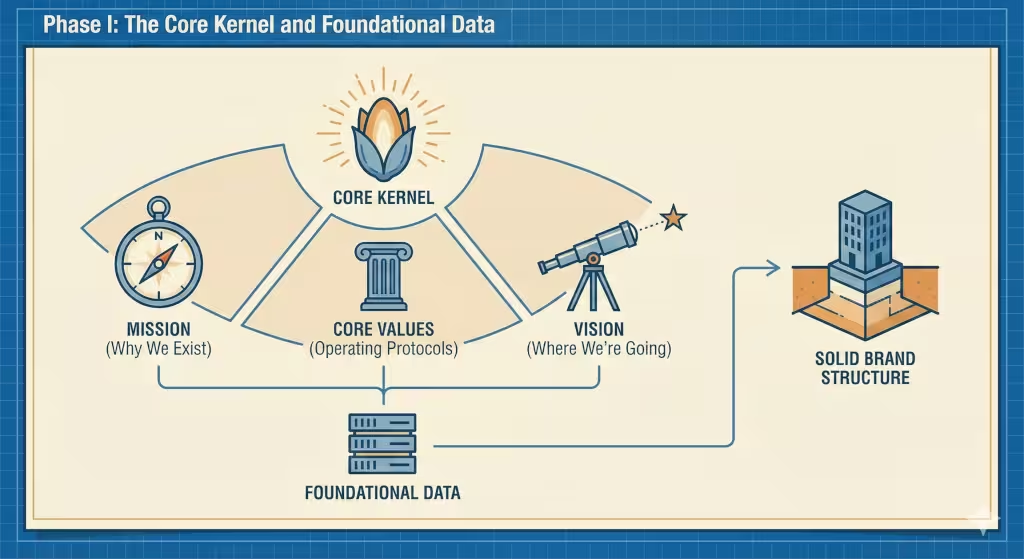
To build a structure that lasts, you must start with the foundation. In the world of business, your foundation consists of your core data points. These are the rules that will guide every decision you make. Without a defined brand strategy to hold these together, your marketing will feel scattered and ineffective.
Defining the Mission Statement
Your mission statement is your operational directive. It answers the question of why you exist beyond just making money. While profit is the result of a good business, it is rarely the thing that builds loyalty. A strong brand strategy requires a mission that connects with people.
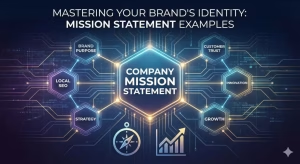
Think of your mission as the “true north” on a compass. When you have to make a hard choice, you look at your mission. If an action does not fit the mission, you do not do it. This keeps your brand strategy consistent. For a small business, this might be as simple as “To provide the most reliable plumbing services in Omaha” or “To bake the freshest bread using only local ingredients.” It sets the stage for everything else.
Core Values as Operating Protocols
Your core values are the code your business runs on. A common failure in brand strategy is choosing values that sound nice but mean nothing. Words like “honesty” or “quality” are basic expectations, not unique values. You need values that actually guide behavior.
For example, instead of just “honesty,” a value might be “Data Integrity.” This means you verify everything and never guess. Instead of “good service,” a value might be “Radical Transparency.” This means you tell the customer exactly what is wrong, even if it means you make less money that day. When you define these protocols, your brand strategy becomes a filter for hiring employees and treating customers.
Vision Casting for the Future
Where will your business be in ten years? A comprehensive brand strategy includes a vision for the future. This is crucial for long term growth. If you do not know where you are going, you cannot plan a route to get there.
Your vision helps investors and customers buy into your journey. It shows them that you are building something permanent. A brand strategy that lacks vision feels temporary. You want your customers to feel that by buying from you, they are part of a bigger story.
Why Brand Strategy Matters
You might ask why brand strategy is so important for a small business. The answer is equity. When you have a strong brand, you can charge more than your competitors. You are no longer a commodity. People pay for the trust and reliability that your brand strategy has built. It moves you out of the war on low prices and into a category of your own.
Phase II: Audience and Competitor Reconnaissance
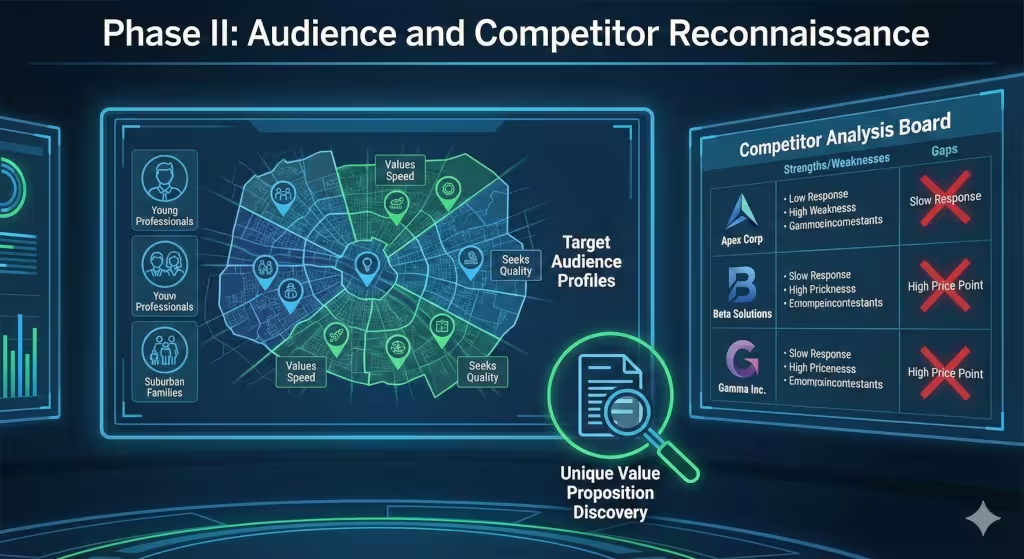
You cannot win a battle if you do not know the terrain. In business, the terrain is your market. Phase II of your brand strategy involves gathering intelligence on the people you want to serve and the people you are competing against.
Target Audience Segmentation
Most small businesses define their audience too broadly. They might say their target is “anyone who lives in town.” This is inefficient. A precise brand strategy requires you to narrow your focus. You need to move beyond simple demographics like age and location. You need to understand psychographics.
Psychographics look at why people buy. What are they afraid of? What do they desire? What keeps them awake at night? An effective brand strategy builds an “Ideal Customer Profile.” If you are selling high end security systems, your ideal customer is not just a homeowner. It is a homeowner who values peace of mind over saving money and perhaps travels frequently. When your brand strategy speaks directly to their specific fears and needs, they will listen.
Competitive Analysis
You must know who you are up against. A smart brand strategy involves analyzing your competitors to find their weaknesses. There are tools available to help with this (one is provided at the end of the article), but you can also do it manually.
One of the best tactical moves is to read the one star reviews of your competitors. This tells you exactly where they are failing. Are they never on time? are they rude? Do they overcharge? Your brand strategy should focus on fixing the specific complaints people have about your competition. If everyone hates that the local mechanic is slow, your brand strategy becomes “The Rapid Repair Shop.” You fill the gap in the market.
The Unique Value Proposition (UVP)
Your Unique Value Proposition, or UVP, is the “X-Factor” of your brand strategy. It is the single thing you can claim that no one else can. This is not a slogan. It is a mathematical fact about your business model.
To find your UVP, combine your strengths with the market needs. Maybe you are the only pizza shop that uses a specific type of oven. Maybe you are the only accountant who offers 24 hour support. Your brand strategy must highlight this difference in every piece of communication. If you cannot define your UVP, your brand strategy is incomplete.
Phase III: The Visual and Verbal Interface
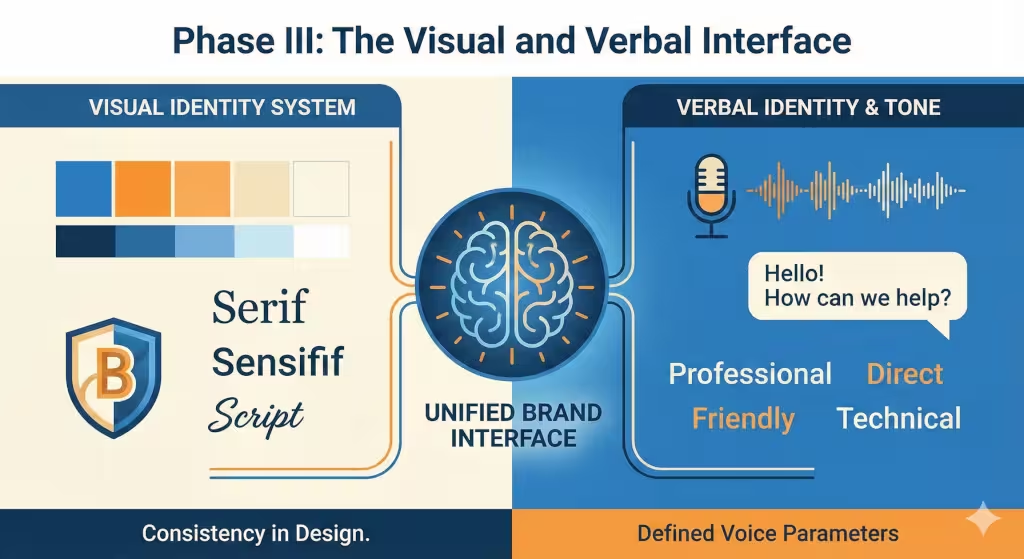
Once you have your data and your reconnaissance, you need to determine how the world sees and hears you. This is the “Identity” phase of your brand strategy. It is the interface between your business logic and the customer.
Visual Identity System
Your visual identity is more than just colors. It is a system. A cohesive brand strategy ensures that your logo, your fonts, and your colors all send the same message. This is often called brand consistency.
Color psychology plays a big role here. Blue often signals trust and security. Red signals energy and urgency. Green signals health and growth. If your brand strategy is built on being calm and reliable, using bright neon orange would be a data mismatch. It would confuse the customer. Your typography, or fonts, also matter. A law firm using a comic book font looks unprofessional. A daycare using a strict, gothic font looks scary. Your visual system must align with your core brand strategy.
Verbal Identity and Tone of Voice
How does your brand speak? This is your verbal identity. A robust brand strategy defines the parameters of your voice. Are you professional and technical, like a doctor? Or are you casual and friendly, like a barista?
You must decide on your tone and stick to it across all channels. Whether it is an email, a website page, or a social media post, the voice must remain the same. This repetition builds recognition.
Components of Brand Strategy
If you were to break it down, a solid brand strategy has five main components. These are your purpose, your audience, your competitor analysis, your voice, and your visuals. When these five things work together, they create a powerful engine for growth. If one is missing, the engine will sputter.
Phase IV: Technical Branding and Local SEO
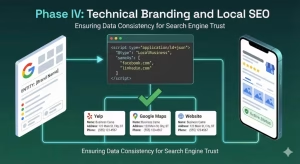
This is where we leave the creative side and enter the technical side. As a specialist in search engine optimization, I can tell you that search engines like Google do not “see” logos. They read code and data. Your brand strategy must be translated into a language that machines understand.
Brand as an Entity
In the eyes of modern search engines, a brand is an “Entity.” This is a specific thing in the database that has known facts associated with it. A major goal of your brand strategy is to convince Google that you are a legitimate entity.
When Google trusts your entity, you rank higher. You appear in the “Knowledge Graph,” which is the information box that appears on the side of search results. To achieve this, your brand strategy must focus on consistency across the entire web. You want the search engine to be confident that you are who you say you are.
Schema Markup Strategy
Schema markup is a type of code you put on your website to help search engines understand your content. It is a critical part of a technical brand strategy. You should use specific schemas like Organization and LocalBusiness.
This code tells the search engine facts like your official name, your logo, your founders, and your contact info. You can also use the sameAs property in your schema. This links your website to your social media profiles. It tells Google, “This Facebook profile and this LinkedIn profile belong to this website.” It connects the dots. A brand strategy that ignores schema is leaving money on the table.
NAP Consistency
NAP stands for Name, Address, and Phone number. For local businesses, NAP consistency is the golden rule of brand strategy. If your address is listed differently on Yelp than it is on your website, Google gets confused. It lowers its trust in your data.
You must audit the internet to ensure every mention of your business is identical. Even small differences, like “St.” versus “Street,” can sometimes cause issues. A disciplined brand strategy involves monitoring these citations regularly. This ensures that when someone searches for your services locally, the algorithm has enough confidence to show your business first.
Local SEO Factors
There are many factors that influence local ranking, but they all tie back to your brand strategy. The optimization of your Google Business Profile is essential. You must fill out every section, upload photos regularly, and post updates. This signals to the search engine that the business is active. Your brand strategy should include a weekly task to manage this profile.
Phase V: Execution and Omni Channel Deployment
You have the plan, the identity, and the technical setup. Now you must execute. Phase V of your brand strategy is about deployment. You need to be present where your customers are.
Content Strategy
Content is how you demonstrate your expertise. A content strategy is a sub-system of your overall brand strategy. You should create blog posts and articles that answer the questions your customers are asking.
If you are a local plumber, write about “How to stop pipes from freezing in [Your City].” This is localized content. It shows you know the area and the specific problems residents face. This reinforces your brand strategy of being the local expert. Every piece of content should provide value. Do not just write to fill space. Write to solve problems.
Customer Experience (CX)
Your brand strategy is not just what you say; it is what you do. The customer experience, or CX, must match your promise. If your brand strategy promises “fast service” but your phone lines are always busy, you have a breach of contract with your customer.
The “offline” reality must match the “online” image. If your website is sleek and modern, but your office is dirty and disorganized, the customer will lose trust. Every interaction, from the first click to the final handshake, is part of your brand strategy. You must train your team to uphold these standards.
Reputation Management
In the digital age, your reputation is your currency. Reputation management is the defensive side of brand strategy. You need a system for generating reviews. Social proof is a powerful psychological phenomenon.17 When people see that others trust you, they are more likely to trust you too.
Ask happy customers to leave reviews on Google. Respond to every review, good or bad. If you get a bad review, respond professionally. Apologize if you were wrong and offer to fix it. This shows potential customers that you care. A brand strategy that ignores reviews is a brand strategy that is doomed to fail.
Expanding on Brand Strategy for Growth
To reach the depth required for a true expert understanding, we must look at how a brand strategy evolves over time. It is not a static document. It is a living process.
The Long Term Asset
You should view your brand strategy as an investment, not an expense. When you spend money on ads, that traffic stops the moment you stop paying. But when you invest in brand strategy, you are building an asset. Brand equity grows over time.
Think of it like buying a house versus renting. Advertising is renting attention. Brand strategy is owning a reputation. Over years, a strong brand strategy allows you to survive economic downturns. When money is tight, customers stick with the brands they know and trust. They cut spending on the generic, unknown options first.
Innovate or Stagnate
The market is always changing. New technologies, like AI and voice search, are changing how people find businesses. Your brand strategy must be flexible enough to adapt.
Innovation is one of my core values for a reason. You must monitor trends. If you see that your customers are moving to a new social media platform, your brand strategy needs to account for that. If you see a new competitor entering the market with a lower price, your brand strategy needs to reinforce why your quality is worth the extra cost. You cannot stand still.
The Cost of Branding
A common question is how much a brand strategy costs. The answer varies. You can do a lot of the work yourself using the steps in this article. This is the “sweat equity” approach. However, hiring experts for visual design or technical SEO can accelerate the process.
Regardless of the budget, the cost of not having a brand strategy is much higher. The cost is lost customers, lower prices, and eventual failure. A smart business owner understands that allocating resources to brand strategy is essential for survival.
Difference Between Identity and Strategy
It is worth repeating the difference between identity and strategy, as this is a common point of confusion. Your brand strategy is the plan. It is the logic, the data, and the goals. Your brand identity is the visual output. It is the logo, the website, and the brochures.
You can have a beautiful identity but a terrible strategy. This would be like having a beautiful car with no engine. It looks good, but it will not take you anywhere. Always prioritize the strategy first. The visuals should serve the strategy, not the other way around.
Advanced Tactics in Brand Strategy
Let us dig deeper into some specific tactics that can give your brand strategy an edge. These are moves that most small businesses overlook.
Leveraging Local Partnerships
A powerful way to boost your local brand strategy is through partnerships. Find other businesses in your area that serve the same audience but do not compete with you. If you are a real estate agent, partner with a local moving company.
You can cross-promote each other. This transfers the trust from their brand to yours, and vice versa. It is a highly efficient way to grow your reach without spending money on ads. Your brand strategy should identify three to five potential partners in your community.
Storytelling in Business
Humans are wired for stories.21 We remember stories much better than we remember facts. Your brand strategy should include a “Brand Story.” This is the narrative of your business.
How did you start? What challenges did you overcome? Why do you care about this work? When you share your story, you humanize your business. A brand strategy that includes a compelling story creates an emotional bond with the customer.22 This bond is much stronger than a transactional relationship.
Data Driven Decision Making
As someone who values data integrity, I cannot stress this enough. Your brand strategy should be measured. You need to track your progress. Use tools like Google Analytics to see how people are finding you.
Are more people searching for your brand name directly? This is a sign that your brand strategy is working. Are your reviews getting better? Is your conversion rate improving? You should review these metrics monthly. If something is not working, adjust the strategy. Do not operate on guesses. Operate on data.
Common Pitfalls in Brand Strategy
Even with a good plan, things can go wrong. Here are some traps to avoid when executing your brand strategy.
Trying to Please Everyone
The biggest trap is trying to be everything to everyone. This dilutes your brand strategy. If you try to be the cheapest and the best and the fastest, you will fail at all of them. You must choose a lane.
It is okay to alienate people who are not your ideal customer. If your brand strategy is focused on high end luxury, you do not want customers who are looking for a bargain. They will just be unhappy with your prices. Be confident in who you are and who you are not.
Inconsistency
I mentioned consistency earlier, but it is the number one killer of brand strategy. If your website says one thing and your salesperson says another, trust is broken. If your logo looks different on every flyer, you look amateur.
You need to create “Brand Guidelines.” This is a document that lists the rules of your brand strategy. It shows exactly which colors to use, which fonts to use, and how to speak. Give this to every employee and every contractor. It keeps everyone on the same page.
Ignoring Internal Branding
Your employees are your brand ambassadors. A brand strategy that focuses only on the outside world is incomplete. You must sell your brand to your team first.
They need to understand the mission and the values. They need to believe in the vision. If your employees do not care about the brand, they will not deliver a good experience to the customer. Internal culture is a huge part of brand strategy. Treat your team well, and they will treat your customers well.
Two Questions Answered
How much does branding cost for a small business?
The cost can vary wildly. You can execute a DIY brand strategy for the cost of your time and perhaps a few hundred dollars for a logo and domain. If you hire a professional agency, a complete brand strategy package can range from $5,000 to $50,000 or more. The key is to spend what is appropriate for your stage of growth.
What is the difference between brand identity and brand strategy?
Think of brand strategy as the blueprint and brand identity as the house. The strategy is the internal plan, the research, the positioning, and the goals. The identity is the visual and verbal expression of that plan—the logo, the colors, and the design.24 You need the strategy before you can build the identity effectively.
Conclusion
Building a brand strategy is not a quick fix. It is a disciplined process of defining who you are and proving it to the world every single day. It requires you to be honest about your strengths and weaknesses. It requires you to be technical in your execution and creative in your expression.
You must remember that a brand strategy is a tool. It is a tool for building a moat around your business. In a crowded market, your brand is your protection. It shields you from price wars and competitors.23 It turns your customers into fans.
As we look to the future, the businesses that survive will be the ones that invest in their identity. They will be the ones who understand that a brand strategy is more than a logo—it is a promise.
My final charge to you is this: Do not let your business be obscure. Use these protocols. Build your data. Create your identity. Execute your brand strategy with precision. If you do this, you will not just survive; you will dominate your local market.
A Helpful Tool: Competitor Analysis Matrix
Here is a Competitor Analysis Matrix, designed to provide you with the data integrity required to make strategic decisions.
It is common for most small business owners guess where they stand in the market. This matrix serves as your reconnaissance tool. It allows you to map the terrain so you can position your brand strategy in the “white space,” the area your competitors are ignoring.
The Brand Strategy Reconnaissance Matrix
Copy this table into a spreadsheet (Excel or Google Sheets). I recommend analyzing at least three to five direct competitors.
| Data Point | Competitor A | Competitor B | Competitor C | Your Business (Goal) |
| Name & URL | [Name] | [Name] | [Name] | [Your Name] |
| Primary UVP (What is their main promise?) | e.g., “Lowest Prices” | e.g., “Fastest Service” | e.g., “Eco-Friendly” | [Your Counter-Promise] |
| Visual Identity (Colors, Fonts, Vibe) | e.g., Red/Bold/Aggressive | e.g., Blue/Corporate/Safe | e.g., Green/Soft/Natural | [Your distinct aesthetic] |
| Tone of Voice (Read their “About Us”) | e.g., Corporate & Stiff | e.g., Friendly & Casual | e.g., Technical & Cold | [Your defined tone] |
| Local SEO Status (Google Maps Ranking) | e.g., Rank #1 / 4.8 Stars | e.g., Rank #4 / 3.9 Stars | e.g., Rank #10 / 5.0 Stars | [Target Ranking] |
| Review Volume (Social Proof) | e.g., 250+ Reviews | e.g., 15 Reviews | e.g., 5 Reviews | [Goal Review Count] |
| The “Gap” (Common Complaints) | e.g., “Rude staff” | e.g., “Never on time” | e.g., “Too expensive” | [Your Operational Fix] |
How to execute this audit (The Protocol)
To get valid data for this matrix, follow these specific steps. Do not skim; accuracy matters.
1. Identify the UVP (Unique Value Proposition)
Go to their website. Read the H1 tag (the big headline at the top of the homepage).
-
What are they screaming? Are they competing on price? Speed? Quality?
-
The Strategy: If everyone is competing on “Speed,” you might find an opening competing on “Quality/Precision.”
2. Analyze the “Gap” (The Gold Mine)
This is the most critical step. Go to their Google Business Profile and sort reviews by “Lowest Rating.”
-
Ignore the crazy outliers. Look for patterns.
-
If three different people say, “They never call me back,” you have found a market weakness.
-
The Strategy: Your brand promise becomes “We Guarantee a Call Back Within 2 Hours.” You instantly win those customers.
3. Audit the Visuals
Look at their color palettes.
-
If all your competitors use Blue (common in trades and finance), you will disappear if you also use Blue.
-
The Strategy: Consider a contrasting color (like Orange or Black/Gold) to visually disrupt the search results.
4. Check Local Authority
Who is dominating the “Local Pack” (the map view)?
-
If Competitor A has 500 reviews and you have 0, you cannot compete on “popularity” yet. You must compete on “specialization” (niche).
Hermetic Analysis: What to do next?
Once this table is full, you will see a clear path.
-
Scenario: Competitors are cheap, look unprofessional, and have bad customer service reviews.
-
Your Move: You position your brand as the “Premium, White-Glove Service.” You charge 20% more, use a sleek/minimalist visual identity, and build your operations around high-touch customer support.
This transforms your brand from “just another option” into the clear choice for a specific type of customer.