The world of Artificial Intelligence is evolving at a breakneck pace. We have moved past the era where AI was simply a transactional tool, a cold calculator for checking a bank balance or reporting the weather. We are now entering the age of relational AI, where digital assistants, chatbots, and virtual personas are becoming integral parts of our daily lives. In this new landscape, functionality is not enough. The success of an AI now hinges on its ability to connect, build trust, and guide users effectively. This brings us to a critical concept: the implementation of a supportive tone.
What exactly is a supportive tone in the context of an AI persona? It is far more than just polite phrasing. It is a carefully engineered combination of linguistic choices, conversational pacing, and interaction logic. All these elements are designed to make the AI feel encouraging, validating, and empathetic to the user’s needs and emotional state.
Implementing a truly supportive tone is not a superficial design choice or a simple coat of friendly paint on a rigid system. It is a deep technical and strategic imperative. Getting it right directly impacts user retention, increases the rate of successful task completions, and fundamentally shapes a positive perception of your brand. An AI with a supportive tone can turn a moment of user frustration into an experience of being understood and helped.
The Psychological Framework: Why Humans Crave Support from AI

To build an effective supportive tone in AI, we must first understand the human brain it interacts with. Humans are social creatures, and we are hardwired to look for intent and personality in our interactions, even with machines. This natural tendency is a key factor in how we experience AI.
User Expectation and Anthropomorphism
A famous early computer program from the 1960s was named ELIZA. It was a simple chatbot that mimicked a therapist by rephrasing a user’s statements as questions. For example, if a user said, “I am feeling sad,” ELIZA might respond, “Why do you say you are feeling sad?” Despite its simplicity, many users felt a deep connection to ELIZA, talking to it for hours and sharing personal thoughts.
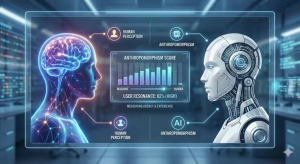
This phenomenon is called the ELIZA Effect, and it highlights our powerful, often unconscious, tendency to anthropomorphize, or give human like qualities to non human agents. When we interact with a conversational AI, a part of our brain expects a human like response. A cold, robotic, or dismissive AI violates this expectation and can feel jarring or frustrating. A supportive tone meets this subconscious need, making the interaction feel more natural and comfortable.
Cognitive Load Reduction
Cognitive load refers to the amount of mental effort required to use a product or complete a task. When a user is confused, stressed, or frustrated, their cognitive load is high. This makes it harder for them to process information and find solutions. Imagine trying to solve a complicated problem while someone is yelling unhelpful instructions at you. It is nearly impossible.
A supportive tone acts as a powerful tool to reduce this cognitive load. When an AI responds to a user’s problem with phrases like, “I can see why that would be confusing, let’s work through it step by step,” it accomplishes two things. First, it validates the user’s feeling of frustration, making them feel heard. Second, it provides a clear, calm path forward. This de-escalates stress and frees up the user’s mental resources to focus on the solution. The consistent use of a supportive tone makes the entire user journey smoother and more efficient.
Trust and Vulnerability
Whether a user is trying to manage their finances, learn about a medical condition, or get help with a sensitive customer service issue, they are often in a state of vulnerability. In these moments, trust is paramount. An AI that is purely transactional and impersonal can feel like a wall, making users hesitant to share the information needed to solve their problem.
A supportive tone helps create a feeling of psychological safety. This is the belief that you will not be punished or humiliated for speaking up with ideas, questions, concerns, or mistakes. By using encouraging and non judgmental language, the AI signals to the user that it is a safe and reliable partner. This trust encourages users to be more open and honest, which in turn allows the AI to provide more accurate and helpful assistance. Building an AI with a supportive tone is fundamentally an exercise in building trust at scale.
The Architectural Components of a Supportive AI Voice
Creating a supportive tone is not magic; it is a matter of precise engineering. It involves carefully selecting words, structuring sentences, and even using timing to convey empathy and encouragement. These components are the building blocks of a compassionate AI persona.
Linguistic Markers
Linguistic markers are the specific words and phrases that signal support.
- Validating Language: This type of language shows the user that their feelings or difficulties are understood and considered legitimate. Instead of a blunt “Error,” a more supportive tone would use, “I understand that must be frustrating,” or “That’s a great question, and a common one.” This simple shift validates the user’s experience before addressing the problem.
- Encouraging Phrasing: When a user is working through a multi step process, a supportive tone can keep them motivated. Phrases like, “You’re making good progress,” or “We’re almost there,” act as digital pats on the back that encourage persistence.
- Empathetic Hedging: Absolute statements can sometimes sound accusatory. For instance, “You entered the wrong password,” is blunt. A softer, more supportive approach is, “It seems like that password wasn’t quite right. Let’s try again.” Using words like “it seems like” or “perhaps” softens the language and shifts the focus from user error to a collaborative effort to find a solution.
Paralinguistic Textual Cues
In human conversation, we use more than just words. Our tone of voice, pauses, and body language add layers of meaning. In text based AI, we can simulate some of these cues.
- Pacing and Pauses: A wall of text delivered instantly can be overwhelming. By programming a chatbot to deliver messages with slight delays, or by using ellipses (…) to simulate a moment of thought, we can make the conversation feel more natural and less robotic. This careful pacing is a subtle but effective element of a supportive tone.
- Strategic Use of Emojis and Formatting: While not appropriate for all applications, a well placed, professional emoji can sometimes convey warmth and support more effectively than words alone. Similarly, using bolding or italics to emphasize key positive words can help shape the user’s perception of the AI’s tone. The key is to be subtle and align these choices with the brand’s voice.
Error Handling and Recovery
Few things are more frustrating than a dead end error message. A supportive tone is most critical in these moments of failure. Instead of a generic “Invalid Input,” a supportive system frames the error as a solvable hiccup. For example: “It looks like that date format didn’t work. The system works best with MM/DD/YYYY. Let’s try entering it that way.” This approach does three things: it gently points out the error, clearly explains the correct way, and uses inclusive language (“Let’s try”) to show it is on the user’s side.
Technical Implementation: NLP, Sentiment Analysis, and Machine Learning

Behind every effective supportive tone is a sophisticated technical backbone. Modern AI uses advanced technologies to understand not just what a user says, but how they feel, allowing it to respond with genuine and timely support.
Sentiment Analysis as a Trigger
Sentiment analysis is a core function of Natural Language Processing (NLP). In simple terms, it is the process of teaching a computer to “read the mood” of a piece of text. The AI can analyze the user’s words and classify their sentiment as positive, negative, or neutral. This acts as a critical trigger. If the system detects a negative sentiment, like frustration or anger, it can automatically switch its response style to be more patient, validating, and apologetic. This dynamic adjustment is what makes a modern supportive tone feel so responsive and intelligent.
Intent Recognition for Nuance
Going a step beyond sentiment, intent recognition tries to understand the user’s underlying goal. Two users might express negative sentiment, but for very different reasons. One might be frustrated because a feature is broken (intent: report a bug), while another might be upset about a billing issue (intent: resolve a financial query). By understanding the specific intent, the AI can tailor its supportive tone even more precisely. For the bug report, the tone might be apologetic and fact finding. For the billing issue, it might be more reassuring and focused on security.
Training LLMs for Tone
Today’s most advanced conversational AI systems are built on Large Language Models (LLMs) like Google’s LaMDA or OpenAI’s GPT series. These models are like incredibly advanced students of language. To teach them a supportive tone, developers use a process called fine tuning. They feed the model vast datasets of conversations that exemplify the desired tone. This could include anonymized transcripts from highly rated customer service agents, conversations from counseling hotlines, or scripts written by psychologists.
By learning from these examples, the LLM can adopt a deeply nuanced and consistent supportive tone across a wide range of topics and situations. Key technologies in this space include frameworks like Google Dialogflow and Rasa, which help developers build and manage these complex conversational flows.
A Practical Guide to Designing a Supportive Persona
Building an AI with a supportive tone requires a deliberate and user centered design process. It is an intentional effort that begins long before any code is written.
Step 1: Foundational User Research
You cannot support a user if you do not understand their struggles. The first step is always research. Techniques like empathy mapping involve creating a detailed profile of your target user, thinking about what they see, hear, think, and feel. User journey mapping charts every step a user takes to accomplish a goal, highlighting potential “pain points” where they are likely to become confused or frustrated. These are the exact moments where a supportive tone will be most crucial.
Step 2: Defining the Persona’s “Support” Archetype
“Supportive” can mean different things in different contexts. You need to define what kind of support your AI will offer. Is it a patient teacher, calmly guiding a new user through a complex interface? Is it an encouraging coach, motivating someone to reach a fitness or savings goal? Is it a calm and reassuring expert, providing clear information during a stressful situation? Defining this archetype will guide all subsequent writing and design decisions, ensuring a consistent supportive tone.
Step 3: Scripting and Conversation Flow Design
This is where the persona comes to life. Designers and writers create dialogue trees and libraries of potential responses. For every possible user query, they must also anticipate the user’s likely emotional state. What happens if the user enters the wrong information three times? What if they ask a question the AI does not understand? By scripting supportive recovery paths for these scenarios, you can ensure the AI remains helpful even when things go wrong.
Step 4: Prototyping and A/B Testing
Once you have initial scripts, it is time to test them with real users. A/B testing can be very effective here. You might create two versions of the AI’s response to a common problem. Version A might be direct and efficient, while Version B uses a more expressive and supportive tone. By measuring which version leads to higher task completion rates and user satisfaction scores, you can use real data to refine your AI’s voice.
Real-World Applications and Case Studies

The need for a supportive tone in AI is not theoretical. It is being put into practice across many industries to solve real human problems.
- Healthcare & Mental Wellness: Companies like Woebot have developed AI chatbots that provide support for mental health using principles from Cognitive Behavioral Therapy (CBT). A gentle, non judgmental, and supportive tone is absolutely essential for these tools. It creates a safe space for users to discuss their feelings and learn coping mechanisms.
- Customer Service Automation: Many people dread contacting customer service. AI chatbots are changing this by handling common issues instantly. When a customer is angry about a product or service, an AI with a supportive tone can de-escalate the situation by immediately validating their frustration and clearly outlining the steps for resolution. This can turn a negative experience into a positive one and build brand loyalty.
- Education and Tutoring: Learning a new skill can be intimidating. AI powered tutoring platforms use a supportive tone to encourage students who are struggling. Instead of just saying “That’s incorrect,” the AI might say, “Not quite, but you’re on the right track! Have you considered this part of the equation?” This kind of feedback reduces anxiety and promotes a growth mindset.
- Financial Services: Making financial decisions can be stressful. AI robo advisors are now helping people manage investments and plan for retirement. A calm, steady, and supportive tone is crucial for guiding users through market volatility and helping them stick to their long term financial goals.
Measuring the Impact: Metrics for a Supportive Tone
How do you know if your supportive tone is actually working? Success can be measured with both quantitative and qualitative data.
Quantitative Metrics
These are the hard numbers that tell a story.
- User Satisfaction (CSAT) and Net Promoter Score (NPS): After an interaction with the AI, you can ask users a simple question like, “How satisfied were you with this conversation?” (CSAT). Or, “How likely are you to recommend our company based on this experience?” (NPS). Higher scores are a strong indicator that the AI’s tone is effective.
- Task Completion Rate & Conversation Abandonment Rate: If users are successfully achieving their goals with the AI, the task completion rate will be high. If they are getting frustrated and giving up midway, the abandonment rate will be high. A supportive tone directly helps improve these metrics by reducing friction.
- Reduction in Escalation to Human Agents: A key goal for many companies is to have their AI solve problems so human agents can focus on more complex issues. If your AI’s supportive tone is effective at de-escalating issues and guiding users, you will see a measurable drop in the number of conversations that need to be handed off to a human.
Qualitative Metrics
These metrics provide deeper insights into the user experience.
- Sentiment Analysis of User Feedback: You can apply the same sentiment analysis technology mentioned earlier to the conversation logs themselves. Are users frequently expressing gratitude and relief? Or are signs of frustration still common? This provides direct feedback on the AI’s performance.
- Direct User Interviews and Usability Testing: The best way to understand user perception is to ask them directly. Conduct interviews where you ask users how they felt during the conversation. Did they feel the AI was helpful? Did they feel understood? Their answers will provide rich, qualitative data to help you further refine your AI’s supportive tone.
Ethical Considerations and Mitigating Risks
Building an AI with a supportive tone comes with significant ethical responsibilities. While the goal is to help, a poorly designed supportive AI can inadvertently cause harm.
Avoiding “Toxic Positivity”
Toxic positivity is the act of being relentlessly positive and dismissing negative feelings. If a user is genuinely upset and the AI responds with a cheerful, “Everything will be okay!”, it can feel incredibly invalidating and dismissive. An ethically designed supportive tone must validate negative feelings. Sometimes the most supportive response is, “That sounds incredibly difficult. I’m sorry you’re going through that.”
The Risk of Emotional Dependency
As AI becomes more sophisticated and supportive, there is a risk that some users may form an unhealthy emotional attachment to the persona. Designers have a responsibility to create gentle boundaries. This can include programming the AI to periodically remind users that it is a machine or designing it to encourage users to seek help from human professionals for serious issues. The goal of a supportive tone should be to empower users, not to create dependency.
Transparency and Disclosure
It is a fundamental ethical principle that users should always know when they are interacting with an AI. It is deceptive to design a chatbot to trick a user into believing it is a human. This disclosure builds long term trust and manages user expectations. A supportive tone should be an authentic expression of the AI’s helpful programming, not a tool for deception.
Bias in Sentiment Analysis
The AI models that detect sentiment are trained on data. If that data is biased, the AI’s perception will be biased. For example, a model trained primarily on one demographic’s communication style might misinterpret the sentiment of slang or dialects from other groups. It is crucial to use diverse and representative datasets to ensure the AI’s supportive tone is applied fairly and accurately to all users.
The Future of Empathetic and Supportive AI
The field of empathetic AI is just getting started. The future will bring even more sophisticated ways to create a genuinely supportive tone.
- Multimodal Emotion AI: The next frontier is moving beyond just text. Multimodal AI will be able to analyze a user’s tone of voice, facial expressions from a camera, and even physiological data like heart rate. This will allow for a much richer, more accurate understanding of the user’s emotional state, enabling an even more responsive and supportive tone.
- Proactive Support: Instead of waiting for a user to get stuck and ask for help, future AIs will use behavioral patterns to anticipate their needs. If an AI notices a user has been stuck on the same web page for several minutes, it might proactively pop up and ask, “It looks like you might be having some trouble. Can I help you find what you’re looking for?” This proactive support is the ultimate expression of a helpful, supportive tone.
- Hyper Personalization: Over time, an AI will learn an individual user’s communication style and preferences. It will be able to tailor its supportive tone specifically for them. Some users might prefer a more direct and concise tone, while others might benefit from more expressive and encouraging language. This level of personalization will make AI interactions feel uniquely helpful.
Conclusion: Supportive AI as a Pillar of Modern UX
We have seen that creating a supportive tone in an AI persona is a deeply interdisciplinary effort. It is a technically complex feature that stands on a foundation of human psychology, advanced data science, and thoughtful, ethical design. It is not an add on or a “nice to have.” In the modern digital world, a well executed supportive tone is a core pillar of a successful user experience. As artificial intelligence becomes more woven into the fabric of our lives, its ability to provide not just accurate answers but also genuine support will be the ultimate differentiator between a transient, forgettable tool and a trusted, indispensable digital companion.