The custom home market is one of the most competitive sectors in the world. You are not selling a simple product that people buy every day. You are asking a client to trust you with their life savings and their future memories. Yet, the websites of most custom builders, have the same thing. Just lists of specifications. I see generic photos of kitchens. I see claims about “quality” that everyone else is also making. This is a failure of data and connection.
To win in this market, you must do more than build walls. You must build a narrative. This is where brand storytelling comes into play. Brand storytelling is the strategic use of narrative to connect your company to your customers. It turns a business into a legacy. For a custom home builder, this is not optional. It is the only way to separate yourself from the noise.
When you use brand storytelling correctly, you stop competing on price per square foot. You start competing on value and trust. This article will show you exactly how to do this. We will look at the psychology of the buyer. We will look at the structure of a good story. We will look at the technical ways to put this on your website so Google can find you. If you follow this guide, you will not just get more traffic. You will get the right kind of traffic. You will get clients who want to build a home with you because they believe in your story.
The Data Case: Why Narrative Beats Specs
Many builders come from an engineering or trade background. You might think that numbers and facts are what sell homes. You might think that listing the R-value of your insulation or the brand of your windows is the most important thing. The data tells us a different story.
Human beings make decisions based on emotion. We use logic later to justify those decisions. This is especially true for high-ticket items like custom homes. A client does not dream about a foundation. They dream about the Thanksgiving dinner they will host in the dining room. They dream about watching their children grow up in the backyard.
When your website only lists facts, you are ignoring the emotional side of the brain. You are forcing the client to do the hard work of imagining the result. Brand storytelling does that work for them. It paints a picture. It creates a feeling.
Search engines like Google are also changing. They are looking for content that shows experience and authority. They want to see that you are a real business with a real purpose. A generic list of services does not show this. A rich history of your company and detailed stories about your projects will show Google that you are an expert. This helps your local SEO. It helps you rank higher when people search for builders in your city.
Deconstructing the Hero’s Journey for Construction

There is a classic structure in literature called the “Hero’s Journey.” You see it in movies like Star Wars. A hero goes on an adventure, faces a crisis, wins a victory, and comes home changed. You can use this exact structure for your marketing.
Most businesses get this wrong. They think they are the hero of the story. They talk about their awards and their trucks. But in brand storytelling, you are not the hero. The client is the hero.
Deconstructing the Hero
- Who is the Hero?
- The Mistake: 90% of builder websites position the builder as the hero.
- “We have won 10 awards.”
- “We have been in business for 30 years.”
- “Look at our trucks.”
- The Correction: The client is the hero. Luke Skywalker is the hero; he is the one with the problem (the Empire) and the goal (save the galaxy). You are Obi-Wan Kenobi. You are Guide.
The hero is weak, confused, and worried. The Guide is strong, wise, and has a plan. If you position yourself as the Hero, you are competing with your client for the spotlight. If you position yourself as the Guide, you become essential to their success.
The Cast of Characters in Construction
The Hero (The Client)
They have a specific “Want” (a custom home) and a specific “Problem” preventing them from getting it.
- Internal Problem: Anxiety. “Will I get ripped off? Will this take 3 years? Do I have bad taste?”
- External Problem: Lack of land, lack of technical knowledge, confusing financing.
The Villain (The Obstacles)
Every good story needs a villain. In construction, the villian is not a person; it is is the chaos of the build.
- The Villains: Budget creep, zoning boards, supply chain shortages, hidden mold, bad weather.
- Strategy: You must identify these villains in your marketing. Say things like, “We know that navigating city permits feels like a battle. We fight that battle for you.”
The Guide (The Builder)
This is you. The Guide must possess two traits: Empathy and Authority
- Empathy: “We understand how stressful building a home is.”
- Authority: “Here is our 50-point checklist to ensure your project stays on time.”
The Narrative: The Timeline of the Build
You can map the construction process directly onto the story. Use this structure for your “Our Process” page on your website.
Phase 1: The Call to Adventure (The Consultation)
The hero realizes their current world (their old house) is insufficient. They need to change. Your job here is to offer a “Call to Action.”
- Your Script: “You are ready for a home that fits your lifestyle. Schedule a feasibility study today.”
Phase 2: Crossing the Threshold (Signing the Contract)
The hero commits. This is the scariest part for them because money is changing hands.
- The Guide’s Role: Provide a “Plan.” A story without a plan is a tragedy. Show them the schedule. Show them the communication portal (like CoConstruct or BuilderTrend). This reduces fear.
Phase 3: The Ordeal (The Construction Phase)
In every movie, there is a point where all seems lost. In construction, this is when the framing is done but the drywall hasn’t started, and it looks like nothing is happening. Or when it rains for two weeks straight.
- The Guide’s Role: Constant communication. You frame the ordeal as a neccessary step toward victory. You remind them of the vision.
Phase 4: The Reward (The Move-in)
The hero has defeated the villian (chaos) and achieved the goal (the home).
- Your script: Do not just hand over the keys. Celebrate the transformation. “You have gone from a cramped apartment to a legacy estate.”
When you write the copy for your website, position yourself as the guide. Do not just say, “We build great homes.” Say, “We guide you through the complex building process so you can enjoy the home of your dreams without the stress.” This is a powerful shift. It tells the client that you understand their fears. It builds immediate trust.
The 4 Pillars of a Custom Builder’s Brand Story
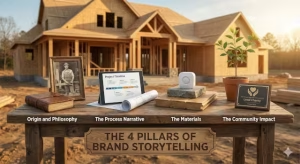
To create a complete brand storytelling strategy, you need to look at four specific areas. These are the pillars that will hold up your marketing.
1. Origin and Philosophy
Every business has a beginning. Why did you start building homes? Did you learn it from your father? Did you see poorly built homes and decide you could do better? This is your brand origin story.
People want to know who they are hiring. If you hide behind a corporate logo, you are a stranger. If you share your history, you become a person. Write an “About Us” page that reads like a biography, not a resume. Talk about your values. Do you believe in traditional craftsmanship? Do you believe in modern, eco-friendly design? Make your philosophy clear. This helps the right clients find you and filters out the ones who are not a good fit.
2. The Process Narrative
The construction process is scary for a client. It involves a lot of money and a lot of time. You can use brand storytelling to make this process feel safe.
Instead of a dry list of steps like “Design, Permit, Build,” tell a story about how you work. Describe the excitement of the first design meeting. Describe the care you take when pouring the foundation. Describe the final walkthrough. Turn the technical process into a journey. Use words that imply safety, precision, and partnership. This calms the nerves of the client before they even sign a contract.
3. The Materials
In custom home building, the materials matter. But again, do not just list them. Tell the story of the materials.
If you use a specific type of wood for flooring, explain why. Is it more durable? Does it have a richer grain? If you use smart home technology, explain how it makes life easier. This is called “ingredient branding.” It shows that you care about every detail. It shows that you are not just buying the cheapest stuff at the hardware store. You are curating the best materials for the client’s story.
4. The Community Impact
You are a local business. You build in a specific city or town. Your homes change the look of that community.
Talk about your connection to the area. Do your homes fit the local history? Do you hire local tradespeople? This shows that you are rooted in the community. It sends a strong signal to Google that you are a local entity. This is vital for local SEO. When people search for builders in your specific town, this content helps you show up.
Visual Storytelling: Integrating SEO with Aesthetics
As a builder, you have a visual product. You have photos of beautiful homes. However, a photo without a story is just a pretty picture. You need to combine visuals with brand storytelling.
Every project in your portfolio should be a mini case study of your brand. It should have a beginning, a middle, and an end. Show the “Before” photos of the empty lot. Show the “During” photos of the framing and the crew working hard. Show the “After” photos of the finished home.
This visual arc proves that you can take a project from start to finish. It is proof of your competence.
You also need to think about the technical side. Google cannot “see” images the way humans do. You must use Alt Text. This is a text description hidden in the code of the image. Instead of naming a file “photo1.jpg,” name it “custom-home-kitchen-island-oak-cabinets.jpg.” This tells Google exactly what is in the picture. It helps your images show up in search results. This is a mix of art and science that drives traffic.
Common Questions about Brand Storytelling in Custom Home Building
To capture more traffic, you must answer the specific questions people are asking. Here are common questions and how brand storytelling provides the answer.
“How do I market my custom home building business?”
The best way is to stop selling and start sharing. Move away from ads that just say “Call Us.” Start creating content that educates. Write blogs about the hidden costs of building. Write about how to choose a lot. Use stories from your past projects to teach these lessons. This builds authority.
“What is a brand story in construction?”
A brand story in construction is the cohesive narrative of your firm. It is the combination of your history, your team, your style, and your promise to the client. It is what people say about you when you are not in the room. It is the reputation you build through consistent communication.
“How to write a bio for a home builder?”
Focus on the intersection of skill and passion. State your technical qualifications, like your degrees or licenses. Then, explain your passion for design and client satisfaction. A good bio balances the brain (engineering) and the heart (family/home).
Case Study Framework: From Blueprint to Reality
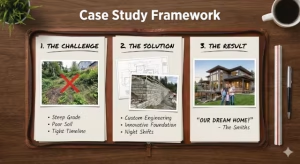
One of the most powerful tools that you have for your brand is the case study. But most builders write boring case studies. They just say, “We built this house in 2024.”
You need to use brand storytelling to make your case studies interesting. Here is a simple framework you can use for every project on your website:
1. The Challenge:
Start with the problem. Was the lot steep and difficult? Was the timeline very tight? Did the client have a unique request, like a hidden room or a specific architectural style? This creates tension. It makes the reader want to know what happened.
2. The Solution:
Explain how you solved the problem. Did you use a special engineering technique? Did you work late nights? Did you source materials from a specific place? This highlights your expertise. It shows that you are a problem solver.
3. The Result:
End with the emotion. Quote the client saying how much they love the home. Describe how the light hits the kitchen in the morning. This provides the happy ending to the story.
If you write your case studies this way, they become powerful sales tools. They prove that you can handle difficulties and deliver happiness.
Executing the Strategy: A Checklist for Builders
Knowing about brand storytelling is not enough. You have to do the work. Here is a practical checklist to get you started.
-
Audit Your Website: Read your current “About Us” page. Does it sound like a robot wrote it? Does it list facts or tell a story? Rewrite it to focus on your values and history.
-
Identify Your Values: Pick three words that define your company. Examples could be “Precision,” “Family,” or “Innovation.” Make sure these three words appear in your stories.
-
Interview Past Clients: Ask your happy clients why they chose you. Their answers will give you the seeds for your brand story. They might say, “You listened to us,” or “You were honest about the budget.” Use these themes in your marketing.
-
Start a Blog: Write one article a month. Use it to tell stories about your current projects. Discuss the trends you are seeing. This keeps your website fresh and gives Google more keywords to scan.
-
Use Video: You do not need a film crew. Use your phone to record a quick video at a job site. Explain what you are doing that day. Explain a problem you just solved. This is raw, authentic storytelling.
Conclusion
The construction industry is changing. Technology is advancing. But the human need for connection remains the same. A custom home is the biggest purchase most people will ever make. They are terrified of making a mistake.
By using brand storytelling, you remove that fear. You replace it with trust. You show the client that you are not just a builder, but a partner. You show them that you honor the craft and care about the outcome.
Do not let your excellent work get lost because of poor marketing. Take control of your narrative. Tell your story with pride and precision. If you do this, you will build a brand that stands as strong as the homes you create. The search engines will reward you with traffic, and your community will reward you with trust. This is the ultimate goal of any business.