I remember the first time I saw a small business owner truly understand the power of artificial intelligence. It wasn’t when they saw a robot dancing or a computer beating a chess grandmaster. It was when they realized they could automatically answer a customer’s question at 2:00 AM on a Tuesday without lifting a finger. That moment of realization, that technology could buy back their time, is what the current revolution in business is all about.
For years, the phrase “artificial intelligence” sounded expensive. It sounded like something only giant tech companies with glass skyscrapers could afford. If you owned a bakery in Omaha or a plumbing service in the Bronx, you likely thought AI was out of your league. You might have felt a mix of fear and annoyance, fear of being left behind, and annoyance at another buzzword that didn’t help you make payroll.
But here is the brilliant truth about 2025: The script has flipped. We are now living in the era of the “Democratization of AI.” Powerful, world-changing technology that used to cost millions of dollars is now available for the price of a daily coffee. The barrier to entry has crumbled. Today, finding AI solutions is not about having a massive budget; it is about having a curious mind and a strategic plan.
This article is your roadmap to AI solutions for your small business. We are going to strip away the hype and focus on the practical, affordable reality. We will explore how you can use AI solutions to compete with the big guys, automate the boring stuff, and focus on what you do best: serving your customers. Whether you are a team of one or twenty, there is a path for you here.
Why “Affordable” No Longer Means “Low Quality”
There was a time when “affordable” software meant “bad” software. If you didn’t pay top dollar, you got a clunky, slow program that crashed half the time. That is no longer the case. The economics of software have changed completely, and this is great news for small business owners looking for AI solutions.
The Magic of “Freemium”
Most modern tech companies use a model called “Product-Led Growth.” This is a fancy way of saying they let you use a really good version of their product for free, hoping you will like it so much that you eventually pay for the extra features. This means you can access enterprise-grade AI solutions without paying a dime upfront. Tools like ChatGPT, Canva, and HubSpot offering powerful free tiers are not “lite” versions; they are fully functional tools that can transform your business immediately.
Scalability: Pay as You Grow
Another reason AI solutions are so affordable is scalability. In the old days, you had to buy a server and hire an IT guy just to install software. Now, everything lives in the cloud. You can start with a $20/month subscription. If your business takes off and you need more power, you just upgrade your plan. You never have to pay for more than you need. This flexibility allows a two-person marketing agency to use the exact same AI solutions as a Fortune 500 company, just on a smaller scale.
The 2025 Small Business “Tech Stack”

To build a house, you need a hammer, a saw, and a drill. To build a modern business, you need a different set of tools. We call this a “Tech Stack.” Below is a breakdown of the best affordable AI solutions for the core functions of your business. These are not theoretical; these are tools you can sign up for today.
1. Marketing and Content Creation
Marketing is often the biggest headache for small businesses. You know you need to post on social media and write emails, but who has the time?
-
ChatGPT / Claude / Gemini: These are the “brains” of your operation. You can use them to write blog posts, draft emails, creating catchy Instagram captions, and even brainstorm new product names. The free versions are incredible, and the paid versions (usually around $20/month) are even smarter. They act like a tireless marketing intern who never sleeps.
-
Canva Magic Studio: You do not need to be a graphic designer to look professional. Canva has integrated AI solutions that let you type “flyer for a summer sale” and instantly generate beautiful designs. It can even edit photos, remove backgrounds, and resize images for different social platforms automatically.
-
CapCut / Descript: Video is king on social media. These tools use AI to add captions to your videos automatically, edit out the “ums” and “ahs” from your speaking, and even let you edit a video by just editing the text transcript. It turns hours of editing work into minutes.
2. Customer Service and Support
If you miss a call, you might miss a sale. AI solutions in this category ensure your business is “open” 24/7.
-
Tidio / Chatfuel: These are AI chatbots that live on your website. They can answer common questions like “What are your hours?” or “Do you offer free shipping?” instantly. If the question is too hard, they can pass it to a human. They ensure every visitor gets a greeting, no matter the time of day.
-
Help.ly: This tool helps automate email support tickets. It reads incoming emails, tags them by topic (like “Returns” or “Urgent”), and can even draft a response for you to approve.
3. Operations and Productivity
This is the unglamorous “back office” work that eats up your day. AI solutions here are pure time-savers.
-
Fireflies.ai / Otter.ai: Stop taking notes in meetings. These tools join your Zoom or Teams calls, record the audio, write out a full transcript, and, best of all, summarize the key points and action items. You can finish a meeting and instantly have a to-do list ready to go.
-
Notion AI: Notion is a great tool for organizing information. Its AI add-on can summarize long documents, fix your grammar, or help you organize your project steps. It acts like an intelligent filing cabinet.
-
Zapier: Zapier is the “glue” that connects all your other apps. While not strictly an AI itself, its new AI features let you describe a workflow in plain English (e.g., “When I get a new lead in Facebook, send them an email and add them to my spreadsheet”), and it builds the automation for you.
4. Sales and Customer Relationships (CRM)
Keeping track of leads is vital. AI solutions in CRM (Customer Relationship Management) help you close more deals.
-
HubSpot Free CRM: HubSpot is famous for its powerful free tools. It includes AI email writers that help you craft the perfect sales pitch. It also automatically tracks when someone opens your email so you know exactly when to call them.
-
Zoho CRM (Zia): Zoho’s AI assistant, Zia, can predict which leads are most likely to buy from you based on their behavior. This helps you focus your energy on the people who are ready to say “yes.”
3 High-Value AI Workflows to Implement Now
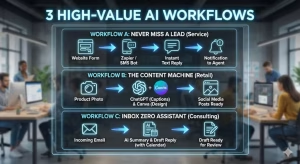
Knowing the tools is step one. Knowing how to string them together into a “workflow” is where the magic happens. A workflow is just a repeatable process. Here are three specific ways you can combine AI solutions to save massive amounts of time.
Workflow A: The “Never Miss a Lead” System (Real Estate & Service)
If you run a service business like real estate or plumbing, speed is everything. The first person to respond often gets the job.
-
The Trigger: A potential customer fills out a “Contact Us” form on your website or Facebook ad.
-
The AI Action: Zapier detects this new entry. It sends the name and phone number to an AI tool like ChatGPT or a specialized SMS bot.
-
The Response: The AI immediately sends a friendly text message: “Hi [Name], thanks for asking about [Service]. I’m with a client right now, but can I call you in 30 minutes?”
-
The Result: The customer feels heard instantly. You stop them from calling your competitor. You get a notification to call them back when you are free. This simple chain of AI solutions costs pennies to run but can save thousands of dollars in lost business.
Workflow B: The “Content Machine” (E-commerce & Retail)
For a shop selling products, you need to be visible online constantly. This workflow automates your social media.
-
The Idea: You take a photo of a new product (let’s say, a hand-knit scarf) and upload it to a folder.
-
The AI Action: You use a tool like ChatGPT to “look” at the photo. You ask it to write three different Instagram captions: one funny, one professional, and one focused on a sale. You also ask for relevant hashtags.
-
The Design: You use Canva to instantly put that photo into a branded “New Arrival” template.
-
The Result: In five minutes, you have a week’s worth of content ready to post. You didn’t have to stare at a blank screen wondering what to write. AI solutions did the heavy lifting of creativity for you.
Workflow C: The “Inbox Zero” Assistant (Consulting & B2B)
If you sell your advice or professional services, your inbox is probably a nightmare.
-
The Trigger: An email arrives from a client.
-
The AI Action: Your email software (using an integration like Copilot or Gemini) reads the email. It summarizes the request.
-
The Draft: It drafts a reply based on your past emails. If the client asks for a meeting, the AI looks at your calendar, finds free slots, and includes them in the draft.
-
The Result: You open your email and see a draft ready to go. You just check it for accuracy and hit send. You spend 10 seconds on an email that used to take 10 minutes.
Strategic Implementation: How to Start
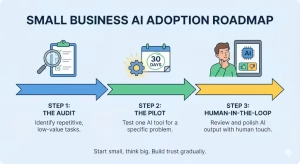
The biggest mistake small business owners make is trying to do everything at once. They sign up for ten free trials, get overwhelmed, and quit. Implementing AI solutions requires a steady, strategic approach.
Step 1: The Audit
Before you download anything, look at your day. Take a piece of paper and write down everything you do for three days. Circle the tasks that are:
-
Repetitive (you do the exact same thing over and over).
-
Boring (you hate doing them).
-
Low-value (they don’t directly make you money).
These circled items are your targets for AI solutions. Do not try to automate your core craft. If you are a baker, do not try to automate the baking. Automate the ordering of the flour.
Step 2: The Pilot Program
Pick one pain point. Just one. Is it scheduling meetings? Is it answering basic emails? Choose one of the AI solutions we discussed above that solves this specific problem. Commit to using it for 30 days.
-
Week 1: Set it up and learn the basics.
-
Week 2: Use it for real work, but double-check everything it does.
-
Week 3: Start trusting it more and integrating it into your daily routine.
-
Week 4: Evaluate. Did it save you time? Was it worth the cost?
Step 3: The “Human-in-the-Loop”
This is the golden rule of AI. AI solutions are assistants, not replacements. You must always have a human (you or your employee) review the work. AI can hallucinate (make things up) or sound robotic. Your customers want to feel a personal connection. Use AI to create the first draft, but use your human empathy to polish the final product. This combination, AI speed plus human soul, is unbeatable.
Future Trends: What to Watch in 2025
The world of technology moves fast. While you are implementing today’s tools, it is helpful to keep one eye on the horizon. The next wave of AI solutions will be even more capable.
From Chatbots to “Agents”
Right now, most people use AI like a chatbot: you ask a question, it gives an answer. In 2025, we are moving toward “Agentic AI.” An agent doesn’t just talk; it does.19 Instead of asking “What flights are available to New York?”, you will tell an AI agent “Book me a flight to New York for under $300 next Tuesday,” and it will go to the website, fill out the forms, and buy the ticket (with your permission). For small businesses, this means AI solutions will soon be able to handle complex tasks like “Restock inventory when it gets low” all on their own.
Hyper-Personalization
Customers are tired of generic marketing. They want to feel special. New AI solutions will allow you to send thousands of emails that each feel like a personal note. The AI will know that Customer A likes red shoes and bought a hat last year, and Customer B likes blue boots and just moved to a new city. It will write a unique message to each of them. This level of service used to require a team of marketers; soon, it will be standard for everyone.
Voice AI
Typing is slow. Speaking is fast. We are seeing a rise in Voice AI, where you can talk to your computer to get things done. Imagine a plumber who can drive to a job and dictate an invoice to their phone, and the AI formats it and emails it to the client before the plumber even parks the van. Voice-driven AI solutions will be a massive game-changer for blue-collar and field service businesses.
Common Questions about Using AI In Small Business
When helping businesses optimize their web presence, we hear the same questions over and over. Let’s address them directly.
Q: Is AI even relevant for a small business like mine?
A: Absolutely. In fact, AI solutions are more relevant for small businesses than big ones. Big companies have thousands of employees to do busy work. You don’t. AI acts as a force multiplier, allowing you to punch above your weight class. Whether you sell cupcakes or consulting, there is a repetitive task you can automate today.
Q: What is the difference between AI and automation?
A: This is a great question. Automation is like a train on a track; it follows a strict set of rules (e.g., “If X happens, do Y”). AI is like a car with a driver; it can make decisions and adapt. Automation moves data; AI creates content and understands context. The best AI solutions combine both.
Q: How much does it cost to implement AI in a small business?
A: It is surprisingly cheap. You can build a very powerful “Starter Stack” for under $50 per month.
-
ChatGPT Plus: $20/mo
-
Canva Pro: $15/mo
-
HubSpot CRM: Free
- Total: $35/moCompare that to the cost of hiring an employee or even a freelancer. The ROI (Return on Investment) is massive.
Q: Can AI replace employees in a small business?
A: It is better to think of AI solutions as replacing tasks, not roles. It replaces the data entry, the scheduling, and the basic drafting. This frees up your human employees to do higher-value work, like building relationships with clients, solving complex problems, and being creative. Your employees will likely be happier because they can stop doing the boring grunt work.
Conclusion
The year 2025 is an exciting time to be a business owner. The tools available to you are more powerful and more affordable than at any time in history. But remember, buying a hammer doesn’t make you a carpenter. The tool itself is not the solution; using the tool effectively is.
Do not let “AI Anxiety” paralyze you. You do not need to understand how the code works. You just need to understand how it can help you serve your customers better. Start small. Pick one of the AI solutions we discussed. Try it for a month.
The gap between businesses that use AI and those that don’t is widening. By reading this article, you have already taken the first step to being on the winning side. The future isn’t coming; it’s already here, and it is affordable.