In today’s digital world, consumers are surrounded by marketing messages. They see ads on social media, get emails in their inbox, and see banners on websites. Because of this, most people have become very good at ignoring generic advertising that doesn’t speak directly to them. The old method of grouping customers into a few broad categories and showing them all the same message is failing. Businesses that continue to use this one-size-fits-all approach are finding it harder to connect with their audience and are wasting their marketing budgets. The solution to this growing problem is a powerful strategy known as hyper-personalization.
This article serves as a complete guide on how to achieve this level of personalization. We will explore the framework for moving away from outdated, static buyer personas and embracing dynamic, AI-driven personas. These advanced profiles are the key to unlocking true 1:1 marketing campaigns that work on a large scale. At its most basic, an AI Persona is a detailed and constantly changing profile of a customer group. Unlike old-fashioned personas created from surveys and guesswork, AI personas are built and updated by smart computer programs using real-time customer data. This allows for a much more accurate and useful understanding of your customers.
This technology is the engine behind 1:1 marketing, a strategy focused on creating a unique and personal interaction with every single customer. The main goal of 1:1 marketing is to treat each person as an individual with specific needs and preferences, building a stronger and more loyal relationship over time.
The Foundational Shift: From Manual Personas to AI-Driven Insights
For many years, marketing teams relied on traditional buyer personas. These were fictional characters created to represent a company’s ideal customers. A team might invent “Marketing Mary,” a 35-year-old manager who likes yoga and reads certain blogs. The problem is that “Marketing Mary” was often based on a small amount of data, a few customer interviews, or even just the marketing team’s best guess. This approach has serious limitations in the modern market.
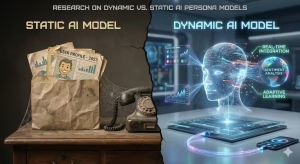
First, these traditional personas are static. The profile created for “Marketing Mary” in January is the exact same in December, even if customer behaviors have completely changed. They do not adapt to new trends or shifts in the market. Second, they lack the specific details needed for deep personalization. Knowing that Mary likes yoga doesn’t tell you what kind of email subject line will make her open a message or what product recommendation she would find most useful. Because they are based on small samples, they often miss the rich diversity within a customer base, lumping thousands of unique individuals into a few simple buckets.
Finally, these old personas are subject to human bias. The marketing team might unconsciously create personas that reflect their own views, not the reality of their customers. This leads to ineffective campaigns and missed opportunities. True 1:1 marketing is impossible with such limited tools.
This is where the advantage of AI comes in. Artificial intelligence provides a much more powerful way to understand customers. AI systems can analyze massive amounts of information, often called Big Data. This includes data from your company’s customer relationship management (CRM) system, website analytics, social media activity, and purchase history. AI doesn’t just look at what a customer bought; it looks at what they browsed, what they clicked on, how long they stayed on a page, and what they said in a product review. This is a level of detail that no human team could ever process on their own.
Using this data, AI employs a technique called dynamic segmentation. Think of it like a super-smart sorting hat. It can look at all your customers and find small, hidden groups of people who share very specific behaviors or interests, creating thousands of “micro-personas.” These are not based on guesswork but on real, observable data. Furthermore, AI uses predictive analytics to forecast what these customers might do next. By analyzing past behavior, machine learning models can predict which customers are most likely to make a purchase, which ones might be about to switch to a competitor, and which products they are most likely to be interested in.
This forward-looking insight allows businesses to be proactive with their 1:1 marketing efforts, reaching out with the perfect offer at the perfect time. This data-driven approach removes human bias and creates a living, breathing understanding of the customer base that is essential for successful 1:1 marketing.
The Step-by-Step Guide: How to Implement AI Personas for 1:1 Marketing
Making the switch to an AI-powered 1:1 marketing strategy might seem complex, but it can be broken down into a logical, step-by-step process. Following this framework will allow your organization to build a strong foundation for creating truly personalized customer experiences.
Step 1: Centralize Your Data
Before you can use AI to understand your customers, you need to bring all of your customer information into one place. Most companies have data scattered across many different systems. Your sales team uses a CRM, your marketing team uses an email platform, your website has its own analytics, and your customer support team has a ticketing system. To get a complete picture of a customer, you need to connect these scattered pieces.
This is where a Customer Data Platform (CDP) becomes essential. Think of a CDP as a central hub or a master library for all your customer data. It collects information from all your different sources and connects it to a single customer profile. For example, a CDP can see that the person who just clicked on your Facebook ad is the same person who abandoned a shopping cart on your website last week and called customer service yesterday.
Without a CDP, these events look like they were done by three different people. With a CDP, you get a unified, 360-degree view of the customer journey. This complete view is the absolute starting point for any effective 1:1 marketing strategy. You cannot personalize for a customer you do not fully understand.
Step 2: Employ Machine Learning for Persona Generation
Once your data is centralized, you can apply machine learning to make sense of it. This is the step where AI automatically discovers your micro-personas. Using techniques known as unsupervised learning, AI algorithms can sift through your customer data and identify natural clusters of people with similar behaviors. The AI isn’t told what to look for; it finds the patterns on its own.
For example, an e-commerce company might find that it doesn’t just have one persona called “Bargain Shoppers.” The AI might identify dozens of different bargain-hunting micro-personas. One group might only buy during major holiday sales. Another group might only buy items that have a 4.5-star rating or higher, but only if they are also on clearance. A third group might respond only to “buy one, get one free” offers.
Each of these micro-personas can then be targeted with a much more specific message. Instead of a generic “Sale On!” email, you can send a highly relevant offer that speaks directly to their unique shopping habits. This is what makes 1:1 marketing so powerful. You are moving from talking to a crowd to having a personal conversation with thousands of customers at once, all automated by technology.
Step 3: Map AI Personas to the Customer Journey
Understanding your micro-personas is only half the battle. You also need to understand how they interact with your brand over time. This is known as customer journey mapping. The customer journey includes every touchpoint, from the first time a person hears about your brand to the moment they become a loyal, repeat customer.
With AI personas, you can analyze the unique journey that each micro-segment takes. You might find that one persona discovers your products through Instagram, reads reviews on your website for a week, and then makes a purchase after receiving an email with a small discount. Another persona might come directly from a Google search, watch a video demonstration, and buy immediately.
By mapping these different paths, you can identify key moments where a personalized message can make a big difference. You can find points of friction where certain personas tend to drop off and fix them. You can also find opportunities to delight customers with helpful content or a special offer right when they need it most. This deep understanding of the customer journey is critical for delivering the right message at the right time, a core principle of 1:1 marketing.
Step 4: Activate Personas with Dynamic Content Optimization (DCO)
This is the step where your 1:1 marketing strategy comes to life. All the data, personas, and journey maps are put into action. Dynamic Content Optimization (DCO) is a technology that uses AI to automatically change the content of your website, emails, and ads to match the person viewing them.
Imagine two people, belonging to two different AI personas, visit your website’s homepage at the same time. The first person is part of a persona that values durability and long-term quality. The website might automatically show them a banner image of a rugged, high-quality product and testimonials about its reliability. The second person belongs to a persona that is very price-sensitive. When they visit, the same homepage might automatically show them a banner highlighting the latest sale items and special discounts.
This happens in real-time, for every single visitor. The same technology can be used in email marketing. Instead of sending one email blast to your entire list, you can send an email where the subject line, the images, and the product recommendations are all dynamically changed to fit each recipient’s persona. This is the ultimate execution of 1:1 marketing, making every interaction feel personal and relevant.
Real-World Applications and Examples of 1:1 Marketing

The theory behind AI-driven 1:1 marketing is powerful, but seeing it in action makes its value even clearer. Some of the world’s most successful companies have built their entire business models around this type of deep personalization.
Amazon
The most famous example of 1:1 marketing is the e-commerce giant Amazon. When you visit Amazon’s website, the homepage you see is completely unique to you. The “recommended for you” section is not just based on what you have bought in the past. Amazon’s sophisticated AI, a technology called collaborative filtering, analyzes your browsing history, what you’ve put in your cart, and what you’ve added to your wish list.
But it goes a step further. It also analyzes the behavior of millions of other shoppers, finding people with similar tastes. It then recommends products that those “similar” people have purchased. This is why Amazon often feels like it knows what you want before you do. This is a perfect example of 1:1 marketing at a massive scale.
Netflix and Spotify
Content streaming services like Netflix and Spotify are also masters of 1:1 marketing. Netflix doesn’t just recommend movies and shows based on what you’ve watched. Its AI analyzes everything: what time of day you watch, how long you watch, what device you use, and whether you binge-watch a series or watch it slowly. It even personalizes the artwork for the movie posters you see.
Netflix will test multiple images for the same movie and show you the one its AI predicts you are most likely to click on. If you tend to watch movies starring a certain actor, it might show you a poster featuring that actor, while someone else sees a poster for the same movie emphasizing an action scene.
Similarly, Spotify’s “Discover Weekly” playlist is a beloved feature for millions of users. Every Monday, Spotify’s AI generates a unique playlist of 30 songs it thinks you will love but haven’t heard before. It does this by analyzing your listening habits and comparing them to the habits of users with similar musical tastes. This creates a deeply personal experience that keeps users engaged and subscribed. Both Netflix and Spotify have shown that a strong 1:1 marketing strategy can be a company’s biggest competitive advantage.
This approach isn’t just for giant consumer brands. A B2B company that sells software can also use 1:1 marketing to nurture its leads. Imagine a company that sells project management software. Using AI, it can analyze a new lead’s behavior on its website. If the lead spends most of their time reading blog posts about budget tracking features, the AI can assign them to a “budget-focused” persona.
Instead of getting generic marketing emails, this lead will automatically receive a series of emails with content tailored to their interest, such as a case study on how a similar company saved money using the software’s budget tools or an invitation to a webinar on financial project management. This targeted approach is far more effective than a generic campaign and is a prime example of how 1:1 marketing can shorten the sales cycle.
Measuring Success and Overcoming Challenges

Implementing a 1:1 marketing strategy requires an investment in technology and data, so it’s crucial to measure its success. The benefits are often significant and can be tracked using several Key Performance Indicators (KPIs). One of the most important metrics is an increase in conversion rates. When you show people more relevant content and products, they are more likely to make a purchase.
Another key benefit is a higher Customer Lifetime Value (CLV). By building stronger, more personal relationships, you encourage customers to stay longer and buy more over time. Effective 1:1 marketing can also lead to a lower Customer Acquisition Cost (CAC), as your marketing becomes more efficient and you spend less money on ads that don’t work. Ultimately, all of these improvements lead to a better overall Return on Investment (ROI) for your marketing efforts.
However, a successful 1:1 marketing program requires navigating some important challenges and ethical considerations. The biggest challenge is data privacy. To personalize effectively, you need to collect customer data, and you have a responsibility to protect it. Regulations like the GDPR in Europe and the CCPA in California have strict rules about how companies can collect, store, and use personal information. It is essential to be transparent with customers about what data you are collecting and give them control over it.
There is also the “creepiness” factor. Personalization is a balancing act. When it’s done well, it feels helpful and convenient. When it’s done poorly, it can feel intrusive and creepy. For example, a timely reminder that an item you looked at is back in stock can be helpful. An ad that references a private conversation you just had can feel like a violation of privacy. The best 1:1 marketing strategies focus on adding value to the customer’s experience, not just using their data to sell more products.
Finally, there is the risk of algorithmic bias. AI systems learn from the data they are given. If the historical data contains biases, the AI can learn and even amplify them. For example, if a past loan application process was biased against certain neighborhoods, an AI trained on that data might unfairly deny loans to people from those areas. Companies using AI for 1:1 marketing must actively work to ensure their models are fair and that their personalization efforts are inclusive and equitable for all customers.
The Technology Stack for AI-Powered Personalization

To run a modern 1:1 marketing program, you need the right set of technology tools, often referred to as a technology stack. This stack can be broken down into three essential layers.
The first is the Data Layer. This is the foundation of your entire strategy. As discussed earlier, its main component is a Customer Data Platform (CDP). Tools like Segment and Tealium are designed to collect data from all your sources and create that single, unified customer view. Without a clean and organized data layer, the other layers cannot function properly. This is the starting point for anyone serious about 1:1 marketing.
The second is the Analytics & Intelligence Layer. This is where the “brains” of the operation reside. This layer takes the data from the CDP and uses AI and machine learning to analyze it, generate the micro-personas, and predict future behavior. This might be a broad platform like Google AI Platform or IBM Watson, or it could be a specialized marketing AI tool that is built specifically for tasks like customer segmentation and predictive analytics. This is the layer that turns raw data into actionable insights for your 1:1 marketing campaigns.
The third and final layer is the Activation Layer. This is where you put your insights into action. This layer includes the tools that deliver the personalized experiences to your customers. It includes your marketing automation platforms and email service providers, like HubSpot or Marketo, which can use the persona data to send targeted email sequences. It also includes your advertising platforms and content management systems for your website, which can use DCO to show dynamic content. The activation layer is what makes your 1:1 marketing visible to the customer.
Conclusion
The landscape of marketing has fundamentally changed. Customers now expect and demand experiences that are tailored to their individual needs and preferences. The broad, one-size-fits-all campaigns of the past are no longer effective. The shift to 1:1 marketing is not just a trend; it is a necessary evolution for any business that wants to build meaningful, lasting relationships with its customers. As we have seen, this level of personalization is only possible at scale through the intelligent use of technology.
By moving away from static, outdated personas and embracing dynamic, AI-generated personas, companies can gain a deep and accurate understanding of who their customers truly are. This data-driven approach, from centralizing data in a CDP to activating insights with dynamic content, provides a clear roadmap for success. The examples of Amazon, Netflix, and Spotify show that a commitment to 1:1 marketing is not just a cost, but a powerful driver of growth and customer loyalty.
Looking forward, the capabilities of AI will only continue to grow, offering even more exciting possibilities for personalization. For businesses today, the message is clear: the journey to effective 1:1 marketing begins with a commitment to understanding each customer as an individual. The time to start building that data foundation is now.