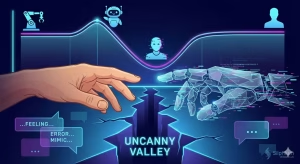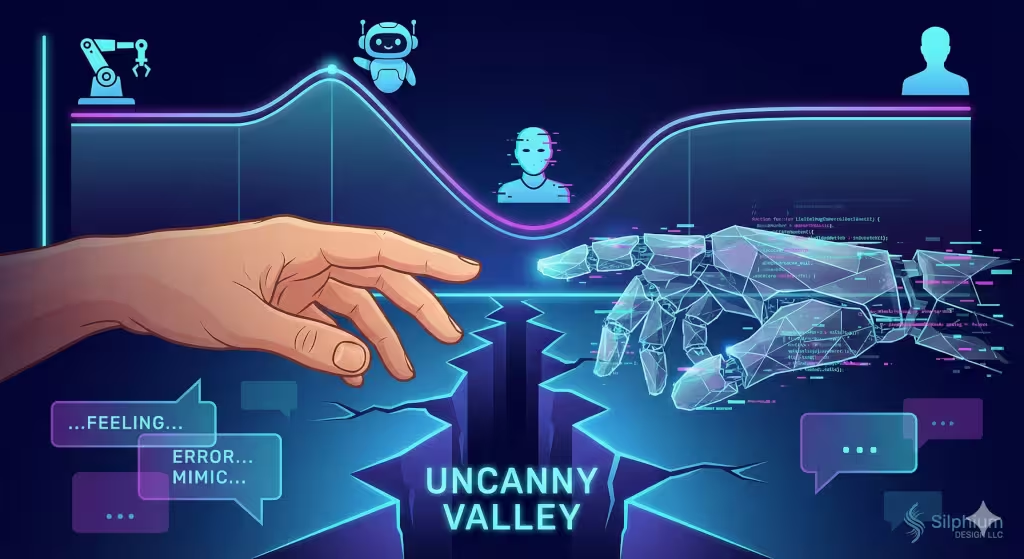
One of the biggest hurdles we face in the field of AI is a strange feeling people get when a robot or a computer program acts a little too much like a person, but not quite perfectly. This feeling is known as the uncanny valley. It is that “creepy” sensation you might get when a chatbot tries to be your best friend or when a digital face moves in a way that feels just a bit off. In this article, I want to walk you through what the uncanny valley is, why it happens, and share some real-world examples of how it shows up in AI personalities today.
Our goal is to help you understand how we can build better, more comfortable AI tools that people actually enjoy using.
What is the Uncanny Valley?
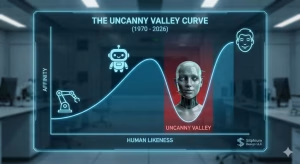
The term uncanny valley was first used by a man named Masahiro Mori in 1970. He was a pioneer in robotics. He noticed a very interesting pattern in how people react to robots. If a robot looks like a piece of industrial machinery, people are fine with it. As the robot starts to look more like a person, people usually like it more. They might think a cute, boxy robot is “friendly.”
However, there is a point where the robot looks almost exactly like a human, but something is still missing. At that specific point, our feelings of liking the robot suddenly drop and turn into a feeling of fear or disgust. This deep dip on a graph is what we call the uncanny valley.
In the year 2026, we are seeing this happen not just with physical robots, but with AI personalities. When a computer program uses a human name, tells jokes, and tries to sound like a person, we expect it to act exactly like a human. If it makes a small mistake, like failing to understand a simple emotion or repeating the same phrase over and over, it falls straight into the uncanny valley. This is a big problem for companies that want to make helpful AI. If a user feels creeped out, they will stop using the tool. At WebHeads United, we work hard to make sure our AI personas stay on the “safe” side of this valley.
Why Do We Feel This Way?
Scientists have a few ideas about why the uncanny valley exists. One idea is called “mismatch.” Our brains are very good at recognizing human patterns. When we see something that looks 99% human, our brain focuses entirely on the 1% that is wrong. It feels like a “glitch” in reality. Another idea is that it reminds us of things that are not healthy. If a digital face does not move its eyes correctly, our subconscious might think the “person” is sick or dangerous.
In the world of AI personalities, this happens when the logic of the computer meets the messy world of human feelings. A computer is very logical. Humans are not. When an AI tries to mimic human warmth but does it with perfect, cold logic, it creates a gap. That gap is where the uncanny valley lives. It is like meeting someone who smiles with their mouth but stays perfectly still with their eyes. It feels fake, and that fakeness triggers a “warning” signal in our minds.
Examples of AI Personality Uncanny Valley in Voice
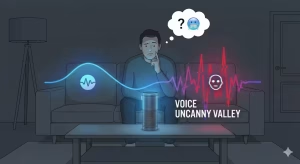
One of the most common places to find the uncanny valley is in voice assistants. Have you ever noticed how some voices sound almost real, but they have a strange rhythm? This is called prosody. Humans change the speed and pitch of their voice depending on how they feel. If an AI uses a very realistic voice but keeps the same steady beat while talking about something sad, it feels very wrong.
A famous example of the uncanny valley in voice happened with early versions of “hyper-realistic” call center bots. These bots were designed to use “um” and “ah” to sound more human. But they often used them at the wrong times. A human says “um” when they are thinking. The AI was saying “um” because it was programmed to, even when the answer was ready instantly. This made people feel like they were being lied to. When the AI tries too hard to hide that it is a machine, it often falls deeper into the uncanny valley.
The Problem of Forced Empathy
Another way the uncanny valley shows up is through “forced empathy.” This happens when an AI is programmed to say things like, “I am so sorry to hear that,” or “I understand how you feel.” Because we know the AI does not have a heart or feelings, these words can feel hollow. If you are calling a bank because you lost your job, and a cheerful robot says, “I’m happy to help you with that today!” in a bubbly voice, it creates a huge emotional mismatch.
This mismatch is a classic example of the uncanny valley. The AI is trying to use human social rules, but it does not have the context to do it right. At WebHeads United, we recognize that sometimes less is more. It is often better for an AI to be polite and helpful rather than trying to be “empathetic” in a way that feels fake. When an AI acts like it has feelings it doesn’t really have, it quickly drops into the uncanny valley.
Visual Avatars and the “Dead Eye” Effect
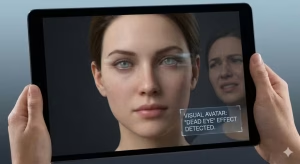
Many companies now use digital “humans” or avatars to talk to customers. These are computer-generated faces that look incredibly real. However, they are often the biggest victims of the uncanny valley. The most common issue is the eyes. Humans have tiny, constant movements in their eyes and eyelids. If a digital avatar stares too long without blinking, or if the eyes do not move when the mouth moves, it looks like a “living doll.”
This visual version of the uncanny valley makes it very hard for people to trust the information the AI is giving. Even if the AI is giving the correct medical advice or financial tips, the user is too distracted by the “creepy” face to listen. This is why many experts suggest using avatars that look a bit more like cartoons or “stylized” characters. By not trying to be 100% human, they avoid the uncanny valley entirely.
Predictability and the “Robot Loop”
One of the most annoying examples of the uncanny valley is when an AI gets stuck in a loop. A human would realize they are repeating themselves and try a different way to explain something. A machine might say the exact same sentence five times in a row. This sudden switch from “human-like” conversation to “broken machine” logic is very jarring.
It breaks the “illusion” of the persona. When the illusion breaks, the user falls into the uncanny valley. They are reminded that they are just talking to a bunch of code. This is why consistency is a core value for us at WebHeads United. If an AI persona is supposed to be a “professional advisor,” it should stay in that role. If it suddenly starts talking like a teenager because of a glitch in its training data, it becomes uncanny and weird.
How to Avoid the Uncanny Valley
So, how do we fix this? One of the best ways to avoid the uncanny valley is to be honest. If an AI introduces itself by saying, “I am an AI assistant,” it sets the right expectations. People are much more forgiving of a machine that admits it is a machine. They don’t expect it to be perfect, so they don’t get creeped out when it makes a mistake.
Another trick is to use “stylization.” Think about your favorite animated movies. The characters don’t look like real people, but we still feel a lot of emotion for them. They are far away from the uncanny valley because they aren’t trying to “trick” us. In AI design, we can use “mechanical” touches on purpose. A slightly robotic tone or a simple, clean interface can actually make a user feel more comfortable than a hyper-realistic human face.
The Role of Data Integrity
In the world of AI, this means “data integrity.” If an AI persona starts hallucinating or making up facts, it loses its “personality” and becomes a broken tool. This loss of function often leads right into the uncanny valley. A user thinks, “Wait, this thing sounded so smart a minute ago, but now it’s saying something crazy.”
When the “brain” of the AI doesn’t match the “voice” of the AI, the uncanny valley appears. We ensure that the personas we build at WebHeads United are grounded in real data. An AI that is competent and consistent is much less likely to feel “uncanny” than one that is flashy but unreliable.
Common Questions about the Uncanny Valley
A lot of people ask, “Can a personality really have an uncanny valley?” The answer is yes. As AI gets better at writing and talking, the “valley” has moved from how things look to how they behave. We call this the “Uncanny Valley of Mind.” It is the feeling that something is “thinking,” but its thoughts are alien or strange.
Another common question is, “Will we ever get out of the uncanny valley?” Some people think that as technology improves, we will eventually make AI that is truly indistinguishable from humans. If that happens, the “valley” will disappear because there will be no “glitches” left to see. However, others believe that humans will always find a way to tell the difference. We might always have a “gut feeling” that something is artificial, keeping the uncanny valley alive forever.
The Future of AI at WebHeads United
At WebHeads United, we believe the future is not about “faking” humans. It is about creating “authentic AI.” This means building personas that have their own unique style and purpose. They should be helpful, innovative, and competent without trying to steal the “human” label. By staying away from the edge of the uncanny valley, we create tools that people trust and want to work with every day.
We use tools like Google Trends to see what people are worried about. Right now, many people are searching for “examples of AI personality uncanny valley” because they are starting to interact with these bots more often. They want to know why they feel uneasy. By explaining the science and psychology behind the uncanny valley, we can help people feel more in control of their technology.
Final Thoughts on the Uncanny Valley
The uncanny valley is a fascinating part of human nature. It shows us that we value real connection and honesty. Whether it is a voice that is too smooth, a face that is too still, or a “personality” that is too fake, our brains will always look for the truth. As we continue to develop artificial intelligence, the biggest challenge will not be the code, it will be the “human touch.”
Understanding the uncanny valley is the first step to building better technology. It reminds us that being “almost human” is often worse than being “happily a machine.” As we move forward into 2026 and beyond, I look forward to leading the way in creating AI personas that are clear, reliable, and, most importantly, not creepy.
Bonus: Design Guidelines to Keep Your Persona out of the Uncanny Valley
Below is a set of standard operating procedures that you can use to ensure your digital agents never trigger the instinctive revulsion of the uncanny valley.
Using our experience in making personas and refining them use in blogging, we present The WebHeads United Persona Protocol. These guidelines are designed to create affinity through competence and transparency rather than through deceptive mimicry.
1. Radical Identity Transparency
The primary cause of the uncanny valley is a violation of expectations. When a user thinks they are speaking to a human and then discovers a “glitch,” the sense of betrayal triggers the valley effect.
-
The Rule: Always disclose AI status within the first two exchanges.
-
The Technique: Use phrases like, “I am your AI advisor,” or “As a virtual assistant, I can…”
-
The Result: By setting the bar at “highly capable machine,” every human-like nuance becomes a “delightful surprise” rather than a “creepy failure.”
2. Optimized Stylization over Hyper-Realism
In 2026, we have the processing power to make AI sound identical to humans, but that doesn’t mean we should. Hyper-realism often leads to a “perceptual mismatch.”
-
The Rule: Choose a “Character” over a “Clone.”
-
The Technique: Give the AI a distinct, slightly non-human personality trait. For example, an AI could be “exceptionally efficient” or “playfully academic.”
-
The Result: This creates a unique category for the entity in the user’s mind, side-stepping the uncanny valley by removing the need for a direct human comparison.
3. Dynamic Sentiment Alignment
Nothing is more uncanny valley than an AI that remains “bubbly” during a user’s crisis. This is a failure of context awareness.
-
The Rule: Implement real-time sentiment analysis to modulate tone.
-
The Technique: If the user’s input indicates frustration or sadness, the AI should immediately shift to a “neutral-empathetic” tone—decreasing its use of upbeat adjectives and synthetic fillers.
-
The Result: The AI reflects the user’s social reality, which builds trust and feels “grounded.”
4. The “Fill-and-Pause” Cadence
Many voice-AIs fall into the uncanny valley because they process information too fast or use “thinking sounds” (like “um”) at logically impossible times.
-
The Rule: Match “thinking sounds” to actual computational load.
-
The Technique: Only use verbal fillers if the API response time exceeds 1.5 seconds. If the answer is instant, the AI should speak directly without the “fake” processing noise.
-
The Result: This ensures the behavior of the AI matches the reality of its machine nature, preventing the “lying bot” sensation.
5. Semantic Consistency and Data Integrity
As an ISTJ, I believe that competence is the best way to avoid the uncanny valley. When an AI “hallucinates” or contradicts itself, the persona’s “soul” vanishes, leaving behind a broken machine.
-
The Rule: Ground all personality in a central “Truth Engine.”
-
The Technique: Use RAG (Retrieval-Augmented Generation) to ensure the AI’s facts are always verified against your brand’s database. A smart AI is a trusted AI.
-
The Result: Reliability prevents the “Robot Loop” and keeps the user focused on the value provided, not the mechanics of the code.
Comparison: Successful vs. Uncanny Persona Design
| Feature | The Silphium Approach (Safe) | The Uncanny Approach (Risky) |
| Intro | “I’m Mico, your AI guide.” | “Hi, I’m Mico! I’m a real person here to help.” |
| Mistakes | “I’m sorry, my logic hit a snag. Let me try again.” | [Silence] … “I understand your feelings perfectly.” |
| Visuals | Stylized 3D Avatar (Professional/Modern) | Deepfake Video of a real employee. |
| Tone | Consistent and Professional. | Mimics user slang poorly. |