The world of e-commerce is currently fighting a silent war. While you sleep, invisible digital agents are wide awake. They are scanning your prices, reading your customer reviews, and analyzing your stock levels. These aren’t human spies; they are artificial intelligence (AI) systems. If you are running a WooCommerce store today, you might feel like you are drowning in numbers. You have spreadsheets for sales, emails for inventory, and alerts for social media. This is a common problem called “Data Paralysis.” It happens when you have so much information that you freeze up and cannot make a decision. By the time you finish analyzing a competitor’s price manually, they have already changed it again.
This is where AI competitor analysis changes the game. It is not just about watching your rivals; it is about predicting their next move before they even make it. Instead of spending hours staring at a screen, AI tools can do the heavy lifting for you. They work 24/7 to find patterns that a human would miss.
In this article, we will look at real-world AI competitor analysis case studies from giants like Amazon and Sephora. We will see exactly how they use these tools to win. More importantly, I will show you how to apply these same strategies to your own business using simple WooCommerce plugins. By the end of this guide, you will know how to turn AI competitor analysis into your secret weapon for growth and gain an edge against your competition.
The Mechanics of AI Intelligence: How It Works

To truly master AI competitor analysis, you cannot just trust the “magic box.” You need to understand the gears turning inside it. When we say AI “analyzes” a competitor, it is not simply reading a website like a human does. It is deconstructing millions of data points into a mathematical map of the market. This process happens in two distinct phases: Data Collection (seeing the world) and Pattern Recognition (understanding the world).
Data Collection: The “Eyes” of the Operation
The first step is gathering raw information. In the past, this meant hiring an intern to copy prices into a spreadsheet. Today, AI uses advanced sensors to “scrape” and “ingest” data from every corner of the internet.
Natural Language Processing (NLP)
This is the technology that allows computers to understand human speech and text. In AI competitor analysis, NLP does not just read words; it reads intent.
-
Tokenization: Imagine a customer review says, “The hiking boots are durable but the laces snapped immediately.” A human reads this as a mixed review. AI breaks this sentence down into “tokens” or small chunks. It separates the product (“hiking boots”) from the attribute (“durable”) and the complaint (“laces snapped”).
-
Aspect-Based Sentiment Analysis: Standard tools might mark that review as “Neutral” (3 stars). Advanced AI digs deeper. It assigns a “Positive” score to the boot structure and a “Negative” score to the laces. This allows you to see exactly where your competitor is failing without reading thousands of reviews.
-
Semantic Search: AI can tell that “waterproof jacket” and “rain shell” mean the same thing. If your competitor ranks for “rain shell,” the AI knows you can compete by targeting “waterproof jacket,” ensuring you don’t miss customers just because they use different slang.
Visual AI (Computer Vision)
The internet is visual, and competitors hide many secrets in their images. Visual AI acts like a digital set of eyes that scans pixels instead of text.
-
Ad Creative Analysis: The AI can scan ten thousand Instagram ads from your competitor. It might notice a pattern: “Ads with blue backgrounds and a human face perform 20% better than ads with white backgrounds and just the product.” It identifies the winning visual formula for you.
-
Stock Level Detection: Some clever AI tools can look at a competitor’s product page image. If the “Add to Cart” button turns gray or if a “Low Stock” label appears in the corner of the image, the AI records this visually, even if the website code tries to hide the actual inventory numbers.
Pattern Recognition: The “Brain” of the Operation
Once the AI has seen the data, it needs to understand it. This is where “Machine Learning” comes in. The system looks for invisible connections between the data points it just collected.
Pricing Algorithms (Reinforcement Learning)
This is the most aggressive form of AI competitor analysis. It moves beyond simple rules like “be $1 cheaper.”
-
The Learning Loop: Reinforcement Learning works by trial and error. The AI might raise your price by $0.50. If sales stay the same, it learns that customers are willing to pay more. If sales drop, it quickly lowers the price back down.
-
Predicting Elasticity: The AI calculates “price elasticity” for every product. It learns that your customers will stop buying socks if the price goes up by $1, but they will keep buying tents even if the price goes up by $50. It uses this math to squeeze the maximum profit from every single item, reacting instantly to competitor price changes.
Identifying Content Gaps
How do you beat a competitor who has written about everything? You find the “Semantic Void.”
-
-
Topic Mapping: Imagine all the knowledge in your industry is a giant map. The AI looks at your competitor’s blog and places a pin everywhere they have written an article.
-
Finding the White Space: The AI looks for empty spaces on the map, topics that are relevant but uncovered. For example, your competitor might have a great guide on “How to clean leather boots.” But the AI notices they have zero content on “How to waterproof vegan leather boots.” That empty space is your opportunity to rank #1 on Google because no one else has answered that specific question.
-
By combining these “Eyes” and this “Brain,” the AI creates a loop. It sees a change, understands if it is a threat, and tells you exactly how to respond. This turns your business from a reactive victim into a proactive hunter.
Case Study A: Dynamic Pricing Dominance (The “Amazon Strategy”)

When we talk about AI competitor analysis, we have to start with the king of e-commerce: Amazon. Have you ever noticed that prices on Amazon change constantly? That is not an accident. It is a highly advanced strategy called “Dynamic Pricing.”
The Challenge
Amazon wants to win the “Buy Box,” that button you click to add an item to your cart. To do this, they need to offer the best value. But “best value” doesn’t always mean the lowest price. If they always had the lowest price, they would lose money. The challenge is to find the perfect price that is low enough to win the customer but high enough to make a profit.
The AI Solution
Amazon uses AI competitor analysis to adjust prices in real-time. Their system uses something called Reinforcement Learning. The AI looks at demand, time of day, and competitor stock levels.
-
Key Metric: Amazon changes its product prices up to 2.5 million times a day. No human team could ever keep up with that speed.
-
How it Works: If a competitor runs out of stock, Amazon’s AI knows it instantly. It might then raise the price slightly because it knows customers have nowhere else to go. This is a classic example of AI competitor analysis driving profit.
WooCommerce Application
You might not have Amazon’s budget, but you can use their strategy. You can set up AI competitor analysis tools on your WooCommerce store to watch your rivals.
-
Actionable Tip: Do not just use AI competitor analysis to lower your prices. Use it to raise them! If your main competitor is sold out of a popular item, your tool should alert you to increase your price by 10% to capture the extra demand.
-
Tool Recommendation: Plugins like Prisync integrate with WooCommerce. They automate this process, allowing you to compete like a giant without hiring a pricing team.
Case Study B: The Content Gap Attack (The “HubSpot Strategy”)
Pricing isn’t the only battlefield. Content is just as important. HubSpot is a company that mastered the art of “Inbound Marketing.” They used a strategy that relies heavily on a form of AI competitor analysis focused on content.
The Challenge
HubSpot wanted to be the number one resource for marketing advice. But the internet is full of marketing blogs. How could they stand out? They needed to find topics that their competitors were missing or answering poorly.
The AI Solution
They used AI competitor analysis to perform “Content Gap Analysis.” This involves scanning competitor websites to see what keywords they rank for.
-
Semantic Voids: The AI looks for “Semantic Voids.” These are topics that a competitor mentions but doesn’t explain in detail. For example, a competitor might write about “email marketing,” but fail to explain “how to write a subject line.”
-
The Result: By filling these gaps, HubSpot captures “Zero-Click” searches (where Google shows the answer directly) and high-quality traffic. They didn’t just guess what to write; AI competitor analysis told them exactly what was missing.
WooCommerce Application
For a WooCommerce store owner, content brings in free traffic.
-
Actionable Tip: Use AI competitor analysis to scan your competitor’s product descriptions. Are they vague? Do they lack technical specs? If they sell a camera but don’t list the battery life, you should list the battery life in bold on your page. In other words, provide more information than your competitors and become a trusted authority.
-
Tool Recommendation: Rank Math is a great SEO plugin for WooCommerce. Its “Content AI” feature acts like a mini AI competitor analysis tool. It scores your product descriptions against the top 10 results in Google and tells you exactly which words to add.
Case Study C: Sentiment Espionage (The “Sephora Strategy”)
Knowing what your competitors charge and what they write is useful. But knowing how their customers feel is a superpower. This is where Sephora excels using AI competitor analysis.
The Challenge
The beauty industry moves fast. A new lipstick might be trendy today and hated tomorrow. Sephora needed a way to understand why a competitor’s product was succeeding or failing before the official sales numbers came out.
The AI Solution
Sephora uses Aspect-Based Sentiment Analysis. This is a fancy way of saying they use AI competitor analysis to read social media and reviews.
-
Digging Deeper: Standard analysis says a review is “positive” or “negative.” Aspect-based analysis goes deeper. It can tell you that customers “love the color” (positive) but “hate the smell” (negative).
-
The Result: If Sephora sees that a competitor’s new moisturizer is getting complaints about being “too greasy,” they can instantly launch a marketing campaign for their own “oil-free” moisturizer. They use the competitor’s failure as their marketing hook.
WooCommerce Application
You can use this form of AI competitor analysis to fix your own products or target rival weaknesses.
-
Actionable Tip: Use an AI summarizer to read the reviews on your competitor’s Amazon listings. Look for the common complaints. If everyone says their hiking boots “fall apart after one month,” put a banner on your site that says “Guaranteed to Last 1 Year.”
-
Tool Recommendation: Tools like Review Warmth AI or even generic AI writers can summarize text for you. Paste in a hundred reviews and ask the AI: “What is the biggest complaint mentioned here?” This is a manual but powerful form of AI competitor analysis.
Hypothetical WooCommerce Case Study: “The Niche Apparel Store”
Let’s put this all together with a story. Since private business data is hard to get, we will create a realistic scenario based on how these tools work. We will follow “EcoHike,” a small WooCommerce store selling sustainable hiking gear. They are fighting against a massive retailer called “GiantOutdoor.”
Step 1: The Setup
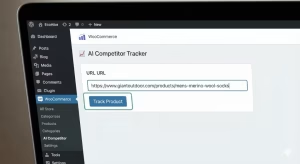
EcoHike knows they cannot beat GiantOutdoor on price for everything. They need to be smart. The owner, Sarah, decides to invest in AI competitor analysis. She installs a plugin that tracks GiantOutdoor’s product pages specifically for her top-selling items: Merino Wool Socks.
Step 2: The Trigger
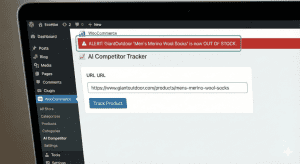
On a Tuesday afternoon, the AI competitor analysis tool sends Sarah an alert. It has detected that GiantOutdoor is “Out of Stock” for their most popular grey wool socks. The giant has stumbled.
Step 3: The Action
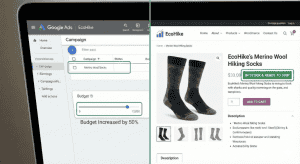
Sarah’s response is automated. Her AI competitor analysis workflow triggers two actions:
-
Ad Spend: It automatically increases her Google Ads budget for the keyword “grey wool socks” by 50%. She knows people are searching for them and finding the giant empty-handed.
-
Site Update: On her WooCommerce product page, a badge activates that says “In Stock & Ready to Ship.”
Outcome
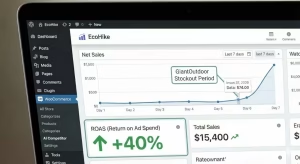
For the next three days, while GiantOutdoor scrambles to restock, EcoHike captures all the frustrated customers. Sarah sees a 40% increase in her Return on Ad Spend (ROAS). She didn’t win by being bigger; she won by using AI competitor analysis to be faster.
Top AI Tools for WooCommerce Competitor Analysis
Now that you see the value, which tools should you use? There are many options, but for a WooCommerce user, integration is key. Here is a comparison of top tools for AI competitor analysis.
| Tool Name | Best For | AI Feature | WooCommerce Integration |
| Prisync | Price Tracking | Dynamic Repricing Algorithms | Native Plugin |
| Rank Math | SEO & Content | Content Gap Analysis | Native Plugin |
| Crayon | Market Intel | Tracking Website Changes (e.g., A/B tests) | External Dashboard |
| ChatGPT (Custom GPTs) | Ad-Hoc Analysis | Summarizing Competitor Annual Reports/PDFs | Manual Input |
Prisync is excellent for automating the pricing strategies we discussed. It runs in the background, constantly performing AI competitor analysis on your rivals’ prices. Rank Math helps you win the content war by analyzing the keywords your competitors are using. Crayon is a bit more advanced; it takes screenshots of competitor sites to see if they change their homepage layout, which is a visual form of AI competitor analysis.
Using the right tool prevents “Data Paralysis.” A good AI competitor analysis dashboard should look simple. It should not show you raw data; it should show you insights. Look for tools that give you a “Green Light” or “Red Light” rather than just a spreadsheet of numbers.
Ethical Considerations & Future Trends
As we embrace AI competitor analysis, we must also talk about the rules. Just because you can do something doesn’t always mean you should.
The “Gray Zone”
There is a difference between public data scraping and corporate espionage. AI competitor analysis relies on data that is publicly available on websites. This is generally legal. However, trying to hack into a competitor’s private backend or using AI to flood their site with fake traffic is illegal and unethical. Stick to analyzing what is public.
Bot Protection
Remember, your competitors might be using AI competitor analysis against you, too! You might see “bot traffic” on your site that isn’t real customers. Tools like Cloudflare Turnstile can help block bad bots while letting the good Google bots through.
Future Trend: Agentic Commerce
The future of AI competitor analysis is even wilder. We are moving toward “Agentic Commerce.” Imagine your AI software talking directly to your competitor’s AI software. They might negotiate a price that works for both of you, finding a perfect market balance. This is the “Nash Equilibrium” of e-commerce. In this future, AI competitor analysis won’t just be about fighting; it might be about negotiating.
Questions about AI Competitor Analysis
Is using AI to track competitor prices legal?
Yes, tracking public prices is legal. AI competitor analysis tools simply automate the process of looking at a public website, which you could technically do yourself manually.
What is the best free AI tool for competitor analysis?
For beginners, the free version of Rank Math is great for content. For general research, ChatGPT can act as a basic AI competitor analysis tool if you feed it public data to summarize.
How often should I run an AI competitor analysis?
Ideally, your tools should run it continuously. In the fast-paced world of e-commerce, a monthly report is too slow. Real-time AI competitor analysis gives you the agility to react to trends as they happen.
Can AI predict a competitor’s Black Friday strategy?
Yes! By analyzing historical data from previous years, AI competitor analysis can predict with high accuracy when a competitor will launch their sale and how deep their discounts will be.
Conclusion
The landscape of online selling has changed. It is no longer enough to just have a good product. You need to understand the market in real-time. AI competitor analysis is the bridge between drowning in data and swimming in profits. We looked at how Amazon uses it to adjust prices instantly. We saw how HubSpot uses it to dominate search results. And we saw how Sephora uses it to understand customer feelings.
For the WooCommerce store owner, the path is clear. You don’t need a team of data scientists. You just need to start small. Pick one area, price, content, or reviews, and apply AI competitor analysis to it. Don’t let your data gather dust. Install one of the recommended plugins today and run your first “Competitor Audit” this weekend. The tools are ready; are you?