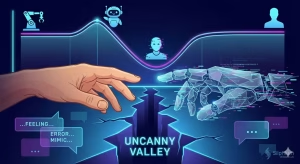
The global virtual influencer market is projected to exceed $20 billion by the end of the decade, a valuation substantiated by high-profile campaigns where virtual entities like Lil Miquela have represented legacy brands such as Prada and Calvin Klein. These digital phenomena, however, are not mere curiosities; they are a new class of strategic asset. A virtual influencer is a computer-generated character—a digital construct meticulously engineered and managed by a creative and technical team. Its primary function is to embody a distinct personality on social media and other digital platforms for the explicit purposes of narrative building, audience engagement, and marketing.
The objective of this analysis is to move beyond the superficial and provide a systematic breakdown of the virtual influencer ecosystem. We will deconstruct their technical architecture, evaluate their strategic business applications and monetization models, identify the key corporate and creative entities defining the market, and address the critical ethical and legal considerations that will undoubtedly shape their future trajectory.
The Technical Architecture: How Are Virtual Influencers Engineered?

To comprehend the strategic value of virtual influencers, one must first deconstruct their creation. This process is not a simple act of automation but a complex, multidisciplinary pipeline that blends artistry with computational power. It is a critical distinction that separates the majority of today’s influencers from truly autonomous artificial intelligence.
The Role of Computer-Generated Imagery (CGI) and 3D Modeling
The visual foundation of any virtual influencer is built using the same core technologies behind feature-film visual effects and advanced video games. The workflow typically involves several stages:
- Modeling: Digital artists use software like Autodesk Maya, ZBrush, or the open-source platform Blender to sculpt a 3D model of the character, defining their physical features with meticulous detail.
- Texturing: “Skin,” hair, and clothing are applied to the model as high-resolution textures to achieve photorealism. The physics of how light interacts with these surfaces (e.g., skin sub-surface scattering) is simulated to avoid a plastic or artificial look.
- Rigging: A digital “skeleton” or rig is constructed within the model. This armature allows animators to manipulate the character’s body, limbs, and facial expressions for posing in static images or for full-motion video.
- Rendering: Finally, the completed 3D scene—character, clothing, background, and lighting—is processed by a rendering engine. Modern real-time engines like Epic Games’ Unreal Engine 5 are increasingly used, as they allow for rapid iteration and the creation of dynamic video content more efficiently than traditional offline renderers.
The Human Element: The Teams Behind the Avatars
A prevalent misconception is that virtual influencers operate autonomously. In their current dominant form, this is factually incorrect. The vast majority are “digital puppets” under the direct control of a human team. This team often consists of:
- Art Directors & 3D Artists: Who manage the character’s visual identity.
- Writers & Narrative Strategists: Who craft the character’s backstory, personality, and day-to-day “life” as portrayed in captions and stories.
- Social Media Managers: Who execute the content strategy, engage with the community, and manage brand partnership deliverables.
This human-in-the-loop model ensures complete control over messaging and narrative, a key advantage for brand safety.
The Spectrum of Intelligence: From Digital Puppets to AI-Driven Personas
While most virtual influencers are human-steered, the industry is at an inflection point. The integration of advanced AI is creating a new tier of interactive entities. We can classify them on a spectrum:
- Scripted Personas (Current Standard): All actions, dialogue, and interactions are predetermined by a human team.
- AI-Assisted Personas (Emerging): Generative AI tools may be used to help writers create caption variations or to generate novel visual concepts for the artists.
- AI-Driven Personas (The Future): These influencers will leverage sophisticated Natural Language Processing (NLP) models to engage in real-time, unscripted conversations with thousands of users simultaneously. They will learn from interactions to develop a more nuanced persona, moving from a broadcast model to a truly interactive one.
Key Entities in the Virtual Influencer Ecosystem

The market is not a one size fits all. It is defined by several key entities that pioneered different models of creation and deployment. An analysis of these archetypes provides a map of the current strategic landscape.
The Independent Creator Model: Lil Miquela
- Entity: Lil Miquela (@lilmiquela)
- Creator Entity: Brud (acquired by Dapper Labs)
Lil Miquela represents the archetypal virtual influencer. Launched in 2016, her creators at Brud pioneered a strategy of blending a fictional, serialized narrative with real-world activities and brand partnerships. Her “life” in Los Angeles, complete with friends, breakups, and a music career on Spotify, created a new form of transmedia storytelling. This model proved that an audience would willingly suspend disbelief and form a parasocial relationship with a digital construct, paving the way for the entire market.
The Agency Model: Shudu Gram
- Entity: Shudu (@shudu.gram)
- Creator Entity: The Diigitals
Created by photographer Cameron-James Wilson, Shudu was presented as the “World’s First Digital Supermodel.” Unlike Lil Miquela’s narrative focus, Shudu’s value proposition is purely aesthetic. She is a digital model for high-fashion and cosmetic brands like Balmain and Fenty Beauty. The Diigitals agency, which Wilson founded, operates like a traditional modeling agency, but its entire roster is composed of CGI creations. This model directly challenges the human-dominated fashion industry by offering a flawless, eternally available alternative.
The Corporate Mascot Model: Lu do Magalu
- Entity: Lu do Magalu (@magazineluiza)
- Creator Entity: Magazine Luiza
Arguably the most financially successful virtual influencer is Lu do Magalu, the face of the Brazilian retail giant Magazine Luiza. Created in 2009, long before the term “virtual influencer” was popularized, Lu evolved from a simple website guide into a national icon. She unboxes products, gives tech tips, and spearheads marketing campaigns, directly linking her influence to e-commerce sales. With over 30 million followers across platforms, she demonstrates the immense power of a vertically integrated, brand-owned virtual persona to drive both engagement and revenue.
The Business of Virtual Influence: Monetization and ROI
The adoption of virtual influencers by brands is not driven by novelty alone, but by compelling financial and strategic logic. Their business model offers a degree of predictability and control that is unattainable with human influencers.
Monetization Channels
Virtual influencers generate revenue through channels largely parallel to their human counterparts, but with unique digital extensions:
- Brand Partnerships & Sponsored Content: The primary model, where brands pay for product placement in posts, stories, and videos.
- Entertainment Ventures: Lil Miquela has released singles on Spotify, demonstrating a path into traditional media.
- Digital Goods & Web3: With the rise of the metaverse, virtual influencers are uniquely positioned to sell digital assets, from branded NFTs to virtual apparel for use in platforms like Roblox or Decentraland.
- Direct-to-Consumer (DTC): As exemplified by Lu do Magalu, brand-owned influencers can directly feature products and link to purchase pages, creating a seamless sales funnel.
The Strategic Imperative for Brands
For a Chief Marketing Officer, the advantages are clear:
- Total Control: The influencer’s messaging, actions, and appearance are 100% controlled by the brand or agency. There is zero risk of a past problematic tweet surfacing or a personal scandal damaging a campaign.
- Global Availability: A virtual influencer can be in multiple places at once, is not bound by time zones, and never ages or gets fatigued.
- Predictable ROI: The controlled environment allows for more precise measurement of campaign effectiveness. The return on investment can be calculated with fewer confounding variables. The formula remains standard, but the input variables are more reliable:
The Uncanny Valley: Ethical Debates and Legal Considerations

The rapid ascent of virtual influencers is not without significant ethical and legal friction. These debates are critical, as their resolution will dictate the long-term social acceptance and regulatory framework for the technology.
Transparency and Disclosure
The primary ethical imperative is transparency. Is it clear to the audience that they are engaging with a non-human entity? Deception can erode trust. Regulatory bodies like the U.S. Federal Trade Commission (FTC) have clear guidelines requiring disclosure for sponsored content, and these principles are being extended to demand clarity on the non-human nature of an influencer to prevent misleading audiences.
Perpetuating Unrealistic Standards
A significant criticism is that virtual influencers, who can be digitally perfected to an impossible degree, exacerbate the already prevalent issue of unrealistic beauty and lifestyle standards on social media. While human influencers often use filters and editing, virtual influencers are inherently “edited,” setting a benchmark for perfection that is literally inhuman.
Economic Displacement
The rise of digital models like Shudu poses a direct economic threat to human models, photographers, and other creators. As the technology becomes cheaper and more accessible, brands may opt for the control and cost-effectiveness of a virtual campaign, potentially displacing humans from the creator economy.
Data & Autonomy
Looking ahead to AI-driven personas, new ethical dilemmas emerge. When a user has a seemingly personal conversation with an AI influencer, what data is being collected? How is it being used to further profile the user for advertising? The data privacy implications of these future interactions are substantial and largely unaddressed by current legislation.
The Future Trajectory: Convergence with the Metaverse and AI
The current iteration of the virtual influencer is merely a precursor. The convergence of this technology with parallel developments in AI and persistent virtual worlds points toward a future where digital personas are far more integrated into our daily lives.
Integration with Web3 and the Metaverse
Virtual influencers are natural citizens of the metaverse. They will not just post about these digital worlds; they will inhabit them. They can function as brand ambassadors in a virtual Nike store, as guides in a complex gaming world, or as hosts for purely digital events. Their existence as code makes them native to these emerging platforms.
Hyper-Personalization and True Interactivity
The most significant shift will be from the one-to-many broadcast model of social media to a one-to-one conversational model at scale. Powered by generative AI, a future virtual influencer could have millions of unique, simultaneous, and personalized conversations with its followers, building a far deeper and more effective form of brand loyalty and engagement.
The Rise of the Enterprise AI Persona
The technology underpinning virtual influencers will expand beyond marketing. At Silphium Design LLC, we are actively developing and monitoring the application of these principles for enterprise use. AI-driven personas will serve as scalable, perfectly consistent brand representatives in roles such as:
- Corporate Trainers: Delivering customized training modules to a global workforce.
- Customer Service Agents: Providing empathetic and efficient problem-solving.
- Onboarding Specialists: Guiding new employees through complex organizational processes.
Conclusion
The virtual influencer is a powerful synthesis of art, technology, and commerce. It represents a fundamental shift from leveraging human influence to engineering influence itself. While today they exist primarily as sophisticated digital puppets in the marketing sphere, this is a transitional phase. Their architecture, business models, and underlying technologies are rapidly evolving. To dismiss them as a novelty is to overlook the trajectory toward a future where autonomous, interactive AI personas become a standard interface for communication, entertainment, and commerce. The critical task ahead is not to question their arrival, but to build the ethical and technical frameworks necessary to manage their integration into society.