The digital world is overflowing with information. Every day, countless articles, videos, and social media posts fight for our attention. In this crowded space, many businesses try to reach “everyone” with their messages. However, trying to please everyone often means pleasing no one at all. This common approach leads to what I call the “Inefficiency of Generic Content.” It’s like shouting into a large stadium hoping someone, anyone, will listen. The result is often wasted effort, low engagement, and a poor return on investment.
But what if there was a better way? What if we could stop guessing and start truly understanding who we’re talking to? My core belief, or “The Hypothesis,” is that a smart, data-first approach, specifically a persona-driven content strategy, is the clear answer. This method uses real information to create messages that truly connect. It’s about building content that feels personal, relevant, and valuable to the people you most want to reach.
The goal of this article is to give you a clear, step-by-step guide. We’ll explore how to define, create, and use a persona-driven content strategy. By the end, you’ll see how this powerful approach can not only make your content more effective but also build stronger connections with your audience and deliver better results for your business.
Foundational Definition: What is a Persona-Driven Content Strategy?

To truly understand what we’re talking about, let’s break down the term “persona-driven content strategy” into its core parts. This isn’t just a fancy marketing phrase; it’s a specific, powerful way of thinking about how you share information.
Defining Component A: The Content Strategy
Think of a “content strategy” as your master plan for talking to your audience. It’s much more than just randomly creating articles or social media posts. Without a strategy, you’re just making “random acts of content.” This is like throwing darts in the dark – you might hit something, but it’s mostly luck.
A true content strategy is a thoughtful, organized blueprint. It’s about deciding:
- What kind of information will you create? (Is it articles, videos, podcasts, guides?)
- Who are you trying to reach? (This is where personas come in!)
- What problems are you trying to solve for them?
- What do you want them to do after they engage with your content? (Sign up for a newsletter, buy a product, learn something new?)
- Where will you share this content? (Your website, social media, email?)
- How often will you create new content?
The main purpose of a content strategy is to consistently create and share valuable, relevant content. This isn’t just about selling; it’s about attracting and keeping a specific group of people interested, eventually building trust and loyalty. It’s about showing your audience that you understand their needs and can offer them something truly useful.
Defining Component B: The Persona
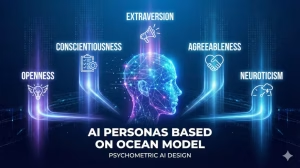
Now, let’s talk about the heart of this strategy: the “persona.” You might have heard this word before. In simple terms, a persona is like creating a detailed picture of your ideal customer. But it’s not just a guess or a broad description like “women aged 25-45.” That’s too vague to be truly useful for persona-driven content. Note that for this article, the “persona” is different than the AI personas that are often discussed in this blog. The AI personas give your AI responses “personality.”
A persona is a “semi-fictional, data-backed representation of an ideal customer segment.” Let’s unpack that:
- Semi-fictional: You give your persona a name, maybe even a picture, and a background story. This makes them feel real, helping you and your team remember who you’re talking to. For example, you might create “Marketing Manager Mark” or “Small Business Owner Sarah.”
- Data-backed: This is crucial. Your personas aren’t just made up. They are built on real information. This data comes from two main places:
-
- Quantitative data: This is information you can count. It comes from things like:
- Web analytics: What pages do people visit on your website? How long do they stay? Where do they come from?
- Demographics: Age ranges, job titles, income levels, where people live.
- CRM data: Information from your customer relationship management system about your existing customers’ purchase history and interactions.
- Qualitative data: This is information that describes qualities, often gathered through conversations. It comes from things like:
- Customer interviews: Talking directly to your customers to understand their goals, challenges, and how they make decisions.
- Surveys: Asking your audience specific questions about their needs and preferences.
- Customer support logs: Seeing what common problems or questions your customers have.
- Quantitative data: This is information you can count. It comes from things like:
- Ideal customer segment: A persona doesn’t represent every customer, but rather a specific group that shares common traits, needs, and behaviors. You’ll likely have several personas for different parts of your audience.
The more detailed and accurate your personas are, the better you can tailor your persona-driven content to their specific needs. They become your guideposts for all content decisions.
Synthesis: What is a Persona-Driven Content Strategy?
Bringing these two parts together, a persona-driven content strategy is a very specific way of working. It means that every single piece of content you create is designed with a particular persona in mind.
Think about it:
- Topic Idea: You don’t just pick a topic you think is interesting. You pick a topic that solves a problem or answers a question for “Marketing Manager Mark.”
- Format Selection: Will “Small Business Owner Sarah” prefer reading a detailed article, watching a short video, or listening to a podcast? Your persona helps you decide.
- Tone of Voice: Should your content be formal and technical, or friendly and casual? Your persona’s preferences guide this.
- Distribution Channel: Where does your persona spend their time online? LinkedIn, Instagram, a specific industry forum? That’s where you’ll share your content.
In essence, a persona-driven content strategy means moving beyond generic messages and creating highly targeted, relevant, and valuable content that speaks directly to the individuals you want to reach. It’s about building empathy with your audience and then crafting content that truly serves them at every step of their journey. This strategic focus ensures your content isn’t just seen, but truly felt and acted upon. This commitment to the persona-driven content approach is what separates effective communication from mere noise.
The Strategic Imperative: Why Are Personas Critical for Content Strategy?
Now that we understand what a persona-driven content strategy is, let’s explore why it’s not just a good idea, but absolutely essential for any business serious about reaching its audience. Many people ask, “Why are personas important for content strategy?” The answer lies in several key benefits that fundamentally change how your content performs.
Enhanced Relevance
Imagine walking into a store where every item is exactly what you’ve been looking for. That’s the feeling you want to create with your content. When you use a persona-driven content strategy, you move away from broad, generic messages that try to appeal to everyone. Instead, you create content that speaks directly to the specific interests, challenges, and goals of each persona.
This shift from “product-centric” (what we want to say about our product) to “customer-centric” (what they want to hear) communication makes all the difference. When content is highly relevant, your audience feels understood. They see that you know their problems and have solutions tailored just for them. This connection is powerful and makes your content stand out in a noisy digital world. It’s about creating content that truly resonates, making your persona-driven content efforts more impactful.
Improved Audience Engagement
When content is relevant, people pay attention. They spend more time reading, watching, or listening. They’re more likely to share it with others, leave comments, or click through to learn more. This is “improved audience engagement.”
Think about it: If an article directly addresses a problem a persona is facing, they’re much more likely to read it from start to finish. If a video offers a clear solution to a pain point, they’ll watch it. This isn’t just about vanity metrics like likes; it’s about building a deeper connection. Higher engagement signals to search engines that your content is valuable, which can improve your search rankings. More importantly, it shows that your audience is truly connecting with your brand. This kind of interaction is a direct result of a well-executed persona-driven content plan.
Data-Backed Decision Making
One of the biggest advantages of a persona-driven content strategy is that it takes the guesswork out of content creation. How often do content teams argue about what topics to cover or what format to use? With personas, those decisions become much clearer.
Because personas are built on data – from customer interviews, website analytics, and market research – every content decision is supported by real information. Instead of saying, “I think our audience would like this,” you can say, “Our persona, ‘Small Business Owner Sarah,’ consistently searches for solutions to X problem, and our data shows she prefers video tutorials. Therefore, we will create a video addressing X problem.” This makes your content team more efficient and confident, ensuring every piece of persona-driven content serves a clear purpose.
Increased Conversion Rates & ROI
Ultimately, most businesses create content to achieve specific goals, often related to sales or lead generation. A persona-driven content strategy is incredibly effective at “guiding specific user segments through the marketing funnel with targeted content.”
The “marketing funnel” is just a way to describe the journey a potential customer takes from first learning about your brand to making a purchase. With personas, you can create specific content for each stage of this journey:
- Awareness: Content that educates them about a problem they have.
- Consideration: Content that helps them compare solutions, including yours.
- Decision: Content that convinces them to choose your product or service.
By delivering the right message to the right persona at the right time, you significantly increase the chances of converting them into a customer. This leads to a higher “Return on Investment” (ROI) for your content efforts, meaning you get more value back for the time and money you spend. Your persona-driven content directly impacts your bottom line.
Fostering Internal Alignment
Have you ever been on a team where everyone had a different idea of who the customer was? This can lead to mixed messages and inefficient work. Personas solve this problem by “providing a common language and understanding of the target customer across marketing, sales, and product development teams.”
When everyone in your company understands “Marketing Manager Mark” – his goals, his challenges, how he makes decisions – then all teams can work together more effectively. Marketing can create content he’ll love, sales can talk to him in a way that resonates, and product development can build features he actually needs. This internal alignment ensures that your entire organization is pulling in the same direction, all focused on serving your well-defined personas. This shared understanding is a powerful benefit of developing a strong persona-driven content approach.
Persona Taxonomy: Classifying Audience Archetypes

When we talk about personas, it’s important to know that there isn’t just one type. Different personas serve different purposes, even within the same company. If you’ve ever wondered, “What are the 4 types of personas?”, this section will clear things up. Understanding these classifications helps you apply a persona-driven content strategy more effectively across various business functions.
The Buyer Persona
This is likely the most common and widely discussed type of persona, especially in marketing. A “buyer persona” focuses on the journey a person takes before making a purchase. It digs deep into:
- Purchasing decisions: What makes them decide to buy something?
- Motivations: What drives their interest in a product or service? What benefits are they truly looking for?
- Barriers: What might stop them from buying? Is it price, lack of information, trust issues, or something else?
- Their role in the buying process: Are they the decision-maker, an influencer, or someone who just gathers information?
For example, if you sell business software, your buyer persona might be “IT Manager Isabel.” You’d know Isabel’s job responsibilities, the size of her company, her budget constraints, who she needs to convince internally, and what technical specifications are important to her. Her persona-driven content would focus on showing how your software solves her specific IT challenges and makes her job easier, leading to a confident purchase decision.
The User Persona
While a buyer persona focuses on getting a customer, a “user persona” often comes into play after the purchase. This type of persona is primarily used in user experience (UX) design and product development. It focuses on how a person interacts with a product, service, or website once they are already a customer.
A user persona looks into:
- How they use the product: Which features do they use most? Which ones do they ignore?
- Their goals when using the product: What are they trying to achieve?
- Their challenges or frustrations with the product: What makes it difficult or confusing?
- Their overall experience: Is it intuitive? Is it satisfying?
Let’s stick with “IT Manager Isabel.” Once she’s bought your software, a user persona for her would help your product team understand how she interacts with its various features. This might lead to updates that make the software more intuitive or add new features that address her ongoing needs. The persona-driven content in this context might be help guides, tutorial videos, or advanced feature spotlights designed to enhance her product usage.
The “Anti” or Negative Persona
This persona is just as important as the others, but for a different reason. An “‘anti’ or negative persona” represents someone you do not want as a customer. This might sound strange, but it’s incredibly valuable for refining your persona-driven content strategy and saving resources.
Why create a negative persona?
- Qualifying leads: It helps your sales team quickly identify people who are not a good fit, so they don’t waste time on them.
- Optimizing ad spend: If you know who you don’t want, you can avoid targeting them with your ads, saving money.
- Refining your positive personas: Defining who is not your customer helps sharpen your understanding of who is.
For example, if you sell high-end, complex enterprise software, an “Anti-Persona” might be “Start-up Sam.” Sam is looking for free or very low-cost solutions, doesn’t have a dedicated IT department, and needs something super simple. While Sam is a great customer for some businesses, he’s not for yours. By understanding Sam, you can adjust your messaging to avoid attracting him, focusing your persona-driven content purely on your ideal clients.
The Proto-Persona
A “proto-persona” is a starting point. It’s a preliminary persona created based on what your team already knows or thinks they know about your audience. It’s often developed through workshops and discussions with internal stakeholders (like sales, marketing, and customer service teams) who have direct experience with customers.
Key aspects of a proto-persona:
- Hypothesis-driven: It’s a working guess, a set of assumptions.
- Quick to create: It doesn’t require extensive, expensive research upfront.
- Serves as a foundation: It gives your team something concrete to discuss and iterate on.
Proto-personas are useful when you’re just starting with persona-driven content or have limited resources for deep research. They provide a common understanding and can guide initial content efforts. However, it’s crucial to remember that a proto-persona should always be validated and refined with real data as soon as possible. It’s the first step before developing truly data-backed, comprehensive personas.
By understanding these different types, you can see how personas are not just for marketing, but can influence product design, sales strategies, and even who you decide not to pursue. This comprehensive approach strengthens your entire persona-driven content ecosystem.
The Development Framework: How to Systematically Create a Content Persona

Creating effective personas isn’t about guesswork; it’s a systematic process driven by data and research. If you’ve wondered, “How do you create a content persona?”, this framework will guide you through the necessary steps. Each stage is crucial for building a robust persona-driven content strategy.
Phase 1: Data Aggregation & Research
This is where you gather all the raw materials needed to build your persona. Think of yourself as a detective, collecting clues from various sources. AI can also give you a jump on the analysis.
- Quantitative Analysis: This means looking at numbers and statistics.
- Leverage Google Analytics: This free tool tells you a lot about your website visitors. You can find out their age ranges, gender, where they live, what devices they use, which pages they visit most often, and how long they stay. It also shows you where they came from (e.g., a search engine, social media).
- CRM Data: Your Customer Relationship Management (CRM) system holds a treasure trove of information about your existing customers. Look at their purchase history, the types of products or services they buy, how often they interact with your company, and any notes from sales or customer service.
- Social Media Analytics: Platforms like Facebook, Instagram, LinkedIn, and Twitter all have built-in analytics that show you the demographics and interests of your followers and those who engage with your content.
- Qualitative Analysis: This involves gathering insights that aren’t just numbers, but descriptions and understandings.
- Conduct Customer Interviews: This is one of the most powerful methods. Talk directly to your current (and even past) customers. Ask open-ended questions about:
- Their goals and aspirations.
- Their biggest challenges or “pain points.”
- How they make purchasing decisions.
- What they like or dislike about your product/service (or competitors’).
- What kind of information they seek when making decisions.
- Deploy Surveys (using tools like SurveyMonkey): Surveys allow you to gather feedback from a larger group. You can ask about demographics, preferences, motivations, and how they use your products.
- Analyze Customer Support Logs: Your customer service team deals with customer problems every day. Their logs and common questions can reveal widespread issues, frustrations, and needs that your content can address.
- Conduct Customer Interviews: This is one of the most powerful methods. Talk directly to your current (and even past) customers. Ask open-ended questions about:
- Market Research: Look beyond your own data to understand the broader market.
- Use tools like SEMrush and Ahrefs: These tools help you understand what keywords people are searching for, what questions they’re asking, and what content your competitors are producing. This gives you insight into market demand and content opportunities for your persona-driven content.
Phase 2: Pattern Recognition and Segmentation
Once you’ve collected all this data, the next step is to make sense of it. It’s like putting together a giant puzzle.
- Identify Recurring Patterns: As you review your data, you’ll start to see common themes.
- Do several customers mention the same pain point?
- Do many people in a certain age group share similar goals?
- Do specific job titles tend to buy similar products?
- Group Individuals into Distinct Segments: Based on these patterns, you’ll start to see natural groupings of people who share similar characteristics. These groups will become the foundation of your individual personas. For example, you might notice one group is very price-sensitive and focused on basic features, while another is willing to pay more for advanced solutions and top-notch support. Each of these segments will need its own persona-driven content.
Phase 3: Persona Construction
Now it’s time to bring your segments to life by creating detailed persona documents. These documents will be the blueprint for your persona-driven content strategy.
- Develop a Detailed Persona Document for Each Segment: Each document should be like a mini-biography for your ideal customer. Include:
- Name and Photo: Give your persona a memorable name (e.g., “Marketing Manager Mark,” “Small Business Owner Sarah”) and find a stock photo that represents them. This makes them feel real.
- Demographics: Age, job title, industry, company size, income level, education, location.
- Goals (Primary and Secondary): What are their main objectives in life and at work? What do they hope to achieve? (e.g., “Grow their business by 20%,” “Automate repetitive tasks,” “Find more time for family”).
- Challenges/Pain Points: What problems do they face? What keeps them up at night? (e.g., “Struggling with inconsistent leads,” “Software is too complex,” “Budget constraints”).
- Motivations: What truly drives their decisions? Is it saving time, making more money, gaining status, reducing risk?
- “Watering Holes” (Where they consume information): Where do they spend their time online? What websites, blogs, social media platforms, or industry publications do they read? This is key for distributing your persona-driven content.
- A Representative Quote: A short quote that sums up their attitude or a common sentiment they might express. (e.g., “I just need a solution that works simply and quickly,” or “My biggest concern is proving ROI to my boss.”)
Phase 4: Socialization and Integration
Creating personas is only half the battle. They need to be used!
- Share the Finalized Personas Across the Organization: Don’t let your persona documents gather dust. Present them to your marketing, sales, product, and customer service teams.
- Ensure Buy-in and Consistent Application: Everyone needs to understand and agree on who these personas are. Train your teams on how to use them. Encourage them to think, “How would ‘Small Business Owner Sarah’ react to this?” when making decisions. This consistent application ensures that your persona-driven content strategy truly permeates your entire organization.
By following these systematic steps, you’ll move from vague ideas about your audience to concrete, actionable personas that will revolutionize your content strategy.
Implementation: Mapping Content to the Persona’s Journey
Once you have your well-defined personas, the real magic of a persona-driven content strategy begins: creating content that speaks directly to them at every stage of their customer journey. People often ask, “How do personas drive content?” and “What is an example of a content strategy?” This section will provide the answers by showing you how to map your content to your personas’ evolving needs.
The Customer Journey Framework (AIDA Model)
The customer journey is the path a potential customer takes from first becoming aware of a problem to finally making a purchase. A common framework to understand this journey is the AIDA Model: Awareness, Interest, Desire, Action.19 By understanding where your persona is in this journey, you can create the perfect piece of persona-driven content for that moment.
- Awareness Stage: The Problem Seeker
- What it is: At this stage, your persona is just realizing they have a problem or a need. They’re not looking for your product yet; they’re looking for information to understand their situation better. They’re asking “What is…?” or “Why is…?” questions.
- Content Types: The goal here is to educate and inform, not to sell.
- Blog posts: Articles that explain concepts, common problems, or industry trends.
- Infographics: Visual summaries of complex information that are easy to digest.
- White papers: Detailed, authoritative reports on a specific topic.
- Short videos: Quick explanations or introductory content.
- Example: Let’s imagine our persona is “Small Business Owner Sam.” Sam is struggling with his company’s cash flow, but he might not even know the term “cash flow management” yet. He’s just feeling stressed about money.
- Persona-driven content example: An article titled “5 Common Accounting Mistakes Small Businesses Make.” This article doesn’t push a product; it identifies a problem Sam has and offers general insights. Another might be “Signs Your Small Business is Struggling with Money Management.” This content educates Sam and helps him put a name to his problem.
- Interest/Consideration Stage: The Solution Explorer
- What it is: Now, your persona understands their problem and is actively looking for solutions. They’re comparing different options and trying to figure out what approach is best. They’re asking “How to…?” or “Best ways to…?” or “What are the options for…?”
- Content Types: The goal is to show how various solutions (including yours) can address their needs.
- Case studies: Real-world examples of how your product or service helped another customer solve a similar problem.
- Webinars: Live or recorded online presentations that go into more detail about solutions, often demonstrating features or benefits.
- Detailed guides: Comprehensive how-to articles or ebooks that explain various strategies or tools.
- Product comparisons: Articles or charts that compare different solutions (including your own, honestly) to help them make an informed choice.
- Example: “Small Business Owner Sam” now knows he needs to improve his cash flow. He’s researching ways to do it.
- Persona-driven content example: A webinar for “Sam” titled “How to Choose the Right Accounting Software for Your Business.” This webinar could compare different software types, highlight key features to look for, and subtly position your solution as a strong contender without being overtly salesy. Another piece could be a guide titled “Top 3 Strategies for Improving Small Business Cash Flow (with Software Examples).”
- Decision/Action Stage: The Buyer
- What it is: At this final stage, your persona is ready to make a choice. They know what they want and they’re looking for the final push to commit to a specific solution, ideally yours. They’re asking “Why choose this one?” or “How do I get started?”
- Content Types: The goal is to remove any final doubts and encourage them to take action (buy, sign up for a trial, contact sales).
- Free trials: Offering a chance to use your product for a limited time.Demos: Personalized demonstrations of your product or service.
- Consultations: Offering to speak directly with an expert to address specific questions.
- Detailed pricing pages: Clear information about costs and plans.
- Testimonials/Reviews: Social proof from satisfied customers.
- Example: “Small Business Owner Sam” has evaluated several accounting software options and is very close to choosing one.
- Persona-driven content example: A targeted landing page offering “Sam” a free 30-day trial of your accounting software, emphasizing how easy it is to set up for small businesses. Or perhaps a personalized email showcasing testimonials from other small business owners who successfully used your software to improve their cash flow. The persona-driven content here is all about converting his interest into a final decision.
Content Auditing: Finding Gaps and Opportunities
Once you understand the customer journey and how to create persona-driven content for each stage, you should look at what you already have.
- Analyze Existing Content Assets: Go through all your current blog posts, videos, guides, and web pages.
- Map Them to Personas and Journey Stages: For each piece of content, ask:
- Which persona is this meant for?
- Which stage of their journey does it address (Awareness, Interest, Decision)?
- Identify Gaps Where New Content Is Required: You’ll likely find that you have a lot of content for one stage (like Awareness) but very little for another (like Decision). Or you might find you have plenty of content, but it’s not truly persona-driven content, meaning it doesn’t speak directly to your target personas. This audit helps you prioritize what new persona-driven content you need to create to fill those gaps and ensure a smooth journey for your personas.
By systematically implementing this mapping process, you ensure that every piece of persona-driven content you create serves a strategic purpose, guiding your ideal customers effectively and efficiently towards your business goals.
Measurement and Optimization: Validating the Strategy with Data
Creating personas and mapping content is a fantastic start, but a truly effective persona-driven content strategy is never static. It requires constant monitoring, evaluation, and adjustment. This is where “Measurement and Optimization” come in – using data to see what’s working, what isn’t, and how to make things even better.
Defining Key Performance Indicators (KPIs) per Persona
Just like you wouldn’t drive a car without a dashboard, you shouldn’t run a content strategy without clear metrics. “Key Performance Indicators” (KPIs) are specific measurements that tell you if you’re achieving your goals. For a persona-driven content strategy, it’s crucial to track these per persona.
Think about “Marketing Manager Mark” and “Small Business Owner Sarah” again. Their goals and how they interact with content might be very different, so what success looks like for Mark might not be the same for Sarah.
Here are some KPIs you should consider tracking, tailored to your personas:
- Engagement Rate: This measures how much people interact with your content.
- For blog posts: How many comments, shares, or likes did it get? Did people scroll to the end?
- For videos: What’s the average watch time? Do they watch the whole thing?
- Example for Mark: If Mark is looking for in-depth industry reports, a high engagement rate might mean he’s downloading the report and spending a long time on the page.
- Example for Sarah: If Sarah is looking for quick tips, a high engagement rate might mean she’s sharing your infographic on social media.
- Time on Page/Average Session Duration: How long do people spend consuming your persona-driven content? Longer times usually indicate higher interest and relevance.
- If your persona is seeking detailed information, a low time on page might mean your content isn’t deep enough or isn’t structured well.
- Conversion Rate: This is perhaps the most important KPI for many businesses. It measures how many people who see your content take a desired action.
- Did they sign up for your newsletter?
- Did they download a guide?
- Did they fill out a contact form?
- Did they start a free trial?
- Example for Mark: Your persona-driven content (a case study) leads Mark to request a product demo. Your KPI would be the percentage of Marks who view the case study and then request a demo.
- Example for Sarah: Your persona-driven content (a tutorial video) leads Sarah to sign up for your free tool. Your KPI would be the percentage of Sarahs who watch the video and then sign up.
- Content-Influenced Lead Generation: This tracks how much of your lead generation can be directly linked back to specific pieces of persona-driven content.
- Did a particular blog post help convert a visitor into a lead?
- Which content pieces are most effective at bringing new, qualified leads into your sales funnel for each persona?
By analyzing these KPIs specifically for each persona, you get a much clearer picture of whether your persona-driven content strategy is truly resonating with your target audience segments.
Iterative Refinement: The Cycle of Improvement
The digital world is constantly changing. What works today might not work tomorrow. That’s why a persona-driven content strategy is never a “set it and forget it” task. It requires “iterative refinement,” which means constantly making small improvements based on your data.
- Use Performance Data to Refine Both the Content Strategy and the Personas Themselves:
- Refine Content Strategy: If you notice that “Small Business Owner Sam” isn’t engaging with your long-form articles, but loves your short videos, then you should shift your persona-driven content creation towards more video content for Sam. If a specific keyword or topic consistently performs well for “Marketing Manager Mark,” create more content around that theme.
- Refine Personas: Sometimes, your data might reveal that your initial persona assumptions were slightly off. For example, you might have thought “Marketing Manager Mark” cared most about cost savings, but your data shows he prioritizes efficiency and automation. This means you need to update Mark’s persona document and adjust your persona-driven content to reflect this new understanding.
- Personas are not static; they should evolve with your market and customer base: Your customers change, new competitors emerge, and market trends shift. Your personas should be living documents that are reviewed and updated regularly (perhaps quarterly or annually). This ensures your persona-driven content remains fresh, relevant, and highly effective.
This continuous cycle of measurement and refinement is what makes a persona-driven content strategy so powerful. It’s a dynamic approach that adapts to real-world performance, ensuring your content always delivers maximum value to your audience and your business.
Conclusion: From Abstract Audience to Actionable Insight
We’ve journeyed through the intricate world of the persona-driven content strategy, from its foundational definitions to its systematic implementation and ongoing optimization. What should be clear by now is the profound truth: a persona-driven content strategy is not merely a beneficial addition to your marketing efforts; it is a non-negotiable component of a sophisticated, modern marketing system.
The age of generic content is over. In today’s hyper-competitive digital landscape, shouting into the void and hoping for a response is a recipe for inefficiency and wasted resources. The strategic imperative is to move beyond abstract ideas of your “target market” and into the granular, data-backed reality of your ideal customers.
This approach transforms vague audience data – numbers on a spreadsheet, anonymous website visitors – into an actionable blueprint.22 It gives names, faces, goals, and challenges to the people you aim to serve. With a clear understanding of your personas, every content decision, from topic selection to distribution channel, becomes deliberate, strategic, and profoundly more effective. This careful crafting of persona-driven content ensures that your messages not only reach, but truly resonate with the individuals who matter most to your business.
So, where do you begin? The journey into a persona-driven content strategy doesn’t have to be overwhelming. My final call to action is simple and direct: Begin by creating a single proto-persona. Don’t wait for perfect data or infinite resources. Start with what you know, your existing insights, and the collective wisdom of your team. This initial proto-persona will provide a starting point. Then, commit to validating and refining it with real data gathered from your analytics, customer conversations, and market research.
From that foundational persona, you can begin to build your persona-driven content strategy, one targeted piece at a time. This systematic approach will not only enhance your content’s performance but also build deeper, more meaningful connections with your audience, driving tangible results for your business. Embrace the power of the persona, and unlock a new era of effective, empathetic content.