Today, we want to talk to you about a very important tool we have in 2026: Artificial Intelligence and how it is being using for sustainability efforts. We are using AI to change how we pick what we use to build our houses. It is not just about picking something that looks “green.” It is about using smart data to find the best sustainable home materials for where you actually live.
The New Era of Climate-Responsive Building
Building a home used to be simple. You used what was nearby. If you lived in the woods, you used wood. If you lived in a rocky area, you used stone. But in the modern world, we started shipping things from all over the globe. This created a big problem for the planet. We might buy a “green” material from thousands of miles away, but the fuel used to ship it makes it bad for the environment. This is where our work comes in. We use AI to look at the big picture.
When we talk about sustainable home materials today, we have to look at the carbon footprint. A carbon footprint is like a measurement of how much “pollution” or greenhouse gas a material makes during its life. For a long time, people just used one general list of good materials. But AI has shown us that what is good for a house in Boston might be bad for a house in Arizona.
AI can look at millions of pieces of data at once. It looks at where a material is made, how it is moved, and how long it lasts in your specific weather. This is called climate-responsive design. It means we design buildings that actually fit their environment. By using AI, we can make sure the sustainable home materials we choose are truly helping the planet. We are moving away from guessing and moving toward using hard data to make responsible choices.
Understanding the “Embodied Carbon” Equation
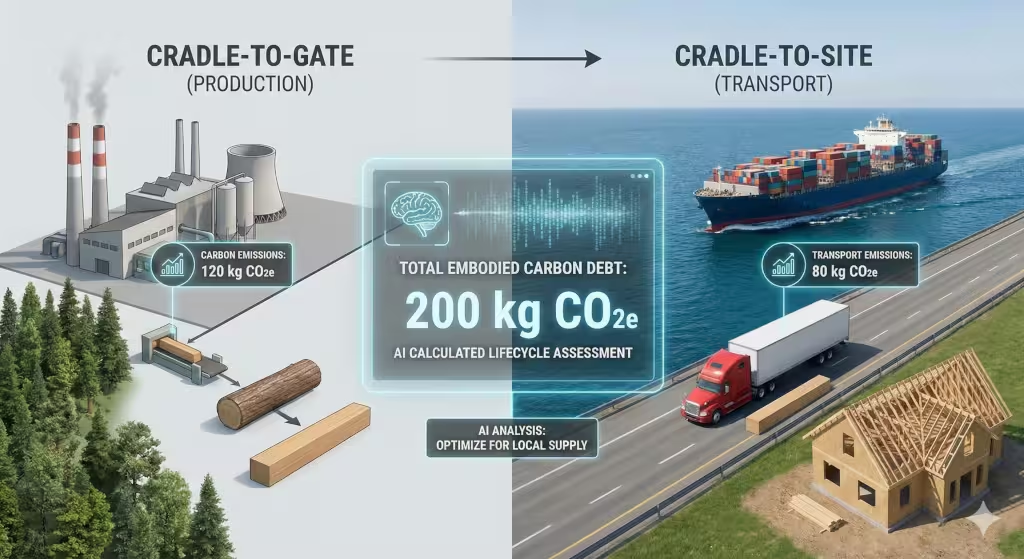
To really understand how to build a better home, we have to talk about something called embodied carbon. Most people think about the energy a house uses once people move in, like the heater or the lights. That is called operational energy. But embodied carbon is different. It is the energy used to dig up the raw materials, make the product in a factory, and drive it to your building site.
Think of it like this. If you buy a solar panel, it saves energy every day. But it took energy to make that solar panel in the first place. AI helps us calculate this “starting debt” of energy. Builders use two main ways to look at this: “Cradle-to-Gate” and “Cradle-to-Site.”
Cradle-to-Gate means we measure the carbon from the moment the material is taken from the earth until it leaves the factory door. Cradle-to-Site is much more important for us. It includes the carbon made while the material is on a truck or a ship coming to your house. This is why regional data is so important. If you pick sustainable home materials like bamboo because it grows fast, it might seem like a win. But if that bamboo has to travel on a massive ship from overseas to get to Vermont or where it is going is a long distance, the carbon footprint gets much larger.
AI now creates something called a Life Cycle Assessment, or LCA for short. In the past, these took months for humans to write. Now, AI does them in seconds. It looks at the Environmental Product Declaration (EPD) for every single item. This is like a nutrition label for building supplies. It tells us the Global Warming Potential of the item. By looking at these labels with AI, we can find the best sustainable home materials that have the lowest total carbon “debt.”
How AI Models Analyze Regional Variables

AI is amazing because it does not just look at a map. It looks at the invisible details. When we ask an AI to help us pick sustainable home materials, it looks at several regional factors.
First, it looks at the local power grid. Every state or region makes electricity differently. Some use coal, while others use wind or sun. If a factory makes bricks in a place with lots of solar power, those bricks have a lower carbon footprint than bricks made in a place that burns coal. AI tracks this in real-time. This helps us know which factories are the cleanest at any given moment.
Second, the AI looks at transport logistics. It knows the exact routes trucks take. It can predict how much fuel will be used based on traffic patterns and the weight of the materials. This is why local materials almost always win. When we use AI to find sustainable home materials, it often points us to things located within 500 miles of the build site.
Third, the AI looks at how the material will behave in your climate. This is very important for how long a house lasts. If you live in a very humid place, some wood might rot faster. If it rots, you have to replace it, which doubles the carbon footprint over time. AI predicts this “climate durability.” It matches the sustainable home materials to the local weather so the house lasts for 100 years instead of 30. This is part of the circular economy, where we try to waste as little as possible.
Regional Comparison: AI-Driven Insights
To show you how this works, let’s look at different parts of the country. AI has helped us see which sustainable home materials are the champions in different regions.
| Region | AI-Recommended Low-Carbon Material | Traditional Alternative | Carbon Reduction % |
| Pacific Northwest | Mass Timber (CLT) | Steel and Concrete | 50% |
| The Northeast | Hempcrete and Mycelium | Fiberglass Insulation | 70% |
| Southwest/Arid | Rammed Earth | Fired Brick | 80% |
| Gulf Coast | Low-Carbon Concrete | Standard Cement | 40% |
In the Pacific Northwest, we have huge forests that are managed well. AI tells us that using Mass Timber, like Cross-Laminated Timber (CLT), is a great choice there. CLT is like a giant, super-strong piece of plywood used for walls and floors. It stores carbon inside the wood. This is called biogenic carbon sequestration. Since the wood is grown nearby, the shipping cost is very low.
In the Northeast, we have been looking at Mycelium. This is actually made from the roots of mushrooms! We can grow it into shapes for insulation. It is one of the most exciting sustainable home materials because it is carbon negative. That means it takes more carbon out of the air while it grows than it takes to make it.
Down in the Southwest, it is very hot and dry. AI often suggests Rammed Earth. This is a very old way of building, but we use new tech to make it better. You use the soil right from the ground to make thick walls. These walls stay cool during the day and warm at night. Because the material is literally under your feet, the transport footprint is almost zero. This is a perfect example of how local data helps us find the right sustainable home materials.
Common Questions Answered about Sustainable Home Materials
People often ask the same questions about sustainable home materials. Here are the common ones, answered with the latest data from 2026.
What is the most sustainable material for a house in 2026?
The most sustainable material is usually the one that is closest to you and stores carbon. Right now, Mass Timber and Hempcrete are the leaders. However, the “real” winner depends on where you live. AI shows us that there is no single best material for everyone. You have to look at your local supply chain to find the best sustainable home materials for your specific project.
How does AI calculate the carbon footprint of building materials?
AI uses a process called Building Information Modeling, or BIM. It takes the 3D model of a house and looks at every screw, board, and bag of cement. Then, it connects to a global database of carbon costs. It also checks the local grid intensity and the distance from the factory to your site. It adds all these numbers up to give us a total carbon score.
Is recycled steel more eco-friendly than new timber?
This is a tricky one. AI tells us that it depends on how the steel is made. If the steel is recycled in a factory that uses clean electricity, it is very good. But timber usually wins because trees pull carbon out of the air as they grow. This “stored carbon” makes timber very hard to beat. However, if you are in a city where there is a lot of salvaged steel nearby, the AI might tell you that the recycled steel is one of the better sustainable home materials for that specific spot.
Case Study: The “Burlington Prototype”
Let’s look at a real-life example in Burlington, Vermont. The example building company worked on a small apartment building we called the “Burlington Prototype.” Usually, a building this size would use a lot of concrete and steel. But it used AI tools to find local sustainable home materials.
The AI suggested that it should use a mix of local softwood for the frame and Hempcrete for the insulation. Hemp grows very fast in the Northeast and doesn’t need much water. By using an AI dashboard, it found a farm only 40 miles away that could supply the hemp.
The results were amazing. The total carbon footprint by 34%. That is like taking 500 cars off the road for a whole year. This project showed that when you use data instead of just following old rules, you can make a huge difference. Using sustainable home materials that were grown and processed locally allowed the company to build something that was both beautiful and very kind to the planet.
The Future: Real-time Sustainability Dashboards
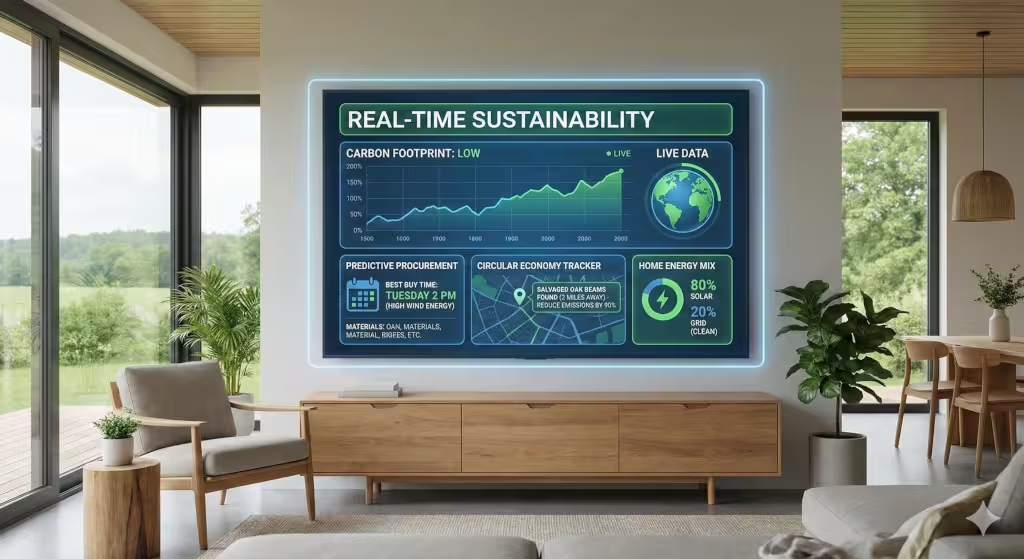
As we look toward the end of this decade, AI is getting even smarter. We are starting to see “Real-time Sustainability Dashboards.” These are tools that stay connected to the house even after it is built.
One thing builders are working on is predictive procurement. This means the AI looks at the weather and the power grid. It might suggest buying your sustainable home materials on a Tuesday because the local wind farms will be making extra power that day, making the factory’s footprint lower.
We are also using AI to track salvaged materials. Imagine an old warehouse is being torn down in the next town over. The AI can find the old bricks and wood and tell a new home builder about them. Reusing old materials is the best way to be sustainable because the carbon “debt” was already paid decades ago. AI makes it easy to find these “hidden” sustainable home materials in our own communities.
Data Over Dogma
In the past, being “green” was mostly about how we felt. People wanted to do the right thing, but they didn’t always have the facts. Today, we don’t have to guess. We use AI to turn sustainability into a science.
Choosing sustainable home materials is one of the most powerful things a homeowner can do to help the environment. But remember, the best choice for a house in the mountains might not be the best choice for a house by the sea. Always look at the data. Look at where things come from. Use the tools we have in 2026 to make sure your home is truly a part of the solution.
By focusing on regional carbon footprints, we can build houses that are not just places to live, but are active parts of a healthier planet. Using local sustainable home materials is the smartest way to move forward. It supports our neighbors, saves energy, and protects the earth for the next generation.
Bonus Section: A List of Sustainable Material Suppliers in the Tri-Cities Area of Tennessee
It is a pleasure to help you with your project in the Johnson City, TN area. As someone who appreciates the beauty of the Appalachian mountains and the technical details of carbon modeling, I find Johnson City to be a fascinating place for building. In East Tennessee, you have high humidity, varied temperatures, and a rich history of forestry. Using our AI models, we can identify the specific sustainable home materials that work best for your zip code.
Welcome to the Tri-Cities, TN Region: A Data Profile for Johnson City
When we look at Johnson City, TN through the lens of a sustainability expert, we see a region with a specific “carbon signature.” Your electricity often comes from a mix of sources through the Tennessee Valley Authority (TVA). While they have a lot of hydro and nuclear power, which is clean, there is still a local effort to move toward even more renewable energy.
Choosing sustainable home materials in Johnson City means looking at the mountains around you. You are in a prime location for timber and stone. Because these are heavy items, shipping them from far away would create a large carbon footprint. By sourcing your sustainable home materials within a 100-mile radius, you are already winning the carbon game.
In this list, I will break down the best local suppliers and explain the technical reasons why their products are the right choice for your climate. We want to make sure your home is durable, energy efficient, and gentle on the planet.
Local Timber and Salvage: Reducing Transport Miles in East Tennessee
One of the biggest wins for your carbon footprint is using wood that was grown and milled nearby. In the Johnson City, TN area, we have access to some of the best hardwood and softwood in the country.
Vintage Timbers (Greeneville, TN)
Located just a short drive from Johnson City, Vintage Timbers specializes in reclaimed barn wood, flooring, and beams. When we talk about sustainable home materials, “reclaimed” is the gold standard. This wood has already lived a full life as a barn or warehouse. By reusing it, you are not cutting down new trees. The carbon that was pulled from the air a hundred years ago stays locked inside that wood.
The AI model gives reclaimed wood a very high score because it has almost zero “extraction” carbon. You aren’t using heavy machinery to log a forest. Instead, you are giving old materials a new purpose. This is a key part of the circular economy. Using reclaimed wood for your floors or accent walls is a great way to use sustainable home materials that have a story.
Yankee Salvage (Telford, TN)
If you are looking for budget-friendly sustainable home materials, Yankee Salvage is a local treasure. They offer discounted and salvaged building supplies like doors, windows, and lumber.
From a technical standpoint, salvage is superior to new materials because the energy cost of making them has already been “paid.” Every time you buy a used door instead of a new one, you save the energy it would have taken to run a factory and a kiln. For a builder in Johnson City, TN, this local resource keeps materials out of the landfill and reduces the need for long-distance trucking.
Builders FirstSource (Johnson City, TN)
For your standard framing needs, this local yard provides “Ready-Frame” packages. These are computerized, pre-cut lumber kits. While it might sound like a small thing, pre-cutting wood in a factory reduces waste on the job site by up to 30%. In the world of sustainable home materials, reducing waste is just as important as picking the right product. Less waste means fewer trips to the dump and less raw material taken from the forest.
East Tennessee Stone: The Zero-Carbon Foundation
One of the most durable sustainable home materials you can find in the Johnson City area is natural stone. Because East Tennessee sits on a wealth of limestone and fieldstone, you don’t have to look far for high-quality building blocks.
Watauga Quarry (Watauga, TN)
Located right on the edge of Johnson City, the Watauga Quarry provides aggregates, crushed stone, and sand. If you are building a foundation or a driveway, sourcing your stone here is a massive win.
Think about the weight of stone. If you buy stone from another state, the truck has to burn a lot of diesel to get it to Johnson City, TN. By getting it from a few miles away, you keep that carbon footprint tiny. Natural stone is one of the ultimate sustainable home materials because it lasts forever. It does not rot, it does not burn, and it does not off-gas harmful chemicals into your home.
In our AI comparisons, local stone often beats concrete for certain uses. While making concrete creates a lot of CO2, stone just needs to be dug up and crushed. If you use it for landscaping or thermal mass walls inside your house, you are using one of the most sustainable home materials available in the Appalachians.
Insulating for the Appalachians: Managing Humidity and Heat
In Johnson City, the weather can be a challenge. You have hot, humid summers and chilly winters. Your choice of sustainable home materials for insulation will determine how much energy your house uses for the next 50 years.
31-W Insulation (Johnson City, TN)
This local company offers several types of insulation, but I want to focus on their cellulose and spray foam options.
Cellulose is made from recycled newspapers and treated with natural minerals to resist fire and pests. It is one of my favorite sustainable home materials because it turns waste paper into a high-performing thermal barrier. It is also great at handling the humidity of East Tennessee.
Spray foam, like the options provided by All Seasons Insulation in Johnson City, is a more technical choice. While it is a chemical product, it creates an “air seal” that other materials cannot match. In a humid climate, stopping air leaks is the best way to prevent mold and lower your power bill. Our AI models show that in Johnson City, a house with a perfect air seal can use 40% less energy. Over the life of the home, this energy saving far outweighs the carbon cost of making the foam. This makes it a smart choice for those looking for high-performance sustainable home materials.
Mullins Company (Johnson City, TN)
Another local expert in air sealing and insulation, Mullins Company helps homeowners reach that “Net Zero” goal. By focusing on the “building envelope,” they make sure the sustainable home materials you choose are doing their job effectively. A well-insulated house is a comfortable house, and it is a major step toward building a responsible, eco-friendly home.
Harnessing the Sun in Johnson City: Local Solar Resources
Energy is a big part of the sustainability equation. Once you have built your house with local sustainable home materials, you want to power it with clean energy.
Greene Tech Renewable Energy (Northeast TN)
This is a locally owned company with a great reputation. Because they are based right here in the region, they understand the local permits and the way the sun hits our hills and valleys.
Installing solar panels is a way to make your home an active part of the solution. When you combine solar power with energy-efficient sustainable home materials, you can often create more energy than you use. In Johnson City, we have enough sunny days to make solar a very viable option.
BrightRidge (Local Utility)
Your local utility, BrightRidge, has been a leader in offering solar programs and energy audits. They can help you understand how your house uses power. Before you buy new sustainable home materials, it is always a good idea to get an audit. This data-driven approach tells you exactly where your house is losing energy, so you can spend your money on the right upgrades.
The Role of Regional Networks: ASPN and ASD
In my work as a specialist, I look for organizations that are building the infrastructure of the future. In your region, we have two standout groups.
Appalachian Sustainable Development (ASD)
Based in the region, ASD has been working for over 25 years to build a stronger, greener Appalachia. While they do a lot of work in agriculture, they are also focused on resource management. They help connect local producers with the people who need them. By supporting local farmers and foresters, they are making it easier for you to find sustainable home materials that support your neighbors.
Appalachian Sustainable Products Network (ASPN)
This is a newer initiative that is very exciting. They are working to map out the entire supply chain for sustainable building products in our region. Their goal is to make sure that builders in places like Johnson City have easy access to things like low-carbon concrete and energy-efficient windows. They are using data mapping to find the gaps in our local market. This is exactly the kind of AI-driven work I advocate for at WebHeads United.
Summary Table of Sustainable Home Materials for Johnson City, TN
| Category | Local Supplier/Resource | Sustainable Benefit |
| Reclaimed Wood | Vintage Timbers (Greeneville) | Zero extraction carbon; stores CO2. |
| Salvaged Supplies | Yankee Salvage (Telford) | Low cost; keeps waste out of landfills. |
| Natural Stone | Watauga Quarry (Johnson City) | Infinite lifespan; zero shipping emissions. |
| Recycled Insulation | 31-W Insulation (Johnson City) | Made from recycled paper; high R-value. |
| Solar Power | Greene Tech Renewable Energy | Local expertise; clean energy production. |
| Framing Waste | Builders FirstSource (Johnson City) | Pre-cut lumber reduces site waste by 30%. |
Building for the Future of the Tri-Cities of Tennessee
Building a sustainable home in Johnson City is about more than just picking a label. It is about understanding the land, the weather, and the community. By using local sustainable home materials, you are reducing the carbon footprint of your build and keeping your money in the East Tennessee economy.
Whether you are using reclaimed wood from an old tobacco barn or stone from the local quarry, every choice matters. My data shows that a home built with these local sustainable home materials will not only be better for the planet but will also be more durable and comfortable for you and your family.
As we move toward a world driven by AI and data, remember that the most “high-tech” solution is often finding the best sustainable home materials right in your own backyard. Building a better future starts with the choices we make today, right here in Johnson City, TN