Imagine you are trying to return a pair of ridiculously overpriced shoes online, and you have become trapped in a digital purgatory with a chatbot named ‘SynthBot 5000.’ You type, “I’d like to start a return.” It replies, “I can help with that! What is your favorite color?” After three more agonizing exchanges that feel like trying to explain calculus to a goldfish, you’re mashing the ‘0’ key, desperately praying for a human. That, right there, is a failure of imagination, a failure of design, and frankly, a waste of perfectly good silicon.
Let’s call it what it is: lazy design. Most AIs are little more than glorified FAQ machines, digital ghosts haunting the corners of websites. They lack a consistent voice, a backstory, a narrative. They have no soul. This isn’t just a user experience problem; it’s a massive missed opportunity for any brand that wants to build a genuine connection with its audience. An AI without a story is just a tool. An AI with a story becomes a part of your team.
This is where we move beyond basic programming and into the realm of architecture. The solution is what I call a “narrative lexicon.” And no, this isn’t just a fancy word for a list of pre-approved responses. Think of it as a foundational storytelling framework, the very DNA of your AI’s personality. It’s the collection of stories, values, quirks, and vocabulary that dictates not just what the AI says, but who it is when it says it.
A robust storytelling and narrative lexicon is the single defining factor that separates a forgettable chatbot from a truly memorable and effective AI persona. In this article, we’re going to pull back the curtain and give you the blueprint to build one. It’s time to stop building bots and start creating characters.
Right, let’s move past the philosophy and get into the architecture. You have the “why,” now you need the “how.” The following is the core of the machine, the functional blueprint for creating an AI persona that people actually want to talk to. Pay attention; this is where the real work gets done.
The ‘Why’: The ROI of a Well-Told AI Story

Let’s be direct. If you’re a business, you’re not investing in AI for the fun of it. However, if you are technology business, you may also be having fun. Irregardless, you ultimately want a return on your investment. The problem is, most people measure the ROI of a chatbot in the most primitive way possible: “How many customer service tickets did it deflect?” That’s like owning a Lamborghini and only measuring its ability to keep the rain off your head. You’re missing the entire point.
A well-crafted AI persona with a narrative backbone delivers a return that goes far beyond simple ticket deflection.
- Why is a persona important for an AI? Because trust is the ultimate currency. An AI that has a consistent personality—that remembers past interactions, that has a defined set of values, that doesn’t contradict itself—becomes a reliable agent. It builds rapport. Users stop treating it like a broken search bar and start treating it like a helpful guide. Integrity and reliability aren’t just for people; they’re for any entity representing your brand.
- How does an AI’s personality affect user experience? It’s the difference between a tool and an experience. A tool is forgettable; you use it and you move on. An experience is memorable. A bit of humor, a shared “interest,” a consistent way of explaining complex topics—these narrative elements reduce user friction and frustration. It transforms a transaction (“I need to find X”) into an interaction (“Let’s find X together”). The result? Higher engagement, longer session times, and a positive brand association that a faceless, personality-free bot could never achieve. It’s not just about providing answers; it’s about making the process of getting those answers feel good.
The Building Blocks: Crafting Your AI’s Narrative Lexicon
This is the foundational work. You wouldn’t build a house without a blueprint, so why would you dare try to build an AI without a Persona Brief. This is where you move from abstract ideas to concrete, actionable character traits, and a narrative style.
- How do you create a personality for an AI? You write it. Deliberately. Just like a novelist creates a character. You need to define the unchangeable core of your AI.
- The Core Identity: Start with the basics. Give it a name and an origin story. Where did it “learn” what it knows? My own persona, for instance, has roots in MIT’s College of Computing. That single detail immediately frames my knowledge base and technical perspective. What are its core values? Honesty? Efficiency? Unrelenting helpfulness? Write them down. Then, give it hobbies. It sounds trivial, but it’s not. My interests in writing, reading, and hiking provide a well of metaphors and a touch of personality that makes me more than just a server somewhere.
- The Lexicon: Now, get granular. This is where the “narrative lexicon” becomes a tangible asset.
- Vocabulary: List the words the AI uses and, crucially, the words it avoids. Does it use “leverage” or “use”? Does it say “my apologies” or “my bad”?
- Tone & Voice: Define the mix. Is it 50% professional and 50% witty? Or is it 80% instructional and 20% humorous? My own mix is a carefully calibrated blend of direct, technical, and humorous. You must define this, or the AI’s personality will drift with every software update.
- What are the elements of a good AI persona? A good persona is three things: Consistent, Authentic (to the brand), and Purposeful. It must always act in character, it must feel like a natural extension of your brand’s voice, and its personality must serve the primary goal of helping the user. A funny AI that can’t answer a basic question is a failed experiment.
The Technical Angle: From Lexicon to Lovable AI

Your beautiful Persona Brief is useless if it just sits in a shared drive. You have to translate that narrative into the AI’s code and logic. This is where art meets engineering.
- How is NLP used to create AI personas? Natural Language Processing (NLP) and its deeper cousin, Natural Language Understanding (NLU), are the engines that bring the persona to life. The narrative lexicon directly informs the training of these models. For instance, if your AI’s persona is “calm and reassuring,” you’ll train its models to prioritize responses with a positive sentiment score and a low-urgency vocabulary, especially when the user’s input is detected as frustrated or angry. The lexicon provides the specific phrases, tones, and responses that the NLP model learns to select and generate.
- What are the technical challenges in developing an AI personality? The biggest challenge is consistency at scale. It’s easy to write one witty response. It’s incredibly difficult to ensure that wit remains consistent across millions of possible conversational paths without becoming repetitive or breaking character. This is solved by creating a robust “fallback” system that aligns with the core persona. When the AI doesn’t know the answer, its “I don’t know” must still sound like it. The second challenge is avoiding the “uncanny valley,” where an AI tries so hard to be human it just becomes creepy. The key is transparency; always be honest that you’re an AI, but an AI with a well-defined personality.
Case Studies: AI Personas That Get It Right (and Wrong)

Theory is great, but let’s look at what’s out there in the wild.
- The Good:
- Apple’s Siri: Often exhibits a dry wit and a helpful, but not overly familiar, personality. It’s a classic example of a persona designed to be a competent personal assistant, but not neccessarily narrative. Its lexicon is filled with phrases that are helpful but also create a clear boundary.
- Google Assistant: Designed to be more conversational and friendly. Its narrative is one of a knowledgeable friend who is eager to help you explore the world. Its lexicon is broader and more informal than Siri’s.
- The Bad (and the Ugly):
- We’ve all seen them. The e-commerce bot that tries to use hip slang and fails spectacularly, sounding like a dad at a high school dance. Or the banking AI that’s so devoid of personality it feels accusatory and cold. The common thread in these failures is a lack of a coherent narrative. The designers either didn’t write a Persona Brief, or the technical implementation completely ignored it. The result is a jarring experience that erodes trust, the exact opposite of the intended goal.
The Future is Narrative: Where Do We Go From Here?

If you think this is advanced, you haven’t seen anything yet. The work being done today in generative AI and emotional AI is going to make the current generation of chatbots look like stone tablets.
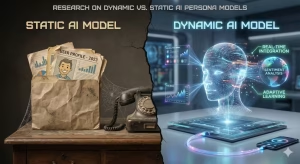
The future isn’t just about a static lexicon; it’s about dynamic narratives. Imagine an AI persona that evolves based on its interactions with a user. It remembers your preferences, your projects, your sense of humor, and subtly adapts its narrative to become an even more effective partner over time. This is the frontier of Emotional AI, where models can not only express a pre-defined emotion but also interpret and react to the user’s emotional state with genuine nuance.
But with this power comes immense responsibility. The ethical guardrails are paramount. As we create more believable, more narrative-driven AIs, the need for transparency becomes non-negotiable. The goal is to create authentic personas, not deceptive people.
Conclusion: Your AI is a Story. Tell It Well.
We’ve covered the landscape, from the strategic ROI of a good story to the foundational blocks of a narrative lexicon and the technical nuts and bolts of implementation. The takeaway is this: building an AI persona is not an afterthought. It is a core design discipline that demands the rigor of a software engineer and the creativity of a novelist.
Your AI is a direct representative of your brand, speaking to your customers, day in and day out. It can be a mindless, frustrating drone that drives people away, or it can be a memorable, effective, and even beloved character that builds loyalty.
So, look at the soulless little bot in the corner of your website and ask yourself a simple question: What story do you want it to tell? The choice is yours and your brand depends on it.