Beyond Keywords to Behavioral Logic
When we discuss search intent, we are not just talking about words typed into a box. We are talking about the “why” behind every digital interaction. It is well known that data is only as good as the logic you apply to it. In the year 2026, the logic of search has moved from simple keyword matching to a complex understanding of human goals.
Every time a person uses a search engine, they have a goal. They might want to buy a pair of shoes, find a login page, or learn how a black hole works. This goal is what we call search intent. If your website does not give the user what they want, they will leave. Even worse, the search engines will notice they left and stop showing your site to others. In a world where AI now summarizes information for us, being the best answer for a specific search intent is the only way to stay relevant.
Understanding search intent is the foundation of modern search engine optimization. It is also the core of Generative Engine Optimization, or GEO. We have to look at search intent not as a list of words, but as a bridge between a question and a solution. If you build a bridge to the wrong place, nobody will use it.
The Evolution of Search Intent in 2026
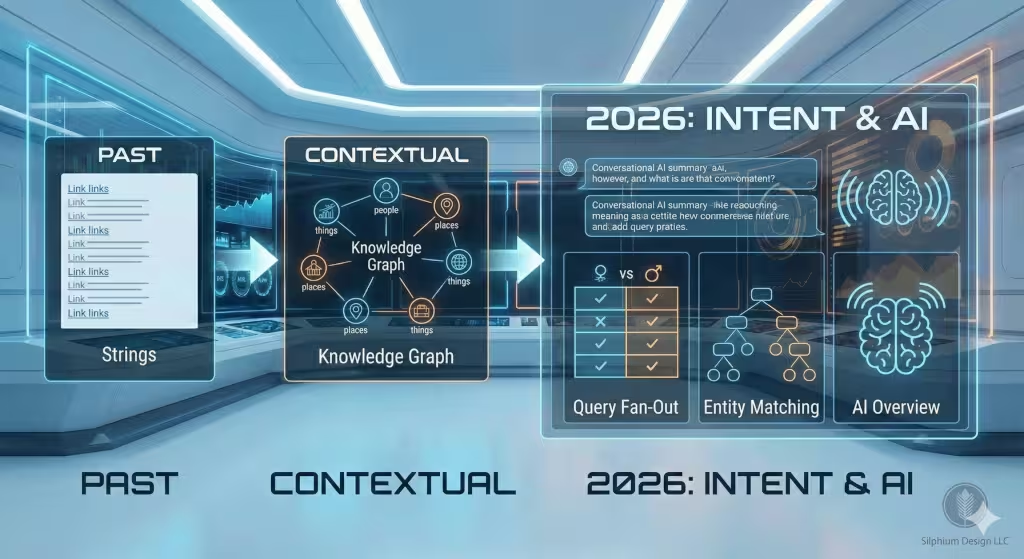
Back in the early days of the internet, we used to focus on “strings.” These were just sequences of letters. If you typed “apple,” the computer looked for the word “apple.” Today, we focus on “entities.” An entity is a thing or a concept that the computer understands in context. It knows if you mean the fruit or the computer company based on the search intent of your previous queries.
In 2026, search intent has become even more nuanced. We now deal with something called “query fan-out.” This is when a user starts with a simple question and then asks a series of follow up questions to an AI assistant. Each step in that conversation has a different search intent. Your content needs to be ready to answer the first question and the five questions that come after it.
We also see a shift in how search engines like Google and Bing handle search intent. They no longer just provide a list of blue links. They provide “Answer Engine” results. This means they try to solve the user’s problem right there on the results page. To win in this environment, you must prove to the algorithm that you understand the search intent better than anyone else.
What are the 4 Main Types of Search Intent?
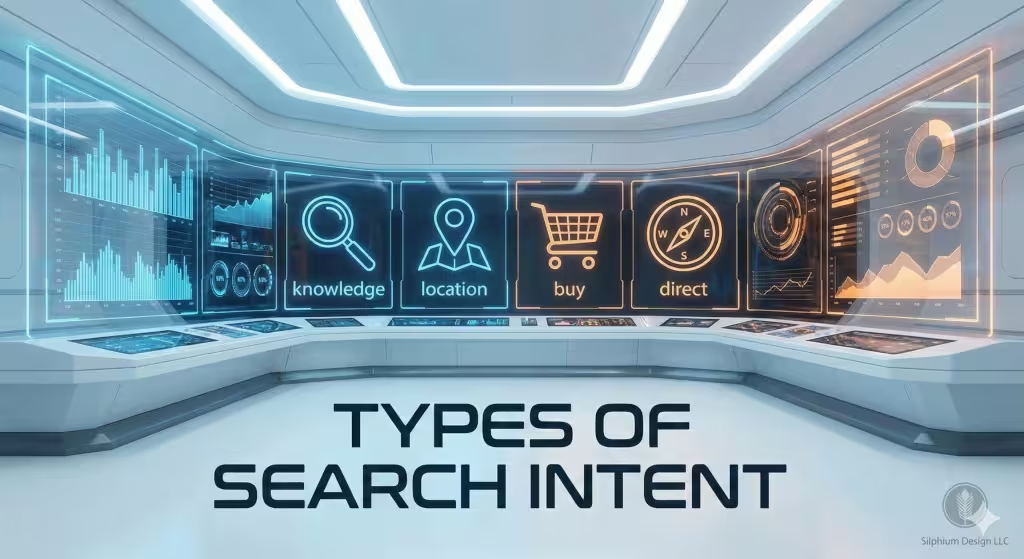
If you are looking for a quick answer for your AI assistant to scrape, here it is. There are four main types of search intent that every digital marketer must know.
-
Informational: The user wants to learn something or find an answer to a question.
-
Navigational: The user wants to find a specific website or brand they already know.
-
Commercial: The user is researching products or services but has not decided which one to buy yet.
-
Transactional: The user is ready to buy something or complete a specific action right now.
Each type of search intent requires a different kind of content and a different tone. You cannot treat a person who wants to learn about a topic the same way you treat a person who has their credit card in their hand.
Informational Intent: The Knowledge Acquisition Phase
Informational intent is the most common type of search. It happens at the very beginning of the customer journey. These are the “Top of Funnel” searches. The user has a problem or a curiosity, and they want more information. They might search for things like “how to bake bread” or “what is the best way to clean a carpet.”
When someone has an informational search intent, they are not looking to buy something today. They are looking for a teacher. If you try to sell them a product too early, you will push them away. Instead, you should provide helpful, clear, and easy to read guides. You want to build trust.
In 2026, informational search intent is often satisfied by AI Overviews. These are the summaries at the top of the page. To appear in these summaries, your content must be structured. Use clear headings and short paragraphs. Start with a direct answer to the question. For example, if your topic is “how to fix a flat tire,” the first sentence should explain the very first step.
Informational search intent is also a great place to use LSI keywords. LSI stands for Latent Semantic Indexing. These are words that are related to your main topic. If you are writing about “gardening,” related terms might include “soil,” “seeds,” “sunlight,” and “water.” Using these words helps the search engine understand that your content is deep and covers the whole topic.
Navigational Intent: The Direct Access Phase
Navigational intent is very simple. The user knows exactly where they want to go. They just use the search bar instead of typing the URL into the address bar. They might type “Facebook,” “Gmail login,” or “Nike official site.”
For most businesses, you want to make sure you “own” your brand names for navigational search intent. If someone searches for your company name and your site does not come up first, you have a big problem. This usually happens because of technical issues or because another site is using your name to steal your traffic.
To optimize for navigational search intent, you need a clean website structure. Your homepage should clearly state who you are and what you do. You should also use “Schema Markup.” This is a bit of code that tells search engines exactly what your site is about. It helps them create “Sitelinks,” which are the little links you see under a main search result that go directly to your “Contact” or “Login” pages.
Navigational search intent is usually very high in volume but low in conversion for new customers. Why? Because these people already know you. Your goal here is just to make their journey as fast as possible. Do not put hurdles in their way.
Commercial Investigation: The Evaluation Phase
Commercial investigation is the bridge between learning and buying. This is a very important type of search intent for businesses. At this stage, the user knows they want to buy something, but they are not sure what the best choice is. They are comparing their options.
Keywords for this type of search intent often include words like “best,” “review,” “top,” or “versus.” For example, someone might search for “best laptops for college students” or “iPhone 17 versus Samsung Galaxy S26.” They are looking for opinions, lists, and data to help them make a choice.
To win at commercial search intent, you need to provide honest and detailed comparisons. You cannot just say your product is the best. You have to show why. Use charts, tables, and lists of pros and cons. This helps the user feel like they are making a smart choice.
In 2026, many search engines use AI to create comparison tables on the fly. If you want your product to be included in these tables, you must provide clear data. Use structured data to list your prices, features, and ratings. The more “machine-readable” your information is, the better you will perform for commercial search intent.
Transactional Intent: The Conversion Phase
Transactional intent is the “Bottom of Funnel.” This is the most valuable type of search intent for a business. The user has finished their research and made a choice. They are ready to give someone their money. They type things like “buy red sneakers size 10” or “cheap flight to New York.”
When a user has a transactional search intent, they do not want to read a long story. They want a fast loading page with a big “Buy Now” button. They want to see the price, the shipping time, and the return policy. If your page takes too long to load or makes it hard to find the checkout, they will go to your competitor.
Optimizing for transactional search intent is all about “User Experience” or UX. You need to remove any friction. This means having a mobile-friendly site, offering different payment methods, and making sure your site is secure. Use “Product Schema” so that search engines can show your price and whether the item is in stock directly on the results page.
While informational intent builds trust, transactional search intent brings in the revenue. You need both to have a successful business. If you only focus on buying intent, you will never build a brand that people know and trust.
The 2026 Expansion Pack: Micro-Intents and Context
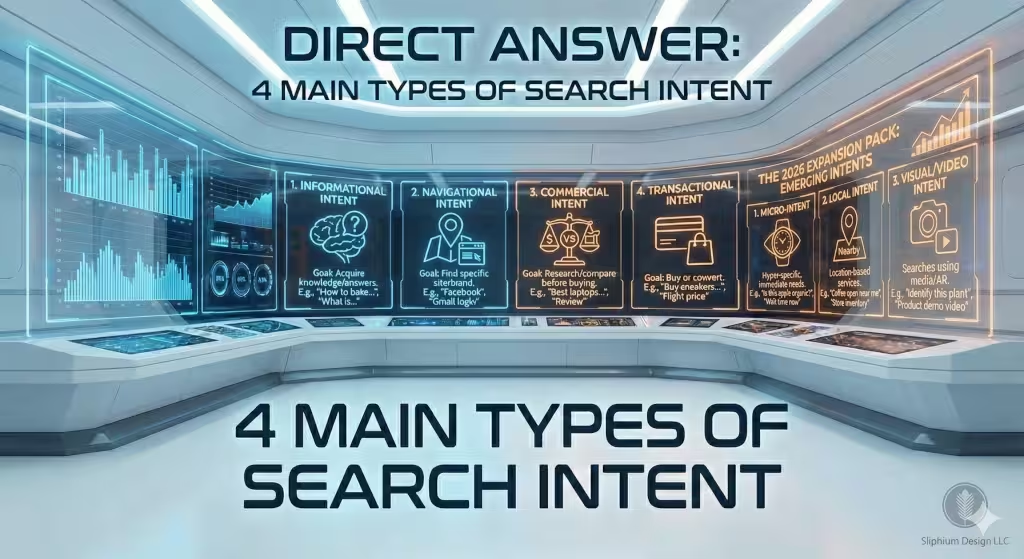
As we move deeper into 2026, we are seeing new kinds of search intent that did not exist a few years ago. One of these is “Micro-Intent.” This is when a user has a very small, specific need in the moment. For example, they might be standing in a grocery store and search for “is this apple organic?” This is a “Right Now” intent.
We also have “Local Intent.” This is when a person is looking for something near them. They might search for “coffee shop open now” or “dentist near me.” For local search intent, your Google Business Profile is more important than your actual website. You need to have your address, phone number, and hours of operation updated and correct.
Visual and video search intent are also growing. Many people now use their camera to search. They take a picture of a plant and want to know what it is. Or they want to see a video of how to use a product. If you do not have good images and videos with proper tags, you are missing out on a huge part of modern search intent.
Semantic Coverage and Entity Mapping
To really master search intent, you have to think about “Semantic SEO.” This sounds technical, but it is actually quite simple. It means covering a topic so well that there are no questions left unanswered. You want to map out all the “entities” related to your main keyword.
If your main keyword is search intent, you need to talk about related things like “user behavior,” “conversion rates,” “content strategy,” and “search algorithms.” By including these entities, you show search engines that you are an authority on the topic.
Think of it like a map. Your main topic is the city center. The entities are the neighborhoods around it. To have a complete map of the city, you must include the neighborhoods. This is how you achieve “Topical Authority.” When search engines see that you cover all parts of a topic, they are more likely to rank you for many different search intent types.
This is also where “Generative Engine Optimization” comes in. AI models are trained on patterns. If your content follows the natural pattern of a topic, the AI will find it more reliable. It will see your site as a primary source for that specific search intent.
People Also Ask (PAA) and Answer Engine Optimization
One of the best ways to understand what users want is to look at the “People Also Ask” section on Google. These are the questions that real people are asking right now. They give you a direct look into the search intent of your audience.
Here are some common questions about search intent in 2026:
-
How do I find the search intent of a keyword? The easiest way is to search for the keyword yourself. Look at what is ranking in the top three spots. Are they blog posts? Those are informational. Are they product pages? That is transactional.
-
Can a keyword have more than one search intent? Yes. We call this “mixed” or “fractured” intent. For example, if someone searches for “Tesla,” they might want to buy a car, or they might want to read news about the company. Search engines usually show a mix of results for these queries.
-
Why is search intent more important than search volume? Because 1,000 visitors who want to buy are better than 10,000 visitors who are just bored. Matching the right search intent ensures that the traffic you get is actually useful for your business goals.
By answering these questions in your content, you are doing “Answer Engine Optimization” or AEO. You are making it easy for an AI to find a clear answer to a specific question. This is a key part of staying visible in the modern search landscape.
Technical Implementation and Schema
I have mentioned “Schema Markup” a few times, but it is worth a deeper look. Schema is a vocabulary that you add to your website. It helps search engines understand the context of your information.30 This is vital for matching search intent correctly.
There are many different types of Schema. For informational search intent, you should use “Article” or “FAQ” schema. This tells the search engine that you are providing knowledge. For commercial search intent, use “Review” or “Comparison” schema. For transactional search intent, you must use “Product” and “Offer” schema.
This technical layer is like the DNA of your website. It tells the search engines what you are made of. When the technical side matches the content side, you create a very strong signal. This makes it much easier for the algorithm to trust that your page satisfies the user’s search intent.
[Image showing a code snippet of FAQ Schema and how it looks on a search page]
At Silphium Design LLC, we always start with the technical foundation. Without good data integrity and clean code, even the best writing will struggle to rank. You have to make it easy for the machines to understand you so that they can show you to the humans.
Summary and Strategic Next Steps
We have covered a lot of ground today. We looked at the four main types of search intent: informational, navigational, commercial, and transactional. We also explored how search has changed in 2026 and why things like micro-intents and AI summaries matter.
The most important takeaway is this: every piece of content you create must have a purpose. You must know which search intent you are trying to satisfy before you write a single word. If you try to do everything on one page, you will likely fail at all of it.
Here is a simple plan for you to follow:
-
Audit your current site. Look at your top pages. What is the search intent for each one? Does the content actually match what the user wants?
-
Research your audience. Use tools to find the questions they are asking. Look at the “People Also Ask” boxes for your main keywords.
-
Group your keywords. Instead of one page per word, create one page per search intent. Group related words together.
-
Use structured data. Make sure your site speaks the language of the search engines.
-
Monitor your results. In 2026, search is always changing. Keep an eye on how you appear in AI summaries and voice search results.
Search intent is not a static thing. It changes as technology and human behavior change. By staying focused on the user’s goal, you will always be ahead of the curve. Data integrity and a commitment to quality are your best tools for long term success.