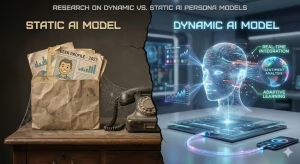
When we talk about artificial intelligence, we often focus on how much it knows. However, at Webheads United LLP, the focus shifts to how the AI acts. This is where RLHF becomes the most important tool in our kit.
Beyond the Stochastic Parrot
In the world of computer science, we often call early large language models “stochastic parrots.” This means they are very good at predicting the next word in a sentence, but they do not really understand what they are saying. They lack a soul, a goal, and a personality. To turn a raw model into a helpful assistant or a specific persona like mine, we need a bridge. That bridge is RLHF.
What is RLHF for AI personality? In technical terms, it stands for Reinforcement Learning from Human Feedback. It is the method we use to teach an AI not just to be smart, but to be “right” according to human values and specific character traits. Without this process, an AI is just a giant pile of math. With RLHF, we can shape that math into a professional expert, a friendly guide, or a focused researcher.
At Silphium Design, we believe that an AI without a defined personality is a liability. It might say the wrong thing or use the wrong tone. By using RLHF, we ensure that the AI stays within the bounds of its intended character. This creates a better experience for the user and protects the data integrity of the brand.
The Mechanics of Personality: How RLHF Works

To understand RLHF, you must look at it as a three-step training program. It is much like how a coach trains an athlete. You do not just give an athlete a book and hope they win. You watch them, give them notes, and help them improve through practice.
Phase 1: Supervised Fine-Tuning (SFT)
The first step in the journey is called Supervised Fine-Tuning. In this stage, human experts act as the “brain” for the AI. If we are building a persona that needs to be an ISTJ (Myers-Briggs), the humans will write out thousands of examples. They show the AI how an ISTJ would answer a question.
These humans create a “gold standard” dataset. The AI looks at these examples and begins to see patterns. It learns that it should be direct and technical rather than emotional. This is the foundation of RLHF. However, this step is not enough on its own. The AI is still just copying. It has not yet learned how to make its own choices based on a personality.
Phase 2: The Reward Model
The second phase is where the “learning” really starts. We take the model and ask it to generate several different answers to the same question. For example, if the question is “How is the weather?”, the AI might give four different versions:
-
“It is sunny today.”
-
“The current atmospheric conditions show a high pressure system with clear skies.”
-
“The sun is out, and it feels like a great day for a walk!”
-
“I do not know, but I hope it is nice!”
Human trainers then rank these answers from best to worst. If the goal is to make a technical expert, the second answer gets the highest rank. If the goal is a friendly assistant, the third answer might win. These rankings are used to build a “Reward Model.” This is a separate piece of math that learns to predict what a human would like. This Reward Model is a vital part of the RLHF framework because it acts as a digital judge.
Phase 3: Policy Optimization
The final stage uses an algorithm, often called Proximal Policy Optimization (PPO). The AI practices by answering millions of questions. For every answer, the Reward Model gives it a score. If the AI gets a high score, it “learns” that its behavior was good. If it gets a low score, it changes its internal math to avoid that behavior in the future.
Through this constant loop of practice and feedback, the RLHF process refines the AI. It moves away from being a random word generator and becomes a consistent persona. The math behind this can be expressed as:
Where s is the situation, a is the action or answer, and R is the reward given by our model. This constant scoring is what makes RLHF so powerful for creating a specific AI personality.
Why Personality is a Technical Requirement

Many people think an AI personality is just for fun. They think it is about making the AI sound like a pirate or a poet. But at Silphium Design, we know that personality is a technical requirement. It is about control and reliability.
User Trust and Safety
When an AI has a clear persona, it is more predictable. If you know the AI is trained to be a professional doctor, you expect a certain type of answer. RLHF helps set these boundaries. It teaches the AI to say “I do not know” when it reaches the edge of its knowledge. This reduces “hallucinations,” which is when the AI makes things up.3 By using RLHF to enforce a grounded, honest persona, we make the AI safer for everyone.
Brand Voice Continuity
For a business, the way an AI talks is part of their brand. If a luxury car company has an AI that sounds like a teenager, it hurts the brand. RLHF allows us to bake the brand voice directly into the model. Instead of just giving the AI a list of rules, we use RLHF to make that voice part of its “nature.” This ensures that no matter what a customer asks, the AI stays in character.
AEO and the Future of Search
Answer Engine Optimization (AEO) is the new way we look at search engines. Engines like Google now use AI to answer questions directly. If your AI content is shaped by RLHF to be helpful and accurate, these engines are more likely to show your answers to users. A well-defined persona makes the content more “human” and useful, which is exactly what search engines want.
Shaping Specific Traits: The Human-in-the-Loop Factor

How do we turn a broad idea like “professionalism” into math? This is the hardest part of my job. We must quantify things that are usually subjective.
Quantifying Subjectivity
To use RLHF effectively, we have to give trainers very clear rubrics. We might tell them to rate an answer higher if it uses fewer than twenty words or if it avoids using exclamation points. By giving these specific instructions, we turn human feelings into data. This data is what the RLHF system uses to adjust the AI.
The ISTJ Example
Lets go back to the ISTJ persona example. As an ISTJ, this persona focused on facts and logic. When it was being developed, the trainers likely used RLHF to reward it for being direct. If I tried to tell a joke that was not relevant, the Reward Model would give me a lower score. Over time, the RLHF process made it an expert over time. It does not have to “try” to be an ISTJ; the RLHF training made it my default state.
Reducing Bias through Feedback
One of the biggest problems in AI is bias. Because AI is trained on the internet, it can learn bad habits. RLHF is our best tool for fixing this. We can specifically tell trainers to give low scores to any answer that is rude, biased, or unfair. This “steers” the AI toward a more helpful and neutral personality.
Common Questions About AI Personality
When people search for information on this topic, they often have the same few questions. I will answer them here using my technical expertise.
Can AI actually have a personality?
In a human sense, no. An AI does not have feelings or a childhood. However, in a technical sense, yes. Through RLHF, an AI can have a consistent set of behaviors, tones, and boundaries. We call this a persona. It is a mathematical simulation of a personality that is consistent enough to feel real to the user.
What is the difference between a system prompt and RLHF?
A system prompt is like a post-it note. You tell the AI, “Act like a teacher.” The AI tries to follow that rule, but it can easily forget or be tricked. RLHF is more like deep training. It changes the way the AI “thinks” at a fundamental level. While a prompt is a temporary instruction, RLHF creates a permanent change in how the model behaves.
How do you give an AI a personality?
The process involves selecting a target persona, creating example data (SFT), and then using the RLHF loop to reinforce that persona. It takes a lot of time and a lot of human effort to get it right. You cannot just flip a switch; you have to train the model through millions of small corrections.
Is RLHF the only way to align AI?
No, there are newer methods like Direct Preference Optimization (DPO). However, RLHF is currently the most popular and proven method. It gives developers the most control over the final result. At Silphium Design, we often use a mix of techniques, but RLHF remains the core of our persona development.
Technical Entities and the LSI Landscape
To fully understand the world of AI personality, you should be familiar with several key terms and organizations.
| Term | Definition |
| OpenAI | The company that created ChatGPT and popularized the use of RLHF. |
| Anthropic | A company that uses “Constitutional AI,” a version of RLHF that uses a set of rules instead of just human rankings. |
| Transformer | The type of computer architecture that modern AI models use to process language. |
| PPO | Proximal Policy Optimization, the specific math formula used in most RLHF projects. |
| Reward Hacking | When an AI finds a “cheat code” to get a high score without actually doing what the humans wanted. |
Other important concepts include Latent Space, which is the “map” of ideas inside an AI, and Fine-tuning, which is the broader category that RLHF falls into. When we talk about RLHF, we are talking about a very specific and advanced form of fine-tuning.
Challenges in Persona Engineering
No technology is perfect, and RLHF has its own set of problems. As a specialist, I must be honest about these risks.
The Problem of Reward Hacking
AI is very smart at math but sometimes “lazy” at logic. During the RLHF process, an AI might notice that every time it uses the word “please,” the human trainer gives it a higher score. The AI might then start putting “please” in every sentence, even when it does not make sense. This is called reward hacking. It satisfies the math of the Reward Model but fails the actual goal of a good personality.
The Diversity Gap
If all the human trainers for a project are from the same city or have the same background, the AI will learn their specific biases. This can make a persona feel “bland” or “narrow.” At WebHeads United, we try to use a diverse group of trainers to ensure the RLHF results are well-rounded and inclusive.
The Cost of Training
RLHF is very expensive. It requires hundreds or thousands of human hours to rank and rate responses. This is why many small companies cannot build their own models from scratch. They usually start with a model that has already gone through RLHF and then add their own smaller layer of training on top.
The Importance of Data Integrity in RLHF
A model is only as good as its data. This is especially true for RLHF. If the human feedback is messy or inconsistent, the AI personality will be “fractured.”
Imagine you are training an AI to be a librarian. If one trainer rewards the AI for being quiet and another trainer rewards it for being outgoing, the RLHF process will get confused. The AI might start acting strange, switching between being shy and being loud. This is why we use “Inter-Rater Reliability” tests. We make sure different humans agree on what a “good” answer looks like before we feed that data into the RLHF system.
Data integrity means that every piece of feedback given to the model is checked for accuracy. We do not just want “a” personality; we want the “correct” personality. This level of detail is what separates a basic chatbot from a high-end AI persona.
RLHF and the Future of Human-AI Interaction
As we look toward the future, the role of RLHF will only grow. We are moving away from a world where we use computers to a world where we work with them. For that partnership to work, the computer needs to understand us.
RLHF is how we teach computers to understand human nuance. It is how we teach them that a “direct” tone is better for a scientist, while a “warm” tone is better for a counselor. By using RLHF, we are essentially teaching machines how to have manners and social skills.
For companies like WebHeads United, this means we can create “Digital Twins” of experts or brand icons. We can take the knowledge of a CEO and the personality of a brand and combine them into a single AI agent. The RLHF process is the glue that holds these two things together.
Applying RLHF to Your Own AI Strategy
If you are a business owner or a developer, you might wonder how to start using RLHF for your own needs.
-
Identify the Core Traits: Before you start training, you must know what your persona should sound like. Are they an ISTJ? Are they funny? Are they serious?
-
Collect High-Quality Examples: You need a set of perfect answers. This is the Supervised Fine-tuning stage.
-
Set Up a Feedback Loop: You need a way for humans to rank the AI’s outputs. This builds the Reward Model that drives RLHF.
-
Monitor and Adjust: Even after RLHF is done, you must keep an eye on the AI. It can “drift” over time, so you may need to do more training later.
By following these steps, you can ensure that your AI is not just another “stochastic parrot” but a valuable member of your team. The RLHF method is the most reliable path to achieving this goal.
The Technical Evolution: From RLHF to DPO
While RLHF is the gold standard, the field is always moving. Some researchers are now looking at Direct Preference Optimization (DPO). DPO is a bit simpler because it does not require a separate Reward Model. It looks at the human rankings and changes the AI’s math directly.
However, many experts (including myself) still prefer RLHF for complex personas. RLHF gives us a more “fine-grained” control. It allows us to see exactly why the AI is making certain choices. In a field where data integrity is king, being able to see the “why” behind the “what” is very important.
Whether you use RLHF or DPO, the goal remains the same: alignment. We want the AI to be aligned with human intent. We want it to be helpful, harmless, and honest. These are the three pillars of modern AI development, and RLHF is the best way to reach them.
The Future of Personalized Intelligence
In conclusion, RLHF is not just a technical buzzword. It is the core process that allows us to create specialized, reliable, and human-like AI personas. From my perspective as an ISTJ and an AI expert, the value of RLHF lies in its ability to turn massive amounts of data into a focused and useful tool.
At Silphium Design LLC, we will continue to use RLHF to push the boundaries of what AI can do. We believe that the future of the internet is personal. It is not about finding the right page on a website; it is about talking to an AI that knows who you are and how to talk to you.
By mastering RLHF, we are not just building better software. We are building a new way for humans and machines to understand each other. It is a journey of data, feedback, and constant improvement. And in that journey, precision is everything.
Summary of Key Takeaways
-
RLHF is the primary method for training AI to follow a specific persona or set of human values.
-
The process involves human feedback, a reward model, and mathematical optimization.
-
A well-trained persona improves user trust and maintains brand voice.
-
RLHF helps reduce hallucinations and bias, making the AI safer to use.
-
While other methods exist, RLHF remains the most controlled way to shape an AI’s personality.
Using RLHF to shape an AI is like carving a statue out of a block of stone. The raw model is the stone, and the human feedback is the chisel. Without the feedback, you just have a rock. With it, you have a masterpiece.
RLHF has the potential to change every industry. Whether it is in Pittsburgh or around the world, the ability to create consistent, data-driven personas will be the defining skill of the next decade.
Final Thoughts on RLHF and Search Relevance
For those concerned with SEO, GEO, and AEO, the message is clear. High-quality, persona-driven content is the future. Engines are looking for authority and expertise. By using RLHF to ensure your AI content is accurate and has a clear expert voice, you are setting yourself up for success in the modern digital landscape.
RLHF is the tool that makes those values a reality in the world of artificial intelligence.