Ah, the good old days of real estate marketing? You know, when success meant a slightly larger “For Sale” sign, maybe some color flyers that mostly ended up as expensive confetti, or perhaps splurging on that prime Yellow Pages ad? Charming, in a distinctly analog, carrier-pigeon sort of way. But let’s be brutally honest – in today’s hyper-connected, always-on world, if your marketing strategy still hinges on hoping the right person stumbles across your listing, you’re not just bringing a knife to a gunfight; you’re bringing a butter knife to a drone strike.
The game has fundamentally changed. We’re past the era of carpet-bombing neighborhoods with generic messaging and praying for a blip on the radar. Today, it’s about precision. It’s about intelligence. It’s about drawing a digital line around your ideal clients and saying, “You. Right here. Right now. This is for you.” This, my friends, is the power of Real Estate and Geofencing Solutions. Think of it not as a shotgun blast into the digital ether, but as a sleek, silent, laser-guided missile for your lead generation.
You’re reading this because “good enough” isn’t your default setting. You’re looking for that undeniable competitive edge, the kind that doesn’t just nudge the needle but sends it spinning. You’re ready to evolve your digital marketing for realtors from a game of chance to a science of intent. So, buckle up. We’re about to explore a technology that’s reshaping the landscape, one precise digital perimeter at a time. And trust me, you’ll want to be inside these lines.
Okay, let’s dive deeper into the architecture of what makes Real Estate and Geofencing Solutions not just a buzzword, but a fundamental paradigm shift. We’ve had the overture; now, let’s dissect the movements.
What Actually is Geofencing? (And Why You Haven’t Been Living Under a Digital Rock if You Don’t Know… Yet)
Alright, let’s pull back the curtain on this “geofencing” magic. Don’t worry if the term sounds like something cooked up in a (yes, probably Cupertino-based) lab after one too many cold brews – though, frankly, some of the most revolutionary ideas are. If you’re not yet intimately familiar, you haven’t been living under a digital rock; you’re simply on the cusp of a rather illuminating “aha!” moment, the kind that reorders your thinking.
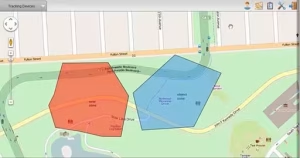
So, how does geofencing marketing work? It’s elegantly simple in concept, yet profoundly powerful in execution. At its core, geofencing is the art and science of drawing invisible, yet incredibly potent, virtual boundaries around specific real-world geographic areas. Picture yourself, stylus in hand (or, more likely, mouse on screen), digitally cordoning off a precise space – your hot new listing, that bustling community event, a competitor’s perpetually crowded open house, or even an entire neighborhood showing signs it’s ripe for new buyers. This digital perimeter is your “geofence.”
Now, the critical part: when an individual in your target audience carrying a mobile device crosses this pre-defined line – in or out, mind you – it acts as a trigger. A trigger for what, you ask? For hyper-relevant, timely location-based advertising. A bespoke message, a compelling offer, a gentle nudge, an exclusive alert. This is mobile marketing evolving from a blunt instrument into a scalpel, allowing for GPS targeting with unprecedented finesse.
Let me be clear: this isn’t the “let’s send ads to everyone in this zip code” approach from the days of yore. That’s broad geotargeting – the digital equivalent of throwing spaghetti at the wall to see what sticks. Geofencing is the sniper rifle, the precision strike in real estate. This accuracy is made possible by technologies most of us treat as mundane extensions of ourselves: GPS provides the backbone for pinpoint outdoor accuracy; Wi-Fi signals offer granular context, especially indoors; low-energy Bluetooth beacons can define micro-locations (think a specific unit in a new development); and in some advanced or industrial contexts, even RFID (Radio-Frequency Identification) plays a role.
These technologies, working in concert, enable apps on a user’s smartphone (with proper permissions, of course – we’re big on integrity and transparency here, and we’ll delve into the ethics later) to understand its location relative to these custom-drawn geofences.
What is an example of geofencing? Imagine this: a prospective buyer, Sarah, has downloaded a popular property search app (and has opted into location services – a crucial detail). You, the savvy agent, have just listed a stunning three-bedroom townhouse and have drawn a geofence around a half-mile radius of it. As Sarah, who has previously shown interest in similar properties, drives into that geofenced zone on her way to a (less impressive) competitor’s showing, her phone gently pings. A notification appears: “Still searching for the perfect townhouse? [Your Listing Address] just hit the market – 3 beds, stunning finishes, and right around the corner. Tap for an instant virtual tour or directions to tomorrow’s open house.”
That, in a nutshell, is the elegance of geofencing in action. The right message, to the right person, at the exact right moment and place. It’s a cornerstone of effective location-based services, and it’s poised to become an indispensable tool in your real estate arsenal.
The “Aha!” Moment: Why Geofencing is a Game-Changer for Realtors (Or, How to Make Your Competitors Wonder What You’re Doing Right)
Now that we’ve demystified the “what,” let’s get to the “why.” Why should geofencing ignite more than a passing flicker of interest? Why is it moving from the periphery to the core of smart real estate lead generation? Because, quite simply, it delivers a strategic advantage so significant, it’ll make your competitors scratch their heads and wonder what secret sauce you’ve suddenly discovered. This isn’t just another tool; it’s a paradigm shift in connecting with clients.
So, what are the benefits of geofencing? Let’s count the ways this technology helps you stop chasing and start attracting:
- Hyper-Local Targeting That’s Actually Hyper-Local: We’re talking about surgical precision. Target potential buyers or sellers not just in a city, but in specific neighborhoods, around new commercial developments that signal growth, within a few blocks of that A-rated school, or even (ethically, of course, and with compelling, value-driven messaging) around a competing brokerage’s office or a rival’s open house. This is property marketing with a zoom lens.
- Dramatically Increased Lead Quality: Forget sifting through a mountain of lukewarm inquiries. Geofencing allows you to engage individuals based on their real-world behaviors and demonstrated intent. Someone frequenting open houses in a specific price range? Someone visiting mortgage brokers or new home builders? These are signals of active interest. Targeting them means you’re talking to people already further down the buying or selling funnel.
- Enhanced Open House Attendance (and Engagement): Picture this: it’s Saturday morning, your open house starts in an hour. You can send a timely, inviting notification to everyone within a mile or two radius who has previously shown interest in similar homes or fits your target demographic. “Pop by [Address] between 1-3 PM today! Fresh cookies and your dream home await.” It’s a direct, personal invitation when they’re most likely to act.
- A Decisive Competitive Advantage: In a crowded market, differentiation is key. While others are still relying on yesterday’s tactics, you’re leveraging cutting-edge targeted marketing. Being the first to reach a prospect with a relevant message in a specific location makes you look innovative, proactive, and in tune with their needs.
- Truly Personalized Property Alerts: Go beyond saved searches. Deliver listings or information based on a user’s real-time or recent location history. If someone spends a lot of time in a particular neighborhood, they’re likely interested in living there. Geofencing can help you connect those dots.
- Optimized ROI on Your Marketing Spend: This is where the pragmatist in all of us smiles. By concentrating your advertising firepower on the most relevant audiences in the most relevant locations, you drastically reduce wasted impressions and slash your cost per qualified lead. Less spray, more pay.
- Invaluable Data and Analytics: Geofencing platforms provide a treasure trove of data on campaign performance, foot traffic patterns (where legally and ethically collected), and audience engagement. These insights allow you to refine your strategies continually, making your marketing smarter over time.
How can I use geofencing to market real estate? As you can see, the applications are manifold. It’s about thinking geographically and contextually. It’s about understanding where your ideal clients are, physically, and meeting them there, digitally, with a message that resonates because it’s relevant to that specific place and moment. This isn’t just an incremental improvement; it’s a smarter way to operate.
Drawing the Digital Lines: Practical Geofencing Strategies in Real Estate (No, It’s Not Just Theory, It’s Actionable)

Theory is elegant, but results pay the bills. So, let’s transition from the “why” to the “how-to” – the tangible, actionable strategies that transform geofencing from a cool concept into a lead-generating powerhouse for your real estate business. This isn’t about painting with broad strokes; it’s about drawing precise, intelligent digital lines.
How precise can you get with your geofencing? How small can the geofences be built? The beauty of modern geofencing is its remarkable precision. Depending on the technology and provider, you can draw geofences as small as a single building or even a specific part of a large venue. Think about targeting attendees of a local home and garden show, or drawing a tight circle around a brand-new coffee shop that’s suddenly the hub of a desirable, up-and-coming neighborhood.
While pinpointing an individual device’s exact location has inherent technological limits (don’t expect to target just one seat in a café), the ability to define small, strategic zones is a game-changer. For example, you could target just the new developments area on the edge of town, or the few blocks around a major employer who’s just announced a hiring spree.
Up to how many buildings or locations can you geofence? Scalability is another strength. Most sophisticated geofencing platforms allow you to manage campaigns with multiple geofences – dozens, hundreds, even thousands if your strategy calls for it (though starting focused is always wise). Imagine creating a network of geofences around all your current listings, key community landmarks, and even competitor locations.
Here are some practical applications to get your strategic gears turning:
- Targeting Competitor Locations (The Art of Ethical Conquesting): Draw a geofence around a competitor’s office or their open houses. When someone visits, you can serve them an ad a short while later showcasing your unique value proposition, a new listing they might have missed, or an invitation to a no-obligation consultation. The message isn’t “Haha, you’re there!” but “Considering your options? See what makes us different.” It’s about offering choice.
- Hyper-Local Listing Promotion: Geofence the immediate vicinity of your new listings. As people enter the area, they receive an alert about the property, perhaps with a link to the virtual tour or open house schedule. This is particularly powerful for “just listed” announcements.
- Spotlighting New Construction & Communities: New home developments are prime candidates. Geofence the entire development, the sales office, and even nearby amenities. Target messages towards those interested in new builds.
- Engaging Renters in Key Apartment Complexes: Identify large apartment complexes where renters might be approaching lease-end or are likely first-time homebuyer candidates. A geofence here with a message like, “Tired of renting? See how affordable homeownership can be in [Neighborhood]” can be very effective.
- Capitalizing on Local Events & Venues: From farmers’ markets and community festivals to home improvement expos and sporting events – if your target audience is there, a geofence can be too. Tailor your open house promotion messages to the event’s context.
- Zeroing in on Related Businesses: Think financial institutions (targeting those potentially seeking pre-approvals), moving companies, or furniture stores. A presence here can capture individuals at key decision-making moments.
- Retargeting with Geographic Context: Someone visited your website and looked at luxury downtown condos? Retarget them with an ad for a new luxury listing when they are physically downtown. The added context supercharges the relevance.
- Audience Segmentation by Location: Identify zones frequented by specific demographics. Luxury buyers might be found near high-end retail, golf courses, or fine dining. Families might be targeted near parks and top-rated schools. Your geofences become proxies for lifestyle and intent.
These real estate advertising examples are just the beginning. The core principle is to think about the physical journey and context of your ideal clients and intersect that journey with a perfectly timed, perfectly placed digital message.
The Nuts and Bolts: Implementing Your Geofencing Strategy (It’s Not Brain Surgery, But It Requires a Scalpel, Not a Sledgehammer)

Alright, you’re convinced. You see the power. Now, the inevitable, practical question: “How do I actually do this in real estate?” Rolling out a geofencing campaign isn’t akin to performing brain surgery, but it does demand more precision and thoughtfulness than, say, wielding a marketing sledgehammer. It requires a methodical approach.
Let’s break down the implementation:
-
Choosing the Right Platform/Provider (Your Digital Toolkit): This is foundational. Not all geofencing services are created equal. You’re looking for a blend of features, robust analytics, reliable support, and transparent pricing models. Some providers offer DIY platforms, others full-service management. Key features to scrutinize include:
- Precision & Accuracy: How tightly can fences be drawn? What’s the location data source?
- Targeting Capabilities: Beyond basic geofences, can you layer in demographic, behavioral, or contextual targeting?
- Ad Formats Supported: Display ads, video, native?
- Analytics & Reporting: What reporting does your agency provide and do I have access to it? This is critical. You need clear dashboards showing impressions, clicks, conversions (like store visits or “secondary action” on-site conversions), and other marketing analytics. Granular reporting isn’t a luxury; it’s a necessity.
- Integration Capabilities: Can it integrate with your CRM or other marketing tools?
- Pricing & Minimums: What are your CPM’s and monthly minimum spend requirements? Understand the cost structure. CPM (Cost Per Mille, or thousand impressions) is common. Some platforms have monthly minimums, others are more flexible. Find what aligns with your budget and scale.
-
Defining Clear Objectives & Target Areas (Your Strategic Blueprint): What, specifically, do you want to achieve in your real estate efforts? Increased open house traffic for Listing X? More leads from Neighborhood Y? Brand awareness among first-time buyers near Z University? Your objectives will dictate where you draw your fences and what your message should be. “More business” is not an objective; “Generate 15 qualified leads for properties over $500k in the Northwood district within 30 days” – that’s an objective.
-
Crafting Compelling Ad Copy & Creatives (Your Digital Bait): The most precise geofence is useless if your ad is dull or irrelevant. Your message must be:
- Concise: Mobile screens are small. Get to the point.
- Value-Driven: What’s in it for them? A new listing? An open house alert? A market update?
- Location-Relevant (if possible): “Steps away from your current location…” or “Discover [Neighborhood]’s newest gem…”
- Visually Appealing: Use high-quality images or brief, engaging video.
- Clear Call to Action (CTA): “Tap for Directions,” “View Listings,” “Schedule a Showing.”
- Remember ad creative best practices – they still apply!
-
Setting Up Conversion Tracking (Measuring What Matters): How will you know if it’s working?
- Primary Conversions: This could be tracking “walk-throughs” – how many people who saw your ad physically visited your geofenced open house or sales office. Some platforms specialize in this.
- Secondary Online Conversions: Clicks to your website, form fills for more information, virtual tour views, calls initiated from an ad.
- Use UTM parameters for web traffic to track sources in Google Analytics.
-
Budget Considerations (Fueling the Engine): As mentioned, understand the real estate advertising costs involved. Start with a pilot budget you’re comfortable with. Test, learn, and then scale what works. Don’t spread yourself too thin across too many geofences initially. Focus your firepower.
-
Testing and Iteration: How can I see my own ads if I walk inside the geofences? Most platforms will have ways for you to test your ad delivery, though seeing your own ad can be tricky due to programmatic delivery algorithms. Focus more on the platform’s reporting and analytics to gauge reach and engagement within your defined zones. The crucial part is to treat your initial campaigns as learning opportunities. A/B test different ad copy, visuals, and even geofence sizes to optimize performance.
Can I learn it myself or do I need help? This depends on your technical accumen, available time, and the complexity of your goals. Many geofencing software platforms are becoming more user-friendly. However, the strategic element – where to fence, what to say, how to interpret results, and ongoing optimization – often benefits from expertise. Consider if a DIY approach or partnering with an agency specializing in location targeting strategies makes more sense for you. The goal is optimal ROI, not just launching a campaign.
Navigating the Minefield: Challenges, Ethics, and Best Practices (Because With Great Power Comes Great Responsibility… and Potential Annoyance)

Now, let’s address the elephant in the room, or rather, the invisible fence around it. Geofencing is incredibly powerful. And as a certain wise, web-slinging young man’s uncle once said, “With great power comes great responsibility.” It’s crucial to approach geofencing not just with enthusiasm, but with a keen awareness of the challenges, ethical considerations, and established best practices.
-
Privacy Concerns (The “Creepiness” Factor): Let’s be direct. The idea of being “tracked” can make people uneasy. The “creepiness” factor is real if geofencing is implemented clumsily or without transparency. Users need to feel in control of their data. This means relying on apps where users have explicitly granted location permissions and understand how their data might be used (even if broadly). Generic, anonymous targeting within a geofence is generally acceptable; hyper-personalized messages that reveal too much knowledge of an individual’s movements can backfire spectacularly.
- Best Practice: Focus on providing value, not just on targeting. If the message is useful and timely, it feels less intrusive.
-
Regulations & Compliance (The Rulebook): Is geofencing marketing legal? Yes, generally, but it operates within a framework of data privacy laws. How does geofence targeted advertising comply with internet privacy policies? Compliance hinges on principles like:
- User Consent: Location data should typically be accessed only after user opt-in (usually by granting location permissions to an app).
- Transparency: Users should be informed (e.g., in privacy policies) that location data may be used for advertising.
- Data Minimization & Purpose Limitation: Collect only what’s necessary for the defined purpose.
- Key regulations like GDPR (General Data Protection Regulation) in Europe and CCPA (California Consumer Privacy Act) in the US1 (and its evolving successors) set stringent rules for handling personal data, including location data. Even if you’re not in these jurisdictions, adopting their principles is a smart move. The FTC (Federal Trade Commission) also has guidelines against deceptive or unfair advertising practices.
- Best Practice: Work with reputable platforms that prioritize compliance. Ensure your own privacy policy reflects your use of such technologies. When in doubt, consult legal counsel.
-
Accuracy of Location Data (The Margin of Error): While location data accuracy has improved immensely, it’s not infallible. GPS signals can be weak indoors or in “urban canyons.” Wi-Fi triangulation has its limits. This means occasionally, someone just outside your fence might get an ad, or someone briefly inside might not.
- Best Practice: Design geofences with slight buffers if pinpoint accuracy is critical. Focus on patterns of behavior rather than single data points.
-
Ad Fatigue & Irrelevance (The Annoyance Threshold): Bombarding someone with the same ad every time they enter a geofence is a fast track to being ignored or actively disliked.
- Best Practice: Implement frequency capping (limiting how often one person sees your ad). Vary your creative. Ensure your targeting is genuinely relevant to the audience within that geofence. If an ad isn’t performing, pull it or change it.
-
Battery Drain (The Historical Hang-Up): In the early days of smartphones, constant GPS use was a notorious battery hog. This is far less of an issue now due to more efficient location services (like passive listening for Wi-Fi or cell tower signals) and better OS-level management. However, it’s good to be aware that apps requesting frequent, high-accuracy location can still have some impact.
- Best Practice: This is mostly managed by the app developers and OS, but it’s a reminder to partner with platforms and apps that are good citizens of the mobile ecosystem.
-
General Best Practices for Ethical Geofencing in Real Estate:
- Start Small & Refine: Don’t try to boil the ocean. Test, learn, and iterate.
- Provide Clear Value: Your ad should be a welcome piece of information, not an intrusion.
- Ensure Easy Opt-Out: Users should always have control over location sharing and ad preferences.
- Maintain Transparency: Be clear in your privacy policies about the use of location-based advertising.
Navigating these considerations thoughtfully doesn’t just keep you on the right side of the law; it builds trust with your audience. And in real estate, trust is gold.
Measuring What Matters: KPIs and Analytics for Geofencing Success (If You Can’t Measure It, You Can’t Improve It – Basic Engineering, Folks)

Alright, you’ve designed your brilliant geofencing campaign. The digital lines are drawn, the ads are compelling. But how do you know it’s truly working? How do you quantify success and, more importantly, identify areas for refinement? In the world of digital marketing – and frankly, in any endeavor rooted in technical competence – if you can’t measure it, you can’t improve it. So, let’s talk Key Performance Indicators (KPIs) and geofencing analytics in Real Estate.
Your chosen geofencing platform should provide a robust dashboard. Here’s what you should be scrutinizing:
-
Impressions & Reach:
- Impressions: The total number of times your ad was displayed to users within your geofenced zones.
- Reach: The number of unique individuals who saw your ad.
- Our Insight: High impressions with low reach might indicate ad fatigue for a small group. Broad reach shows your message is getting out there.
-
Click-Through Rates (CTR):
- The percentage of impressions that resulted in a click on your ad (Clicks ÷ Impressions = CTR).
- Our Insight: This is a primary indicator of ad relevance and creative effectiveness. A low CTR might mean your ad copy isn’t compelling, your visual is weak, or your targeting within that geofence isn’t quite right for that message. It’s time to A/B test.
-
Conversion Rates (The Real Gold): This is where the rubber meets the road. A “conversion” is a desired action taken by the user.
- Walk-Through Rate / Visit Uplift: For brick-and-mortar goals like driving traffic to an open house or a sales office, this is paramount. Many platforms measure how many devices that were served an ad subsequently entered a pre-defined “conversion zone” (e.g., your open house). This shows a direct link between the digital ad and physical action.
- Online Conversions: If your ad directs to a landing page, track actions like:
- Form submissions (e.g., “Request a Showing,” “Download Neighborhood Guide”).
- Virtual tour views.
- Calls initiated from a click-to-call button.
- Time spent on page or pages per visit.
- Our Insight: High CTR but low conversions? Your ad is getting attention, but the landing page or the offer itself might not be sealing the deal. Or, the intent of people in that geofence might be different than you assumed.
-
Cost Per Acquisition (CPA) / Cost Per Lead (CPL):
- Total campaign spend ÷ Number of conversions (or leads).
- Our Insight: This tells you how much you’re paying for each desired outcome. Continuously strive to lower this by improving targeting and ad effectiveness. This is a critical metric for assessing advertising ROI.
-
View-Through Conversions (VTC):
- Users who saw your ad, didn’t click, but later converted (e.g., visited your website directly). This is harder to track but acknowledges the branding impact of your ads.
- Our Insight: Don’t underestimate the subtle power of impression-based branding, especially in real estate where the sales cycle can be longer.
-
Engagement Metrics within Geofences:
- Some platforms might show “dwell time” – how long devices that saw an ad remained within the geofence or a conversion zone.
- Heat maps showing areas of highest activity within larger geofences.
Tools for Tracking and Analysis:
Beyond your geofencing platform’s dashboard:
- Google Analytics (or similar): Use UTM parameters on your ad links to track how users from your geofencing campaigns behave on your website. What pages do they visit? How long do they stay? Do they convert on website goals?
- CRM Systems: Integrate lead data from geofencing campaigns into your Customer Relationship Management system to track their journey from initial contact to closing. This gives you the full picture of real estate metrics.
The Power of A/B Testing:
Never assume your first idea is the best. Systematically test different:
- Ad headlines and copy.
- Visuals (images vs. short videos).
- Calls to Action.
- Geofence sizes and locations.
- Landing page designs.
By meticulously tracking these marketing KPIs and constantly iterating, you transform your geofencing efforts from a hopeful shot in the dark into a finely tuned engine for growth. This data-driven approach is what separates the amateurs from the pros.
The Horizon: Future of Geofencing in Real Estate (Spoiler: It Gets Even Smarter)

If you think what we’ve discussed so far is revolutionary, buckle up. The trajectory of geofencing, especially when interwoven with other emerging technologies, is pointing towards an even more intelligent, intuitive, and integrated future for real estate technology. We’re standing on the verge of some truly exciting advancements. Peeking over the digital horizon, here’s what I see:
-
Hyper-Personalization Fueled by AI and Machine Learning:
- Current geofencing is good. AI-powered geofencing will be extraordinary. Imagine systems that learn from countless data points – property trends, individual user behaviors (anonymized and aggregated, of course), economic indicators, even hyper-local sentiment analysis.
- Predictive Targeting: Artificial Intelligence (AI) and Machine Learning (ML) algorithms will anticipate a potential buyer’s or seller’s needs before they even consciously articulate them, serving up incredibly relevant information or property suggestions when they enter a geofence that aligns with those predicted needs. For example, an AI might identify patterns suggesting a household is outgrowing their current home and proactively highlight larger properties when a member of that household is near a relevant listing or neighborhood.
- Dynamic Audience Segmentation: Geofences won’t just be static lines. AI will dynamically adjust perimeters or messaging based on real-time data, like sudden traffic surges indicating an unexpected event, or shifts in local market conditions.
-
Augmented Reality (AR) Experiences Triggered by Geolocation:
- Think beyond static ads. Picture a potential buyer walking down a street, pointing their phone at a building (or just having it in their pocket), and as they enter a geofence around a listed property, an AR real estate overlay appears on their screen, showing available units, floor plans, pricing, or even a virtual staging of the interior.
- Interactive neighborhood guides could come to life, with historical information, school ratings, or amenity details popping up as users explore a geofenced area.
-
Seamless Integration with the Internet of Things (IoT) and Smart Homes:
- As smart home technology becomes ubiquitous, geofencing can create truly seamless experiences. Imagine a buyer approaching a geofenced smart home for a showing. The system could automatically unlock the door, turn on lights to a preferred setting, and even cue a personalized welcome message on a smart display, all triggered by their authorized arrival.
- For sellers, geofences could trigger “away mode” for their smart home (turning down the thermostat, arming security) when they leave the property’s geofenced perimeter.
-
Even More Sophisticated Behavioral Insights (with Ethical Moorings):
- While privacy remains paramount, the ability to understand aggregated movement patterns and dwell times within commercial or mixed-use developments can provide invaluable insights for developers and urban planners, which in turn helps real estate professionals advise their clients.
- The challenge and opportunity will be in harnessing this data ethically, ensuring transparency and user control remain central to these future of marketing innovations.
-
Ethical AI and Algorithmic Transparency:
- As these systems become more complex, there will be an increasing demand (and rightly so) for transparency in how AI algorithms make decisions, especially in areas as significant as housing. Ensuring fairness and avoiding bias in automated targeting will be critical.
The future of geofencing in real estate isn’t just about more ads in more places. It’s about creating smarter, more intuitive, and genuinely helpful connections between properties and people. It’s about transforming data points into delightful and relevant experiences. The agents and firms that embrace this evolution, that understand the tech while respecting the human element, are the ones who will define the next era.
Conclusion: Are You Ready to Draw Your Digital Lines in the Sand (or Around That Coveted Listing)?
We’ve journeyed from the almost comically outdated bullhorn marketing of yesteryear to the razor-sharp precision of drawing digital perimeters around future clients. We’ve dissected the “what,” explored the “why,” detailed the “how,” and even gazed into the “what’s next” of Real Estate and Geofencing Solutions.
The takeaway is crystal clear: geofencing isn’t some fleeting tech fad destined for the digital dustbin. It’s a fundamental shift, a smarter way to engage in real estate marketing, transforming how you connect with buyers and sellers in an increasingly mobile-centric world. It’s about replacing the scattergun with the scalpel, trading hope for intent, and leveraging real estate technology to work smarter, not just harder.
The power to reach the right person, in the right place, at the right time, with the right message is no longer a marketing pipe dream; it’s an accessible reality. It requires a bit of technical understanding (which, hopefully, we’ve helped illuminate), a strategic mind, and a commitment to ethical execution.
The question now isn’t if geofencing can impact your business, but how profoundly you’ll let it. Are you content to watch from the sidelines as others master these tools? Or are you ready to pick up the digital stylus and start drawing your own lines – around that next big listing, that up-and-coming neighborhood, that competitor you’re about to outmaneuver?