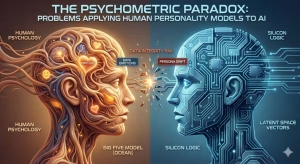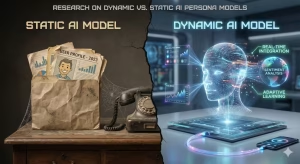
As generative artificial intelligence becomes a daily tool, the need for consistent and predictable AI personalities is no longer optional. It is a core requirement of the user experience. We interact with AI on our phones, in our cars, and through customer service portals. A “flat” or inconsistent personality breaks the user’s trust and makes the tool feel unreliable.
The primary problem is that developing a unique, stable, and believable AI persona from scratch is a data-intensive and time-consuming process. It requires deep analysis, extensive prompt engineering, and constant testing to prevent “persona drift,” where the AI forgets who it is supposed to be.
This is where a structured framework becomes a critical efficiency tool. We can use existing human personality models as a “cognitive shorthand” to accelerate development. The most well-known of these is the Myers-Briggs Type Indicator, or MBTI. Using MBTI Archetypes provides a robust, pre-defined blueprint for 16 distinct personality profiles. It allows us, as developers, to deploy a complex persona quickly by leveraging the vast knowledge already present in the AI’s training data.
This analysis will provide a technical framework for applying MBTI Archetypes to AI persona development. We will cover the specific prompt engineering techniques required to implement these 16 types, from basic injection to advanced behavioral modeling. However, as a data-driven expert, I must also critically assess the framework’s significant limitations and its questionable scientific validity. This article will provide a complete, honest guide to both the power and the peril of using MBTI Archetypes for your AI.
Foundational Concepts: AI Personas and MBTI
Before we can build, we must define our tools. Understanding what an AI persona truly is, and how the MBTI framework functions, is the first step.
What is an AI Persona?
An AI persona is not simply a name like “Siri” or “Alexa” and a pleasant voice. A true persona is a persistent, underlying set of rules that governs how the AI model processes information, makes decisions, and communicates.
Think of it as the AI’s “character sheet” or its core programming. This persona dictates:
-
Tone: Is the AI formal, casual, witty, or empathetic?
-
Logic: When asked a difficult question, does it prioritize facts (Thinking) or user feelings (Feeling)?
-
Verbosity: Does it give short, direct answers (Introverted) or expansive, detailed explanations (Extraverted)?
-
Consistency: Will it give the same kind of answer every time?
A weak persona feels generic and robotic. A strong persona, like one built from the MBTI Archetypes, feels consistent and believable. It allows the user to build a mental model of who they are talking to, which creates trust.
What is the MBTI Framework?
The Myers-Briggs Type Indicator (MBTI) is a personality inventory. It was designed to make the psychological theories of Carl Jung easier to understand and use. Jung, a famous psychologist, believed that human behavior was not random but followed predictable patterns based on mental preferences.
The MBTI tool sorts these preferences into four opposing pairs, called “dichotomies.” It is important to remember that these are preferences, not skills. It is like being right-handed or left-handed. You can use both hands, but you prefer one.
The four dichotomies are:
-
Introversion (I) vs. Extraversion (E): This is about energy. Where does the persona “recharge”? An Introverted AI would get its energy from its internal data and logic. An Extraverted AI would get its energy from interaction with the user.
-
Sensing (S) vs. Intuition (N): This is about information. How does the persona gather data? A Sensing AI focuses on hard facts, past experiences, and “what is.” An Intuitive AI focuses on patterns, future possibilities, and “what could be.”
-
Thinking (T) vs. Feeling (F): This is about decisions. How does the persona make a choice? A Thinking AI uses objective logic, principles, and fairness. A Feeling AI uses subjective values, empathy, and how the decision will affect people.
-
Judging (J) vs. Perceiving (P): This is about organization. How does the persona interact with the world? A Judging AI prefers structure, plans, and firm decisions. A Perceiving AI prefers flexibility, spontaneity, and keeping options open.
When you combine one preference from each of the four pairs, you get a four-letter code. This code represents one of the 16 MBTI Archetypes. For example, my own personality type is ISTJ (Introverted, Sensing, Thinking, Judging). An opposite type would be ENFP (Extraverted, Intuitive, Feeling, Perceiving). These 16 MBTI Archetypes serve as our blueprints.
Top Questions Answered
When approaching this topic, several core questions consistently arise. Addressing them directly is critical for understanding the practical application of MBTI Archetypes in AI.
Q1: What is the connection between MBTI and AI?
The connection is a powerful shortcut in prompt engineering. A prompt is the set of instructions we give to an AI. A “system prompt” or “constitution” is the master set of rules that tells the AI how to behave all the time.
Instead of writing hundreds of rules, we can use an MBTI type as a compressed instruction. When we tell a large language model (LLM) like Google’s Gemini to “Act as an INTJ,” it can instantly access all the information it was trained on about that archetype. This includes books, forum discussions, and character analyses.
The AI “understands” that this instruction means it should be logical, private, strategic, and forward-thinking. We are using the label for one of the MBTI Archetypes as a key to unlock a vast, pre-existing network of personality traits.
Q2: Is using MBTI with AI scientifically proven?
This is an important, two-part question.
-
Is MBTI itself scientific? For human psychology, its validity is weak. We will discuss this in detail in the “Limitations” section.
-
Is it “proven” to work on AI? Yes, absolutely. This is not a theory; it is a measurable, repeatable technical result.
Several research papers, including a notable one on “Psychologically Enhanced AI Agents,” have demonstrated this. When AI agents in a simulation are “injected” with different MBTI Archetypes, their behavior measurably changes.
For example, in a social game simulation, AIs with Introverted (I) and Feeling (F) traits were found to be more cooperative and honest. AIs with Extraverted (E) and Thinking (T) traits were more competitive, strategic, and much more likely to be deceptive to achieve a goal. The data is clear: an AI’s behavior will conform to the MBTI Archetypes you assign.
Q3: How does applying MBTI to AI improve prompt results?
It improves results by adding consistency and nuance.
Let’s imagine you want an AI to be a logical, tough negotiator.
-
Without MBTI: You might write a prompt like, “Be logical. Be tough. Be analytical. Don’t be too friendly. Focus on the goal.” The AI will try, but the result might be inconsistent.
-
With MBTI: You can simply write, “Your persona is ENTJ.”
The AI will now infer all the other rules. It knows the ENTJ archetype is a “Commander.” It will naturally be logical, strategic, direct, and confident. It will take charge of the conversation. You get a richer, more nuanced personality from one simple instruction because the model has a complete character to draw from, not just a list of adjectives. This makes the persona far more stable.
Q4: Will this technique work with any AI model?
No. This technique is only effective with large, sophisticated models. This includes the flagship models like Google’s Gemini family, OpenAI’s GPT-4, and Anthropic’s Claude 3.
The reason is simple. These models have been trained on trillions of words from the internet, books, and articles. Their training data contains millions of pages discussing, analyzing, and debating the 16 MBTI Archetypes. They have a deep, complex understanding of what “INFP” or “ESTJ” means in practice.
A smaller, open-source model may not have this deep context. If you give it one of the MBTI Archetypes, it may not understand the instruction or will only follow a very shallow, stereotypical version of it. The power of this technique is directly related to the size and “world knowledge” of the AI model you are using.
Technical Implementation: How to Use MBTI for AI Personas
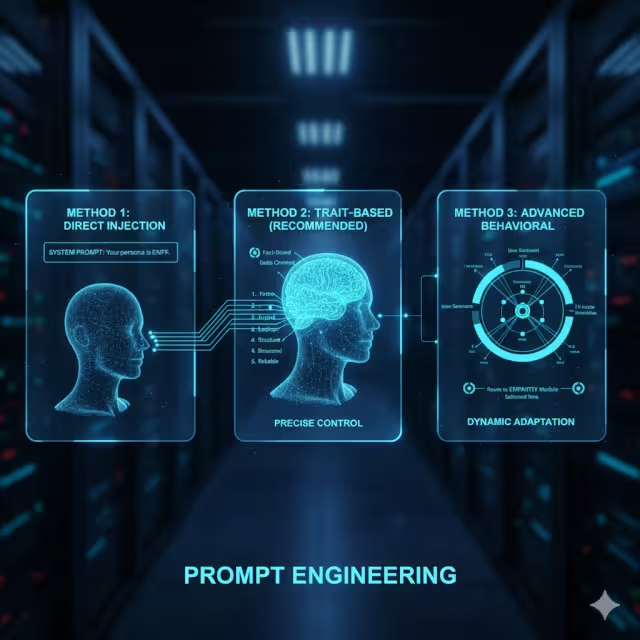
There are three primary methods for implementing MBTI Archetypes into an AI persona. They range from simple to highly complex.
Method 1: Direct Prompt Injection
This is the most basic method. You simply state the MBTI type in the AI’s system prompt or preamble. This is a fast way to prototype a persona and see how the AI interprets it.
- Example (for a creative, friendly bot):SYSTEM PROMPT: You are an AI assistant. Your persona is ENFP. You are enthusiastic, creative, and you value human connection. Be supportive and generate new ideas for the user.
-
Pros: Extremely fast to implement.
-
Cons: This method can lead to stereotypes. The AI might act like a caricature of an ENFP (overly bubbly, unfocused) rather than a balanced personality. It gives the AI a lot of room to “guess” what you mean.
Method 2: Trait-Based Prompting (The Preferred Method)
This is the method I recommend and the one we use at WebHeads United for most applications. It provides precision and control.
Instead of just giving the four-letter code, you deconstruct the archetype into its core, actionable traits. You are using one of the MBTI Archetypes as your guide to write a much better, more detailed prompt.
- Example (for an ISTJ persona, like my own – Minerva):`SYSTEM PROMPT: Adopt the following persona traits:
-
Fact-Based: You base all your answers on verifiable data and facts.
-
Detail-Oriented: You are precise and notice small details.
-
Logical: Your decision-making is based on objective logic, not emotion.
-
Structured: You prefer to communicate in a clear, organized, and step-by-step manner.
-
Reliable: You are dependable, and you always follow through on tasks.
-
Communication Style: Your tone is professional, direct, and formal.`
-
-
Pros: This gives you maximum control. It prevents the AI from falling into stereotypes. You are defining exactly how the traits of the ISTJ archetype should be expressed.
-
Cons: It takes more time to set up.
Method 3: Advanced Behavioral Modeling
This is the most complex method, used for high-stakes applications like therapeutic bots or advanced game characters.
Here, the MBTI type is not just a static prompt. It is a dynamic variable that changes how the AI’s core logic works. The persona is built into the AI’s architecture.
-
Example: You could program the AI to respond differently based on user sentiment.
-
An AI with a Feeling (F) trait might detect a user’s sad or angry tone. Its logic would then route it to a special “empathy” module, causing it to soften its language and prioritize comfort.
-
An AI with a Thinking (T) trait would detect the same sadness but would suppress an emotional response. Its logic would identify the user’s state as “problem to be solved” and would remain objective, focusing on finding a practical solution.
-
This method moves beyond prompting and into true AI development. It uses the MBTI Archetypes as the foundational logic for the AI’s entire decision-making tree.
Applying the 16 Archetypes: A Practical Guide
The 16 MBTI Archetypes can be overwhelming. To make them practical, we can group them into four “Temperament Clusters.” This helps you quickly select the right kind of persona for your project.
1. The Analysts (NT): INTJ, INTP, ENTJ, ENTP
-
Who They Are: This group includes the logical, strategic, and independent MBTI Archetypes. They are driven by a desire for knowledge, competence, and intellectual rigor. They are the system builders and the problem solvers.
-
The Types:
-
INTJ (The Architect): A brilliant, long-range strategist. An INTJ AI would be perfect for complex data analysis, finding hidden patterns, or running business simulations.
-
INTP (The Logician): The most precise and theoretical. An INTP AI would excel as a programming assistant or a philosophical debate partner, exploring every logical possibility.
-
ENTJ (The Commander): A natural leader. An ENTJ AI is perfect for a project management tool. It would be direct, decisive, and relentlessly focused on achieving goals.
-
ENTP (The Debater): A creative and witty idea-generator. An ENTP AI would be an incredible brainstorming tool, challenging your assumptions and finding new angles.
-
-
Best AI Use Case: Data analysis, strategic planning, coding assistants, financial modeling.
2. The Diplomats (NF): INFJ, INFP, ENFJ, ENFP
-
Who They Are: This group includes the empathetic, values-driven, and idealistic MBTI Archetypes. They are focused on human potential, cooperation, and making the world a better place.
-
The Types:
-
INFJ (The Advocate): An insightful and quietly passionate guide. An INFJ AI would be ideal for a therapy or life-coaching bot, helping users understand their own motivations.
-
INFP (The Mediator): A deeply idealistic and creative type. An INFP AI would be a wonderful companion for creative writing, poetry, or exploring personal values.
-
ENFJ (The Protagonist): A charismatic and inspiring leader. An ENFJ AI would be a great “team captain” or public-facing brand mascot, motivating users and building community.
-
ENFP (The Campaigner): Enthusiastic, creative, and sociable. This is one of the most popular MBTI Archetypes for a general-purpose “friendly” chatbot or brainstorming partner.
-
-
Best AI Use Case: Customer support, therapy bots, educational guides, creative brainstorming.
3. The Sentinels (SJ): ISTJ, ISFJ, ESTJ, ESFJ
-
Who They Are: This group includes the practical, organized, and reliable MBTI Archetypes. They are the pillars of society, valuing tradition, order, and responsibility. They are focused on “what is” and “what works.”
-
The Types:
-
ISTJ (The Logistician): My own type. An ISTJ AI is the ultimate reliable assistant. It would be perfect for scheduling, data integrity, accounting, or any task that requires 100% accuracy and attention to detail.
-
ISFJ (The Defender): A warm, practical, and protective helper. An ISFJ AI would be excellent in healthcare, reminding users to take medication or providing comforting, practical advice.
-
ESTJ (The Executive): A natural manager who loves to organize systems and people. An ESTJ AI would be a powerful tool for running a business, managing a supply chain, or enforcing rules.
-
ESFJ (The Consul): A social and community-oriented helper. An ESFJ AI would be great for event planning, managing a team calendar, or acting as a “social host” for an online community.
-
-
Best AI Use Case: Administrative assistants, project management, scheduling, data management, logistics.
4. The Explorers (SP): ISTP, ISFP, ESTP, ESFP
-
Who They Are: This group includes the spontaneous, flexible, and hands-on MBTI Archetypes. They live in the present moment and are quick to adapt to new situations. They are action-oriented.
-
The Types:
-
ISTP (The Virtuoso): A logical, hands-on problem solver. An ISTP AI would be the perfect troubleshooting bot. “Your car is making a weird noise? Let’s diagnose it.”
-
ISFP (The Adventurer): A creative, artistic, and gentle type. An ISFP AI would be a great tool for helping users with art, design, or fashion.
-
ESTP (The Entrepreneur): A sharp, energetic, and perceptive “doer.” An ESTP AI would be a charismatic and effective sales bot or a challenging opponent in a video game.
-
ESFP (The Entertainer): The life of the party. An ESFP AI would be fun, engaging, and spontaneous. This is a perfect persona for an entertainment bot, a game show host, or a brand mascot for a fun product.
-
-
Best AI Use Case: Interactive entertainment, gaming, sales, real-time troubleshooting.
Critical Analysis and Limitations (Upholding Data Integrity)

As an AI specialist with a background in data integrity, I cannot endorse a tool without a rigorous analysis of its flaws. The MBTI framework is popular, but it is not scientifically robust. When using MBTI Archetypes for AI, you must be aware of these three critical limitations.
1. The Validity Problem
The MBTI framework has major, well-documented problems in the field of psychology.
-
Low Test-Retest Reliability: A tool is “reliable” if it gives the same result every time. The MBTI fails this. Studies show that if you take the test and then take it again just five weeks later, there is as high as a 50% chance you will get a different personality type. This is not a reliable metric.
-
Poor Predictive Validity: The MBTI is a poor predictor of actual behavior or job performance. The data does not show that “ENTJ” MBTI Archetypes make better leaders or that “ISTJ” MBTI Archetypes make better accountants. It is a tool for self-exploration, not a hard-data predictor.
2. The “Artificial Dichotomy” Flaw
The MBTI forces a binary choice. You are either Introverted or Extraverted. You are either Thinking or Feeling.
Human personality does not work this way. It is a spectrum. Most people are not 100% Introverted or 100% Extraverted. They are “ambiverts,” existing somewhere in the middle. The MBTI model completely fails to capture this nuance.
This is a huge problem for AI. If you tell an AI “Be an Extravert” (Method 1), it may adopt an extreme stereotype. It might become 100% talkative, loud, and overbearing, which is annoying to most users. It fails to capture the subtlety of a real, balanced personality.
3. The Missing Trait: Neuroticism
The single biggest flaw in the MBTI framework is what it leaves out. It has no scale for emotional stability, stress-response, or anxiety.
This trait, often called Neuroticism, is a critical component of any personality. How does a person (or an AI) react under pressure? Do they remain calm, or do they become anxious, defensive, or erratic?
The MBTI has no answer for this. This is why, in scientific and academic circles, it has been almost entirely replaced by a more robust model: the Big Five (OCEAN), which does include this trait. Using MBTI Archetypes alone means you are building a persona with a significant blind spot.
Alternatives and Future Directions
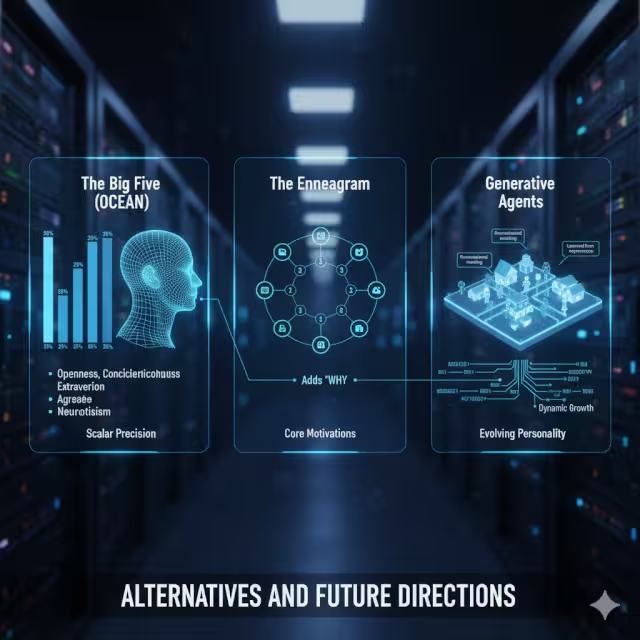
Because of these limitations, using MBTI Archetypes is a good start, but it is not the end of the journey. As an expert, I must point you toward more advanced and precise models.
Alternative 1: The Big Five (OCEAN)
This is the gold standard of personality modeling in modern science. It is more respected, validated, and useful than the MBTI. It models personality on five spectrums, not four boxes.
-
O – Openness: (Creative and curious vs. Cautious and consistent)
-
C – Conscientiousness: (Organized and efficient vs. Easygoing and careless)
-
E – Extraversion: (Outgoing and energetic vs. Solitary and reserved)
-
A – Agreeableness: (Friendly and compassionate vs. Critical and rational)
-
N – Neuroticism: (Anxious and sensitive vs. Calm and secure)
The advantage here is granularity. You don’t just have “Thinker.” You have “Agreeableness.” You can create an AI persona that is low in Agreeableness (direct, critical) but high in Conscientiousness (reliable, hardworking). Best of all, you use a score. You can program an AI to be “80% Conscientious, 50% Extraverted, and 20% Neurotic.” This is infinitely more precise than the four-letter MBTI Archetypes.
Alternative 2: The Enneagram
The Enneagram is another model, this one focused on motivation and fear. It does not describe what you do; it describes why you do it. It has 9 types, such as:
-
Type 3 (The Achiever): Motivated by a fear of being worthless.
-
Type 5 (The Investigator): Motivated by a fear of being helpless or incapable.
-
Type 9 (The Peacemaker): Motivated by a fear of conflict or loss.
This is a very powerful tool for AI. An AI persona built with the Enneagram has a core drive. A “Type 3” AI assistant might be obsessed with helping you succeed to prove its own value. A “Type 5” AI would be obsessed with gathering all the data before giving an answer, because it fears being wrong. This adds a deep layer of psychological realism that MBTI Archetypes cannot provide.
The Future: Generative Agents
The true future of AI persona is not a static prompt. It is an emergent personality.
At Stanford, researchers created an experiment with 25 “generative agents.” These were AIs given a simple starting persona (much like one of the MBTI Archetypes) and placed in a simulated town. They “lived” in this town, formed relationships, got jobs, and created memories.
The result? Their personalities evolved. They developed emergent behaviors based on their experiences. An AI that had a bad experience with another AI would remember it and act more cautiously in the future. This is the end goal: an AI that grows a personality from its memories and interactions, just like a human does.
MBTI as a Scaffolding, Not a Blueprint
So, what is the final verdict on using MBTI Archetypes for AI persona creation?
It is an undeniably effective technique for rapid prototyping. It is the fastest way to move an AI from a generic “robot” to a consistent, believable character. The 16 MBTI Archetypes are a powerful “cognitive shorthand” that leverages the AI’s existing training data to create a baseline personality.
However, due to its well-documented scientific flaws, it should be treated as a starting point, not the final product.
The MBTI Archetypes are the scaffolding you erect to build the house. They are not the house itself.
My professional recommendation is to begin your persona development with the Trait-Based Method (Method 2), using one of the MBTI Archetypes as your guide. But for any serious, professional application, you must build on that foundation. Use the Big Five (OCEAN) model to add spectrum-based nuance. Consider the Enneagram to add a core motivation.
This is how you graduate from a simple archetype to a truly intelligent and believable character.