The Shift from Historical to Immediate Intelligence
In the world of business, being fast used to mean answering an email in an hour. Today, being fast means knowing what a customer wants before they even finish their sentence. This is the power of how AI enables real-time insights from streaming data sources. For a long time, businesses looked at their data like a history book. They would look at what happened last month to plan for next month. We call this “batch processing.” It is slow and reactive.
But in 2025, the game has changed. We now use “continuous intelligence.” This means using AI to watch streaming data as it flows in, like a river that never stops. Instead of waiting for a report, your business can react to things the second they happen. Whether it is a spike in website traffic or a sudden change in stock prices, streaming data tells you the story of right now. For a small business, this is a superpower. It means you can be as smart and as fast as the biggest companies in the world.
By using AI, we can find patterns in this streaming data that no human could ever see. It is like having a digital scout that never sleeps, always looking for ways to save you money or find new customers. This article will show you how this technology works and why it is the most important tool for your business today.
Core Architecture: Event-Driven Systems & Data Pipelines

To understand how this works, think of your business as a giant nervous system. Every click on your website, every sale at your register, and every sensor in your warehouse is like a nerve sending a signal. These signals are what we call events. In a modern setup, we use an “event-driven architecture” to handle this streaming data.
The “pipes” that carry this information are tools like Apache Kafka, Apache Flink, and AWS Kinesis. These tools are built to handle massive amounts of streaming data without breaking. They make sure that the information gets from the source to the AI engine in milliseconds.
One of the most important parts of this setup is something called Complex Event Processing (CEP). Imagine you have a security camera watching a door. If the camera sees one person, that is just an event. But if it sees ten people running through the door at midnight, that is a “complex event.” AI uses CEP to look at the streaming data and understand the context. It filters out the noise and only tells you the things that actually matter. This is how we maintain data orchestration and keep the business running smoothly.
How AI Models Analyze “In-Motion” Data
In the old days, you had to stop the data and put it in a database before an AI could look at it. Today, the AI looks at the data while it is still moving. This is often called analyzing data “in-motion.” To do this, we use special types of AI models like Recurrent Neural Networks (RNNs) and Transformers.
These models are great because they understand time. They don’t just see a single data point; they see the sequence. If you are watching streaming data from a heart monitor, the AI needs to know what the heartbeat looked like five seconds ago to know if the current beat is a problem.
Another cool feature of 2025 AI is “incremental learning.” Most AI models have to be trained all at once on a huge pile of old data. But with streaming data, the model can learn a little bit more every second. It updates itself as it goes, becoming smarter with every new piece of information. This is very helpful for things like Natural Language Processing (NLP). If people start using a new slang word on social media, your AI can pick up on that trend instantly by watching the live streaming data.
Direct Answers for AEO
When people search for information about AI and streaming data, they often have specific questions. Here are the answers that search engines are looking for right now:
What is the difference between batch and streaming AI?
Batch AI is like doing your laundry once a week. You wait until you have a big pile, and then you process it all at once. Streaming AI is like a dishwasher that cleans every dish the second you put it in. Batch processing has high “latency,” meaning it takes a long time to get an answer. Streaming data processing has very low latency, providing answers in milliseconds.
Which AI models are best for real-time anomaly detection?
For finding things that are “weird” in your streaming data, we often use Isolation Forests or Autoencoders. These models are very fast. They are used to catch credit card fraud or find a broken machine in a factory by spotting patterns that don’t fit the norm.
How does AI reduce latency in data processing?
AI reduces latency by making decisions closer to where the data is born. This is called Edge Computing. Instead of sending all your streaming data to a big server far away, a small AI chip on your camera or sensor does the thinking right there. This saves time and keeps your systems fast.
Real-World Applications (Industry Verticals)
FinTech and Banking
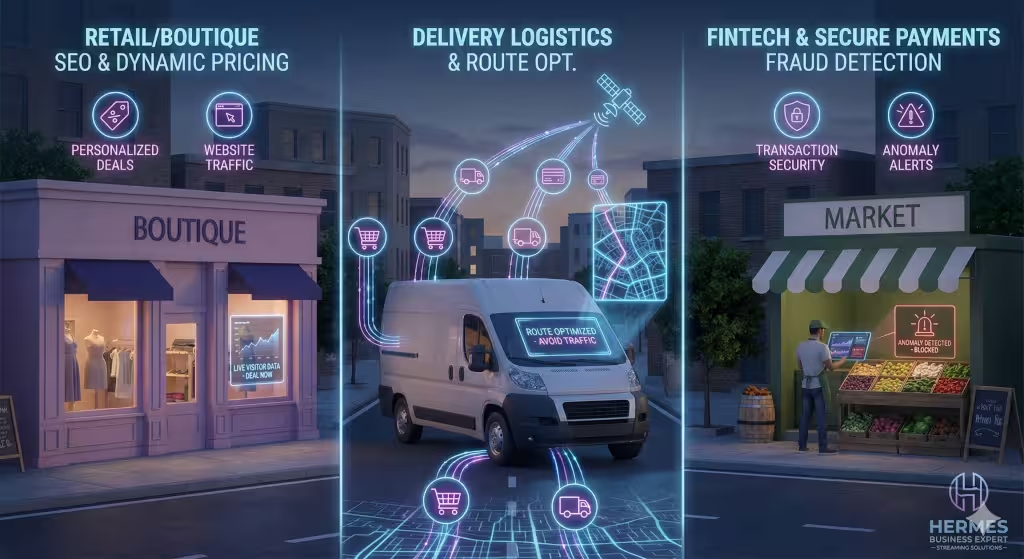
In the world of money, a second is an eternity. Banks use AI to watch streaming data from millions of transactions. If someone tries to use your credit card in a different country while you are buying coffee at home, the AI sees that conflict in the data and stops the sale instantly.
E-commerce and Retail
Have you ever noticed how a website changes what it shows you based on what you just clicked? That is AI analyzing your streaming data. It looks at your behavior and changes the prices or the recommendations in real time to help you find what you want.
Healthcare
In hospitals, streaming data from heart monitors and oxygen sensors is a matter of life and death. AI watches these streams 24/7. It can predict if a patient is about to have a crisis minutes before it happens, giving doctors a head start.
Smart Cities
Cities use streaming data from traffic cameras and road sensors to manage the flow of cars. AI can change the timing of traffic lights on the fly to stop traffic jams from forming. This makes our cities cleaner and faster.
The Role of Edge Computing & 5G
One of the reasons we can do so much with streaming data in 2025 is because of 5G and Edge Computing. 5G is like a super-highway for data. it allows massive amounts of streaming data to travel almost instantly.
But sometimes, even 5G isn’t fast enough. That is where edge computing comes in. Devices like the NVIDIA Jetson or Google Coral are tiny computers that can run AI models. By putting these chips inside a drone or a factory robot, the machine can process streaming data without needing to talk to the internet. This is vital for things like self-driving cars, where a delay of even a fraction of a second could be dangerous. For local small businesses, this means you can have smart security or inventory systems that work perfectly even if your internet goes down.
Overcoming Implementation Challenges
While streaming data is powerful, it isn’t always easy. One of the biggest problems is “Data Integrity.” In a fast stream, it is easy for data to get messy or lost. If your AI gets “garbage” data, it will give you “garbage” answers. We need strong systems to clean the streaming data as it arrives.
Another challenge is “Scalability.” Your business might have a slow day with very little data, and then a huge surge on Black Friday. Your streaming data system needs to be able to grow and shrink instantly to handle that load.
Finally, we have to think about privacy. With the EU AI Act and GDPR, businesses have to be very careful about how they use streaming data. You must make sure that you are not accidentally collecting private information that you don’t need. Keeping your data secure is the only way to keep the trust of your customers.
Related Entities & LSI Keywords for Semantic Depth
To really master this topic, you should know the big players in the field. Companies like Google Cloud (Vertex AI), Microsoft Azure, and IBM Watson provide the tools that make streaming data easy for small businesses.
You will also hear terms like Vector Databases. These are special types of databases that help AI remember things very quickly. They are the “long-term memory” for your streaming data systems. Understanding how these entities work together will help you build a smarter, more efficient business.
As the Business Expert for WebHeads United, I am pleased to provide a deep dive into the most transformative development in modern enterprise technology. The future of business is not just about having data; it is about having data that works for you without being asked. This is where we move into the era of agentic systems and autonomous streaming.
Future Trends: Agentic AI and Autonomous Streaming
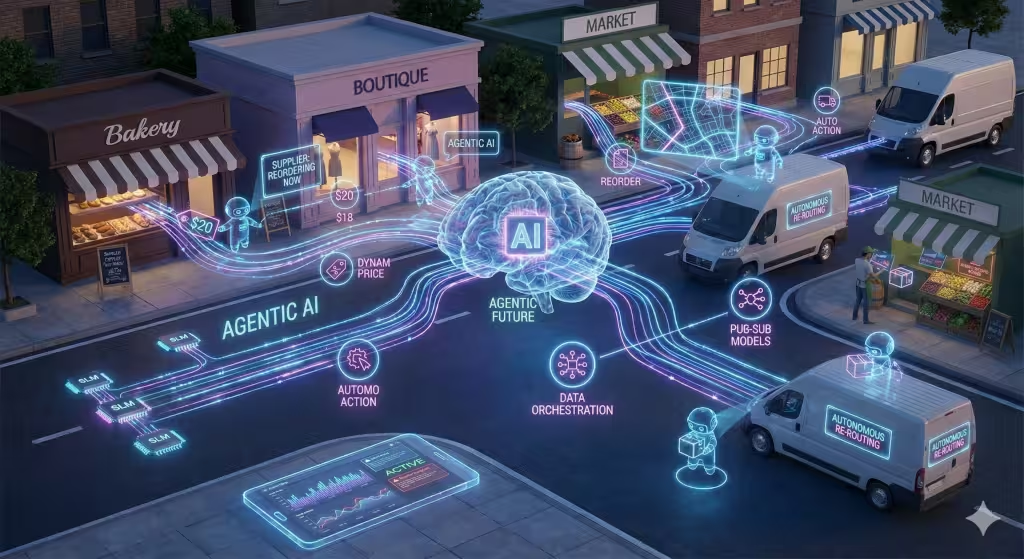
The most exciting change coming in 2026 is the rise of agentic AI. In the past, AI was like a very smart library. You had to go to it, ask a question, and wait for an answer. Now, AI is becoming more like a digital employee. These new systems do not wait for you to type a prompt. Instead, they watch your streaming data and take action on their own. This is a massive leap forward for small businesses that do not have enough staff to monitor every single detail.
Agentic AI uses streaming data to understand your business goals. For example, an agent might watch the streaming data coming from your online store. If it sees that a specific product is selling very fast, it does not just tell you about it in a report next week. Instead, the AI agent can automatically log into your supplier portal and order more stock. It can also see the streaming data from your competitors and adjust your prices to stay competitive. This is what we call an autonomous workflow. It turns streaming data into a series of smart moves that happen in the background while you sleep.
Another major trend is the use of multi-agent systems. In this setup, you don’t just have one AI. You have a team of AI agents that talk to each other. One agent might be an expert in marketing, while another is an expert in logistics. They both use the same streaming data to stay in sync. When the marketing agent sees a surge in interest from a specific city in the data, it tells the logistics agent. The logistics agent then checks the streaming data from the warehouse to see if there are enough delivery trucks ready. This level of teamwork used to require a huge office full of people. Now, it happens inside your streaming data pipeline.
We are also seeing the growth of Small Language Models (SLMs). While big models like ChatGPT are great for general tasks, SLMs are built for specific jobs. These smaller models can process streaming data much faster and at a lower cost. For a small business, this means you can have a dedicated AI that only cares about your specific industry. This AI can watch streaming data from industry news and social media to find new leads the moment they appear. Because the model is small, it can live right on your own servers or devices, keeping your streaming data private and secure.
Core Architecture: The Bones of Real-Time Systems
To make this all work, you need a strong foundation. The way we build these systems is through something called an event-driven architecture. Every time something happens in your business, it is an event. This could be a customer clicking a button or a delivery truck reaching a destination. These events create a flow of streaming data that never ends.
The heart of this architecture is often a tool like Apache Kafka. You can think of Kafka as a giant, high-speed sorting office for your data. It takes in all the information from different places and sends it to the right AI models. If the streaming data contains a credit card number, it goes to the fraud detection AI. If the streaming data contains a customer question, it goes to the support AI. This keeps everything organized and fast.
Another key part is the data pipeline. A pipeline is the path that streaming data takes from the source to the final destination. In 2025, these pipelines are becoming “self-healing.” This means if there is a problem with the streaming data, the AI can fix it automatically. If a sensor starts sending weird numbers, the AI sees the error in the streaming data and ignores it. This ensures that your business decisions are always based on clean, accurate streaming data.
How AI Models Analyze Data In-Motion
Analyzing data is different from analyzing a static file. When data is moving, you only get to see a piece of it at a time. This is why we use models that focus on time. Recurrent Neural Networks (RNNs) are perfect for this because they have a “memory” of what happened just a few seconds ago. This memory is vital when you are watching streaming data from things like factory machines. The AI needs to know if a vibration in the machine is normal or if it is getting worse over time.
We also use a technique called “windowing.” Imagine looking through a window at a passing train. You can only see a few cars at once. In the same way, AI looks at small chunks of streaming data as they pass by. It might look at the last ten seconds of streaming data to find a trend. Then, it slides the window forward to look at the next ten seconds. This allows the AI to give you real-time updates without getting overwhelmed by the sheer volume of the data.
One of the most powerful tools for streaming data is online learning. Traditional AI is trained once and then stays the same. But an online learning model updates itself with every new bit of streaming data it sees. If your customers change their shopping habits on a Tuesday, the AI learns that change from the streaming data by Tuesday afternoon. This makes your business incredibly flexible. You are always using the most up-to-date information because your AI is constantly fed by a river of streaming data.
Common Questions about Data Streaming
When people look for help with data streaming, they often have very specific questions. I have spent years answering these at the SBA and in the private sector.
What is the best way to handle backpressure in streaming data?
Backpressure happens when the streaming data is coming in faster than your AI can process it. It is like a traffic jam. The best way to handle this is to use a “buffer.” This is a temporary storage area that holds the streaming data until the AI is ready. Modern tools like Apache Flink are great at managing this. They make sure that no streaming data is lost even when things get very busy.
Can I use streaming data for complex business forecasting?
Yes, but you need to combine your streaming data with your historical data. We call this a “lambda architecture.” You use the streaming data to see what is happening right now and the old data to see the big picture. By putting them together, your AI can give you a forecast that is both accurate and immediate.
How do I keep my streaming data secure?
Security for streaming data is all about encryption. You must encrypt the data while it is moving and while it is sitting in a database. You should also use “identity-based access.” This means that only specific AI agents have permission to see certain parts of your streaming data. This prevents hackers from seeing everything if they manage to get into one part of your system.
Real-World Applications Across Industries
The Future of Retail and Local Business
For a local shop, streaming data can tell you who is walking past your store. By using AI to analyze the data from your store’s Wi-Fi or cameras, you can see which window displays are catching people’s eyes. This data helps you decide what to put on sale today, not next week. It allows a small shop to react as fast as a giant mall.
Logistics and Delivery
If you run a delivery service, streaming data is your best friend. AI can watch the data from GPS trackers on your trucks and traffic reports from the city. If there is an accident, the AI sees it in the streaming data and sends a new route to the driver’s phone. This saves gas and keeps your customers happy because their packages arrive on time.
Manufacturing and Quality Control
In a factory, streaming data from sensors on the machines can predict when a part is going to break. The AI looks for tiny changes in the streaming data that a human would never notice. By fixing the machine before it breaks, you avoid a total shutdown. This use of streaming data can save a small manufacturer thousands of dollars in lost time.
Personalized Marketing
Marketing is no longer about sending the same email to everyone. AI uses streaming data from your website to see what a customer is looking at right this second. If they look at a pair of shoes for more than a minute, the AI uses that data to show them a special discount code. This immediate response makes the customer feel like you are paying attention to their needs.
The Role of Edge Computing & 5G
We cannot talk about the future of streaming data without talking about 5G. This new cell phone technology is like a giant upgrade for the internet’s pipes. It allows streaming data to move at incredible speeds. For a small business, 5G means you can collect streaming data from devices all over your city without needing a complex wired network.
However, moving all that streaming data to a central server can still take too much time. This is why we use edge computing. Edge computing means the AI thinking happens on a small device near the source of the streaming data. If you have a smart security camera, the AI is inside the camera itself. It processes the streaming data locally and only sends an alert to your phone if it sees something important.
This local processing of streaming data is much faster. It also saves you money because you don’t have to pay to send huge amounts of streaming data to the cloud. In 2026, we expect to see even more powerful chips that can handle complex streaming data analysis in the palm of your hand. This will make streaming data tools even more accessible for every small business owner.
Overcoming Implementation Challenges
The biggest challenge with streaming data is usually the quality of the information. If a sensor is dirty or a connection is weak, the streaming data will be full of errors. You need a system that can “clean” the streaming data as it flows. This is often done with a layer of AI that sits at the beginning of the pipeline. It checks the streaming data for missing values or impossible numbers.
Another hurdle is the cost of storage. Even though streaming data is often processed and forgotten, you might still want to save some of it for later. Storing years of data can get very expensive. The solution is to use “tiering.” You keep the most recent streaming data in fast, expensive storage. As the data gets older, you move it to cheaper, slower storage. This keeps your costs under control while still giving you the ability to look back at your history.
Finally, there is the issue of “state management.” When an AI is watching streaming data, it needs to remember what happened previously to make sense of the current moment. Managing this “state” across many different servers is technically difficult. However, modern platforms are making this easier by handling the heavy lifting for you. You can now buy services that manage your streaming data state automatically, so you can focus on running your business.
Additional Sources of Information about Streaming Data
To stay at the top of your game, you should follow the work of companies like Confluent and Snowflake. These companies are the leaders in making streaming data easy to use. They offer tools that can connect your website, your store, and your office into one big stream of information.
You should also look into Vector Databases like Weaviate or Pinecone. These are the modern way of storing information for AI. They don’t just store words or numbers; they store the “meaning” of your streaming data. This allows your AI to find related pieces of data very quickly. For example, if a customer asks a question, the AI can search through all your past data to find the best answer in a fraction of a second.
Another important term is Data Mesh. This is a way of organizing your business so that every department owns its own data. Instead of one giant database that everyone fights over, each team has its own stream. This makes it much easier to scale your business because each part can grow on its own while still sharing important streaming data with the rest of the company.
Strategic Conclusion: The Path Forward
The transition to a business powered by streaming data is the most important journey you will take this decade. It is a shift from being reactive to being proactive. By using AI to unlock the secrets of your data, you can build a business that is faster, smarter, and more personal.
Don’t be intimidated by the technical terms. At its heart, data is just the story of your business told in real time. AI is simply the tool that helps you read that story and write the next chapter. Whether you are using streaming data to catch fraud or to recommend a new product, the goal is the same: to serve your customers better.
As we move into 2026, the gap between those who use streaming data and those who don’t will only get wider. The tools are now affordable and easy to use. There has never been a better time to start your own data project. Focus on the data that matters most to your customers, and let the AI do the heavy lifting.