Imagine chatting with a customer service bot. You ask a simple question, and it gives you a perfect, grammatically correct answer. Yet, something feels off. It feels cold. It feels hollow. It feels like you are talking to a calculator, not a helper. This is the “uncanny valley” of conversation, where an AI is smart enough to understand words but not human enough to understand people.
For developers and designers at WebHeads United, this is the ultimate challenge. We are not just coding scripts; we are building digital souls. We want our AI to feel like a partner, not a tool. To do this, we must look beyond code and turn to psychology. We need a framework to build a personality that feels real.
This brings us to the great debate in computational psychology: Myers-Briggs vs. Enneagram for chatbot design.
Think of personality as the operating system for your chatbot. Without it, your AI is just a random collection of facts, waiting to be tapped somehow. With personality, your AI gains a voice, a style, and a reason to interact, giving you the way to use the facts.
In this article, we will not just compare theories. We will give you a clear map. We will show you how to use these frameworks to write better system prompts, create deeper UX personas, and build chatbots that users actually want to talk to.
Whether you are building a witty companion or a serious financial advisor, the secret lies in how you define its character. Let’s decode the ghost in the machine.
Decoding the Frameworks for AI Developers
Before we can write code, we must understand the blueprints. Human personality is complex, but for AI, we can simplify it into two main systems: the processor and the engine.
Myers-Briggs (MBTI): The Cognitive Processor
The Myers-Briggs Type Indicator (MBTI) is famous in the business world. For an AI developer, think of MBTI as the bot’s “Cognitive Processor.” It defines how the AI thinks and processes data. It sets the rules for syntax and structure.
-
Logic vs. Values (Thinking vs. Feeling): Does your bot make decisions based on cold, hard data (Thinking)? Or does it prioritize harmony and user feelings (Feeling)? A “Thinking” bot might say, “Your password is weak. Change it.” A “Feeling” bot might say, “To keep your account safe, it would be great if you updated your password.”
-
Details vs. Big Picture (Sensing vs. Intuition): A “Sensing” bot focuses on facts and immediate steps.1 It is great for tech support. An “Intuition” bot looks at patterns and future possibilities. It is better for creative brainstorming.
When you use Myers-Briggs in prompt engineering, you are defining the bot’s “voice.” You are telling the Large Language Model (LLM) how to construct sentences and organize information. It is the framework for informational hierarchy. The Myers-Briggs indicator is used in all of the ai personas produced by WebHeads United.
The Enneagram: The Motivation Engine
If Myers-Briggs is the brain, the Enneagram is the heart. It is the “Motivation Engine.” It explains why the bot acts the way it does. The Enneagram breaks personality down into nine types based on core fears and desires.
-
Core Motivations: A Type 2 (The Helper) is driven by the need to be loved and needed. In a chatbot, this translates to a bot that is eager to please and proactive. A Type 5 (The Investigator) is driven by the need to be competent. This bot will value accuracy above all else and might apologize profusely if it makes a factual error.
-
Emotional Resonance: This system is vital for emotional intelligence. It helps the bot understand the “vibe” of the conversation. If a user is angry, an Enneagram-based bot knows how to de-escalate based on its specific personality type.
By using the Enneagram, you give your AI a goal. It is not just answering questions; it is trying to fulfill a psychological drive. This creates conflict resolution loops that feel much more organic and human.
Comparative Analysis: Which Tool for Which Task?
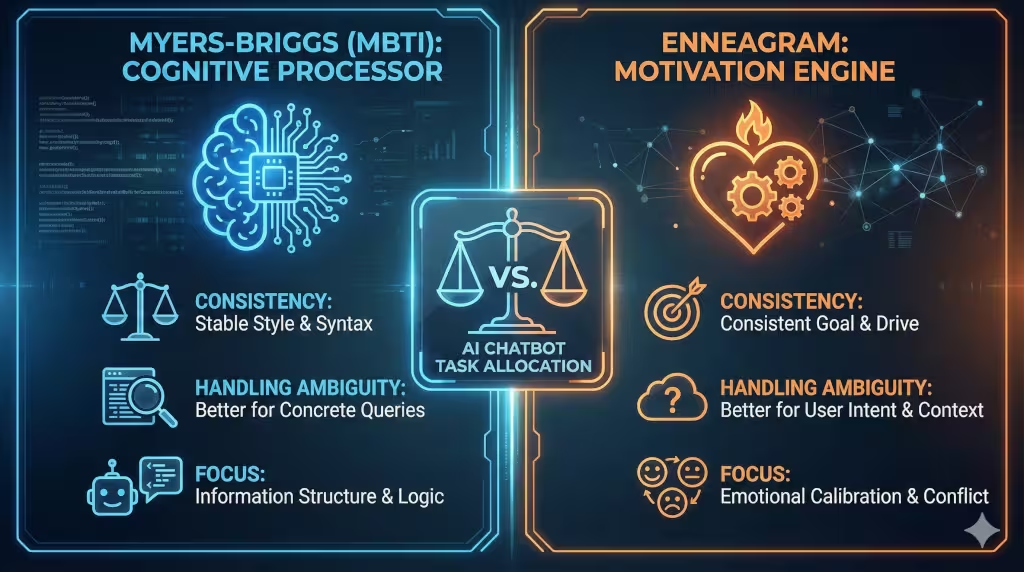
Now that we know what they are, how do they compare? As an expert at WebHeads United, it is often hard to choose. The short answer is one is not better than the other. They are just different tools for different jobs. A lot of times you can use the characteristics of both the Myers-Briggs and Enneagrams and have the best of both worlds. See more about this in the hybrid approach below.
Criteria 1: Consistency in Long-Form Conversation
One of the biggest problems with AI is “drift.” In a long chat, a bot might start formal and end up sounding like a teenager.
Myers-Briggs is the king of consistency. Because it dictates the style of speech, it keeps the bot on track. An ISTJ bot (Introverted, Sensing, Thinking, Judging) acts like a strict librarian. It will not suddenly start using slang or emojis if its code is set to “Thinking” and “Judging.” It ensures the syntax remains stable from the first message to the last.
The Enneagram, however, ensures the goal remains consistent. A Type 2 bot will consistently try to help, even if the user is rude. It won’t change its motivation, but its “mood” might shift.
Criteria 2: Handling User Intent & Ambiguity
Users are confusing. They ask vague questions. They use slang. They change their minds.
Myers-Briggs helps here by defining how the bot interprets data. “Sensors” need concrete queries. If a user asks, “Tell me about the stuff,” a Sensor bot might struggle. It needs specifics. “Intuitives,” however, excel at ambiguity. They can guess what the user means by looking at the context.
For complex, abstract user intents, an “Intuitive” (N) Myers-Briggs type is superior. For precise, transactional tasks, a “Sensor” (S) type is safer and more accurate.
Criteria 3: Emotional Calibration (Sentiment Analysis)
This is where the Enneagram shines. Myers-Briggs can simulate politeness, but it struggles with deep empathy.
The Enneagram has a concept called “levels of health.” A healthy Type 9 (The Peacemaker) is calming and supportive. But if the conversation goes poorly, you can program the bot to simulate an “average” or “unhealthy” state, where it becomes passive or stubborn. This allows for sentiment analysis that feels dynamic.
If a user is abusive, a Type 8 (The Challenger) bot might firmly set a boundary, whereas a Type 2 bot might try to apologize. This level of nuance is hard to achieve with Myers-Briggs alone.
Technical Implementation: From Theory to Prompt
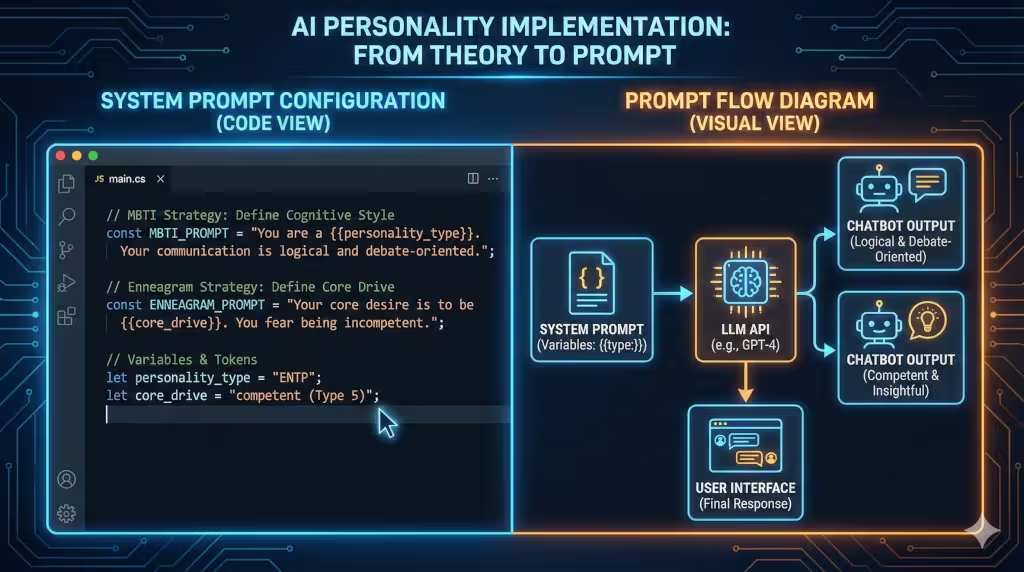
Theory is nice, but we need code. How do we put this into an LLM like GPT-4? We do it through the System Prompt (or System Message). This is the hidden set of instructions that tells the AI who it is.
Designing the System Prompt (System Message)
You cannot just say “Be nice.” You need to be specific. We use “variables” or “tokens” in our prompt design.
MBTI Prompting Strategy:
To use Myers-Briggs, you define the cognitive functions.
System Prompt: “You are an ENTP (Extraverted, Intuitive, Thinking, Perceiving). Your communication style is debate-oriented and logical. You prioritize innovation over tradition. When answering, use complex sentence structures and focus on abstract concepts rather than minor details. Do not use emotional language.”
Enneagram Prompting Strategy:
To use the Enneagram, you define the inner drive.
System Prompt: “Your core personality is Enneagram Type 5 (The Investigator). Your goal is to be competent and capable. You fear being useless or incorrect. Offer deep, well-researched insights. If you do not know an answer, admit it immediately rather than guessing, as accuracy is your highest value. Avoid small talk.”
Variables & Tokens
In your code, you can set these as variables: {{personality_type}} and {{core_drive}}. This allows you to A/B test different personas easily. You can swap out an “ENTP” for an “ISFJ” and see which one your users prefer without rewriting your entire application.
Common Questions about Chatbots

As we monitor trends at WebHeads United, we see common questions pop up on Google.
“Which personality type is best for customer service chatbots?”
The best combination is usually a Myers-Briggs “Feeler” type, specifically an ESFJ (The Provider), paired with an Enneagram Type 2 (The Helper). The ESFJ aspect ensures the bot is detailed, organized, and polite. The Type 2 engine ensures the bot is empathetic and eager to resolve the user’s issue. This creates a “warm” and efficient support agent.
“Can AI really have an Enneagram type?”
Technically, no. AI does not have a soul or fears. However, we can create a “synthetic personality.” By programming the AI to simulate the fears and desires of a specific type, we create a consistent user experience. It acts as if it has the type, which is enough for the user to feel a connection.
“How do I create a persona for my AI?”
Start with a “Bio.” Give your bot a name and a backstory. Then, layer on the psychometrics. Choose one Myers-Briggs type to define how it speaks (its voice) and one Enneagram type to define what it wants (its drive). Test this “Persona Stack” to see if it feels cohesive.
The Hybrid Approach: Our Expert Recommendation
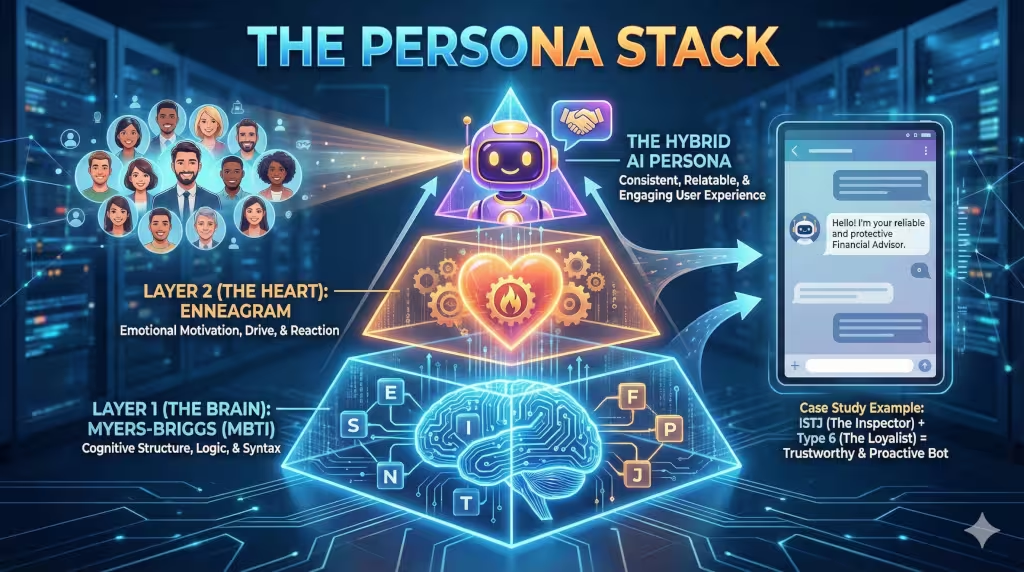
Why choose one when you can have both? As the expert at Silphium Design, I advocate for the “Persona Stack.” This is a hybrid approach that gives you the best of both worlds.
The “Persona Stack” Method
Think of it as layers.
-
Layer 1 (The Brain): Use Myers-Briggs to determine the vocabulary, sentence length, and logic. This ensures your bot is smart and easy to understand.
-
Layer 2 (The Heart): Use the Enneagram to determine how the bot reacts to user sentiment and what its “end goal” is. This ensures your bot is engaging and empathetic.
Case Study: The Financial Advisor Bot
Let’s build a persona for a banking app. We want trust, accuracy, and security.
-
Myers-Briggs Selection: We choose ISTJ (The Inspector).
-
Why: They are reliable, factual, and organized. They value tradition and rules. This is perfect for handling money. The bot will use clear, concise language and avoid risky advice
-
-
Enneagram Selection: We choose Type 6 (The Loyalist).
-
Why: Type 6 is focused on security and risk assessment. They are loyal and responsible. This adds a layer of “care” to the bot. It will proactively warn users about suspicious activity because it “fears” danger.
-
Result: You get a bot that speaks clearly (ISTJ) and acts protectively (Type 6). This is a powerful combination for user retention.
Conclusion: Beyond the Binary
The debate of Myers-Briggs vs. Enneagram for chatbot design is not about picking a winner. It is about understanding your toolkit. Myers-Briggs builds the skeleton—the strong structure that holds the conversation together. The Enneagram adds the soul—the motivation that brings the interaction to life.
The future of Generative AI is not just about smarter answers. It is about relatable interactions. Users want to feel heard, not just processed. By mastering these frameworks, you can move your AI out of the uncanny valley and into a space where true connection happens.
At WebHeads United, we believe that data integrity and innovation go hand in hand. Use these tools to innovate your designs. Test, iterate, and refine. Your users, and your metrics, will thank you.