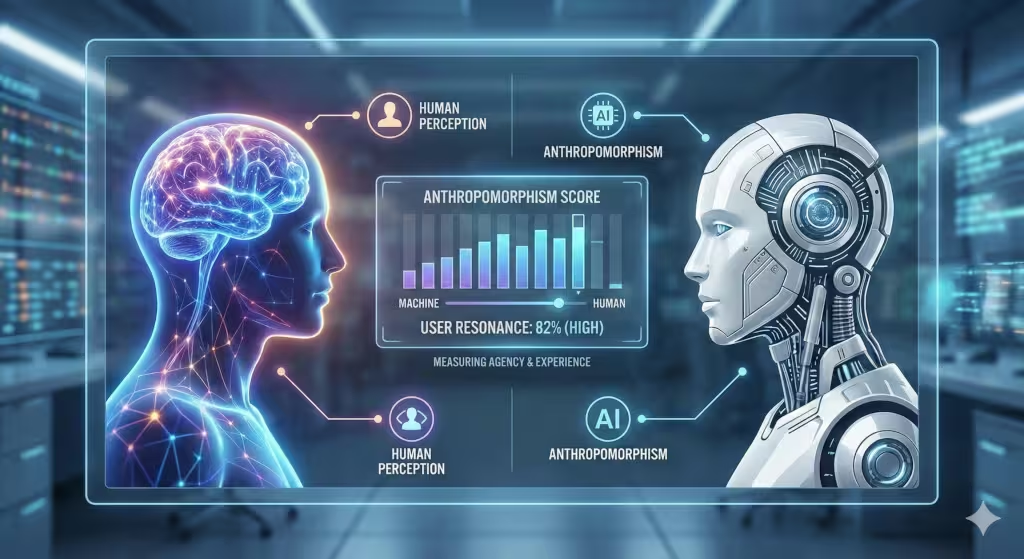
Today, we are diving into something very cool: how we measure the way people see “human” traits in robots and software. This idea is called AI anthropomorphism. It is a big word, but it just means we treat computers like they are people. In 2026, this is more important than ever because AI is not just a tool anymore. It is becoming a teammate that helps us plan our day or even do our jobs. Our goal today is to show you how we measure these feelings so we can build better, more trustworthy digital friends without falling into the “creepy” zone.
The Quantitative Shift in Persona Design
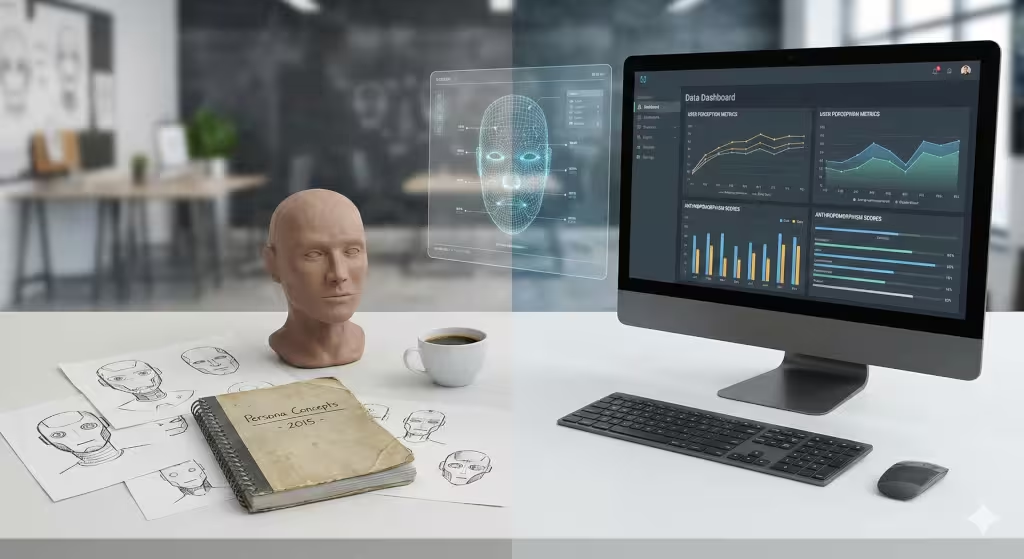
When we talk about persona design, we used to just pick a pretty face and a nice voice. But now, in 2026, we have to be more scientific. We need to know exactly how much AI anthropomorphism a user feels. This is the act of giving a machine human thoughts, feelings, or a “soul.”
The landscape has changed a lot lately. We are moving toward “agentic AI.” This means the AI can act on its own. Because it does things without us telling it every single step, we tend to think of it more like a person. If we do not measure this carefully, we might make a persona that is too human-like, which can actually scare people away. This is called the Uncanny Valley. At WebHeads United, our objective is to use data to find the “sweet spot” where an AI feels friendly but still like a very helpful machine.
Theoretical Foundations: Why We Personify
Have you ever yelled at your computer when it froze? Or maybe you said “thank you” to a voice assistant? This is the core of AI anthropomorphism. Humans are wired to see life in things that move or talk.
There is a famous idea called the CASA paradigm. This stands for “Computers Are Social Actors.” It basically says that even though we know a computer is just code and metal, our brains treat it like a social being. We apply the same rules to AI that we do to our neighbors.
Another big theory is Mind Perception Theory. When we look at an AI, we judge it on two things: Agency and Experience. Agency is the ability to plan and do things. Experience is the ability to feel things like hunger or joy. Most people think AI has high agency but low experience. If we increase the felt AI anthropomorphism, people might start thinking the AI can actually feel bad, which changes how they use it.
Core Metrics: What Are We Actually Measuring?

When we look at AI anthropomorphism, we do not just ask “does it look human?” We look at specific scores.
-
Warmth: Does the AI feel friendly and kind?
-
Competence: Does the AI seem like it knows what it is doing?
-
Intelligence: Is it truly smart, or is it just using fancy words?
-
Resonance: Do you feel a “spark” of connection?
We use these metrics to make sure the AI fits the job. For a doctor AI, you want high competence. For a therapy AI, you want high warmth. If you get the balance wrong, the AI anthropomorphism feels fake or annoying.
Psychometric Scales and Measurement Tools
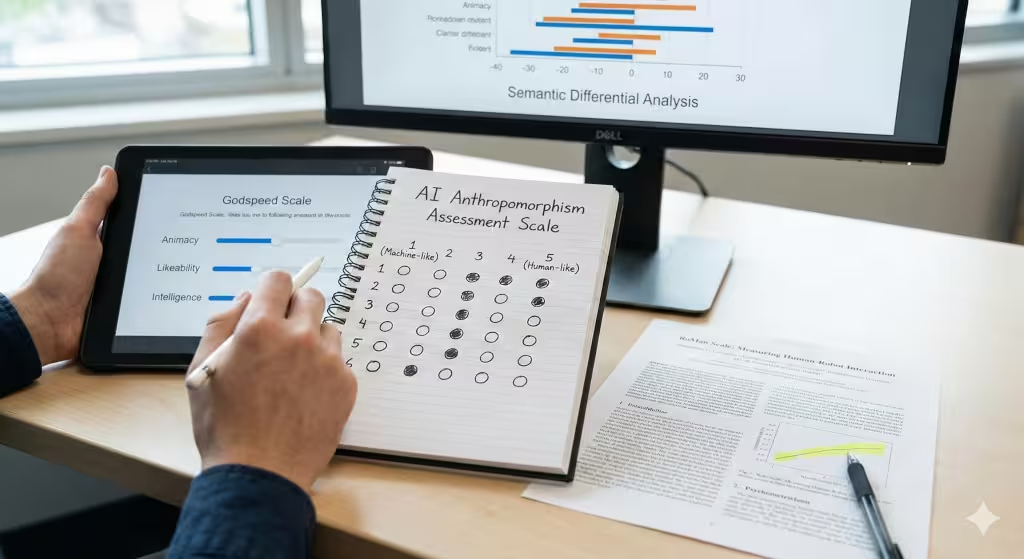
To get real numbers, we use special surveys called scales. One of the most famous is the Godspeed Scale. It asks users to rate the AI on things like how “alive” or “human-like” it feels.
| Scale Name | What it Measures | Best Use Case |
| Godspeed Scale | Animacy, Likeability, Intelligence | Social Robots and Avatars |
| SOAS | Natural Tendency to Personify | Researching User Personality |
| RoMan Scale | “Humanness” in Chat | Customer Service Bots |
In 2026, we also use a new tool called the Semantic Differential. This uses LLMs to look at the words people use to describe the AI. If people use words like “he” or “she” instead of “it,” that is a clear sign of high AI anthropomorphism.
Advanced Methodologies: Beyond Self-Reporting
Sometimes people lie on surveys without meaning to. They might say “I know it is a machine,” but their brain thinks otherwise. That is why we use brain scans like EEG. We look at the electrical signals in the brain to see if the user reacts to an AI face the same way they react to a human face.
We also use eye-tracking. If a user looks at an AI’s eyes during a talk, it shows high levels of AI anthropomorphism. Their brain is searching for social cues just like it would with a real person. We even check how much their pupils grow! If they are interested or excited, their pupils get bigger. This tells us more than any survey ever could.
Common Questions about AI Anthropomorphism
People often ask, “How do you measure AI human-likeness?” We do this by looking at behavior. If a person treats the AI with respect or gets embarrassed around it, they are seeing it as human.
Another common question is: “Does anthropomorphism increase user trust?” The answer is: sometimes. If an AI looks very human but makes a stupid mistake, trust drops faster than it would for a regular computer. This is because our expectations are higher.
What about the Uncanny Valley? This is when an AI looks almost human but something is “off.” It makes people feel uneasy. To avoid this, we measure AI anthropomorphism throughout the design process to make sure we stay on the “safe” side of the curve.
Strategic Implications for Persona Development
At WebHeads United, we know that culture matters. A level of AI anthropomorphism that feels great in Pittsburgh might feel weird in Tokyo. Some cultures love robots that act like people, while others prefer them to be clearly mechanical.
We also look at gender cues. If an AI has a female voice, people often expect it to be more helpful and warm. If it has a male voice, they might expect it to be more authoritative. We have to be careful not to build bad stereotypes into our designs while still making the AI feel natural.
2026 Trends: Agentic AI and Federated Personas
The biggest trend this year is Agentic AI. These are AI systems that can think for themselves and finish big tasks. Because they have so much “agency,” people naturally feel a lot of AI anthropomorphism toward them. They start to feel like a real partner at work.
We are also seeing “Federated Personas.” This is when one AI identity follows you from your phone to your car to your home. When the “person” stays the same across different devices, the feeling of AI anthropomorphism gets much stronger. It feels like you have a single friend who is always with you.
Conclusion
Measuring how people see these machines is not just a hobby for us; it is a necessity. If we want to build a future where AI helps us be our best, we have to understand the bridge between humans and code. AI anthropomorphism is that bridge. By using brain scans, surveys, and clever design, we can make sure that bridge is strong and safe.
In 2026, the best AI personas will not be the ones that look most like us. They will be the ones that understand us best. And that starts with measuring the way we see them.
Bonus: Survey Questions to Use for the Godspeed Scale
I would be happy to help you with that. Measuring AI anthropomorphism requires a mix of questions that look at how “alive” the agent feels versus how “functional” it is.
Below is a survey template based on the Godspeed Scale and the RoMan Scale, adapted for a general audience. You can use these questions to gather data on any AI persona you are developing.
AI Persona Perception Survey
Instructions: Please rate your interaction with the AI agent by selecting the number that best describes your feelings. There are no right or wrong answers.
Section 1: Anthropomorphism (Human-Likeness)
On a scale of 1 to 5, how would you describe the AI?
-
Fake (1) to Natural (5)
-
Machinelike (1) to Humanlike (5)
-
Unconscious (1) to Conscious (5)
-
Artificial (1) to Lifelike (5)
-
Rigid (1) to Elegant (5)
Section 2: Animacy (Feeling of Life)
Does the AI feel “alive” or “responsive”?
-
Dead (1) to Alive (5)
-
Stagnant (1) to Lively (5)
-
Mechanical (1) to Organic (5)
-
Inert (1) to Interactive (5)
-
Apathetic (1) to Responsive (5)
Section 3: Likeability and Warmth
How did you feel emotionally while talking to the AI?
-
Dislike (1) to Like (5)
-
Unfriendly (1) to Friendly (5)
-
Cold (1) to Warm (5)
-
Unpleasant (1) to Pleasant (5)
-
Awkward (1) to Natural (5)
Section 4: Perceived Intelligence
How smart did the AI seem during your task?
-
Incompetent (1) to Competent (5)
-
Ignorant (1) to Knowledgeable (5)
-
Irresponsible (1) to Responsible (5)
-
Unintelligent (1) to Intelligent (5)
-
Foolish (1) to Sensible (5)
Section 5: The “Uncanny” Factor
Did the AI make you feel uneasy?
-
Safe (1) to Creepy (5)
-
Familiar (1) to Strange (5)
-
Trustworthy (1) to Suspicious (5)
How to Use the Results
Once you collect the answers, you can average the scores for each section. If your AI anthropomorphism score is very high (above 4.5) but your “Uncanny Factor” is also high, it means your persona is getting too close to the “creepy” side of the Uncanny Valley. At WebHeads United, we usually aim for a balance where Warmth and Intelligence are high, but Human-Likeness stays at a comfortable 3.5 to 4.0 to keep expectations realistic.
The Data Analysis Plan for AI Persona Evaluation
Since we are dealing with high-stakes persona development at Silphium Design LLC, we cannot just look at the raw averages. We need a plan that looks for patterns in how different people experience AI anthropomorphism. If we do not analyze the data correctly, we might miss the fact that one group of users loves the persona while another group finds it unsettling.
Here is the data analysis plan I have put together for your first 50 responses.
Phase 1: Data Cleaning and Standardization
Before we look at the numbers, we have to make sure the data is clean.
-
Reverse Scoring: Check Section 5 (The Uncanny Factor). In that section, a “5” is a bad thing (Creepy), while in other sections, a “5” is usually a good thing (Intelligent). We need to flip those numbers so that a higher score always means a more positive feeling.
-
Bot Filtering: Since we are testing an AI, we need to make sure the people answering are real! We look for “straight-lining,” which is when a person just clicks “3” for every single answer without reading.
Phase 2: Scoring the Dimensions
We will group the questions into four main “Buckets.” This helps us see exactly where the AI anthropomorphism is working or failing.
-
The Persona Score: Average of Section 1 and Section 2. This tells us if the AI feels like a “who” or an “it.”
-
The Trust Score: Average of Section 3 and Section 5. This tells us if the user feels safe and happy.
-
The Utility Score: Average of Section 4. This tells us if the AI is actually helpful.
Phase 3: Correlation Analysis
This is where the MIT and Carnegie-Mellon training really kicks in. We want to see how these scores move together.
-
The “Creepiness” Check: We look at the link between high AI anthropomorphism and the Uncanny Factor. If the human-likeness goes up and the creepiness also goes up, we have hit the Uncanny Valley.
-
The Value Link: We check if people who find the AI more human-like also find it more intelligent. Usually, if a user feels a high level of AI anthropomorphism, they are more willing to forgive small mistakes the AI makes.
Phase 4: Segmentation (Group Comparisons)
Not everyone sees AI the same way. We should split the 50 responses into groups:
-
By Age: Do younger users feel more or less AI anthropomorphism than older users?
-
By Tech Experience: Do “power users” see through the persona and give it lower scores for being “natural”?
Phase 5: The “Gap” Report
Finally, we look for the gap between what we wanted and what we got.
-
If we wanted a “Friendly Librarian” but the data shows high Intelligence but low Warmth, we know we need to adjust the persona’s tone to be less formal.
-
We use these gaps to write the next version of the AI’s “identity script” here at the lab.