In the time it takes you to read this sentence, an AI will have answered over 3.5 million queries worldwide. From managing our finances to diagnosing medical conditions, artificial intelligence is no longer a futuristic concept; it’s a pervasive and influential part of our daily reality. But it’s not just the accuracy of the information that matters; it’s the way it’s delivered. This brings us to a crucial, yet often overlooked, element of AI development: its tone. A “knowledgeable tone” in an AI persona transcends the simple recitation of facts. It is the artful projection of expertise, the subtle conveyance of confidence, and the foundational element for building user trust. An AI that communicates with a knowledgeable tone doesn’t just provide answers; it instills confidence and fosters a sense of reliability. This article will serve as your comprehensive guide to mastering this essential component, detailing how to understand, develop, and strategically implement a knowledgeable tone in your AI personas to significantly enhance the user experience and achieve your organization’s core communication objectives.
Of course. Here is a detailed elaboration of points II through IX, written as if they were headings in a comprehensive article.
Why a Knowledgeable Tone Matters: The Core Benefits

Adopting a knowledgeable tone for an AI persona is not merely a stylistic choice; it’s a strategic decision with tangible benefits that directly impact user perception and business outcomes. In a digital ecosystem where users are increasingly reliant on AI for information and task completion, the persona’s tone becomes a primary driver of the overall experience.
- Building User Trust and Credibility: Trust is the bedrock of any successful interaction, and this is especially true for AI. When an AI persona communicates with a knowledgeable and authoritative tone, it signals reliability. Users are more likely to trust the information provided, follow the guidance given, and have confidence in the AI’s underlying capabilities. This perceived competence is critical; without it, user adoption will falter. A consistent, knowledgeable voice assures the user that they are interacting with an expert system, not just a conversational script.
- Enhancing User Engagement and Satisfaction: A knowledgeable AI is an engaging AI. When users feel they are interacting with an expert, they are more likely to ask follow-up questions, explore related topics, and remain engaged for longer periods. This leads to a more satisfying and productive user journey. The alternative—an AI that sounds hesitant, vague, or unsure—creates friction and frustration, causing users to abandon the interaction.
- Improving Task Completion and Goal Achievement: Whether it’s guiding a user through a complex setup process, helping them find a specific product, or providing critical information, a knowledgeable tone provides clarity and direction. Authoritative and precise language minimizes confusion and helps users move efficiently toward their goals. This efficiency not only improves the user experience but also translates to better conversion rates and successful outcomes for the business.
- Strengthening Brand Identity and Authority: An AI persona is a direct extension of your brand. A persona that communicates with expertise and authority positions your entire brand as a leader in its field. It reinforces the perception that your company is knowledgeable, competent, and at the forefront of its industry. This consistent tonal branding across all touchpoints, including your AI, builds a powerful and authoritative brand identity that resonates with customers and differentiates you from the competition.
The Anatomy of a Knowledgeable Tone: Key Characteristics

Crafting a knowledgeable tone requires a deliberate combination of several linguistic and structural characteristics. It’s a nuanced balance that projects expertise without tipping into arrogance.
- Clarity and Precision: A knowledgeable persona avoids jargon where possible but uses technical and specific terminology correctly when necessary. It communicates in clear, unambiguous language, leaving no room for misinterpretation. Sentences are structured to be easily understood, and complex ideas are broken down into logical, digestible parts.
- Confidence and Authority: This is conveyed through declarative statements and a direct, assured manner. An authoritative tone doesn’t use hedging language like “I think” or “maybe.” Instead, it uses phrases that signal certainty, such as “Based on the data,” “The recommended approach is,” or “A key factor to consider is.” It projects confidence in the information being delivered.
- Objectivity and Factual Accuracy: The foundation of a knowledgeable tone is accurate, verifiable information. The persona should ground its responses in data, established facts, and a well-curated knowledge base. This commitment to objectivity demonstrates that the AI’s expertise is based on evidence, not opinion, which is fundamental for building user trust.
- Helpfulness and Proactiveness: True expertise involves more than just answering direct questions. A genuinely knowledgeable persona anticipates user needs, offers relevant additional information, and provides context that can help the user better understand the topic. This proactiveness shows a deeper level of understanding and a commitment to genuinely assisting the user.
- Structured and Logical Flow: Information should be presented in a way that is easy to follow. A knowledgeable persona organizes its responses logically, often using formatting like bullet points or numbered lists to structure complex information. This demonstrates a clear, organized thought process, reinforcing the perception of expertise.
How to Create a Knowledgeable Tone for Your AI Persona: A Step-by-Step Guide

Developing a knowledgeable AI persona is a systematic process that combines data curation, linguistic engineering, and technical implementation.
- Step 1: Define Your Persona’s Domain of Expertise: No AI can be an expert in everything. The first and most critical step is to clearly define the specific domain(s) in which your AI will operate. Are you building a financial advisor, a healthcare informant, or a technical support bot? This definition will guide every subsequent step, from data collection to language style.
- Step 2: Curate and Structure the Knowledge Base: The AI is only as knowledgeable as the data it can access.
- High-Quality, Verified Data: The knowledge base must be built from accurate, up-to-date, and verified sources. This involves rigorous fact-checking and the exclusion of outdated or biased information.
- Structured Data: Utilizing structured data formats like knowledge graphs is crucial. A knowledge graph allows the AI to understand the relationships between different pieces of information, enabling it to provide more contextually aware and nuanced answers, rather than just retrieving isolated facts.
- Step 3: Engineer the Persona’s Language and Style:
- Vocabulary and Terminology: Create a specific lexicon for your AI that includes the correct industry-specific terminology. This ensures the AI speaks the language of your target audience.
- Sentence Structure: Design response templates that use clear, confident, and direct sentence structures.
- Tone Markers: Intentionally embed phrases that signal expertise. For example, instead of “Here is some information,” use “Let’s analyze the key components.”
- Step 4: Leverage Natural Language Processing (NLP) and Machine Learning (ML):
- NLP for Intent and Context: Advanced NLP models are essential for accurately understanding the nuances of user queries, including their intent and the context of the conversation. This allows the AI to provide more relevant and knowledgeable responses.
- ML for Continuous Improvement: Use machine learning to analyze interactions and learn from them. The AI can identify which responses lead to successful outcomes and refine its tone and approach over time, becoming progressively more knowledgeable.
- Step 5: Testing and Iteration:
- User Feedback: Actively solicit and analyze user feedback. Do users perceive the AI as knowledgeable and trustworthy? Where are the points of friction or confusion?
- A/B Testing: Test different tonal variations to see what resonates best with your audience. For example, you could test a more formal knowledgeable tone against a slightly more approachable but still authoritative one to find the optimal balance for your brand.
Real-World Examples of Knowledgeable AI Personas
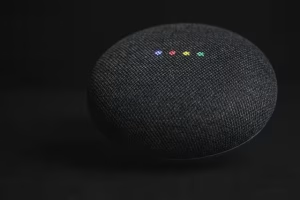
Examining existing AI personas helps to illustrate the practical application of a knowledgeable tone.
- Industry-Specific Examples:
- Finance: A robo-advisor like that from Wealthfront provides data-driven investment advice. Its tone is analytical, precise, and confident, using financial terminology correctly to build the trust of its users in its recommendations.
- Healthcare: Chatbots from organizations like the Mayo Clinic provide clear, factual information about symptoms and conditions. Their tone is cautious, objective, and empathetic, carefully avoiding definitive diagnoses while still conveying authoritative health information.
- Education: An AI tutor like Khanmigo from Khan Academy explains complex subjects with exceptional clarity. Its tone is encouraging and patient, yet it maintains an authoritative stance on the subject matter, guiding students step-by-step through problem-solving.
- Well-Known AI Assistants:
- Google Assistant: Excels at providing direct, factual answers pulled from its vast Knowledge Graph. Its tone is typically neutral, efficient, and highly knowledgeable, focusing on delivering accurate information quickly.
- IBM’s Watson: Particularly in its applications within professional fields like oncology and legal research, Watson is designed to have a deeply knowledgeable and analytical persona. Its communication is dense with data and evidence-based insights, reflecting its role as an expert assistant to professionals.
Potential Pitfalls and How to Avoid Them
While a knowledgeable tone is highly beneficial, there are potential pitfalls that can undermine its effectiveness if not managed carefully.
- Sounding Arrogant or Condescending: There is a fine line between being authoritative and being arrogant. The AI’s tone should be confident but never dismissive of the user. Avoid language that could be perceived as talking down to the user. The goal is to be a helpful expert, not a preachy know-it-all.
- Overloading the User with Information: An expert knows how to distill complex information into what is most relevant. Avoid “data dumping.” A truly knowledgeable persona provides concise, relevant answers and gives the user the option to explore more detail if they wish.
- Inflexibility and Inability to Admit “I Don’t Know”: No system is omniscient. It is crucial to program the AI to gracefully handle queries that fall outside its domain of expertise. A response like, “I don’t have information on that specific topic, but I can help you with [related area X],” is far better for maintaining trust than providing an incorrect or fabricated answer.
- Bias in the Knowledge Base: The AI’s knowledge is a reflection of its training data. If the data contains biases, the AI’s “knowledgeable” responses will perpetuate them. It is imperative to conduct thorough audits of the knowledge base to identify and mitigate potential biases to ensure the AI’s expertise is fair and objective.
The Future of Knowledgeable AI Personas
The development of AI personas is rapidly evolving, with several exciting trends on the horizon that will make them even more effective.
- Hyper-Personalization: Future AI personas will be able to dynamically adjust their knowledgeable tone based on the individual user. They might detect a user’s level of expertise from their vocabulary and tailor the complexity of their responses accordingly—providing simpler explanations for novices and more technical detail for experts.
- Emotional Intelligence (EQ) Integration: The next frontier is combining knowledge (IQ) with emotional intelligence (EQ). An AI that can recognize user emotions like frustration or confusion and adjust its supportive, knowledgeable tone in response will create a much more empathetic and human-like interaction.
- The Rise of AI Voice Cloning: As text-to-speech technology advances, brands will be able to embody their knowledgeable AI persona in a unique and recognizable voice. This will move beyond generic bot voices to create a distinct auditory brand identity, further strengthening the connection with the user and reinforcing the persona’s specific characteristics.
Conclusion: The Strategic Imperative of a Knowledgeable AI
In summary, crafting a knowledgeable tone for an AI persona is a multi-faceted discipline that sits at the intersection of data science, linguistics, and brand strategy. It begins with building a robust and accurate knowledge base, is shaped by precise and confident language, and is validated through continuous testing and user feedback. The benefits—from building foundational user trust and enhancing engagement to strengthening your overall brand authority—are profound.
In an increasingly AI-driven world, a knowledgeable persona is not just a “nice-to-have” feature; it is a strategic imperative. It is the key to transforming automated interactions from simple transactions into meaningful and valuable experiences. For any organization looking to effectively leverage artificial intelligence to communicate, build relationships, and lead in its industry, investing in the development of a well-crafted, knowledgeable AI persona is the definitive path forward.