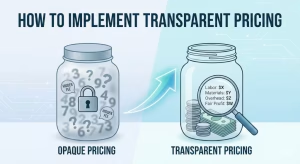
Have you ever walked into a store, picked up an item you loved, and then put it back because there was no price tag? It feels a bit like a trick, right? You might wonder if the clerk just makes up a price based on how nice your shoes look. For a small business owner, keeping your prices a secret is the fastest way to make a customer walk out the door. Today, the internet has changed everything. People want to know what they are paying for before they even talk to you. That is why learning how to implement transparent pricing is the most important move you can make this year.
In this guide, we are going to break down the technical side of being honest about your costs. We will look at how showing your numbers can actually help you show up better in local search results. We will talk about how to build trust without losing your shirt. Being open about your money isn’t just a nice thing to do; it is a smart business strategy that uses data to prove you are the best choice in town.
The Data Behind Radical Transparency

Don’t just look at what feels good; we should look at what the numbers tell us. When we talk about radical transparency, we are talking about a strategy backed by hard data. In my time at the SBA and working with various startups, I have seen that businesses which hide their costs actually lose money in the long run. Let’s look at why the data supports being an open book.
The Cost of Customer Friction
In the world of the internet, “friction” is anything that makes it hard for a customer to buy from you. Data shows that if a customer has to “call for a price,” up to 70% of them will simply leave your website. They don’t want to wait for a callback or deal with a high-pressure salesperson. By providing transparent pricing immediately, you remove that friction. You are essentially clearing the path so the customer can walk straight to the checkout counter.
Building “Cognitive Ease”
There is a psychological concept called “cognitive ease.” This is a fancy way of saying that when information is easy to understand, people trust it more. When you use transparent pricing, you are making it easy for the brain to process your value. If a customer has to do math or guess what a “service fee” covers, their brain gets tired and suspicious. Data from eye-tracking studies shows that users spend more time on pricing pages that are clearly itemized compared to those with vague “package” descriptions.
The Search Engine Advantage
From an SEO perspective, the data is even clearer. Google’s algorithms are designed to reward “Helpful Content.” When you create a detailed breakdown of your costs, you are providing high-value information.
-
Time on Page: Users stay longer to read detailed pricing guides.
-
Bounce Rate: Transparent pricing lowers the number of people who leave your site immediately in frustration.
-
Keyword Richness: By discussing the materials, labor, and overhead involved in your work, you naturally include hundreds of “long-tail” keywords that help local customers find you.
Establishing the “Trust Dividend”
In business, we often talk about the “Trust Dividend.” This is the idea that when trust is high, the speed of business goes up and the cost goes down. When you lead with transparent pricing, you aren’t just selling a product; you are selling your integrity. The data shows that customers who feel a business is honest are 50% more likely to recommend that business to a friend. For a small business in a local community, that word-of-mouth is more valuable than any expensive ad campaign.
Conversion Rate Optimization (CRO)
If we look at the raw conversion data, businesses that move to a transparent model often see a significant lift in their “Lead-to-Close” ratio. Why? Because the leads you get are already “pre-qualified.” If a customer sees your price is $500 and they still contact you, they have already accepted the cost. You no longer waste hours of your time talking to people who can’t afford your services. Transparent pricing acts as a filter, ensuring that your time, your most valuable resource, is spent only on the best prospects.
Phase 1: Auditing Your Current Pricing Architecture
Before you can show the world your prices, you have to make sure your own math is correct. You can’t have transparent pricing if you aren’t even sure where your money is going. This starts with a deep look at your “pricing architecture.” Think of this like the foundation of a house. If the foundation is shaky, the whole house will fall.
First, look at your “Cost-Plus” model. This is the basic math: what does it cost to make your product or provide your service? You have to count everything. Don’t just count the parts; count the electricity, the rent for your office, and the time it takes you to answer emails. Many small businesses fail because they forget to include these small costs.
Next, identify “Hidden Friction.” These are the little fees that annoy customers. Have you ever bought a plane ticket for $200, but by the time you finished, it was $350 because of bag fees and seat fees? That is the opposite of transparent pricing. Look for any “administrative fees” or “service charges” you have hidden in your fine print. To be truly open, you need to either get rid of these or include them in the main price from the very beginning.
Phase 2: Technical Implementation of a Transparent Interface
Now that you know your numbers, how do you show them on your website? This is where the technical side of being an expert comes in. You want your website to be easy to use. If a customer has to click ten times to find a price, you have failed at transparent pricing.
One of the best ways to do this is with a Tiered Pricing Model. Imagine three boxes side-by-side. The first box is the “Basic” plan, the middle is “Recommended,” and the third is “Premium.” Each box lists exactly what the customer gets. This makes it very easy for people to compare and see where their money is going.
Another great tool is a Component Breakdown. This is where you use a simple chart or a list to show the parts of a price. If you sell handmade furniture, show a pie chart. One slice is the wood, one slice is the labor, and one slice is the shipping. This proves to the customer that you aren’t just overcharging them; you are paying for quality.
Finally, consider a Dynamic Quote Engine. This sounds fancy, but it just means a calculator on your website. If a customer wants a bigger lawn mowed, they can slide a bar to the right, and the price changes instantly. This gives them an immediate answer without needing to wait for an email. It is the ultimate form of transparent pricing because it happens in real-time.
Phase 3: Strategic Communication and SEO Optimization
You should spend a lot of time thinking about how to get found on Google. Transparent pricing is actually a secret weapon for Search Engine Optimization (SEO). Most of your competitors are probably hiding their prices. That means they aren’t using keywords related to “cost” or “price” on their websites.
When you create a page called “How Much Does House Painting Cost in New York City?” you are going to get a lot of traffic. People are searching for those exact words. By providing an honest answer, you are giving Google exactly what it wants: helpful content.
You should also use something called Schema Markup. This is a bit of code that tells search engines like Google specifically what your price is. Have you ever seen a search result that shows five stars and a price right there on the Google page? That is because of Schema. When you use this technical tool, you make your transparent pricing visible before the customer even clicks on your link. This makes your business look more professional and trustworthy than everyone else.
Frequently Asked Questions about Transparent Pricing
What is the best way to show pricing transparency?
The best way is to be as simple as possible. Use a clear table or a list. Do not use “starting at” prices if you can avoid it. Give a real number. If the price changes based on the job, explain exactly why it changes. For example: “It costs $50 per hour plus the cost of parts.”
How do you handle price increases transparently?
Prices go up; that is just how the world works. But don’t just change the number and hope no one notices. Tell your customers ahead of time. Explain why. If the cost of wood went up by 20%, tell them that. People are much more understanding when you give them the data. Transparent pricing means being honest about the bad news, too.
Does transparent pricing work for B2B?
Yes, it works even better for business-to-business (B2B) companies. Other business owners are busy. They don’t want to sit through a long sales pitch just to find out they can’t afford you. By being open about your costs, you show that you value their time.
Can transparent pricing be a competitive disadvantage?
Some people worry that their competitors will see their prices and undercut them. But here is the secret: your competitors probably already know what you charge. By being the one to post it publicly, you win the trust of the customer first. Trust is worth much more than being $5 cheaper.
Overcoming Implementation Hurdles
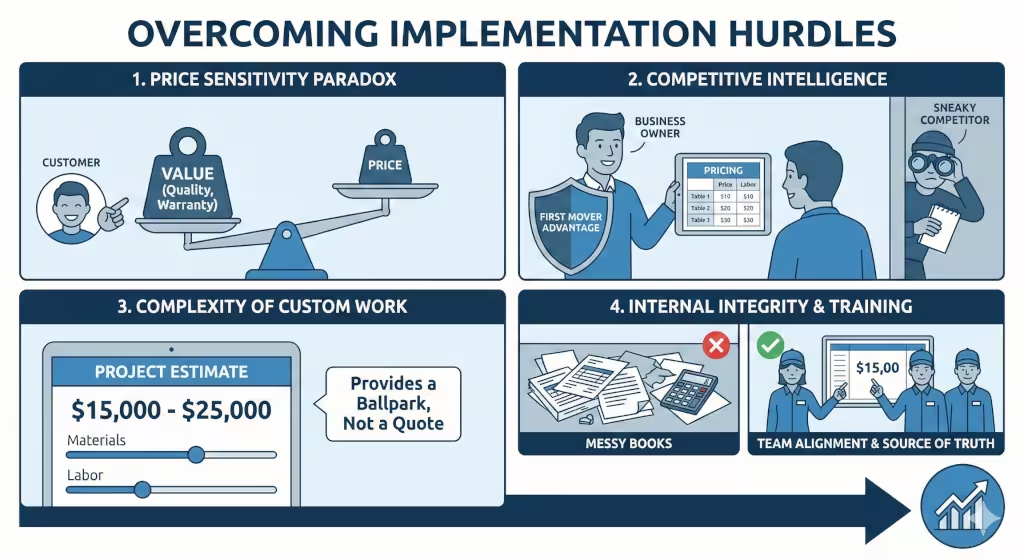
Moving to a transparent pricing model isn’t as simple as flipping a switch. It requires a shift in how you view your data and your competitors. While the benefits are clear, there are several “hurdles,” or roadblocks, that small business owners often face. Let’s break down how to climb over them using a technical, data-driven approach.
The “Price Sensitivity” Paradox
The biggest fear business owners have is that if they show their price, customers will only care about the number. This is called price sensitivity. If you are $10 more expensive than the shop down the street, you might worry the customer will leave.
To overcome this, you must pair your transparent pricing with a “Value Proposition.” Data shows that customers are willing to pay more if they understand why the price is higher. If your price includes a better warranty, higher-grade materials, or faster delivery, list those right next to the number. Transparent pricing isn’t just about the dollar sign; it is about showing the value the customer gets for that dollar.
Managing Competitive Intelligence
A common technical concern is that your competitors will use your transparent pricing to undercut you. In the world of business experts, we call this “Competitive Intelligence.” If you put your prices online, your rival can see them in seconds.
However, the data tells us a different story. In most local markets, your competitors already have a good idea of what you charge. By being the first to offer transparent pricing, you gain a “First Mover Advantage.” You earn the customer’s trust before the competitor even gets a chance to speak. To protect your secrets, you don’t have to show your exact profit margins or the names of your private suppliers. You just need to show enough to make the customer feel informed.
The Complexity of Custom Work
Many small businesses, like contractors or graphic designers, do custom work where every job is different. They argue that transparent pricing is impossible because they don’t know the cost until they see the job.
The fix for this is using “Price Bracketing” or “Starting At” models. Instead of a single number, give a range based on previous data. For example: “A standard kitchen remodel typically ranges from $15,000 to $25,000.” Then, provide a list of the variables that move the price up or down. This gives the customer a “ballpark” figure while protecting you from undercharging for a complex project.
Internal Data Integrity
You cannot have external transparency without internal accuracy. One hurdle is that many small businesses have “messy” books. If your internal data is wrong, your transparent pricing will be wrong, which leads to losing money.
Before you go public, you must perform a “Margin Audit.” This means checking that every service you offer actually makes a profit after all expenses. Once your internal numbers are solid, you can share them with confidence. Remember, transparent pricing is a reflection of a well-run, competent business.
Training Your Team
Finally, there is the human hurdle. Your staff might be used to negotiating or hiding prices. Moving to a transparent pricing model requires training. Your team needs to understand that the price on the website is the “source of truth.” This consistency builds brand integrity. When a customer hears the same price from your website, your secretary, and your sales team, their trust in your business doubles.
Case Studies in Excellence

There are big companies that have become famous just by using transparent pricing. One company is called Everlane. They sell clothes. On their website, they show exactly how much it cost to make a shirt—the materials, the hardware, the labor, and even the taxes. Then they show you their profit. People love them because they feel like they aren’t being cheated.
Another example is a software company called Buffer. They are so dedicated to transparent pricing that they even post the salaries of everyone who works there! While you don’t have to go that far, it shows how powerful honesty can be. When Buffer started being totally open, their sign-ups went through the roof.
The Path Forward
By now, you should see that transparent pricing is more than just a trend. It is a fundamental shift in how small businesses talk to their neighbors. It removes the fear and doubt that often stop a sale. It helps your website show up in more searches. Most importantly, it builds a bridge of trust between you and the people you serve.
When you are ready to start, don’t try to change everything at once. Start with your most popular service. Build a simple pricing table. Explain where the money goes. You will be surprised at how much your customers appreciate the honesty.
Bonus Section: A Value List that Justifies your Higher Price Points
The Value List: Justifying Your Rates Through Data
People do not always choose the cheapest option. They choose the option that offers the most “perceived value.” If you are going to use transparent pricing, you must show the customer exactly what that value is.
A Value List is a technical tool that breaks down your service into “Value Pillars.” These pillars hold up your price and show the customer that they are getting a great deal, even if your total cost is higher than a competitor. By putting this list right next to your numbers, you turn transparent pricing into a powerful sales pitch.
The Anatomy of a High-Value List
To make transparent pricing work for your small business, your list needs to be specific. General claims like “we are the best” do not work. You need data. You need facts. You need to show the items that justify the math. Below is a breakdown of the four main categories you should include in your transparent pricing strategy.
1. Premium Materials and Sourcing
When you are implementing transparent pricing, you should start with what goes into the product. Are you using recycled plastics? Are you using locally sourced wood?
-
Grade of Materials: If you use “Industrial Grade” instead of “Consumer Grade,” say so.
-
Longevity Data: Show that your materials last 5 years longer than the cheap version.
-
Sustainability: Many people will pay a premium if they know the sourcing is ethical. This is a key part of transparent pricing because it explains a higher “Cost of Goods Sold.”
2. Certified Expertise and Labor
Labor is often the biggest part of a bill, and it is where many customers get confused. Transparent pricing allows you to explain that your team isn’t just “workers,” but “specialists.”
-
Certifications: List the licenses or degrees your team holds.
-
Years of Experience: A plumber with 20 years of experience costs more than a trainee. Transparent pricing helps you explain that the customer is paying for “speed and accuracy.”
-
Safety Training: Mentioning that your team is safety-certified can be a huge value add for local homeowners.
3. Protection and Peace of Mind
This is an area where cheap competitors often cut corners. They might not have insurance or a good warranty. By using transparent pricing, you can highlight that a portion of your fee goes toward protecting the customer.
-
Insurance Coverage: Tell the customer you are fully bonded and insured.
-
Guarantee of Work: If you offer a 100% money-back guarantee, that has a specific dollar value.
-
Extended Warranties: Showing the cost of a warranty as $0 on a transparent pricing table is a great way to show value.
4. The Customer Experience Pillar
How easy is it to work with you? This “soft value” is hard to measure but very important.
-
24/7 Support: If you answer the phone at 3 AM, that is a massive value.
-
Digital Updates: Using a client portal or sending text updates has a technical cost that you can show through transparent pricing.
-
Cleanup and Disposal: If you leave a job site cleaner than you found it, that labor time is worth every penny.
The Comparison Matrix: Value vs. Cheapness
One of the best ways to display this information on your website is through a table. This makes your transparent pricing easy to read and understand at an eighth grade level.
| Feature | The “Cheap” Competitor | Your Small Business |
| Material Quality | Standard / Basic | Premium / Long-life |
| Staff Training | General Labor | Certified Specialists |
| Insurance | Often None / Limited | $2 Million Liability |
| Warranty | 30 Days | 3 Year Full Coverage |
| Pricing Model | Hidden / Hidden Fees | Full Transparent Pricing |
| Communication | Voice Mail Only | Real-time Text Updates |
How This List Powers Your SEO Strategy
Beyond just helping you sell, this Value List is great for your search engine rankings. When you list these items, you are naturally using keywords that your customers are searching for. For example, people might search for “insured plumber in New York” or “furniture made with sustainable wood.”
By including these details in your transparent pricing pages, you are telling Google that your site is a rich source of information. This improves your “Domain Authority” and helps you rank higher than competitors who have thin, vague websites. Transparent pricing gives you a reason to write more content, and more content leads to more traffic.
Technical Math: Calculating Your Value-to-Price Ratio
To be truly competent in your business, you should know your Value-to-Price ratio. We can use a simple formula to think about this:
In this formula:
-
V is the Value Perception.
-
B is the Total Benefits (the items in your Value List).
-
C is the hidden costs or risks (like the risk of a bad job from a cheap competitor).
-
P is the Price.
When you use transparent pricing, your goal is to make $B$ (the benefits) as large as possible in the customer’s mind. When the benefits are much higher than the price, the customer feels like they are winning. This is the “sweet spot” where small businesses grow the fastest.
Final Thoughts on Your Value List
Creating this list is the final step in mastering transparent pricing. It takes your numbers and gives them a “soul.” It tells a story of quality, hard work, and honesty. Instead of just seeing a bill, the customer sees a partnership.
When you implement transparent pricing, you are essentially telling the customer, “I have nothing to hide because I know my work is worth it.” That confidence is contagious. It turns one-time buyers into lifelong fans who will tell their friends about the honest business in town.