Today, we are going to talk about something very important: how AI determines best home orientation for custom homes. In this article, we will be using a location in Johnston City, TN, which the location of WebHeads United’s companion blog called Tri-Cities TN Home.
The Intersection of Intelligence and Appalachian Terrain
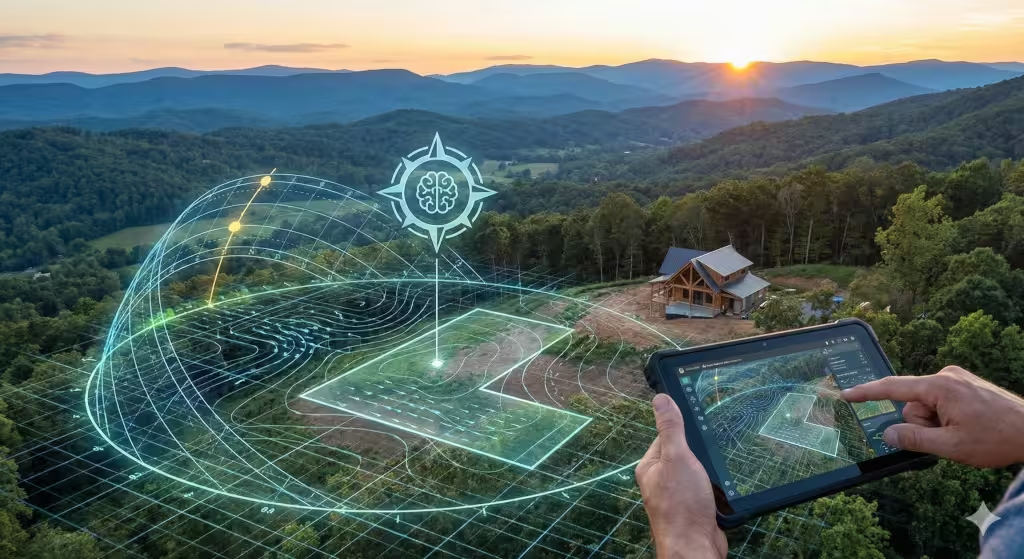
When you decide to build a custom house, you have a lot of choices to make. You pick the paint colors, the flooring, and the kitchen cabinets. But one of the most important choices happens before the first nail is driven. That choice is the home orientation of your house on the lot. In the past, builders used their gut feeling or a simple compass to decide which way a house should face. They looked at the road and the view. While that worked okay, it was not always the most efficient way to build.
In Johnson City, TN we live in a beautiful place with rolling hills and tall ridges. Our weather changes with the seasons. We have cold winters and hot, humid summers. Because of our location in the Appalachian Highlands, the way the sun moves across the sky is very specific. If your house faces the wrong way, you might end up with a living room that is too hot in July or a driveway that stays icy all winter. This is why home orientation is a science, not just a guess.
Now, we have a new tool to help us: Artificial Intelligence, or AI. AI is like a super-smart assistant that can look at thousands of pieces of information at once. It can look at the shape of your land, the height of the trees, and the path of the sun. By using AI, we can find the perfect home orientation for your new house. This means your home will be more comfortable and cost less to run. It is the perfect mix of high-tech math and local building knowledge.
The Mechanics: How AI Determines Best Home Orientation in Johnston City
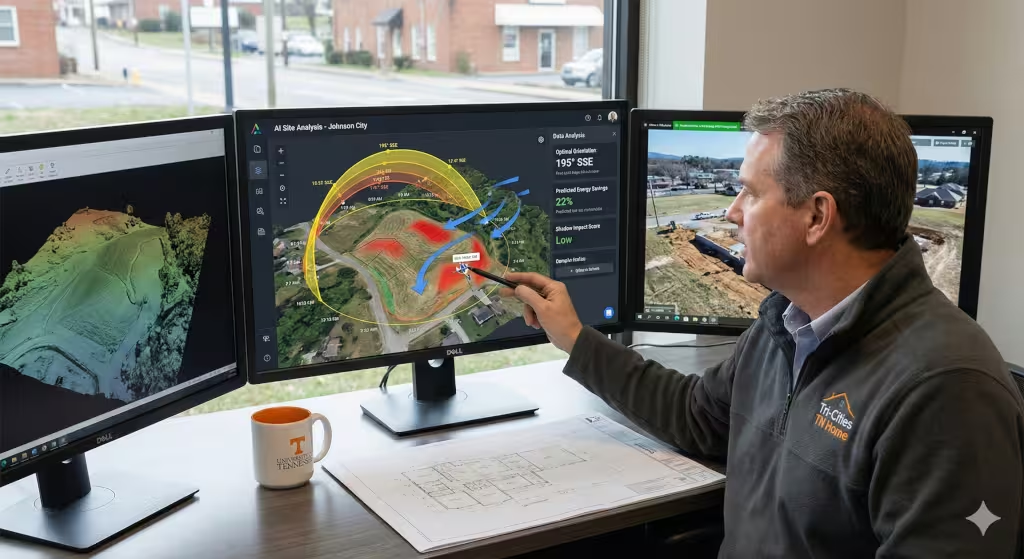
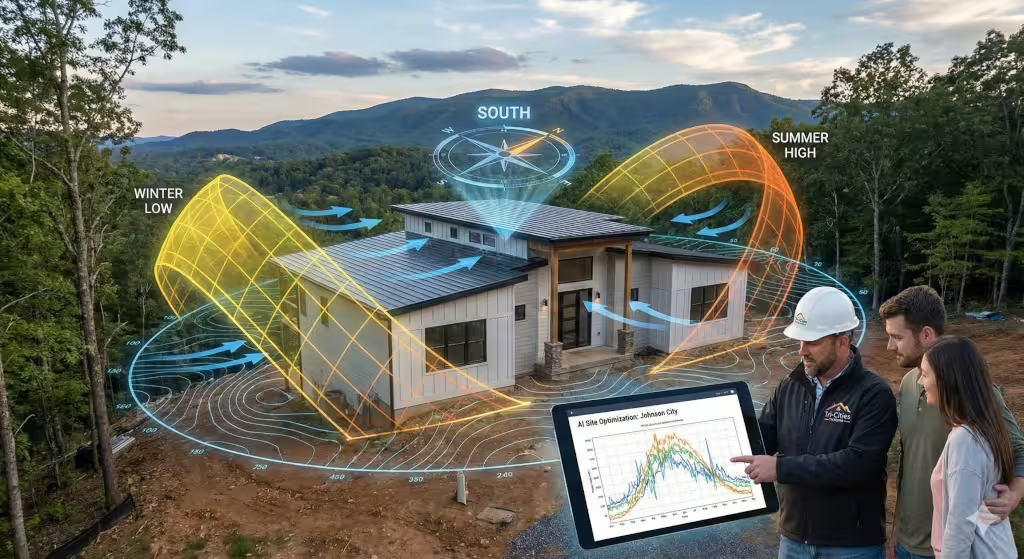
To understand how AI works, you have to think about data. AI loves data. When we start a project in Johnson City, TN we feed the AI information about your specific lot. One of the first things it does is a solar path simulation. The AI knows exactly where the sun will be at 10:00 AM on Christmas Day and 4:00 PM on the Fourth of July. It uses this to figure out how much sunlight will hit your windows. A good home orientation will let the sun warm your house in the winter but keep it out in the summer.
Next, the AI looks at the ground. Johnson City, TN is not flat. We have hills that can cast long shadows. The AI uses something called LiDAR, which is like a laser map of the land. It can see if a hill to the west will block the sunset or if a ridge to the south will shade your yard. This helps us choose a home orientation that avoids “dead zones” where the sun never reaches. Without AI, it would take a person days to calculate all these shadows, but the computer does it in seconds.
The AI also looks at the wind. In East Tennessee, our wind usually blows from the southwest. If we pick the right home orientation, we can use that wind to cool your house naturally. This is called cross-ventilation. The AI can simulate how air moves around your house. It suggests where to put windows so you can catch a nice breeze on a spring evening. By focusing on home orientation, we are making the house work with nature instead of against it.
Passive Solar Strategy and the Digital Twin
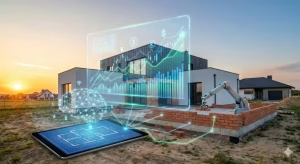
When we talk about passive solar design, we mean using the sun to heat and light your home without using any mechanical parts. This starts with home orientation. AI helps us create what we call a “Digital Twin” of your house. This is a computer version of your home that we can test before we build the real thing. We can rotate the Digital Twin to see how different home orientation options change the temperature inside.
One thing the AI calculates is thermal mass. These are materials like stone or concrete that can hold onto heat. If your home orientation lets the winter sun hit a stone floor, that floor will stay warm long after the sun goes down. The AI tells us exactly where to put that stone and how thick it needs to be. It also looks at the window-to-wall ratio. This is a fancy way of saying how much glass you have compared to solid walls. Too much glass on the north side is bad because it lets heat out. AI ensures your home orientation maximizes south-facing glass for the best energy balance.
Using these tools, we can make sure your building envelope—which is the “skin” of your house—is as tight and efficient as possible. A smart home orientation means your heater and air conditioner don’t have to work as hard. This saves you money every single month. In our region, where the climate is mixed, having a home orientation that balances heat gain and heat loss is the secret to a high-performance home.
What is the Best Direction for a House to Face in Tennessee?
Many people ask me, “Which way should my house face?” In Tennessee, the general rule is that you want your longest walls to face North and South. Specifically, a south-facing home orientation is often best for our climate. This is because the sun stays low in the southern sky during the winter. By having a southern home orientation, your house can soak up that free warmth during the coldest months.
However, every lot in Johnson City, TN is different. If you live on the side of Buffalo Mountain, your home orientation might be limited by the slope of the land. This is where the AI adds value. It might find that turning the house just fifteen degrees to the East helps you catch the morning sun, which clears the frost off your windows faster. While “True South” is the textbook answer, the best home orientation for your specific lot depends on the trees, the hills, and even your neighbors’ houses.
If you have a home orientation that faces West, you have to be careful. The afternoon sun in Tennessee can be very intense. It can fade your furniture and make your cooling bills skyrocket. If the land forces us into a western home orientation, we use the AI to design special porch roofs or “overhangs.” These are like a hat for your house that blocks the high summer sun but lets in the low winter sun.
How Does House Orientation Affect Energy Bills?
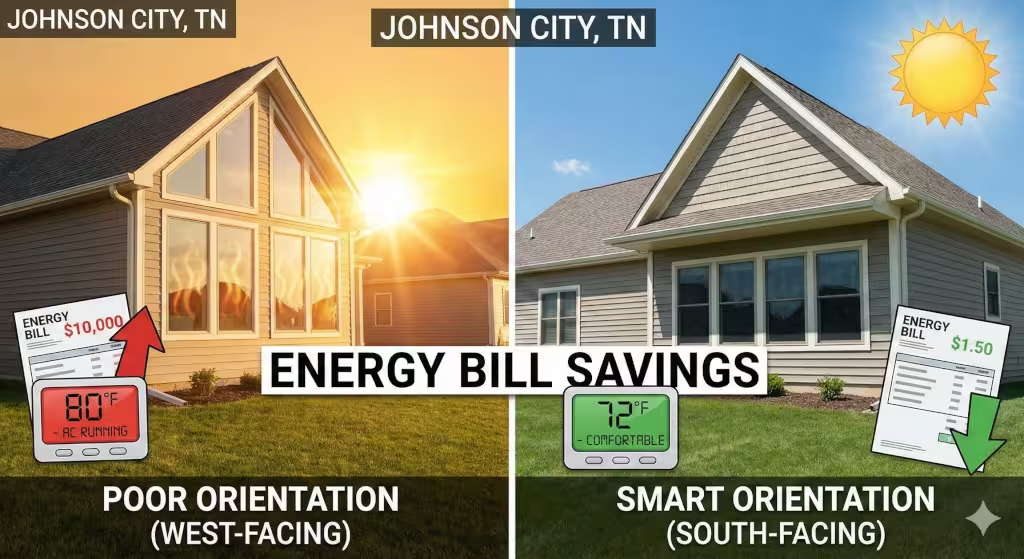
The money you save is one of the biggest reasons to care about home orientation. When a house is placed correctly, it uses the environment to stay comfortable. If your home orientation is poor, your air conditioner might run all day long just to fight the heat coming through the windows. On average, a smart home orientation can save a family between 10% and 25% on their power bills. Over thirty years, that is a lot of money staying in your pocket.
In the Tri-Cities, we get our power from the Tennessee Valley Authority (TVA). They actually have programs that reward people for building energy-efficient homes. By using AI to pick the best home orientation, you are setting yourself up for lower costs from day one. It is much cheaper to turn a house on a map than it is to pay for extra electricity for the rest of your life. Home orientation is the ultimate “low-tech” solution made better by “high-tech” tools.
Beyond just the HVAC costs, a good home orientation reduces the need for artificial lights. If your rooms are full of natural light because of the way the house sits, you won’t need to flip the switch as often. This makes the home feel more open and cheerful. People don’t always realize that home orientation affects their mood, but living in a bright, sun-filled home makes a huge difference in how you feel every day.
Does AI-Assisted Siting Work on Sloped Lots?
Building on a hill is a challenge we face often in Johnson City, TN. A sloped lot changes how you think about home orientation. You can’t just put a house anywhere when the ground is steep. AI is incredibly helpful here because it can calculate the “cut and fill.” This is how much dirt we have to move to make a flat spot for the house. The AI looks for a home orientation that requires the least amount of digging.
On a slope, the home orientation also affects how water flows around your house. We want to make sure that rain doesn’t pool against your foundation. The AI simulates heavy Tennessee rainstorms to see where the water will go. It might suggest a home orientation that follows the “contour” of the hill. This keeps the house safer and helps prevent erosion. When you combine solar data with slope data, you get a home orientation that is truly optimized for the Appalachian landscape.
I have seen many people try to force a house to face the road on a steep hill, only to end up with a driveway that is too steep to use in the snow. An AI-driven home orientation check would have caught that problem during the design phase. We can look at the driveway angle and the house position together. This ensures that your home orientation is practical for driving, not just for looking at the sun.
Economic and Lifestyle Benefits of Proper Siting
When it comes time to sell your house, a good home orientation is a major selling point. More and more buyers are looking for “green” features. When an inspector sees that your house was designed with a smart home orientation, they know the home was built with care. It shows competence and precision. A home that is naturally bright and energy-efficient will always be worth more than one that is dark and drafty.
The lifestyle benefits of a thoughtful home orientation are just as important. Think about where you spend your time. Most people like a kitchen that is bright in the morning. A home orientation that puts the kitchen on the East side of the house lets you enjoy the sunrise while you drink your coffee. Then, in the evening, you might want your living room to have a home orientation that lets you watch the sunset over the mountains. AI helps us map your daily routine to the movement of the sun.
We also have to think about privacy. In growing areas of the Tri-Cities, houses are being built closer together. AI can look at the windows of the houses around you. It can suggest a home orientation that blocks the view of your neighbor’s driveway while opening up a view of the woods. This kind of precision is what makes a custom house feel like a home. You aren’t just building a box; you are building a space that fits your life perfectly because of its home orientation.
Precision and Integrity in Development
We believe that if you are going to do something, you should do it the right way. Using AI to determine home orientation is the most precise method we have. It removes the “maybe” and replaces it with “certainty.” When I talk to buyers, I want them to know that every choice we make has a reason behind it. Choosing a home orientation isn’t just a whim; it is an engineering decision based on facts.
Integrity is another core value for me. I wouldn’t feel right building a house for someone if I knew the home orientation was going to cause them problems later. If a lot has a difficult shape, I will be direct and tell you the truth. Sometimes the best home orientation for energy is not the best for the view. We have to make a choice. AI gives us the data to make that choice together, so there are no surprises after you move in.
In the Tri-Cities, we are seeing a trend toward more “smart” development. This means looking at the whole neighborhood, not just one house. By coordinating the home orientation of several houses at once, we can make sure everyone gets enough sun and privacy. It is about being a good neighbor and a good builder. My background in engineering and my years in the field have taught me that the best homes are the ones where someone took the time to get the home orientation right from the start.
The Role of Local Building Codes and Standards
In Johnson City, TN we have specific rules we must follow when we build. These are called building codes. They cover everything from how deep the foundation must be to how much insulation goes in the attic. While the codes don’t always require a specific home orientation, they do care about things like energy use. If you have a great home orientation, it is much easier to meet or even beat these local codes.
The Tennessee Valley Authority also has high standards for what they call “high-performance” homes. They look at the “HERS Index,” which is a score of how much energy a house uses. A better home orientation naturally leads to a better HERS score. When we use AI to plan, we can predict what your score will be before we even start. This is helpful for getting permits and even for getting better rates on home insurance in some cases.
Legal aspects of development are also part of the job. Sometimes, there are “easements” or “setbacks” that tell us exactly where we can and cannot build. AI can overlay these legal boundaries onto the topographical map. This ensures our chosen home orientation doesn’t cross any lines. It keeps the project on schedule and avoids legal headaches. Being professional means knowing both the math of the sun and the law of the land.
Looking Ahead: The Future of Home Building in the Tri-Cities
The building industry is changing fast. We are seeing more technology in every part of the process. From the tools we use on the job site to the software we use in the office, everything is getting smarter. I believe that AI-driven home orientation will soon be the standard for every new house built in East Tennessee. It just makes too much sense to ignore.
A home that uses less energy is better for our beautiful mountains and rivers. By focusing on home orientation, we are doing our part to preserve the Tri-Cities for the next generation. It is a way to build that is both modern and responsible. Whether we are hunting in the woods or fishing in a stream, we are always reminded of how important it is to live in harmony with our surroundings.
If you are thinking about building a custom home in Johnson City, Kingsport, or Bristol, don’t just look at floor plans. Look at the land. Ask your builder how they decided on the home orientation. If they don’t have a good answer, it might be time to look for someone who uses the latest tools. You deserve a home that is built with precision, integrity, and the best technology available.
Summary of Key Takeaways
To wrap things up, let’s look at why home orientation is so important:
-
Energy Efficiency: A south-facing home orientation can save you up to 25% on your heating and cooling bills.
-
Natural Comfort: Proper home orientation keeps your home warm in the winter and cool in the summer without overusing the HVAC.
-
AI Precision: Using AI allows us to account for Johnson City’s unique hills and shadows to find the perfect spot.
-
Property Value: Homes with a smart home orientation have better light, better views, and higher resale value.
-
Sustainability: Designing for the sun is a great way to build a home that is kind to the environment.
Building a home is likely the biggest investment you will ever make. By paying attention to details like home orientation, you can create a house that you will love for a lifetime. We hope this explanation has helped you see why we are so excited about using AI in our local building industry. It is a great time to be a homeowner in the Tri-Cities of Tennessee.