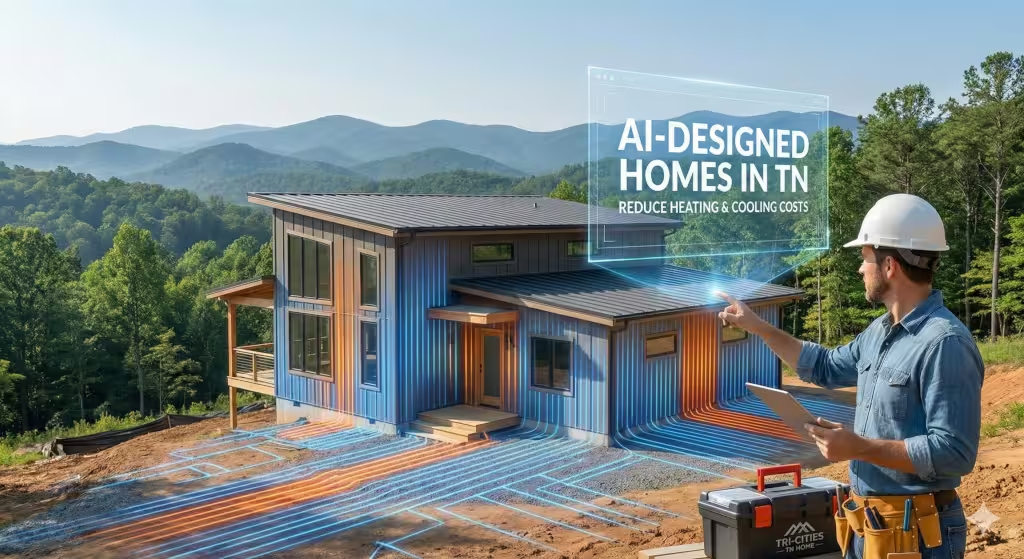
The local weather in the Tri-Cities of TN can do just about everything. We deal with heavy humidity in the summer and sharp freezes in the winter. For years, folks in the Tri-Cities have just accepted high utility bills as a part of life. But things are changing fast in 2026. In this post, we will use the Tri-Cities of Tennessee as an example for showing how AI can help with your heating and cooling costs.
Our goal at WebHeads United is to show you that you do not have to settle for basic building methods anymore. By using artificial intelligence to design your home, we can pinpoint exactly how to save you money. We are moving past the old way of building where every house on the street looks the same and faces the same way.
Now, we use data to make sure your home works with the environment instead of fighting against it. If you want to reduce heating and cooling costs with AI-designed homes in TN, you need a plan that is precise and full of integrity. This article will explain how we use high-tech tools to build better homes for our neighbors in Northeast Tennessee.
Precision Planning: How AI Dictates Home Orientation
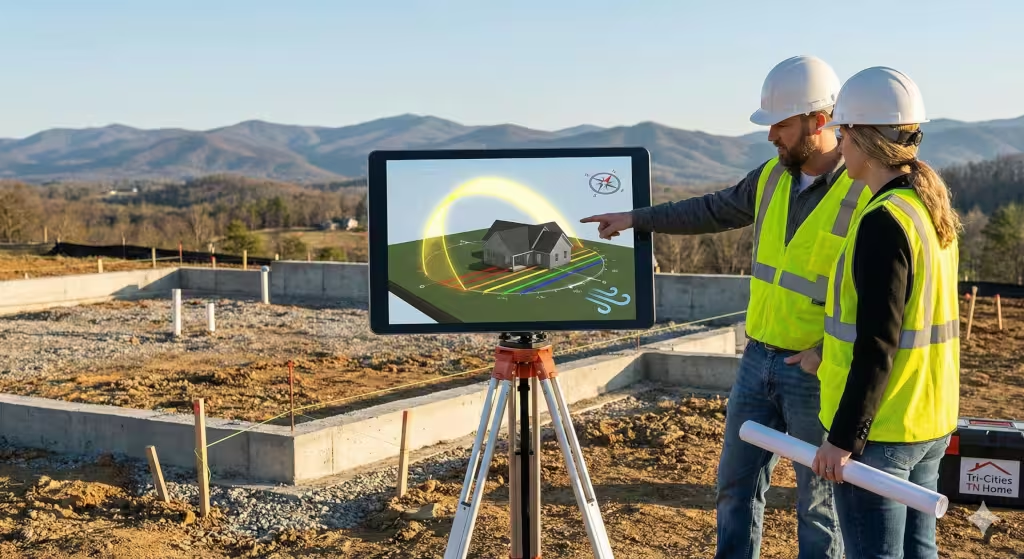
When we talk about building a house in places like Bristol or Johnson City, the first thing we look at is the land. In the past, a builder might just pick the flattest spot and start digging. But AI-designed homes start with a much deeper look at the property. We use AI to study the solar path specifically for our part of the Appalachian Highlands. The sun sits at different angles in July than it does in December. An AI tool can run thousands of tests to find the best way to turn your house. This helps your home soak up free warmth from the sun in the winter while staying shaded in the summer.
This kind of planning is key for managing your heating and cooling. If your largest windows face the blistering afternoon sun in August, your air conditioner will have to work twice as hard. AI helps us avoid that mistake before we ever pull a permit. It also looks at wind patterns. Because we have so many ridges and valleys in the Tri-Cities, wind can act like a funnel. AI models can show us how to place the house so that natural breezes help with cooling. This reduces the need for constant heating and cooling throughout the changing seasons. We call this passive solar design, and it is the smartest way to start any new build.
Using these tools means we can be precise. We do not guess where the shadows will fall. We know exactly where they will be at 2:00 PM on a Tuesday in October. This level of detail helps us pick where to put porches, where to hide the HVAC units, and where to place heavy insulation. When the house is oriented correctly, the natural environment does a lot of the heavy lifting for your heating and cooling. This leaves less work for your mechanical systems and more money in your pocket.
The Digital Twin: Thermal Modeling for the Appalachian Climate

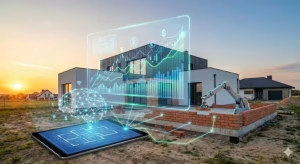
One of the coolest parts of modern home building is the digital twin. This is a virtual version of your home that lives inside a computer. Before we ever buy a single board or nail, we can see how the house will handle the Tennessee air. We use this digital twin to perform thermal modeling and hence, your heating and cooling. This is just a fancy way of saying we test how heat moves through the house. We can simulate a week of 95 degree weather with 90 percent humidity. We can also simulate a January snowstorm.
The AI looks at the digital twin and finds weak spots. Maybe the master bedroom gets too cold because of a certain window layout. Or perhaps the attic is holding too much heat. The AI suggests changes to the design to fix these issues. This ensures that your heating and cooling will be efficient from day one. You do not want to find out your house is drafty after you have already moved in. By stress testing the design virtually, we solve heating and cooling issues that used to take years to notice.
This process also helps us pick the best materials. Not all insulation is the same. The AI can tell us if spending a little more on spray foam in the roof will save enough on heating and cooling to pay for itself in three years. In the Tri-Cities, we have very specific micro-climates. A house on a hill in Jonesborough faces different challenges than a house in a valley in Elizabethton. Digital twins allow us to customize the building envelope for your exact GPS coordinates. This is the kind of competence and precision that makes a custom home truly high-performance.
AI Smart HVAC: The Future of Interior Climate Control

Once the house is built, the AI does not just go away. In 2026, the brain of your home is a smart HVAC system. Traditional systems are either on or off. They wait until the house is uncomfortable and then blast air to fix it. This is a very expensive way to handle heating and cooling. AI systems are different. They are predictive. This means they look at the weather forecast for Kingsport or Bristol and prepare the house ahead of time. If the system knows a cold front is coming tonight, it can slowly adjust the temperature during the day when electricity might be cheaper.
These smart systems also use something called zoning. In a normal house, you might have one thermostat for the whole place. If you are sleeping upstairs, you are still paying to keep the downstairs living room perfectly comfortable. AI-designed homes use sensors to know where people are. If everyone is in the kitchen and dining area, the system focuses the heating and cooling right there. It dials back the energy used in empty bedrooms or the basement. This prevents waste and keeps your bills low.
Humidity is another big deal in East Tennessee. We all know that sticky feeling in the middle of summer. High humidity makes you feel hotter than it really is. This leads people to crank down the AC, which uses a lot of power. An AI-managed system can control a whole-home dehumidifier. By keeping the humidity at the right level, you can feel comfortable at 75 degrees instead of 70 degrees. This is a huge win for your heating and cooling budget. The system learns your habits over time and gets better at keeping you comfortable without you ever having to touch the wall unit.
Real Talk: Costs, Savings, and Professional Roles
Buyers often wonder if these AI-designed homes are too expensive for the average person. It is a fair question. But to be direct, a home built with this much technology can cost about 5 to 10 percent more upfront. However, you have to look at the long term value in your heating and cooling costs. In the Tri-Cities, the average electric bill is around 180 dollars a month. With an AI-optimized house, many of my clients see that bill drop by 30 percent or more. That adds up to thousands of dollars in savings over just a few years. Plus, your home will be worth more if you ever decide to sell it.
Another common question is whether the AI replaces the architect or the builder. The answer is no. Think of AI as a very powerful tool, like a high-end saw or a laser level. It helps me do my job better, but it still takes a human with local experience to make the final calls. You still need someone who understands the local building codes in Johnson City. You still need a person who knows which local subcontractors do the best work. AI provides the data, but humans provide the integrity and the craft.
When we look at the heating and cooling needs of a family, we also consider the ROI, or return on investment. Some tech is worth the price, and some is just for show. The job of the builder is to explain which features will actually lower your bills. For example, a smart grid connection with TVA can save you money by using power when it is most plentiful. We look at the data and help you make a choice that fits your budget and your goals. We want you to have a home that is precise in its design and efficient in its function.
Next-Gen Materials: Insulation and the High-Performance Envelope
The walls of your home are what keep the outside air out and the inside air in. In 2026, we have moved far beyond just pink fiberglass batts in the walls. For the best heating and cooling, we now use materials like Structural Insulated Panels, or SIPs. These are like giant sandwiches of foam and wood. They are incredibly strong and they have almost no gaps. This creates a very tight seal for the house. When a house is “tight,” it means the air you paid to heat or cool stays exactly where you want it.
We also focus on something called thermal bridging. This happens when heat travels through the solid parts of your walls, like the wood studs. Even if you have good insulation between the studs, the wood itself can let heat in or out. AI design helps us use advanced framing techniques to reduce these bridges. We might also add a layer of continuous insulation on the outside of the house. This is like putting a warm coat on your home. It makes a massive difference in how much you spend on heating and cooling throughout the year.
Windows are another critical piece of the puzzle. In the Tri-Cities, we have many beautiful views, but big windows can be an energy nightmare for heating and cooling. We now use high-performance glass with special coatings. These coatings reflect heat back where it came from. In the winter, they keep the heat inside. In the summer, they keep the sun’s heat outside. This makes your heating and cooling much more effective. We look for windows with high R-values and low U-factors. These numbers tell us how well the window resists heat flow. It is all about using the right science to get the best result for your home.
The Smart Grid and Energy Independence in the Tri-Cities
In East Tennessee, we are lucky to have the Tennessee Valley Authority, or TVA. They are doing a lot to modernize our power grid. An AI-designed home can actually talk to the power grid. This is called a smart grid connection. If there is a huge demand for electricity on a hot July afternoon, the grid can send a signal to your home. Your AI system might decide to pre-cool the house by two degrees an hour early. This helps the whole community avoid blackouts and can even earn you credits on your bill. It is a smart way to manage heating and cooling for everyone.
Many buyers are also looking into solar panels and battery storage to use for heating and cooling. AI is perfect for managing these systems. It can decide when to use power from your batteries and when to sell extra solar power back to the utility company. This gives you a level of energy independence we never had before. Even if the power goes out after a big storm in the mountains, your home can keep the heating and cooling running at a basic level. This provides peace of mind for your family.
We also make sure new homes are “solar ready.” This means even if you do not buy panels today, the house is built to handle them later. We run the wires and strengthen the roof in the right spots. This is part of being precise and thinking about the future. We want your home to be a legacy for your family. By preparing for new technology now, we save you from having to do expensive renovations later. This forward-thinking approach is what makes building in the Tri-Cities so exciting right now.
Understanding Efficiency Standards in 2026
Building codes have changed a lot recently. In 2026, the Department of Energy has set new rules for how efficient HVAC systems must be. We now use ratings like SEER2 and HSPF2. These are just ways to measure how much comfort you get for every watt of power you use. For a new home in Tennessee, you want a system that goes above the minimum requirements. This is where the AI comes in again. It helps us calculate the exact size of the system you need.
A lot of old houses have HVAC systems that are too big for heating and cooling. You might think bigger is better, but it is actually worse. A system that is too big turns on and off too quickly. This does not remove enough humidity from the air and it wears out the equipment faster. It also leads to higher costs for heating and cooling. AI helps us get the “Goldilocks” size—not too big, not too small, but just right. This ensures the system runs for longer cycles, which is much better for the equipment and your comfort.
We also look at air quality. A tight house needs to breathe, but it needs to breathe in a controlled way. We use Energy Recovery Ventilators, or ERVs. These devices bring in fresh outdoor air but swap the heat between the incoming and outgoing air. This means you get fresh air without losing all the energy you spent on heating and cooling. It is a win for your health and your wallet. In a place like the Tri-Cities where pollen can be a problem, having a filtered, controlled air system is a huge benefit for anyone with allergies.
The Role of Topography and Local Landscape
Living in a place like Johnson City means dealing with hills. Your home’s location on a hill or in a valley changes your heating and cooling needs. AI can model the local topography to see how shadows from nearby hills or trees will affect your home. If you are on the north side of a steep ridge, you will have less sun in the winter. This means we might need to beef up the insulation on that side of the house.
We also look at landscaping as a tech tool. AI can suggest where to plant deciduous trees—the ones that lose their leaves. If you plant them on the south side of your home, they provide deep shade in the summer to help with cooling. In the winter, the leaves fall off and let the sun shine through to help with heating. This is a natural way to supplement your high-tech AI design. It shows how we can combine nature with data to get the best results.
Even the soil in Tennessee matters. We have a lot of clay here. AI-designed systems can look at the ground temperature for geothermal options. Geothermal uses the steady temperature of the earth to help with heating and cooling. While it can be more expensive to install, the data often shows it is a great choice for long term savings in our region. We provide all this information so you can make a choice that is based on facts and precision.
Building Your Legacy in the Tri-Cities
Building a custom home is one of the biggest things you will ever do. It is about more than just four walls and a roof. It is about creating a space where your family can grow and be comfortable for decades. By choosing to reduce heating and cooling costs with AI-designed homes in TN, you are making a smart investment. You are choosing a path of competence and integrity. You are making sure that your home is ready for whatever the Tennessee weather throws at it.
From the historic streets of Jonesborough to the new developments in Kingsport, we are building homes that are smarter and better than ever before. We do not have to guess anymore about heating and cooling. We have the tools to be precise. We have the data to be efficient. And we have the local heart to make sure every house feels like a home.
If you are ready to start your journey, remember that the best home building experience starts with a good plan. Use the technology available in 2026 to your advantage. Focus on your heating and cooling early in the design phase. Work with people who understand the Tri-Cities and who value precision as much as you do. Your future self, and your monthly bank statement, will thank you for it.