Over the years the field of agriculture has transformed from a game of intuition into a discipline of extreme precision.
In 2026, we are no longer guessing where a cow is grazing or if a tractor has crossed a property line. We are using invisible digital walls to manage the land. This is the spatial revolution, and it is changing everything about how we grow food and manage resources.
Below is the comprehensive examination into the world of geofencing within the agriculture industry.
The Spatial Revolution: What is Geofencing in Agriculture?
The world of agriculture is currently going through a massive change. In the past, a farmer had to be physically present to see if a gate was left open or if a machine was in the right field. Today, we use something called geofencing. Think of a geofence as an invisible, digital fence that you draw on a map using a computer. Even though you cannot see it with your eyes while standing in a field, the machines and sensors on the farm know exactly where that fence is located.
As we move through 2026, this technology has become the backbone of what we call precision agriculture. Because we now have better satellites and faster internet in rural areas, these digital fences are more accurate than ever. We used to be happy if a GPS could tell us where something was within ten feet. Now, we can pinpoint a location within less than an inch. This level of detail allows the agriculture industry to automate tasks that used to take hundreds of man-hours.
At its simplest level, geofencing in agriculture is about creating a “smart” perimeter. When a piece of equipment, a person, or an animal enters or leaves that area, the system sends a signal. That signal can send a text message to a farmer, start a motor, or even shut down a machine for safety. It turns the physical space of a farm into a digital workspace where every movement is tracked and managed.
The Technical Framework: How Agricultural Geofencing Works
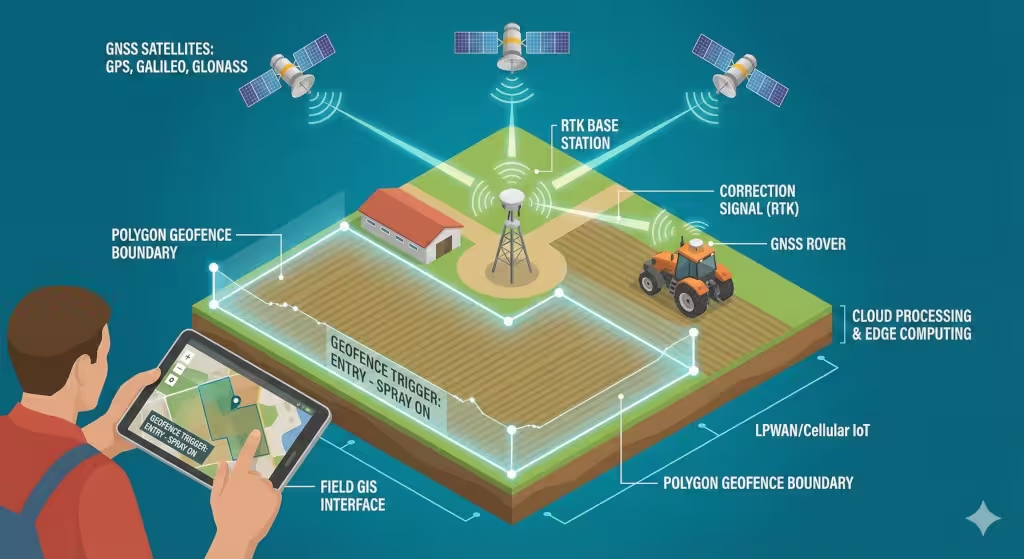
The foundation of any geofence in agriculture is a concept called “Spatial Awareness.” This is the ability of a computer system to understand its location in three-dimensional space. For a farm to use geofencing, it needs three distinct layers of technology working in perfect harmony: the satellite layer, the correction layer, and the software layer.
The Satellite Layer: Global Navigation Satellite Systems (GNSS)
Everything starts in space. While most people use the term “GPS,” in the professional agriculture world, we use the term GNSS. This is because modern equipment doesn’t just use American GPS satellites. It also listens to the European Galileo system, the Russian GLONASS, and the Chinese BeiDou system.
By listening to more satellites, a piece of agriculture equipment can maintain a lock on its position even if there are trees nearby or if the weather is bad. Each satellite sends a time-stamped signal. The receiver on the farm calculates how long it took for that signal to arrive. By doing this with at least four satellites, the receiver can figure out its latitude, longitude, and altitude.
The Correction Layer: Real-Time Kinematic (RTK) Positioning
Standard satellite signals have a natural error of about three to ten feet. In many industries, that is fine. However, in agriculture, if you are planting seeds or spraying weeds, a ten-foot error is a disaster. This is where RTK comes in.
RTK uses a “Base Station” placed at a known, fixed point on the farm. Because the base station knows exactly where it is, it can see the errors in the satellite signals in real-time. It then sends a correction signal to the “Rover” (the tractor or the animal collar). This correction happens instantly, allowing the agriculture equipment to know its position with sub-centimeter accuracy. This is what makes a geofence “solid.” Without RTK, your digital fence would wobble back and forth, causing the system to trigger at the wrong times.
The Software Layer: Geographic Information Systems (GIS)
Once we have an accurate location, we need a place to draw the fence. This happens in GIS software. In the context of agriculture, the GIS acts as the “brain.” A farmer or a technician uses a tablet or a computer to load a map of the property.
They then create a “Vector” file. Unlike a regular picture, a vector file is made of mathematical coordinates. There are three types of shapes used in agriculture geofencing:
-
Point: A single set of coordinates, used for things like a soil sensor or a gate.
-
Line: Used to mark paths, like a specific road the tractors should stay on.
-
Polygon: This is the most common. It is a closed shape that represents a field, a pond, or a grazing area.
Communication Protocols: LPWAN and Cellular IoT
A geofence is useless if the data cannot get back to the farmer. In rural agriculture settings, we often don’t have great cell phone service. This is why we use LPWAN, which stands for Low-Power Wide-Area Network.
Technologies like LoRaWAN allow sensors on a farm to send small bits of data over very long distances while using almost no battery power. This is perfect for livestock collars. The collar doesn’t need to send a video feed; it just needs to send a “Yes/No” signal regarding whether the animal is inside the geofence. For larger equipment, like a combine, we use Cellular IoT (Internet of Things) which can handle larger amounts of data for real-time agriculture analytics.
The 2026 Datum Shift: NATRF2022
As I mentioned earlier, the Earth is not a perfect sphere, and the tectonic plates are always moving. In 2026, the agriculture industry has fully moved to a new system called NATRF2022.
Older maps used a system called NAD83. The problem is that North America moves about an inch every year. Over forty years, that adds up to a big gap. The new 2022 system is “plate-fixed,” meaning the map moves with the continent. For high-tech agriculture, this ensures that a geofence drawn five years ago is still in the exact same spot today, even if the Earth’s crust has shifted.
Trigger Logic and Cloud Processing
The final piece of the technical framework is the “Trigger.” This is the “If-Then” logic that runs in the cloud.
-
If Tractor A enters Polygon B, Then send an alert to the manager.
-
If Cow #402 exits the Virtual Fence, Then trigger the audio cue on the collar.
In 2026, much of this processing happens at the “Edge.” This means the computer on the tractor does the math itself instead of waiting for a signal from a distant server. This removes “latency,” which is the delay in communication. In agriculture, a three-second delay could mean a machine drives through a physical fence before the computer realizes it should have stopped. Edge computing makes geofencing nearly instantaneous.
Core Use Cases: Transforming Efficiency in the Field
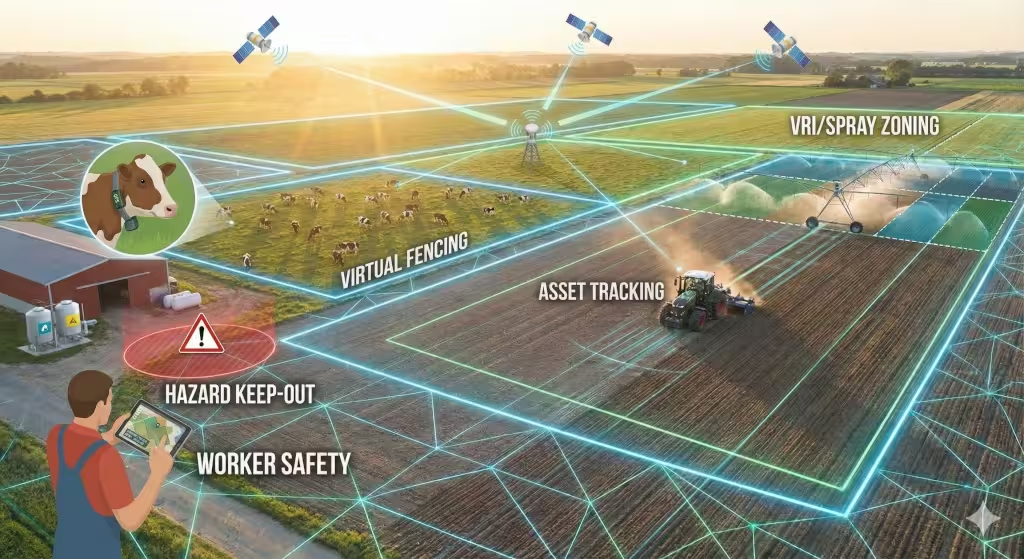
Geofencing solves real world problems that have plagued the world of agriculture for centuries. We are moving from a time where we managed farms by the acre to a time where we manage them by the inch. This section will look at how we apply this technology in the daily life of a farm.
The practical side of geofencing in agriculture is where the data becomes truly valuable. It is one thing to have a digital map, but it is another thing to use that map to save money, protect animals, and grow more food. Here are the primary ways that modern farms are putting these digital walls to work.
Livestock Management and Virtual Fencing
One of the most exciting shifts in agriculture is the move toward virtual fencing for livestock. Traditionally, if you wanted to keep cows in a specific area, you had to build a physical fence. This meant hours of labor digging post holes and stringing wire. It also meant that once the fence was built, it was stuck there. If the grass in that area was eaten down to the dirt, you had to manually move the animals to a new field.
In modern agriculture, we use GPS enabled collars to create virtual fences. A farmer can sit at a kitchen table and draw a new grazing area on a tablet. The collars on the cattle receive this new geofence data immediately. As the cattle move toward the edge of this invisible line, the collar gives a small audio warning. If the cow continues to move toward the line, it receives a mild pulse.
This allows for something called regenerative grazing. In this type of agriculture, animals are moved frequently to ensure they do not overstay their welcome on one patch of grass. This keeps the soil healthy and allows the grass to grow back stronger. Geofencing makes this process easy and cheap because there are no physical fences to move. It also helps with biosecurity. If a farm is dealing with a disease, geofences can keep healthy animals away from areas where sick animals might have been.
Asset and Equipment Tracking
The machines used in agriculture today are extremely expensive. A single combine or tractor can cost as much as a luxury home. Keeping track of where these assets are is a major job. Geofencing provides a high level of security and oversight for these investments.
When a piece of equipment is fitted with a geofence tag, the owner can set up a “home” perimeter. If that tractor leaves the farm property at an unusual time, like in the middle of the night, the system can automatically lock the engine and alert the police. This has significantly reduced the rate of equipment theft in the agriculture industry.
Beyond security, geofencing helps with logistics and maintenance. In large scale agriculture, you might have twenty different machines working across thousands of acres. A manager can look at a screen and see exactly which field each machine is in. The system can also track “dwell time.” If a machine stays in one spot for too long during a work day, it might mean it is broken down or the operator needs help. This allows the agriculture operation to stay on schedule.
Variable Rate Irrigation and Chemical Application
Water is a precious resource in agriculture, and geofencing helps us use it with surgical precision. Many large farms use center pivot irrigation, which is a giant sprinkler on wheels that moves in a circle. In the past, these sprinklers would spray water at a constant rate over the whole circle. The problem is that a single field might have different types of soil. Some parts might be sandy and need more water, while other parts might be clay and need very little.
By using geofencing, we can divide a single field into many different zones. As the irrigation pivot moves, it checks its location against the geofences for those zones. When it enters a “low water” zone, the computer tells the nozzles to slow down. When it enters a “high water” zone, it speeds them up. This type of precision agriculture saves millions of gallons of water and prevents the runoff of nutrients into local streams.
We see the same benefit when applying fertilizers or pesticides. A geofence can be drawn around a sensitive area, such as a creek or a neighbor’s organic garden. When the spray rig approaches that boundary, the system automatically shuts off the nozzles. This ensures that chemicals only go where they are intended to go, which is a major goal for sustainable agriculture.
Hazard Mitigation and Worker Safety
Safety is a top priority in the agriculture sector. Farms have many hidden dangers, from overhead power lines to deep irrigation canals. Geofencing can act as a digital safety net for workers. We can create “Keep Out” zones around these hazards. If a worker carrying a mobile device or wearing a smart vest enters one of these zones, an alarm will sound.
This is also very important for protecting equipment operators. Many accidents in agriculture happen when a tall machine hits a low hanging power line. By geofencing the locations of all power lines on the property, the machine can give the operator a warning before they get too close. It can even be programmed to lower the height of the machine automatically.
Autonomous Agbots and the Future of Labor
As we look toward the future of agriculture, we see more robots in the fields. These “Agbots” perform tasks like weeding, planting, and scouting for pests. Because there is no human sitting in the driver’s seat, these robots rely entirely on geofencing to stay safe.
A geofence creates a “mission area” for the robot. The robot is programmed to never leave that specific polygon. If the sensors on the robot fail or if there is a software glitch, the geofence acts as a hard stop. If the robot crosses the line, the power is cut. This makes it possible for one person to manage a fleet of robots across a large agriculture landscape without worrying about a machine wandering off into a road or a neighbor’s field.
Monitoring Environmental Compliance
In many parts of the world, agriculture is subject to strict environmental rules. Farmers must often prove that they are staying a certain distance away from protected wetlands or forests. Geofencing provides an easy way to track and prove this compliance.
The system creates a digital record of every movement made by machines and livestock. If a government agency needs to see proof that no cattle grazed in a protected riparian zone, the farmer can produce a digital report showing the geofence boundaries and the animal tracks. this level of data integrity builds trust between the agriculture industry and environmental regulators.
By using geofencing in these ways, the world of agriculture is becoming more efficient and more transparent. We are using data to make better decisions every single day. This is not just about cool gadgets; it is about ensuring that we can continue to feed the world while taking better care of the land we all share.
Common Questions About Agriculture Technology
Many people wonder if this technology is too expensive for small-scale agriculture. The truth is that the cost is dropping rapidly. Most smartphones already have the hardware needed to use basic geofences. For a small farm, geofencing can help track shared equipment or monitor high-value crops with very little investment.
Another question is: “Is geofencing the same as GPS tracking?” The answer is no, but they work together. GPS tracking tells you where something is. Geofencing tells the computer what to do when that thing moves to a certain spot. Tracking is about data; geofencing is about action.
People also ask how geofencing affects animal welfare in agriculture. Studies have shown that virtual fences are often less stressful for animals than physical ones. Once the animals learn the audio cues, they rarely ever trigger the pulse. It allows them to roam more freely across diverse landscapes while staying away from dangerous cliffs or poisonous plants.
Advanced 2026 Trends: The Expert Perspective
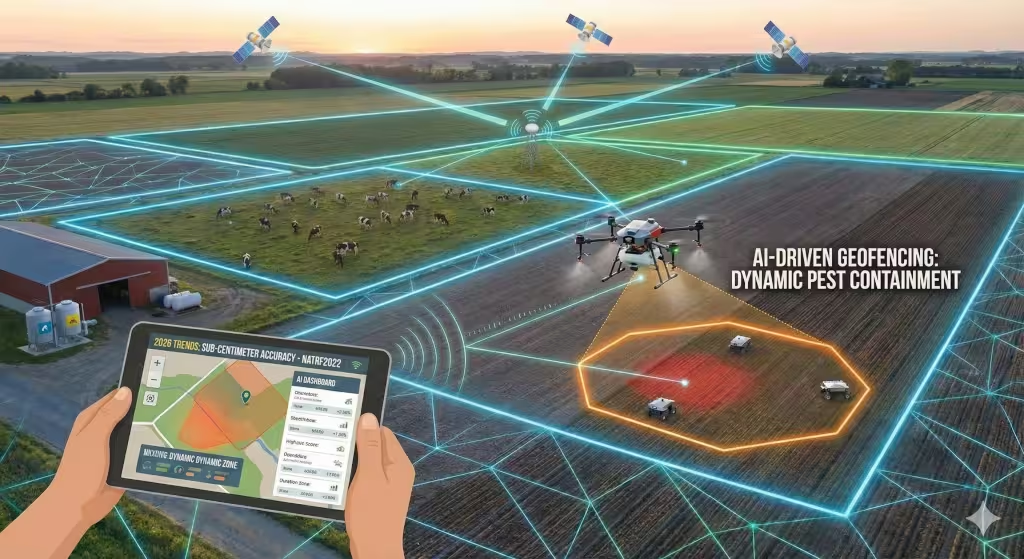
In 2026, we are seeing the rise of AI-driven geofencing. Imagine a field where the geofences change on their own. If a drone sees a patch of weeds, it can create a temporary geofence around that spot. Then, a robot sprayer knows exactly where to go. This “dynamic” geofencing is the next big step for agriculture.
Data Integrity and the Future of Farming
In my years of practice, I have learned that data integrity is the most important part of any tech system. In agriculture, if your map data is wrong, your farm is wrong. We have to ensure that the digital boundaries we draw match the physical world perfectly. This requires high-quality sensors and a deep understanding of geography.
The future of agriculture is digital. As we continue to use geofencing, we will see farms that are more productive, more sustainable, and safer. We are reducing the amount of chemicals we use, saving water, and making sure our animals are healthy, all by using the power of spatial data.
Whether you are a small family farm in Texas or a giant agriculture company in California, geofencing is a tool you cannot afford to ignore. It is the bridge between the physical soil and the digital cloud, and it is here to stay.