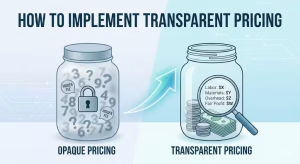
The New Frontier of Custom Building in Northeast Tennessee
Today, we are going to look at custom hom builder pricing trends, and use the Tri-Cities of Tennessee as the example. Building a home in the Tri-Cities in 2026 is different than it was just a few years ago. We are seeing a market that is more stable, but it is also more complex. In places like Johnson City, Kingsport, and Bristol, the old ways of guessing costs just do not work anymore.
Many people used to use a simple price per square foot. They would take a number and multiply it by the size of the house. That is a dangerous way to plan today. It often leads to major budget overruns that can stop a project in its tracks.
The truth is that the cost of wood, concrete, and labor changes every week. If your builder is using a price from six months ago, you are already in trouble. This is why we are seeing a shift toward new technology. We are now using tools that can think and learn. By using AI that watches local pricing trends, we can be much more precise. This approach helps us maintain integrity and competence in every build. It allows us to give you a clear picture of what your dream home will actually cost.
When we talk about building with precision, we are talking about protecting your investment. A custom home is likely the biggest purchase you will ever make. You deserve to have numbers that are backed by data, not just a gut feeling. As we move into this new era of building in Northeast Tennessee, the goal is to use every tool we have to avoid budget overruns. This ensures that the home you finish is the same one you dreamed of at the start.
Understanding the Tech: How AI Learns Local Pricing
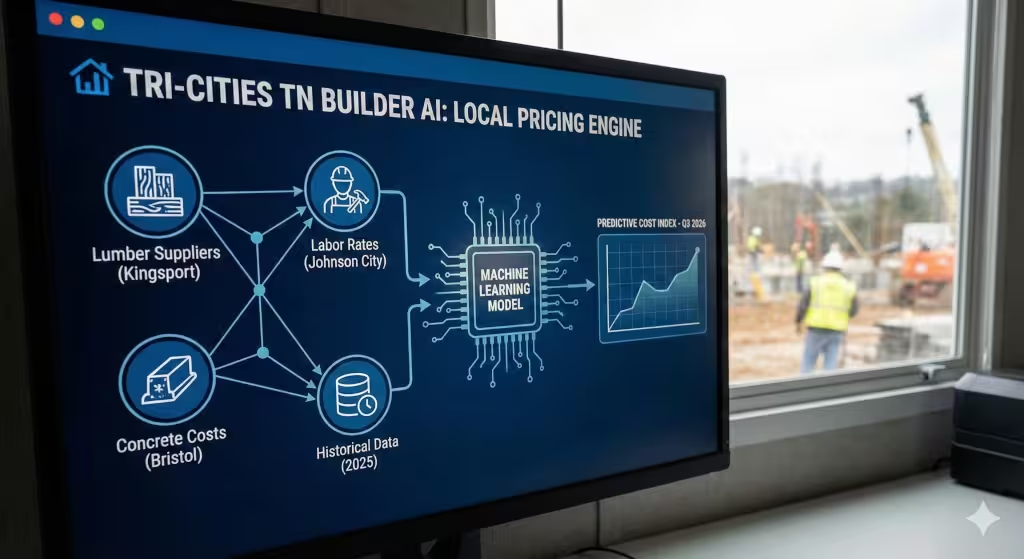
You might wonder how a computer program can know the price of a 2×4 in Kingsport. It starts with data. AI systems today are like sponges. They soak up information from many places at once. They look at what local suppliers are charging for lumber and shingles. They look at the wages being paid to plumbers and electricians in the Tri-Cities area. Because these systems are always active, they see the small changes that a human might miss. This constant watching is the key to stopping budget overruns before they start.
In the past, a builder would have a big book or a spreadsheet with prices. They would update it maybe once or twice a year. But in 2026, the supply chain moves fast. AI can see a spike in concrete prices in Knoxville and know that it will hit Johnson City in two weeks. It uses machine learning to find patterns. If prices always go up in the spring when everyone starts building, the AI accounts for that. It builds those trends into your estimate so you are not surprised later and have budget overruns.
Predictive analytics is another big part of this tech. It does not just look at what things cost now. It looks at what they will likely cost when your house actually needs them. If you start your home in February, you won’t need the kitchen cabinets until the fall. The AI looks at history and current trends to guess what those cabinets will cost months from now. This kind of forward thinking is how we manage to avoid budget overruns. It gives us a digital twin of your finances that stays accurate throughout the whole build.
Avoid budget overruns with AI that learns from local builder pricing trends

The main reason people face budget overruns is that their initial plan was not accurate. Using AI that learns from local builder pricing trends changes the game. It allows for what we call “precision estimating.” Instead of a broad guess, we get a line-item view of the whole house. Every door, every window, and every foot of wire is priced based on the latest local data. This level of detail is the only way to truly stay on track.
Another factor is regional labor indexing. In our part of Tennessee, we have a specific mix of skilled workers. Sometimes there is a shortage of frame workers in Bristol, which drives up their hourly rate. AI tracks these local labor shifts. It knows if it will cost more to get a crew out to a site in rural Washington County compared to a site near the city center. By knowing these details, the system helps you avoid budget overruns that come from unexpected labor costs.
Scenario modeling is also a great feature of this technology. Let’s say you are debating between hardwood floors and high-end tile. The AI can show you how each choice impacts your total cost in real time. It doesn’t just look at the material price. It looks at the labor cost for installing each one in our local market. This helps you make smart choices that fit your wallet. When you have this much information, you can make decisions that help you avoid budget overruns from the very first day.
Combatting the “Five Horsemen” of Budget Overruns
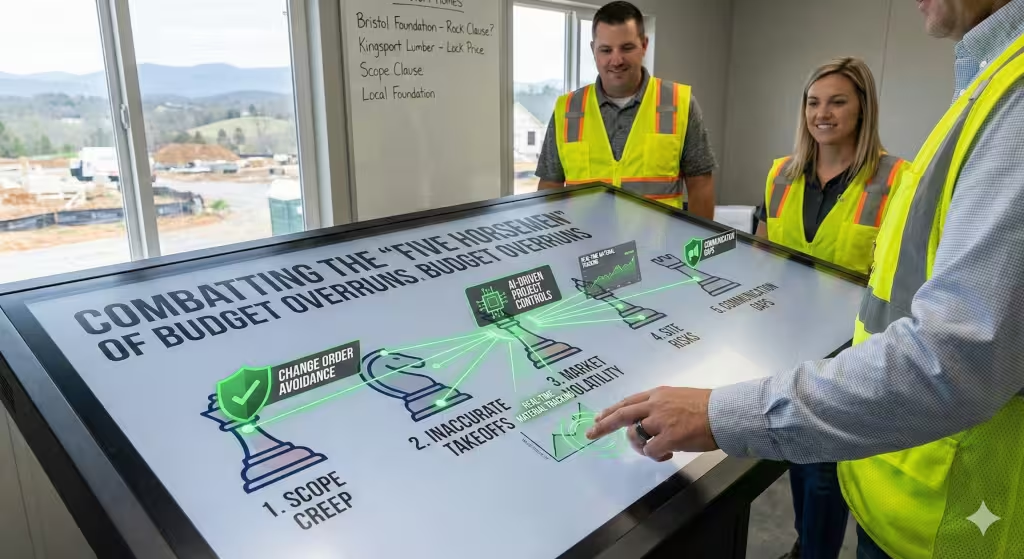
There are five main things that usually cause a project to go over its price limit and have budget overruns. I call them the Five Horsemen. The first is scope creep. This happens when you add “just one more thing” over and over again. Maybe you decide you want a bigger deck or a better stove. Those small choices add up fast. AI helps by flagging these changes immediately. It shows you exactly how that “one more thing” will cause budget overruns so you can decide if it is worth it.
The second horseman is inaccurate takeoffs. A “takeoff” is the list of materials needed for the build. If the builder misses 500 feet of pipe in the plan, that is a cost you will have to pay later. Modern AI uses computer vision to look at your blueprints. It counts every single item with perfect accuracy. It ensures that the initial bid includes everything. This is a powerful way to avoid budget overruns caused by human error during the planning phase.
Market volatility is the third horseman. We all know how prices for things like steel and copper can jump around. AI tracks these global trends and how they affect the Tri-Cities. It can suggest buying certain materials early to “lock in” a lower price. By managing these risks, the tech helps you avoid budget overruns that are outside of your control. It gives you a shield against the ups and downs of the world economy.
Site-specific risks are the fourth horseman. Our area has lots of hills and different types of soil. A lot in Boones Creek might be easy to build on, while a lot in the mountains might need extra foundation work. AI can pull data from local soil maps and past builds nearby. It can warn you if a site is likely to need extra rock removal or a more complex septic system. Addressing these issues early is key to ensuring you avoid budget overruns from site work.
Finally, we have communication gaps. If the architect, the builder, and the homeowner are not on the same page, mistakes happen. Mistakes lead to rework, and rework leads to budget overruns. AI acts as a central hub for all project data. It ensures that everyone is looking at the most current set of plans and prices. When everyone has the same facts, the project moves faster and stays on budget.
Common Questions Answered About Custom Home Budget Overruns
People often ask what causes most construction budget overruns. In my experience, it usually comes down to making changes after the work has started. When you change your mind on the job site, it costs twice as much. You have to pay to tear something down and then pay to build it again. This is why having a “design freeze” is so important. Using AI to visualize everything before you break ground is the best way to prevent these mid-build changes and avoid budget overruns.
Another common question is whether AI construction estimating is really accurate. In 2026, the answer is a clear yes. While no system is 100% perfect, AI is much better than the old manual ways. It can process millions of data points in seconds. It doesn’t get tired or make math errors. Builders who use this tech can often get their bids within 2 or 3 percent of the final cost. That is a huge improvement over the 15 or 20 percent errors we used to see. It is the best tool we have to avoid budget overruns.
Finally, folks want to know how to choose a builder who uses this tech. When you are interviewing contractors in the Tri-Cities, ask them about their estimating process. Do they use real-time local data? Do they have a system that tracks daily price changes? A builder who embraces technology is a builder who values precision. They are more likely to be honest with you about costs. Choosing the right partner is the first step to ensuring you avoid budget overruns during your build.
Engineering Your Investment
We believe that every problem has a logical solution if you have enough data. Building a home is a complex puzzle with many moving parts. To solve it without stress, you need a plan that is built on facts. Using AI to track local pricing trends is not just a “neat feature.” It is a necessary part of a professional building process. It allows us to act with integrity by giving you an honest price from the start.
We have always preferred to look at the long-term view. When you build a house, you aren’t just thinking about today. You are thinking about the next 30 years. If you start with budget overruns, you may have to cut corners on things that matter, like insulation or high-quality windows. Those cuts will cost you more in the long run through high power bills or repairs. By using technology to stay on budget, you protect the long-term value of your home. You ensure that every dollar is spent where it will do the most good.
Integrity is also about being direct. I will always tell you the truth about what a project costs, even if it is not what you want to hear. I would rather have a tough conversation during the planning phase than a crisis during construction. AI gives us the data we need to have those honest talks. It takes the guesswork out of the room. When we have a clear, data-backed plan, we can move forward with confidence and avoid budget overruns together.
Building with Confidence in 2026
We live in a great time to be building in the Tri-Cities. Our local market is finding its balance, and the technology available to us is incredible. Whether you are looking to build a modern craftsman in Gray or a mountain retreat near Bristol, the tools are there to help you succeed. By using AI that learns from local builder pricing trends, you are taking a giant leap toward a stress-free experience. You are choosing to build with precision and intelligence.
Remember that the best way to avoid budget overruns is to be prepared. Take the time to do your research. Choose a builder who uses the best tools available. Be clear about your goals and stick to your plan. Building a custom home is a journey, and like any journey, it goes much better when you have a good map. I hope this guide helps you feel more confident as you start your own building project here in Northeast Tennessee.
Your home should be a place of peace and pride. By focusing on the data and staying disciplined, you can make sure that the building process is just as rewarding as the final result. We have a wonderful community here in the Appalachian Highlands, and I look forward to seeing more beautiful, well-built homes added to our landscape. Let’s work together to use technology for good and avoid budget overruns on every project we touch.
A Checklist of Questions to Ask Your Builder
In our local market, from the suburbs of Johnson City to the more rugged terrain near Bristol, the right technology can be the difference between a successful project and a financial disaster.
To help you avoid budget overruns with AI that learns from local builder pricing trends, I have put together a checklist of questions. These are designed to cut through the marketing “fluff” and get to the core of how a builder actually manages your money.
The Precision Builder Interview Checklist
I. Data and Local Market Intelligence
-
“What specific data sources does your AI use to track material prices in the Tri-Cities?”
-
Why it matters: You want to know if they are looking at national averages or real-time feeds from local suppliers in Northeast Tennessee. National data won’t help if there is a local spike in lumber at the Kingsport yards.
-
-
“How often does your pricing system update its labor rate index for our region?”
-
Why it matters: Labor shortages in specific trades (like HVAC or masonry) can drive up costs quickly. Their system should refresh these rates at least weekly.
-
-
“Can your software account for site-specific costs based on local topography and soil data?”
-
Why it matters: Building in the Appalachian Highlands requires specific foundation work. A tool that learns from nearby builds will be much more accurate about your excavation costs.
-
II. Process and Integrity
-
“Can you show me a sample ‘Price Variance Report’ generated by your AI during a build?”
-
Why it matters: This shows they are actually monitoring the budget in real-time. If costs shift, you want to see how the system flags it before it becomes a crisis.
-
-
“How does your system handle ‘what-if’ scenarios if we decide to change a finish or layout?”
-
Why it matters: You need to see the immediate impact on the total project cost. If it takes them three days to give you a price for a change, they aren’t using real-time AI.
-
-
“What is the average margin of error between your initial AI estimate and the final build cost on your last three projects?”
-
Why it matters: In 2026, a competent builder using modern tech should be within a 3% to 5% range. Anything higher suggests they aren’t using the data effectively.
-
III. Communication and Transparency
-
“Will I have access to a real-time dashboard to see my budget status at any time?”
-
Why it matters: Integrity comes from transparency. You shouldn’t have to wait for a monthly meeting to know if you are on track.
-
-
“How does the AI verify the accuracy of subcontractor bids against current market trends?”
-
Why it matters: Sometimes a sub might overbid because they are busy. The AI should flag any bid that is significantly higher than the local average, helping you avoid budget overruns.
-
Why These Questions Protect You
When you ask these questions, you are looking for competence. A builder who stumbles over these answers is likely still relying on the “old way” of guessing. In an era where material costs can fluctuate overnight, guessing is a recipe for failure. By insisting on a builder who uses AI that learns from local builder pricing trends, you are ensuring that your project is engineered for financial success from the very first shovel in the ground.
Precision isn’t just about the measurements of your walls; it’s about the measurement of your investment. My experience in the Knoxville and Tri-Cities areas has taught me that the most satisfied homeowners are the ones who had the most accurate data at the start.