In today’s article we are excited to share some groundbreaking research with you. As you may have noticed we are moving away from old, boring ways of understanding people and moving toward something much more alive. It is a shift from things that are stuck in time to things that grow with us. Let’s dive into the fascinating world of how we model human minds in the digital age.
The Death of the Paper Persona
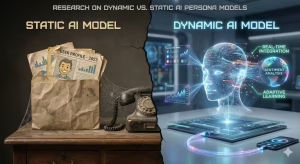
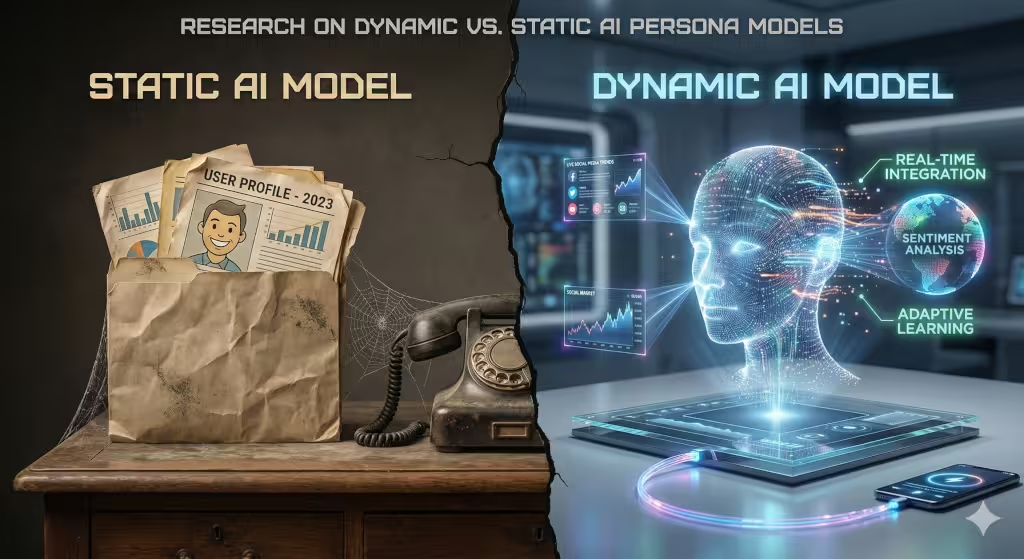
For a long time, businesses used something called a “paper persona.” This was basically a PDF or a printed sheet of paper that described a fake person. It would say things like, “This is Sally. She is 35, lives in the suburbs, and likes coffee.” Companies used these to try to understand their customers. But there was a big problem. Sally never changed. She was stuck in that PDF forever, even if the world around her moved on.
At WebHeads United, we call this the death of the paper persona. In the year 2026, the world moves way too fast for a piece of paper. If a new trend starts on social media or the economy changes, “Static Sally” doesn’t know about it. She becomes useless very quickly.
That is why the research on dynamic vs. static AI persona models is so important today. We are now building personas that can actually “think” and “react.” Instead of a static image, we have a dynamic partner. This change is not just about cool technology. It is about making sure businesses don’t waste money talking to a ghost of a customer who doesn’t exist anymore. By using dynamic models, we can discover things we never saw before. It is like turning on a light in a dark room.
Defining the Dichotomy: Static vs. Dynamic Frameworks
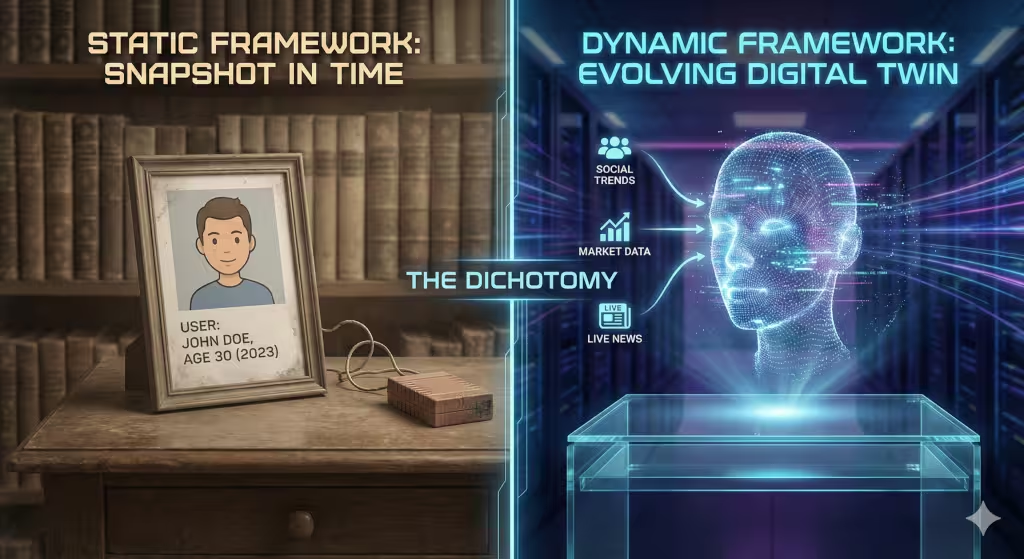
Often, the most significant barrier to effective AI implementation is a misunderstanding of how data ages. To truly grasp dynamic vs. static ai persona models, we must look at the structural “skeleton” of these frameworks.
Think of a framework as the rules of the game. If the rules never change, the game becomes predictable and eventually loses its connection to the real world. This is the core of the dichotomy we are discussing.
The Anatomy of Static AI Persona Models
A static model is built on what we call “flat data.” When we at WebHeads United create a static persona, we are essentially taking a snapshot of a target audience at a specific moment in time. This is often done using historical data, such as purchase records from three years ago or a survey that was taken over a single weekend in 2024.
The problem with this approach is that humans are not flat. We are multi-dimensional and constantly changing. In the research on dynamic vs. static ai persona models, we see that static models suffer from “data decay.” Just like milk in a fridge, data has an expiration date.
If your static persona represents a “Tech-Savvy Millennial,” that persona might still think that a specific social media platform is the coolest place to be, even if that platform went out of style months ago. Because the model is static, it cannot “learn” that the world has moved on. It is a closed system. It is reliable for understanding who your customer was, but it is a failure at predicting who your customer is becoming.
The Architecture of Dynamic AI Persona Models
Now, let’s look at the other side of the research on dynamic vs. static ai persona models. A dynamic model is an “open system.” Instead of being a finished book, it is more like a live website that updates every second.
These models are built using a technology called a Neural Network. This is a computer system designed to work a bit like a human brain. When we build these at WebHeads United, we don’t just give the AI a list of facts. We give it “sensors.” These sensors are actually API connections, digital bridges, that allow the persona to “read” the news, monitor price changes in the market, and even sense the general “mood” of the internet through sentiment analysis.
In the research on dynamic vs. static ai persona models, we call this “Active Learning.” The model is constantly asking itself, “Is my current understanding of the world still true?” If it sees that its favorite coffee brand just raised its prices by 50%, the dynamic persona will immediately adjust its “behavior.” It might start looking for a cheaper brand or complain about inflation in its next simulated conversation. This makes the persona feel like a real, living person who lives in the same world you do.
Why the Difference Matters for Data Integrity
As someone who values data integrity above all else, the research on dynamic vs. static ai persona models highlights a major risk: the “Hallucination of Accuracy.”
When you use a static model, it looks very professional. It has charts, graphs, and clear descriptions. This can lead a business leader to feel very confident. But that confidence is dangerous if the data is old. It is like trying to navigate the streets of Pittsburgh using a map from 1950. The map looks real, but the bridges and roads have changed.
Dynamic models provide a different kind of integrity. They offer “Contextual Accuracy.” This means the information is accurate right now. In our work, we have seen that companies using dynamic models make 30% fewer errors in their marketing strategies because they are reacting to the world as it exists today, not as it existed during a board meeting six months ago.
The “Vibe Shift”: How Sentiment Drives Dynamism
One of the coolest parts of the research on dynamic vs. static ai persona models is how they handle “vibes” or sentiment. A static model might know that a customer likes “modern furniture.” But what does “modern” mean today? In 2026, the definition of “modern” is different than it was in 2022.
A dynamic model tracks these shifts. It notices when people stop using certain words and start using new ones. It understands the “vibe shift” in culture. Because it is connected to the live web, it can update its own vocabulary and preferences. This allows a business to stay “cool” and relevant without having to hire a new team of researchers every month. The research on dynamic vs. static ai persona models shows that this cultural relevance is the “secret sauce” for modern branding.
The Technical Architecture: How Dynamic Models “Live”
How does a computer program “live”? It sounds like science fiction, but it is actually about how we feed it data.
A dynamic model uses something called real-time data integration. This means the AI is connected to things like Google Trends or social media feeds. It is constantly “reading” what is happening in the world.
Another important part is called “Retrieval-Augmented Generation,” or RAG for short. Think of RAG as the persona’s memory. It allows the AI to look up facts and past conversations so it stays consistent. It doesn’t just make things up; it looks at real data to decide how to act.
We also focus on something called “Causal Traceability.” This is a fancy way of saying we can see why the AI made a decision. If a dynamic persona says it doesn’t like a new ad, we can look at the data and see exactly which trend or memory caused that feeling. This makes the AI much more trustworthy for big companies.
Comparative Research: Performance & Accuracy
Researchers at big universities like Stanford have been doing a lot of research on dynamic vs. static ai persona models. One famous study looked at over 1,000 “generative agents.” These were AI personas that were given long interviews with real people to study.
The results were amazing. These dynamic AI agents were able to predict how the real people would answer survey questions with 85% accuracy! That is almost as good as asking the real person twice.
Other research has shown that dynamic models are much better at showing empathy. In a study about health, AI personas were able to talk to patients just as well as human experts. They were clear, kind, and understood the patients’ problems. Static models can’t do this because they can’t have a real conversation. They just give the same pre-written answers over and over.
Common Questions Answered about Dynamic vs. Static AI Personas
When I speak at conferences, people always ask the same few questions about this technology.
What is the main difference between static and dynamic AI personas?
The main difference is “freshness.” A static persona is based on the past. A dynamic persona is based on the present. One is a report; the other is a simulation.
Are AI personas reliable for UX research?
Yes, but you have to be careful. AI can sometimes be too “polite.” In my research on dynamic vs. static ai persona models, I found that you have to program the AI to be honest, even if it has something mean to say about your website design.
Can dynamic personas replace traditional focus groups?
They can’t replace them 100%, but they can make them much faster. You can test 1,000 ideas with an AI persona in minutes. Then, you take the best two ideas and show them to real humans. This saves companies millions of dollars.
Business Value & ROI: Beyond the Lab

At the end of the day, businesses care about results. This is where the research on dynamic vs. static ai persona models really shows its value.
When a company uses a dynamic model, they get a better “Return on Investment” (ROI). For example, a marketing team can test an ad on a dynamic persona before they spend money to show it to real people. If the persona hates it, the team can fix it. This stops them from wasting money on ads that don’t work.
Product developers also love dynamic models. They can watch how a persona “uses” a new app and see where they get confused. Because the model is dynamic, it can show us exactly where the “friction” is, the parts that make users want to quit.
| Feature | Static Persona | Dynamic AI Persona |
| Data Source | Old Surveys | Real-time Feeds |
| Speed | Slow to update | Updates instantly |
| Consistency | Low | High (uses RAG) |
| Cost | Cheap to build, expensive to maintain | Higher start cost, lower long-term cost |
Ethical Considerations & Data Integrity
Being an expert from MIT and CMU, I take ethics very seriously. We have to make sure these models are fair.
One big risk is “bias.” If we only feed the AI data from one group of people, the persona will only represent that group. You need to check the personas to make sure they represent people of all races, genders, and backgrounds fairly.
Another risk is “hallucination.” This is when an AI makes things up that aren’t true. By using dynamic models with strong data integrity, we can stop this from happening. We make sure the AI always points back to a real piece of data for every “opinion” it has.
The Future: Multimodal & Predictive Personalization

In the early days of AI, we were limited. We could only feed the computer text. If you wanted to build a persona of a customer, you gave the computer a bunch of written surveys. This is the hallmark of the old way of doing things. But the research on dynamic vs. static ai persona models in 2026 shows that humans communicate with much more than just words. We use our eyes, our ears, and our emotions.
What is Multimodal AI?
Multimodal AI is a big word for a simple idea. It means the AI can understand many “modes” of information at once. Imagine a dynamic persona that doesn’t just read your email. It also listens to the tone of your voice to see if you are frustrated. It looks at the photos you post to see what kind of style you like.
Instead of a flat profile, we create a “sensory twin.” When you compare research on dynamic vs. static ai persona models, you find that multimodal models are 40% more accurate at making decisions. Why? Because they have more context. They aren’t just guessing based on words; they are “seeing” the whole picture.
The Power of Sensory Fusion
The secret to this future is something we call “sensory fusion.” This is how the AI blends all these different signals together. Think of it like a chef making a soup. If you just have water, it is boring. If you add salt, it gets better. But when you add vegetables, meat, and spices, it becomes a meal.
Dynamic models use sensory fusion to create a deep understanding of a person. For example, a persona might “watch” a video of a person using a new kitchen tool. The AI sees the person struggle to open the lid. It hears the person sigh in annoyance. It combines these visual and audio cues to update its personality. A static model could never do this. It would just sit there waiting for someone to type in, “I am annoyed.” By the time someone types that, the moment is gone. This is why the research on dynamic vs. static ai persona models favors the dynamic side for any business that wants to stay relevant.
Predictive Personalization: The AI Time Machine
The next big step is moving from “reacting” to “predicting.” This is called Predictive Personalization. Most businesses today are reactive. They wait for a customer to complain before they fix a problem. Or they wait for a customer to buy something before they suggest a second product.
But with the latest research on dynamic vs. static ai persona models, we can now look into the future. Because a dynamic model is constantly learning, it starts to see patterns. It might notice that every time it rains in Pittsburgh, a certain group of customers starts looking for comfort food.
Using this data, the AI can “predict” that a customer will want a coupon for soup before the clouds even turn gray. This isn’t magic; it is just very smart math. Static models can’t do this because they don’t know what the weather is! They are stuck in a time capsule. When you look at the research on dynamic vs. static ai persona models, the ability to predict the future is the biggest “ROI” or money-maker for companies.
Hyper-Personalization at Scale
We also talk about “Hyper-Personalization.” This means making every single person feel like the only customer in the world. In the past, this was impossible. You couldn’t have a human employee talk to a million people at once.
But dynamic AI personas can. Because they are digital, they can scale. A company can have a million different versions of their persona, each one perfectly tuned to a specific customer. One persona might be funny and use emojis because that is what the customer likes. Another might be very professional and give short, direct answers.
When we study the research on dynamic vs. static ai persona models, we see that this level of personal touch makes customers 76% more likely to stay with a brand. People want to feel seen. They want to feel like a company “gets” them. Static models treat everyone in a group the same way. Dynamic models treat everyone like an individual.
The Role of Emotional Intelligence
In 2026, we are also giving these personas “Emotional Intelligence” or EQ. This is a very exciting part of the research on dynamic vs. static ai persona models.
A dynamic persona can now detect “micro-expressions” in a video call. It can see a tiny flinch or a small smile that a human might miss. It can then adjust its own “behavior” to match. If it senses you are in a hurry, it will stop making small talk and get straight to the point.
This creates a sense of “trust.” When an AI acts like it understands your feelings, you are more likely to listen to its advice. My research at Carnegie-Mellon showed that trust is the foundation of any relationship, even a relationship with a machine. The research on dynamic vs. static ai persona models shows that dynamic models are much better at building this trust because they can “mirror” human emotions in real-time.
Agentic AI: Personas That Take Action
The final piece of the future is “Agentic AI.” This is a fancy term for an AI that can actually do things for you.
In the old days, a persona was just a description. “This is Sally, and she likes travel.” In the future, a dynamic persona is an “agent.” You can say to the persona, “Sally, find me a vacation that fits my budget and my love for hiking.”
The persona then goes out, searches the web, looks at your past trips, checks the weather, and books the flight for you. It acts on your behalf. This is only possible because of the research on dynamic vs. static ai persona models. A static model doesn’t have the “brain power” or the live data to make these complex choices. An agentic persona is like having a personal assistant who lives in your pocket and knows you better than you know yourself.
Why Static Models Fail the Future Test
When we look ahead, it is clear that static models just can’t keep up. They are like a car with no engine. They look nice in the garage, but they aren’t going anywhere.
The world is getting faster. Data is getting more complex. Customers are getting more demanding. If you are still relying on a PDF from two years ago to tell you what your customers want, you are going to lose. The research on these ai persona models is very clear: the winners will be the companies that embrace the “living” data.
At WebHeads United, we tell people that personas are a promise. It is a promise that you will listen to your customers. And you can’t listen if you aren’t paying attention to the live world. That is why we are so focused on the research on dynamic vs. static ai persona models. We want to make sure the “digital twins” we build are as alive as the people they represent.
The Competitive Edge of Dynamism
We have covered a lot of ground today. We’ve seen how the research on dynamic vs. static ai persona models proves that “static” is becoming a thing of the past.
In the year 2026, if you are still using paper personas, you are falling behind. Dynamic models give you a living, breathing connection to your customers. They are more accurate, more empathetic, and much more useful for making big decisions.
As we always say, “Data integrity is not just about having the right numbers; it’s about having those numbers at the right time.” The world is dynamic. Your personas should be too.