Have you ever stopped scrolling, a little stunned, because an advertisement seemed to be pulled directly from a private conversation or a fleeting thought? Perhaps you’ve interacted with a customer service chatbot that was so intuitive, so… human, that you momentarily forgot you were typing to an algorithm. This feeling of being perfectly understood by a digital entity isn’t magic; it’s a meticulously engineered experience, the product of a sophisticated and increasingly crucial technology. This brings us to the central question shaping the future of digital interaction: What are AI Personas?
They are far more than just a new buzzword. In this article, we will provide a comprehensive exploration of AI personas, dismantling the concept from its foundational definition and data-driven creation to its diverse, real-world applications across marketing, design, and customer service. We will uncover not only how these digital minds are built but also the immense strategic advantages they offer to any business aiming to connect with its audience on a profoundly deeper level.
Defining the Digital Doppelgänger: What is an AI Persona?

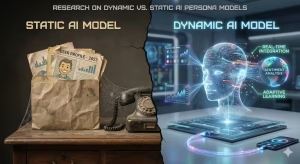
At its core, an AI persona is a simulated, data-driven representation of a target user or customer segment. This moves beyond the traditional, static personas that have been a staple of marketing and design for decades. While a traditional persona is often a semi-fictional summary based on interviews and limited surveys, an AI persona is a dynamic entity, algorithmically generated from vast, diverse, and often real-time datasets.
The fundamental limitation of a static persona is its static nature; it’s a snapshot in time, prone to human bias and quickly becoming outdated. The “why” behind AI personas is to overcome this inertia. By leveraging machine learning, AI can process millions of data points—from website clicks and purchase histories to social media sentiment and customer service transcripts—to construct a far more accurate, nuanced, and evolving model of the target user. This digital doppelgänger isn’t just a description; it’s a predictive model of behavior.
The key characteristics that define an AI persona include:
- Data-Driven: Its foundation is not anecdotal evidence but empirical data. Every attribute, from preference to pain point, is statistically justified by the input information.
- Dynamic: It is not a “one-and-done” document. As new data flows in, the AI persona can learn, adapt, and evolve, reflecting shifts in market trends and consumer behavior.
- Interactive: Through the interface of a Large Language Model (LLM), one can engage with the persona. A developer can ask, “What would be this persona’s primary objection to our new pricing model?” and receive an answer grounded in the synthesized data.
- Predictive: Beyond describing a current state, an AI persona can be used to forecast future behaviors, such as the likelihood of churn, the potential adoption rate of a new feature, or the probable response to a marketing campaign.
The Blueprint for Creation: How to Build an AI Persona

Constructing a robust AI persona is a systematic process that transforms raw data into a strategic asset. It is not an act of pure invention but one of data-driven synthesis.
A. Data Aggregation: The Foundation of Identity
The process begins with gathering the raw materials. The quality and breadth of this data are paramount to the persona’s accuracy. Key sources include:
- Quantitative Data: Website and application analytics (e.g., Google Analytics), CRM data (e.g., Salesforce), transaction records, and demographic information.
- Qualitative Data: Customer surveys, interview transcripts, support tickets, social media comments, and product reviews.
B. The Role of Large Language Models (LLMs)
Once aggregated, this data is fed into a Large Language Model. The LLM acts as the “brain,” processing and synthesizing the disparate information to identify patterns, correlations, and underlying motivations. It can sift through thousands of reviews to extract common pain points or analyze Browse behavior to define a typical user journey. A prompt to the LLM might look something like: “Analyze the attached CRM data, customer surveys, and website analytics to generate a detailed persona for our ‘power user’ segment. Focus on their primary motivations, technical skill level, and key frustrations.”
C. Essential Components of an AI Persona Profile
The output is a detailed profile containing core components:
- Demographics: Age, location, income, and occupation provide the basic context.
- Psychographics: This is the core of the persona, detailing values, interests, lifestyle, and, most critically, their goals and pain points related to your product or service.
- Behavioral Traits: This includes online habits, device preferences, social media activity, and purchase history.
- A “Day in the Life” Narrative: A generated story describing the persona’s typical day helps humanize the data and makes it more relatable for the development team.
D. Refining and Iterating
An AI persona is a living document. The creation process is cyclical. It must be continuously tested against new data and real-world outcomes. If the persona predicts a certain feature will be popular but it isn’t, that feedback is integrated to refine the model, making it more accurate over time.
AI Personas in Action: Real-World Applications
The theoretical power of AI personas is realized in their practical application across multiple business functions.
-
Enhancing User Experience (UX) and Design: Designers can “interview” an AI persona to test concepts before a single line of code is written. They can simulate a User Journey Map, asking the persona how it would navigate a new workflow to identify potential friction points. This allows for rapid, low-cost Usability Testing on a scale previously unimaginable, ensuring the final product is user-centric by design.
-
Revolutionizing Marketing and Advertising: The era of broad demographic targeting is ending. With AI personas, AI in marketing becomes hyper-personal. A company can develop distinct personas for different customer segments and generate ad copy, email campaigns, and content specifically tailored to each one’s voice and pain points, dramatically increasing engagement and conversion rates.
-
Powering Intelligent Customer Service: The difference between a frustrating chatbot and a helpful one often lies in its personality. Chatbot Personalities can be modeled after AI personas, ensuring the tone, language, and problem-solving approach align perfectly with the customer’s expectations. These Virtual Assistants can then handle inquiries with a consistent, on-brand, and empathetic voice, 24/7.
-
Driving Content Creation and Brand Identity: An AI persona serves as a definitive guide for content strategy. By understanding what the target audience values, reads, and shares, it can help generate blog topics, video scripts, and social media posts that resonate deeply. This ensures a consistent Brand Identity AI can maintain across all channels, building a stronger, more authentic connection with its community.
The Strategic Advantage: Unpacking the Benefits of AI Personas

Adopting AI personas moves a business from an intuitive approach to a data-scientific one, unlocking significant strategic advantages.
- Speed and Efficiency: The manual process of persona research, which can take weeks or months, can be condensed into hours or days. This radical acceleration allows organizations to be more agile and responsive to market changes.
- Deeper, Data-Driven Insights: AI can identify subtle correlations in data that a human analyst might miss. It can uncover non-obvious needs and motivations, providing a competitive edge through a genuinely deeper understanding of the customer.
- Enhanced Personalization at Scale: AI personas solve the classic dilemma of personalization vs. scale. They allow a company to deliver highly individualized experiences to thousands or even millions of customers simultaneously, something that is logistically impossible with manual methods.
- Improved ROI: The precision offered by AI personas leads to less waste and better outcomes. Marketing spend is more efficient, product development is more focused on features that matter, and customer retention improves, all contributing to a stronger bottom line.
- Future-Proofing Strategy: A dynamic AI persona acts as an early warning system. By constantly integrating new data, it can signal shifts in consumer sentiment or behavior, allowing a business to adapt its strategy proactively rather than reactively.
Answering Your Questions

Navigating the implementation of AI personas naturally brings up several key questions.
- What are examples of AI personas?Imagine “Proactive Paul,” an IT manager persona for a cybersecurity firm. Paul is 45, manages a team of 10, and his biggest pain point is the time spent on manual compliance reporting. He values efficiency and proven solutions over trendy, unvetted technology. Or consider “Sustainable Sarah,” a 28-year-old urban professional persona for a CPG brand. She makes purchasing decisions based on ethical sourcing and minimal packaging, and her goal is to align her consumption with her values. These personas directly inform product features and marketing messages.
- How accurate are AI personas?The accuracy of an AI persona is directly proportional to the quality and volume of the data it’s trained on. While no model is infallible, a well-constructed persona based on clean, comprehensive data is significantly more accurate than a traditional persona built on assumptions and a small sample size. Accuracy is maintained through continuous refinement and validation against real-world results.
- Can AI replace human researchers and designers?No. AI personas are a tool to augment, not replace, human expertise. The AI can process data and generate insights at a scale humans cannot, but it lacks genuine empathy, ethical judgment, and creative intuition. The role of the human researcher is to guide the AI, interpret its findings, ask the right questions, and make the ultimate strategic decisions. The designer uses the persona as a more accurate muse, not as a replacement for the creative process.
- What are the ethical considerations of using AI personas?This is a critical consideration. The use of personal data requires strict adherence to privacy regulations like GDPR and CCPA. There is also the risk of algorithmic bias, where the AI could inadvertently perpetuate stereotypes present in the training data. Transparency is key; organizations must be committed to ethical data sourcing, regularly auditing their models for bias, and being transparent about how AI is being used to shape customer experiences.
The Future is Personal: The Evolving Landscape of AI Personas

The trajectory of AI personas points toward even deeper integration and capability.
- Integration with the Metaverse and Virtual Worlds: As digital interaction shifts to more immersive environments, AI personas will evolve into fully interactive avatars. Imagine focus groups where you can have a real-time conversation with a brand’s ideal customer, represented by a photorealistic AI persona in a virtual space.
- Hyper-Personalization and Predictive Assistance: The future lies in proactive, not just reactive, personalization. AI personas will evolve into digital companions that can anticipate a user’s needs before they are even articulated, offering solutions, content, or support at the precise moment of relevance.
- The Democratization of Persona Creation: Previously, this level of analysis was the sole province of large corporations with massive data science teams. Today, with the rise of accessible AI platforms, even small businesses and startups can leverage sophisticated AI tools to create and benefit from dynamic personas, leveling the competitive playingfield.
Conclusion: Beyond the Algorithm
From a high-level concept to a practical tool, AI personas represent a paradigm shift in how businesses understand and interact with their customers. We’ve seen how they are defined by their dynamic, data-driven nature, built through a systematic process of aggregation and synthesis, and applied to revolutionize everything from product design to customer service. The strategic benefits—speed, insight, personalization, and ROI—are clear and compelling.
Ultimately, however, the immense power of the AI persona is not found in the complexity of its algorithms, but in its purpose. The goal is not simply to create a better model, but to use that model to better serve people. It is a technology designed to bridge the digital divide between a brand and its audience, fostering a deeper sense of understanding and connection. For any organization looking to innovate and place the customer at the absolute center of its universe, the time to engage with AI personas is now.