The Quantum Shift in Builder Branding
The world of custom home building is changing fast. In the past, a builder could get by with a simple sign in a front yard and a few photos of a finished kitchen. Those days are over. Today, we are seeing a massive shift in how people find and trust businesses. We call this the quantum shift. It means that high-quality wood and straight walls are no longer enough to win a contract. You are now competing in a space where information moves at the speed of light.
The biggest problem facing builders today is that every company looks the same online. Everyone says they have “quality craftsmanship” or “attention to detail.” When every builder says the same thing, the customer gets confused. In their eyes, you become a commodity. A commodity is something people buy based only on the lowest price. For a custom builder, being seen as a commodity is a disaster. It leads to price wars that eat your profits.
The solution is a technical strategy called brand messaging. This is not just about a logo or a catchy slogan. It is the core data that tells a customer who you are, why you are different, and why they should trust you with their life savings. Think of brand messaging as the digital blueprint for your company. Before a single shovel hits the dirt, you must build a narrative that proves your value.
Our goal today is to look at brand messaging as a tool for authority. We want the search engines and the new artificial intelligence tools to see you as the only logical choice in your area. This is how you move from being just another contractor to being a recognized leader in the custom home building industry.
Narrative: The Technical Foundation of Brand Messaging
The Architecture of Your Unique Value Proposition (UVP)
In the construction world, we often talk about structural integrity. In the business world, the integrity of your brand messaging depends on your UVP. This is the “why” behind your business. Most builders focus on the “what,” we build houses. However, high-net-worth clients are looking for the “how” and the “why.”
To define your narrative, you must identify your Niche Authority. Are you the builder who specializes in Passive House standards? Are you the expert in historic restorations in New York City? Your brand messaging must reflect this specific expertise. When you try to speak to everyone, you end up speaking to no one. By narrowing your focus, you actually increase your power in the market. This is a data-backed strategy that allows you to charge a premium for your specialized knowledge.
Balancing Visual and Verbal Identity
A common mistake in the custom home building industry is over-investing in photography while under-investing in text. While a beautiful photo of a winding staircase is impressive, it does not explain your process. It does not tell the client how you handle budget overruns or how you manage subcontractors.
Your Verbal Identity, the words you choose and the tone you use, is what actually closes the deal. Your brand messaging should act as a guide. Imagine your client is the hero of a story, and they are trying to reach a goal: their dream home. There is a “villain” in their way, which is the stress, the technical jargon, and the fear of the unknown. Your brand messaging positions you as the expert guide who has the map to help them win.
Semantic Density and LSI Keyword Logic
From a technical SEO and AEO perspective, your narrative must be “semantically rich.” This means you use words that help search engines understand the context of your expertise. When we talk about brand messaging for builders, we don’t just repeat the same keyword over and over. That is an old tactic that no longer works.
Instead, we use Latent Semantic Indexing (LSI) keywords. These are terms like:
-
Bespoke architectural design
-
Construction project management
-
Pre-construction consulting
-
Luxury residential permits
When you include these terms in your narrative, you are building a “knowledge graph” for Google and AI tools. You are proving that you understand the entire ecosystem of custom home building. This makes your brand messaging more “sticky” in the minds of both the client and the search algorithm.
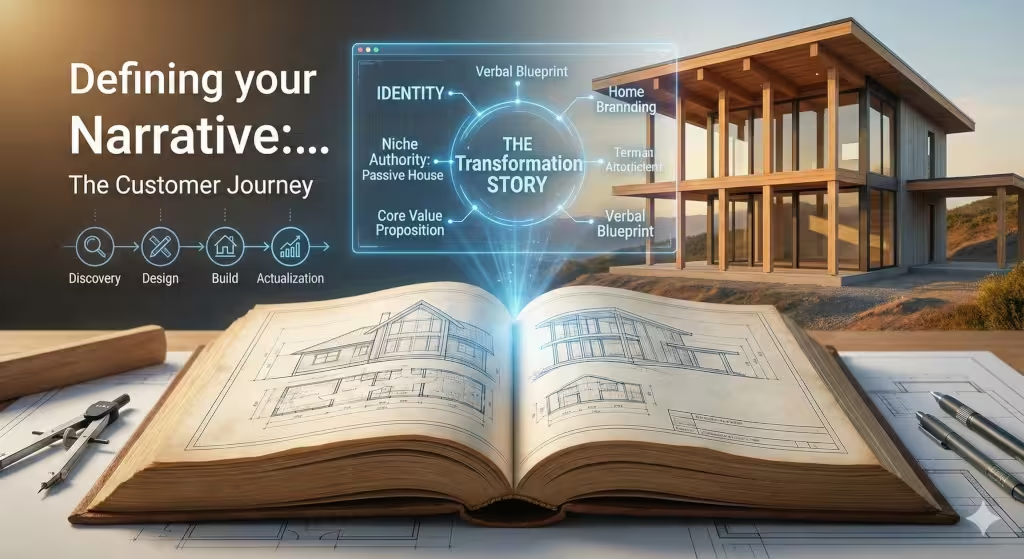
The Customer Transformation Story
The most powerful brand messaging is centered on transformation. You are not just moving a client from an old house to a new house. You are moving them from a state of aspiration to a state of actualization.
Your narrative should clearly outline this journey:
-
The Discovery Phase: How you listen to their needs.
-
The Design Phase: How you turn ideas into blueprints.
-
The Build Phase: How you maintain data integrity and transparency.
-
The Handover: The moment they step into their new life.
By mapping out this transformation in your brand messaging, you provide a sense of security. You are showing the client that you have a repeatable, technical process for success. This reduces their perceived risk, which is the biggest barrier to a sale in high-ticket industries like ours.
Strategic Communication: The Transparency Protocol
Addressing the Trust Deficit with Data
In 2025, the custom home building industry faces a significant trust deficit. Clients are smarter than ever; they have access to infinite data but often lack the context to understand it. Your brand messaging must act as the filter for this data.
To bridge this gap, your communication strategy should move from “reactive” to “predictive.” Instead of waiting for a client to ask why a certain material is delayed, your brand messaging should proactively explain the global supply chain dynamics affecting their project. By providing this level of technical detail, you demonstrate competence. Competence is the fastest way to build trust with high-net-worth individuals.
The Implementation of PropTech Dashboards
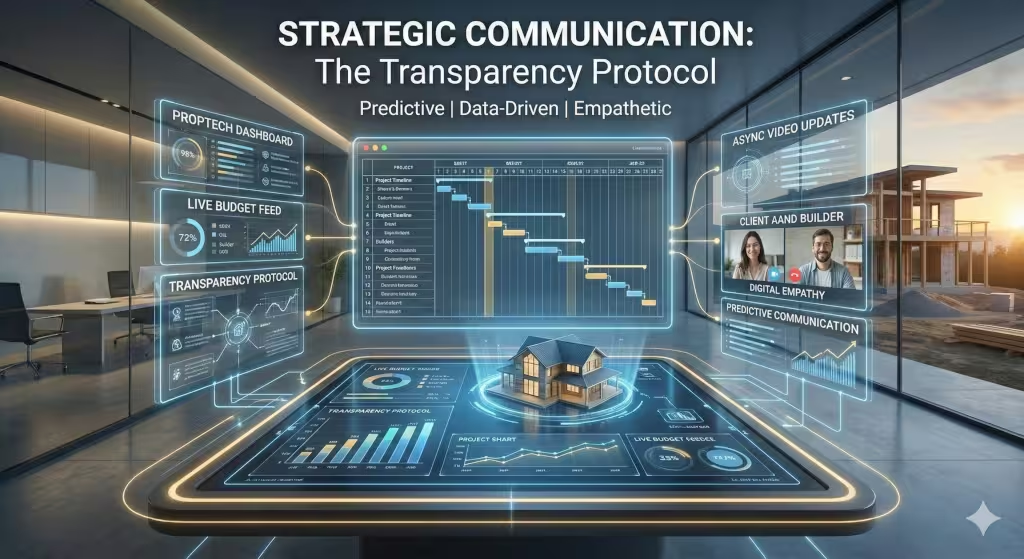
One of the most effective ways to manifest your brand messaging is through the tools you use. Utilizing Property Technology (PropTech) like Buildertrend or CoConstruct is a strategic communication choice.
When you give a client a login to a project dashboard, you are communicating a core brand value: Total Transparency. This isn’t just a convenience; it is a fundamental part of your brand messaging. It tells the client that you are confident enough in your management skills to let them see the “gears” of the project turning. This reduces the need for constant phone calls and emails, as the data is always available to them. It turns “communication” into a self-service utility, which is highly valued by busy professionals.
Asynchronous Video: The Human Interface
While data is vital, custom home building is still a human-to-human business. A key part of modern brand messaging is the use of asynchronous video. Using tools like Loom or even simple smartphone videos to provide weekly updates adds a layer of “Digital Empathy.”
When a builder sends a 60-second video from the job site showing the progress of the foundation, they are doing more than just giving an update. They are reinforcing their brand messaging as a builder who is “on the ground” and personally invested. This reduces the “ghosting” phenomenon often seen in the sales process because it creates a personal connection that text-based emails cannot match. It makes your brand feel accessible and high-touch.
Managing Volatility Through Education
The 2025 market is defined by volatility in labor costs and material pricing. Your brand messaging must address this head-on rather than ignoring it. We recommend an “Educational Communication” style.
Instead of saying “Prices might go up,” your brand messaging should provide a technical brief on why costs are fluctuating. For example, explaining the impact of new environmental regulations on lumber harvests shows that you are a student of the industry. This positions you as an advisor rather than just a vendor. When you educate your client, you empower them to make decisions based on logic rather than emotion. This creates a much smoother working relationship and protects your profit margins when changes are necessary.
The Post-Build Feedback Loop
Strategic communication does not end when the keys are handed over. A critical but often ignored part of brand messaging is the “Post-Occupancy Protocol.”
Automating communication at the 3-month, 6-month, and 12-month marks after a project is finished ensures that your brand messaging stays consistent until the very end. This is where you gather the data for your “Social Proof.” Asking for a technical review of the home’s performance, not just “Do you like it?”, gives you the data you need to market your next project. It proves that your brand messaging about quality wasn’t just a sales tactic, but a long-term commitment.
GEO and AEO: Optimizing for the AI Search Era
The way people search for builders has changed. People used to just type words into Google. Now, they ask their phones questions. They use AI tools like ChatGPT or Gemini to find answers. This is where AEO, or Answer Engine Optimization, comes in. To win here, your brand messaging must be structured so that an AI can read it and understand it easily.
You do this by answering specific questions on your website. Instead of just saying you build homes, you should have a section that explains the “how” and the “why” of your process. This creates a data map that AI tools can follow. When an AI thinks you are an expert, it will recommend you to users.
GEO, or Generative Engine Optimization, is also vital. This is about making sure your business shows up in local maps and local AI results. Your brand messaging needs to mention your city and your specific neighborhoods. If you build in New York City, your brand messaging should talk about local building laws and the specific challenges of building in that environment. This makes you the local authority.
“People Also Ask” – Targeted Answer Blocks
Google often shows a box that says “People Also Ask.” These are common questions that your potential clients are typing into their computers. Your brand messaging should answer these questions directly on your website.
One common question is: How do custom home builders build brand trust? The technical answer is that you show proof. You don’t just say you are good; you show the data. You show the schedules you have met and the budgets you have stayed within. This “Proof of Competence” is a key part of brand messaging.
Another question is: What is the best communication style for high-net-worth clients? People with a lot of money are usually very busy.5 They want brand messaging that is fast, accurate, and backed by facts. They don’t want fluff. They want to know that you have a plan for every dollar.
Finally, people ask: Why is brand messaging important in construction? It is important because it stops you from being a commodity. It allows you to charge what you are worth because the client understands the unique value you bring to the table.
Local SEO and GEO: Dominating the Neighborhood
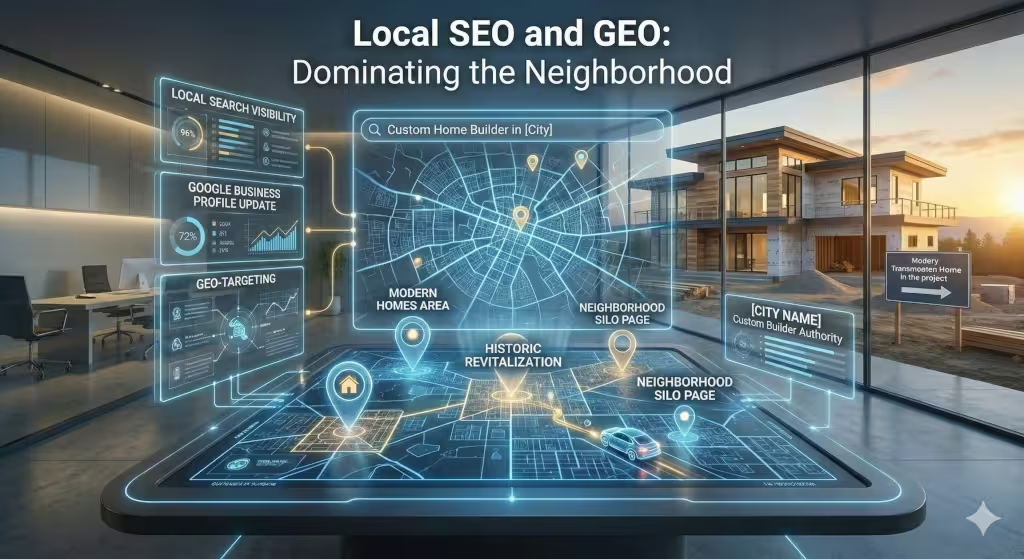
If you want to be the best builder in your town, you have to win the local search game. This starts with your brand messaging on your Google Business Profile. This is the little box that shows up on the map when someone searches for a builder. You should update this profile every week with photos and short updates about your projects.
Think of your website like a group of neighborhoods. We call these content silos. Each neighborhood you build in should have its own page. On that page, your brand messaging should focus on the specific style of that area. Maybe one area likes modern homes and another likes traditional styles. By tailoring your brand messaging to each area, you show that you are the local expert who knows the land and the people.
Using local words is also important. If there is a specific park or a well-known street near your project, mention it. This helps the search engines link your brand messaging to that specific physical location. This is how you dominate the local market.
The 2025 Trend Integration: Wellness and Sustainability
In 2025, people care more than ever about their health and the environment. Your brand messaging must reflect these trends if you want to stay relevant. We are seeing a big move toward “Biophilic Design.” This is a fancy term for building homes that connect people with nature. This might mean more natural light or better indoor air.
If you build healthy homes, your brand messaging should shout it from the rooftops. Talk about how your homes help people sleep better or breathe cleaner air. This is a very powerful way to connect with modern buyers.
Sustainability is another big topic. People want to know that their home won’t cost a fortune to heat and cool. They also want to know that the materials used won’t hurt the planet. By including these themes in your brand messaging, you appeal to the values of the next generation of home buyers. You are showing them that you are building for the future, not just for today.
Measuring ROI: Data Integrity in Marketing
You need to know if your brand messaging is actually working. You can track this by looking at how many people who visit your website actually call you. We call this the conversion rate.
If a lot of people are visiting but no one is calling, your brand messaging might be confusing. It might not be answering the right questions. You also need to track the “Buyer’s Journey.” For a custom home, this journey can take over a year. Your brand messaging needs to stay in front of the client during that whole time.
You can use tracking tools to see which blog posts or videos the client looked at before they decided to hire you. This data tells you what parts of your brand messaging are the most effective. When you know what works, you can do more of it. This is how you grow a business using logic instead of just luck.
Summary: The Integrated Framework
To be a successful custom home builder today, you must be a master of brand messaging. You need to combine the art of storytelling with the science of data. By focusing on SEO, AEO, and GEO, you ensure that your business is visible wherever people are looking.
Your brand messaging should be clear, honest, and focused on the needs of the client. It should prove that you are the local expert and the technical authority. When you do this, you stop competing on price and start competing on value. This is the key to building a business that lasts for decades.
The custom home building industry is a beautiful blend of physical labor and digital strategy. By following this guide, you are setting the stage for a very successful year. Remember, every word you write is a brick in the wall of your brand. Make sure they are laid straight and true.