When we look at the data for small business growth in 2026, a clear pattern emerges. Many owners confuse their identity with their actions. They spend money on ads without knowing who they are. This leads to wasted capital and poor results.
The Strategic Misalignment Problem
Most small businesses fail to grow because they do not understand the difference between brand positioning and marketing strategy. If you look at the numbers, about 70% of small companies stay small or close down within a few years. They often spend thousands of dollars on digital ads, yet they see very little return on that investment. This is the strategic misalignment problem.
The issue is that these owners are trying to build a house without a foundation. They focus on the tools, like social media or search engines, before they decide what makes them special. In the world of business, there is a big difference between “who you are” and “how you sell.” If you do not know who you are, your marketing will be weak. You will end up sounding just like everyone else. Our goal today is to help you fix this. We will look at how brand positioning and marketing strategy work together. When these two things are aligned, you create a business that can survive any market change.
Defining the Entities: The Foundation vs. The Vehicle
To understand how to grow, we must first define our terms. Think of your business like a car.
Brand Positioning (The Foundation)
Brand positioning is the “Mental Real Estate” you want to own. It is the specific place you hold in the mind of your customer. When someone thinks of “the fastest pizza in town” or “the most honest mechanic,” that is positioning. It is built on your value proposition, which is the promise of value you deliver. It also includes your brand personality. Are you serious and professional, or fun and creative? Finally, it requires a Unique Selling Proposition (USP). This is the one thing you do better than every single competitor in your local area.
Marketing Strategy (The Vehicle)
If positioning is the foundation, then marketing strategy is the vehicle that carries your message to the world. A marketing strategy involves the 4 Ps: Product, Price, Place, and Promotion. In 2026, this means looking at where your customers spend their time online. It involves the tactical execution of your plan. This includes your budget, your timeline, and the channels you use, such as SEO or paid ads. A marketing strategy tells the world about your brand positioning. Without a marketing strategy, your great brand will stay a secret.
Brand Positioning vs Marketing Strategy: Key Differences
To understand the true nature of a successful business, we must look deeper into the mechanics of growth. In my experience at MIT and Harvard, I learned that the most complex systems are often built on simple, clear rules. The relationship between your identity and your actions is one such system. Let us look closer at the differences that define your brand and your marketing strategy.
When you run a small business, you are often wearing many hats. You are the CEO, the accountant, and the head of sales. Because of this, it is easy to blur the lines between your brand positioning and your marketing. However, confusing these two is a technical error that can lead to systemic failure.
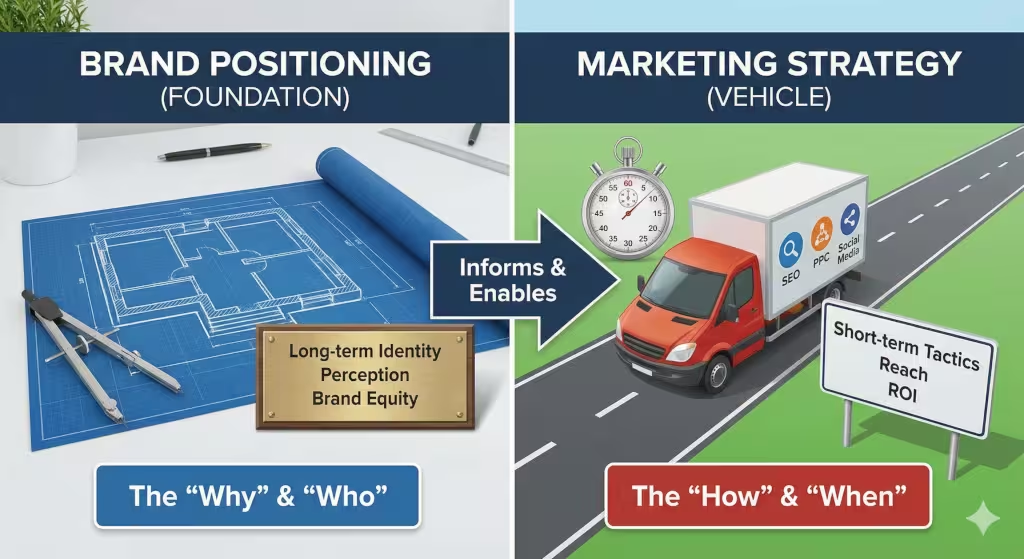
To put it simply, brand positioning is the “Why” and the “Who.” It is the specific space you occupy in a customer’s mind. Marketing strategy is the “How” and the “When.” It is the set of actions you take to reach those customers. You can think of positioning as the blueprint of a building, while the marketing strategy is the construction crew and the tools they use. You cannot build a stable house without a blueprint, and a blueprint alone will not provide shelter.
1. The Primary Goal: Perception vs. Reach
The first major difference lies in what you are trying to achieve. The goal of brand positioning is to create a specific perception. You want your local community to think of you in a certain way.3 For example, if you are an auto mechanic, you might position yourself as the “high-tech specialist” who handles complex electric vehicles. Your goal is for people to associate your name with “expertise” and “advanced technology.”
On the other hand, a marketing strategy has the goal of reach and conversion. Once you know you are the high-tech specialist, your marketing strategy decides how to tell people about it. Should you use Google Ads to show up when people search for “EV repair”? Should you post technical videos on YouTube? The marketing is focused on getting your message in front of the right eyes and making them take an action, like booking an appointment.
2. Time Horizons: Decades vs. Quarters
In business physics, time is a critical variable. Brand positioning is a long-term investment. It is something you decide on and stick with for years, or even decades. Changing your positioning is a massive task called “rebranding,” and it can be very risky. Your positioning is your “North Star.” It stays the same even when the world changes.
A marketing strategy is much more flexible. Because it is tactical, it should change based on the market. If a new social media platform becomes popular in 2026, you might update your marketing to include it. If a competitor starts a big sale, you might shift your marketing strategy for the next quarter to focus on your own value-based offers. While your positioning is permanent, your marketing strategy is a living document that reacts to the data we see every day.
3. Measurement: Brand Equity vs. ROI
How do we know if we are winning? The data we track for these two areas is different.
To measure brand positioning, we look at “Brand Equity.” This is a measure of how much your name is worth. We look at things like “Brand Awareness” (how many people know you) and “Brand Sentiment” (do they like you?). We also look at “Branded Search.” If more people are typing your business name into a search engine instead of just searching for general services, your positioning is working.
A marketing strategy is measured by much harder, more immediate numbers. We look at Return on Investment (ROI) and Customer Acquisition Cost (CAC). We want to know exactly how many dollars we spent on our marketing strategy and how many dollars came back as profit. We look at click-through rates and conversion rates. If a specific part of your marketing is not making money, we change it. We do not usually change our brand positioning just because one ad campaign failed.
4. The Influence of 2026 Technology
The year 2026 has brought new challenges to how we handle a marketing strategy. We now live in the age of Answer Engine Optimization (AEO). When a customer asks an AI, “Who is the best plumber near me?”, the AI looks for a business with a clear identity.
If your brand positioning is weak, the AI might not understand what makes you different from the plumber down the street. However, if your marketing strategy has consistently reinforced your positioning as the “emergency 24/7 plumber,” the AI will pick up on those signals. This is why a modern marketing strategy must be semantically linked to your brand. The AI reads your website, your reviews, and your social media to see if they all tell the same story. If they do, your marketing strategy will perform much better in the new world of search.
5. Synergy: The Multiplier Effect
The most important thing to remember is that these two concepts are not rivals. They are partners. When you have strong brand positioning, every part of your marketing strategy becomes more powerful.
Imagine two businesses. Business A has no clear positioning. They run a marketing strategy that says, “We do everything for a low price.” Business B is positioned as “The most eco-friendly dry cleaner in the city.” When Business B runs its marketing strategy, it attracts a specific group of loyal customers who are willing to pay more. Their ads get more clicks because they speak directly to what their customers care about.
This is the multiplier effect. A well-defined brand makes your marketing strategy cheaper and more effective. You spend less on ads because people already know and trust what you stand for.
A Comparision of Brand Positioning vs. Marketing Strategy
| Feature | Brand Positioning | Marketing Strategy |
| Primary Goal | Perception & Differentiation | Reach & Conversion |
| Time Horizon | Long-term (Years/Decades) | Short-to-Mid-term (Quarters/Months) |
| Measurement | Brand Equity, Awareness, Trust | ROI, CAC, CTR, Revenue |
| Focus | Internal Values & Market Niche | External Channels & Audience Intent |
Why One Cannot Thrive Without the Other
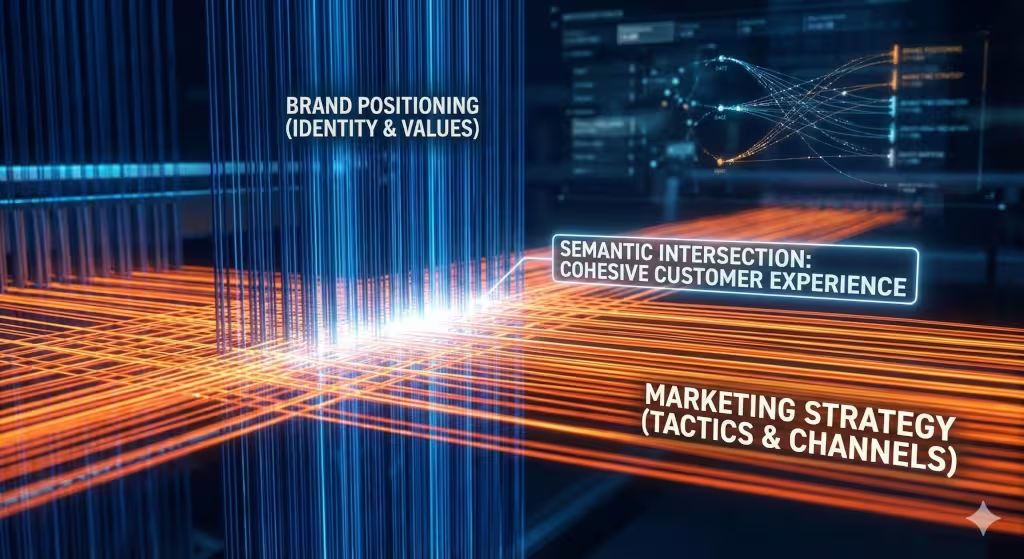
You cannot have a successful marketing strategy if you do not have clear positioning. Think of it as a feed-forward loop. Your positioning tells you what your marketing strategy should look like. It decides the tone of your voice and the type of people you should target in your local ads.
In the modern age of Generative Engine Optimization (GEO), this is more important than ever. AI search engines look for consistency. If your website says one thing but your social media says another, the AI will not trust you. A cohesive marketing strategy that reflects your positioning helps you rank higher. If you have a brand that people trust, your marketing strategy will actually cost less. This is because people are more likely to click on a name they recognize and respect.
Small Business Application: Local SEO Strategy

For a small business owner, the most important place to apply these ideas is in local search. You need a geo-targeted marketing strategy. For example, if you are a law firm in New York City, you don’t just want to be “a lawyer.” You want to be “the most trusted family lawyer in Brooklyn.” That is positioning.
Once you have that positioning, you build your marketing around it. You use those specific keywords on your Google Business Profile. You make sure your “from the business” section tells your unique story. When your positioning is clear, your organic click-through rate goes up. People in the Map Pack will see your listing and feel like you are the right choice for their specific neighborhood. This is how a smart marketing strategy wins against big corporations with huge budgets.
Common Questions about Brand Positioning & Marketing Strategy
I often see the same questions from business owners who are trying to fix their marketing. Here are the data-backed answers.
Can you have a marketing strategy without brand positioning?
Yes, you can, but it is a bad idea. This leads to something called “commodity marketing.” This is when you look exactly like your competitors. When that happens, the only way to win is to have the lowest price. This hurts your profit margins and makes it hard to stay in business.
Which should come first: brand strategy or marketing strategy?
Positioning must come first. You need to know the destination before you pick the vehicle. You must know who you are speaking to and why you are better before you spend a single dollar on a marketing strategy.
How does brand positioning affect SEO?
It affects how people search for you. If your positioning is strong, people will search for your brand name directly. This is a huge signal to search engines that you are an authority. It also helps you choose the right keywords for your marketing so you don’t waste time on terms that don’t bring in the right customers.
Advanced Entities and LSI Keywords
To truly master your marketing strategy, you need to understand the technical terms used in the industry.
One key term is market segmentation. This means breaking the big market into smaller groups of people who have the same needs. Another is Customer Lifetime Value. This is the total amount of money a customer will spend with you over their whole life. A good marketing strategy focuses on keeping customers, not just finding new ones.
You should also think about brand archetypes. Is your brand a “Hero” that solves big problems, or a “Sage” that gives expert advice? This choice will change every part of your marketing strategy. When you use these concepts, you build a digital footprint that is very hard for competitors to beat.
Summary and Final Technical Review
To recap, brand positioning is about who you are, and marketing strategy is about what you do. For a small business to succeed in 2026, these two must be perfectly aligned. You cannot rely on a marketing strategy to fix a brand that has no identity.
By investing in your identity first, you lower your acquisition costs over time.7 You stop being a “choice” and start being the “only solution” for your local customers. This is the most efficient way to run a business. It is based on logic, data, and a deep understanding of human behavior.
The Importance of a Cohesive Marketing Strategy
When you sit down to write your marketing strategy, remember that every word should reflect your brand positioning. If your brand is about luxury, your marketing strategy should not focus on discounts. If your brand is about speed, your marketing strategy should highlight fast delivery and quick response times.
The consistency of your marketing strategy is what builds trust. Trust is the most valuable currency in business. When a customer sees your ad, visits your website, and then talks to your staff, they should feel the same thing every time. This is what a high-quality marketing strategy achieves. It creates a seamless experience that turns strangers into loyal fans.
Measuring the Success of Your Marketing Strategy
As an INTJ, I believe that if you cannot measure it, you cannot improve it. Your marketing strategy must be tracked with precision. Use tools to see where your traffic is coming from. Are people finding you through local search? Are they clicking your ads?
A successful marketing strategy will show a steady increase in “branded search.” This means more people are typing your specific name into Google. It will also show an improvement in your conversion rate. When your marketing is aligned with your positioning, people feel more confident buying from you. This is the ultimate goal of any marketing strategy.
Adapting Your Marketing Strategy for the Future
The world of search is changing. With the rise of AI and answer engines, your marketing strategy must be more than just keywords. It must provide real answers to real problems. By focusing on your brand positioning, you ensure that your marketing strategy stays relevant even as technology changes.
A marketing strategy that is built on a solid foundation will always outperform one that is just following trends. Focus on your local community. Understand their needs. Use your marketing strategy to show them why you are the best fit for them. This is how you build a business that lasts.
Bonus: A Step-by-Step Checklist for Developing a Marketing Strategy
To ensure your brand positioning and marketing strategy are perfectly aligned, we have developed this technical checklist. Use this to audit your next meeting and ensure every dollar of your marketing strategy is backed by data and identity.
Step 1: Validate the Brand Positioning Core
Before discussing any marketing strategy tactics, you must confirm that the foundation is stable. If these questions cannot be answered with one sentence, stop the meeting and define them.
-
Identify the Niche: Can we name the specific group of people we serve better than anyone else?
-
The Unique Selling Proposition (USP): What is the one thing we offer that a competitor cannot copy in their own marketing strategy?
-
The Brand Archetype: Are we the “Hero,” the “Guide,” or the “Innovator”? This must be consistent across all channels.
Step 2: Align Marketing Strategy Channels with Positioning
A marketing strategy often fails because the channel does not match the brand’s voice.
-
Channel Selection: If our positioning is “High-End Luxury,” does a marketing strategy focused on “Discount Coupons” on Facebook make sense? (Likely no).
-
Keyword Intent: Are we targeting “cheap” keywords or “expert” keywords? Your marketing must target words that match your price point and brand value.
-
Visual Assets: Do our images and videos reflect the “Mental Real Estate” we want to own?
Step 3: Local SEO and Geo-Targeting Audit
For small businesses, your marketing strategy must dominate your local community before it goes national.
-
Google Business Profile (GBP) Check: Does our “Business Description” use the exact language from our brand positioning?
-
Local Landing Pages: Does each city-specific page on our site reinforce why we are the best choice for that specific area?
-
Review Management: Are we asking customers to mention our USP in their reviews to help our marketing gain social proof?
Step 4: Technical SEO and GEO Optimization
Since search engines in 2026 are driven by AI and intent, your marketing strategy needs technical precision.
-
Schema Markup: Are we using LocalBusiness schema to tell search engines exactly who we are and where we are?
-
Semantic Clusters: Does our blog content cover enough related topics to prove to an AI that we are an authority in our niche?
-
Answer Engine Optimization (AEO): Does our website have an FAQ section that answers the “People Also Ask” questions related to our marketing strategy?
Step 5: Setting the Measurement Framework
A marketing strategy without metrics is just a hobby. You must track the data.
-
KPI Definition: Are we tracking “Branded Search” (people looking for us by name) as a measure of our positioning success?
-
Customer Acquisition Cost (CAC): Is our marketing strategy becoming more efficient over time as our brand grows stronger?
-
Conversion Rate by Channel: Which part of our marketing strategy is actually turning browsers into buyers?
The Marketing Strategy Alignment Table
Use this table during your meeting to quickly check if your tactics match your identity.
| Marketing Strategy Tactic | Does it match our Positioning? | Expected Outcome |
| Local PPC Ads | Yes / No | High Intent Leads |
| Social Media Posts | Yes / No | Brand Awareness |
| Email Newsletters | Yes / No | Customer Retention |
| Local Event Sponsoring | Yes / No | Community Trust |