Imagine walking down a busy street in your town. You see two coffee shops right next to each other. One has a generic sign, a plain gray door, and a menu posted in the window that looks like a spreadsheet. The other shop has a bright yellow awning, a chalkboard sign out front with a funny joke written on it, and the smell of cinnamon wafting through the open door. Which one do you trust more? Which one are you going to enter? Most people will choose the second one. That shop is not just selling coffee. It is sharing a feeling. It has successfully mastered the art of building a brand personality.
A brand personality is the set of human characteristics that you attribute to a brand name. It is what makes a business feel like a friend rather than a faceless corporation. For a small business owner, this is not just about having a pretty logo. It is a critical survival tactic. If your customers cannot connect with you on an emotional level, they will likely go to a competitor who offers a cheaper price.
Why does this matter for your bottom line? It matters because people buy from people they like. When you focus on building a brand personality, you are giving your customers a reason to choose you that has nothing to do with price. You are building trust. In the world of Search Engine Optimization, or SEO, trust is a major factor in how high you rank on Google. When users spend more time on your site because they enjoy your unique voice, search engines notice. This article will guide you through the data-driven process of defining who you are as a business so you can dominate your local market.
Why Brand Personality Matters for SEO and Growth
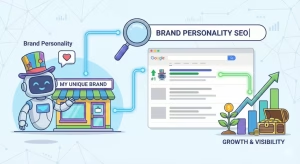
Many small business owners make the mistake of thinking that SEO is only about keywords and code. While those are important, Google serves humans. Google wants to send its users to websites that offer a great experience. This is where your brand personality becomes a technical asset.
Differentiation using your brand personality is the key to growth. If you are a plumber, there are likely twenty other plumbers in your city. If your website looks exactly like theirs, you are a commodity. You are just a name on a list. However, if your brand personality is rugged, reliable, and maybe a little humorous about clogged drains, you stand out. You become the “friendly expert” rather than just “a plumber.” This differentiation leads to higher click-through rates.
Furthermore, Google uses a concept called E-E-A-T. This stands for Experience, Expertise, Authoritativeness, and Trustworthiness. A strong brand personality signals that there are real people behind the business. It shows you are an active entity. When you respond to reviews with a consistent voice, or write blog posts that sound like they come from an expert, you are feeding the search engine exactly what it wants. You are proving that your business is legitimate and active.
Local SEO relies heavily on engagement. When you have a clear brand personality, people are more likely to leave reviews. They are more likely to share your content on social media. These social signals tell search engines that your business is popular and relevant in your local area.
The 5 Dimensions of Brand Personality
To build something solid, we need a framework. We look to Jennifer Aaker, a behavioral scientist and professor at Stanford. She developed a framework known as the “Big Five” dimensions of brand personality. Most businesses fall into one of these five categories. Understanding where you fit is the first step in building a brand personality that remains consistent.
Sincerity Dimension of Brand Personality
This dimension is all about being down-to-earth, honest, wholesome, and cheerful. Think of a local family bakery or a farm-to-table restaurant. If your business is Sincere, your customers trust you because you feel safe and familiar. You are not trying to be flashy. You are trying to be kind. The key traits are Down-to-earth, Honest, Wholesome, and Cheerful. The goal to make the customer feel understood and cared for.
The “Down-to-Earth” Trait
This means your business is unpretentious. You do not use fancy jargon to confuse customers. You do not act like you are better than them.
- How to execute this:
- Language: Use simple, everyday words. Instead of saying, “We utilize the best-in-class culinary methodologies,” say, “We cook it just like Grandma did.”
- Visuals: Avoid stock photos that look too perfect. Use photos of your actual team, your messy workshop, or your real storefront. Imperfection creates connection.
- SEO Tip: When targeting keywords, look for “near me” or “local” queries. Down-to-earth brands dominate local search because they feel like neighbors.
The “Honest” Trait
Trust is the currency of the internet. An Honest brand personality admits when it is wrong and values transparency over profit.
- How to execute this:
- Pricing: Put your prices on your website. Nothing says “dishonest” like “Call for a Quote” on a simple service.
- Mistakes: If you mess up an order, own it publicly. Reply to a negative Google review by saying, “I am so sorry we missed the mark. That was my fault, and I want to fix it.” This vulnerability makes you incredibly likable.
- Content: Write blog posts about the realities of your industry, even the downsides. For example, a roofer might write, “Why a Cheap Roof Repair Might Cost You More Later.”
The “Wholesome” Trait
This trait appeals to nostalgia, family values, and safety. It suggests that your product or service contributes to the greater good of the community or family unit.
-
How to execute this:
- Community Involvement: Sponsor the local Little League team or a charity 5K run. Put these logos on your footer. It shows you care about the town, not just the money.
- Vibe: Think “Sunday Morning” energy. Calm, safe, and reliable.
-
Origin Story: Your “About Us” page should focus on why you started. Did you start your pest control company to keep families safe? Did you open your bakery to share your heritage
The “Cheerful” Trait
A Sincere brand is optimistic. It is a pleasant place to be. It is not edgy, and it is not sarcastic.
-
How to execute this:
- Greetings: Start emails with “Hi there!” or “Good morning!” rather than “To whom it may concern.”
- Social Media: Share wins. Share pictures of happy customers (with permission). Keep the tone light and uplifting.
-
Colors: Use warm colors. Yellows, oranges, soft greens, and pastels work very well here. Avoid stark blacks or aggressive neon reds.
The Strategic Advantage of Sincerity
Why choose this personality?
-
Low Risk: It is very hard for a customer to dislike a Sincere brand. It is a “safe bet.”
-
High Loyalty: Customers form emotional bonds with Sincere brands. They feel like they are supporting a friend.
-
Referrals: People love to refer their friends to “good people.” Sincerity drives word-of-mouth marketing better than any other personality type.
Summary Table: Sincerity Profile
Excitement Dimension of Brand Personality
When you choose to build a brand personality around Excitement, your goal is to generate a dopamine hit. You are targeting the part of the human brain that craves novelty, surprise, and inspiration. This is the realm of the trendsetters.
In the Aaker framework, Excitement is broken down into four distinct traits: Daring, Spirited, Imaginative, and Up-to-date. Here is how to translate these traits into business operations.
The “Daring” Trait
This trait is provocative. A Daring brand is not afraid to take a stand or push boundaries. You are willing to be different, even if it alienates some people.
-
How to execute this:
-
Marketing: Do not just list features. Challenge the status quo. If you run a gym, do not just say “We have weights.” Say, “Stop making excuses. Start sweating.”
-
Visuals: Use high-contrast colors. Red, bright orange, and electric blue work well here. Avoid beige.
-
SEO Strategy: Target keywords that imply a challenge or a distinct difference, such as “alternative to [boring competitor]” or “extreme [service].”
-
The “Spirited” Trait
This is about energy and enthusiasm. A Spirited brand feels alive. It is never passive.
-
How to execute this:
-
Voice: Use active verbs. Instead of “Our software allows you to…” say “Crush your goals with…”
-
Punctuation: It is okay to use exclamation points here (in moderation). Your copy should feel fast-paced.
-
Social Media: This personality thrives on short-form video. TikTok and Instagram Reels are essential. The content should be fast cuts, trending audio, and high energy.
-
The “Imaginative” Trait
This appeals to the creative side of the customer. It implies that your business is innovative and unique. You are not just selling a product; you are selling a vision.
-
How to execute this:
-
Product Names: Get creative. Don’t sell a “Spicy Burger.” Sell the “Volcano Crunch.”
-
Storytelling: Use metaphors. If you are a graphic designer, do not just sell logos. Sell “Visual Magic.”
-
Design: Your website must look modern. Broken links or old layouts kill the “Imaginative” vibe instantly.
-
The “Up-to-date” Trait
This is the most time-consuming trait. To be Exciting, you must be current. You cannot use memes from three years ago.
-
How to execute this:
-
Trend Jacking: Monitor what is trending on Google or Twitter. If there is a big cultural moment (like a new movie release or a viral challenge), find a way to link your business to it immediately.
-
Technology: Offer the latest payment methods (Apple Pay, Crypto). Use the latest booking software. If your tech feels old, your excitement level drops.
-
The Strategic Advantage of Excitement
Why choose this personality?
-
Viral Potential: Exciting content gets shared. Boring content does not. If you want free reach on social media, this is the best personality.
-
Youth Appeal: This personality resonates heavily with Gen Z and Millennials. If that is your target demographic, Excitement is often required.
-
Differentiation: In a boring industry (like insurance or accounting), injecting a little Excitement (The “cool” accountant) creates a massive competitive advantage.
Competence Dimension of Brand Personality
When you are building a brand personality around Competence, you are telling your customer: “I have this under control.” This is the ideal strategy for high-stakes industries. If you are a surgeon, a financial advisor, or a mechanic, your customers do not want you to be “edgy.” They want you to be perfect.
In the Aaker framework, Competence is built on three pillars: Reliable, Intelligent, and Successful. Here is how to engineer these traits into your business.
The “Reliable” Trait
This is the promise of consistency. A Reliable brand delivers the exact same high-quality result every single time. There are no surprises.
-
How to execute this:
-
Guarantees: Offer strong warranties or money-back guarantees. This signals that you are confident your product will not fail.
-
Communication: Be hyper-responsive. If you say you will call at 2:00 PM, do not call at 2:05 PM. Call at 2:00 PM. Precision builds trust.
-
Operations: Use automated confirmations for appointments. It shows your systems are tight and nothing slips through the cracks.
-
The “Intelligent” Trait
This trait signals that you possess knowledge that the customer does not have. You are the authority.
-
How to execute this:
-
Content Marketing: Publish white papers, case studies, or detailed “How-To” guides. Do not just say you are smart; prove it by solving complex problems for free in your blog.
-
Credentials: Display your certifications, degrees, and awards prominently. Do not hide your PhD or your Master Plumber license in the footer. Put it at the top.
-
Voice: Use precise language. Avoid slang. Use data to back up your claims. Instead of saying “We are fast,” say “Our average response time is 12 minutes.”
-
The “Successful” Trait
People want to bet on a winner. The Successful trait implies that you are a market leader. If you are successful, the logic follows that your product must be good.
-
-
How to execute this:
-
Social Proof: Showcase the number of clients served. “Over 5,000 happy customers” is a powerful trust signal.
-
Partnerships: Display logos of well-known brands you have worked with or software partners you use. This is “guilt by association,” but in a positive way.
-
Visuals: Your website must look expensive. A cheap-looking website implies a struggling business. A Competent business invests in quality design.
-
-
The Visual Language of Competence
As seen in color psychology, Blue is the dominant color for Competence. It physically lowers blood pressure and induces a sense of calm and order. This is why Chase Bank, Ford, and Intel all use blue.
-
Font Choice: Use clean, sans-serif fonts (like Helvetica or Arial) or traditional serif fonts (like Times New Roman). Avoid handwriting fonts or comic styles.
-
Layout: Use grids. Everything should be aligned perfectly. Chaos in design suggests chaos in the business.
The Strategic Advantage of Competence
Why choose this personality?
-
Price Elasticity: People will pay a premium for certainty. If you are the most “Competent” option, you can charge more than the “Friendly” option because you reduce the customer’s risk.
-
B2B Dominance: If you sell to other businesses, Competence is almost always the required personality. Business owners do not spend company money on “fun”; they spend it on “results.”
-
SEO Authority: This aligns perfectly with Google’s E-E-A-T guidelines. A site rich in technical data and expert authorship ranks higher for informational queries.
Summary Table: Competence Profile
Sophistication Dimension of Brand Personality
When you focus on building a brand personality around Sophistication, you are not selling a product; you are selling a lifestyle. You are telling the customer that by choosing you, they are elevating their own status. This is the domain of high-end fashion, luxury real estate, premium jewelry, and gourmet dining.
In the Aaker framework, Sophistication is defined by two main traits: Upper Class and Charming. Here is how to weave these into your business model.
The “Upper Class” Trait
This trait signals exclusivity. It implies that what you offer is not for everyone. It is for the select few who can appreciate (and afford) the best.
-
How to execute this:
-
Price as a Feature: In most businesses, a high price is a hurdle. In Sophistication, a high price is a signal of quality. Do not apologize for your rates. Display them confidently.
-
Scarcity: Create a sense of limited availability. “By appointment only” sounds much more sophisticated than “Walk-ins welcome.” It suggests that your time is valuable.
-
Packaging: If you sell physical goods, the unboxing experience must be flawless. Heavy paper, embossed logos, and high-quality ribbons tell the customer the product inside is precious.
-
The “Charming” Trait
This is the softer side of Sophistication. It is not just about being rich; it is about being polite, smooth, and refined. A Charming brand never shouts.
-
How to execute this:
-
Customer Service: This requires “White Glove” service. You must anticipate needs before the customer asks. If you run a high-end salon, you offer sparkling water or champagne before they sit down.
-
Voice: Your writing style should be poetic and polished. Avoid slang entirely. Use words like “curated,” “bespoke,” “timeless,” and “exquisite.”
-
Restraint: Do not clutter your website with pop-ups and flashing banners. A Charming brand is confident enough to be quiet.
-
The Visual Language of Luxury
To successfully execute this personality, your visual identity must be impeccable.
-
Typography: As shown in typography studies, Serif fonts (letters with little feet at the ends) are traditionally associated with elegance and history. Think of the font used by Vogue or Tiffany & Co.
-
Color Palette: Referring back to color psychology, Black and Gold are the primary drivers here. Black implies mystery and power. Gold implies wealth. White space is also critical. A cluttered design looks cheap; a design with lots of empty space looks expensive.
-
Photography: High-resolution, moody lighting, and artistic angles are required. You cannot use generic stock photos. You need custom photography that looks like art.
The Strategic Advantage of Sophistication
Why choose this personality?
-
High Margins: This is the biggest financial benefit. Because you are selling status, you are not competing on cost. You can have profit margins that are double or triple the industry average.
-
Loyal Following: Customers who buy into luxury brands are often very loyal because the brand becomes part of their personal identity. They wear your logo to show the world who they are.
-
Insulation from Recessions: interestingly, the very high end of the market is often the last to feel an economic downturn. Wealthy clients often continue to spend on “Upper Class” goods even when the broader economy slows down.
Summary Table: Sophistication Profile
Ruggedness Dimension of Brand Personality
When building a brand personality around Ruggedness, you are making a promise of endurance. You are telling the customer, “I will not break.” This personality type is heavily favored by construction companies, outdoor gear retailers, landscaping services, and automotive repair shops.
In the Aaker framework, Ruggedness is defined by two primary traits: Outdoorsy and Tough. Here is how to construct this identity for your small business.
The “Outdoorsy” Trait
This trait connects your business to the natural world. It implies freedom, fresh air, and a lack of confinement.
-
How to execute this:
-
Imagery: Your photos should rarely show clean offices. Show mud, dirt, grass, and sky. If you sell trucks, show the truck on a dirt road, not in a showroom.
-
Sustainability: Outdoorsy brands often care about the environment. If you use eco-friendly materials or sustainable practices, highlight them. It shows you respect the “outdoors” you represent.
-
SEO Keywords: Target terms related to nature and location. Words like “trail,” “wild,” “field,” and “terrain” help paint the picture for search engines.
-
The “Tough” Trait
This is the “Masculine” or assertive side of the dimension (though it appeals to all genders). It focuses on strength, resilience, and grit.
-
-
How to execute this:
-
Durability Claims: While a Competent brand talks about “precision,” a Rugged brand talks about “abuse.” Use phrases like “heavy-duty,” “industrial strength,” and “armor.”
-
The “Western” Vibe: This is a sub-set of the Tough trait. It borrows from the American cowboy mythos—independence and self-reliance. It works incredibly well for businesses in rural areas or trades.
-
Voice: Speak plainly. Do not use flowery language. Be direct. “We fix roofs. Period.” is a Rugged sentence. “We offer comprehensive roofing solutions for the discerning homeowner” is a Sophisticated sentence.
-
-
The Visual Language of Grit
Your visual identity needs to feel heavy and grounded.
-
Typography: You want Slab Serif fonts or thick Sans Serif fonts. These letters look like blocks of concrete or wood. They feel heavy on the page. Avoid thin, elegant scripts.
-
Color Palette: Use Earth Tones.
-
Brown: Represents earth, wood, and reliability.
-
Green: Represents nature and growth.
-
Grey/Charcoal: Represents stone, metal, and tools.
-
Avoid pastels or bright neons, as they feel artificial and weak.
-
-
Textures: Use background textures on your website. Images of wood grain, brushed metal, or rough stone add immediate subconscious weight to your brand personality.
The Strategic Advantage of a Ruggedness
Why choose this personality?
-
Trust in Utility: If I am buying a chainsaw or hiring a contractor to pour concrete, I do not want “charming.” I want “tough.” A Rugged personality assures the customer that the product will do the job.
-
Community of “Doers”: Rugged brands often build communities of people who like to get their hands dirty. This creates a very engaged customer base that loves to share photos of their projects.
-
Perceived Value of Longevity: Customers are often willing to pay more for a “Rugged” product because they believe it is an investment that will last for years, rather than a disposable item.
Summary Table: Ruggedness Profile
Step-by-Step Guide to Building a Brand Personality
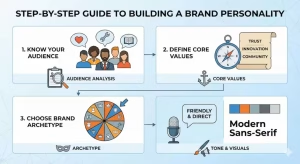
Now that we understand the framework, we must look at the specific steps to apply this to your business. This is not a guessing game. It requires analysis and clear decision making.
Step 1: Know Your Audience
You cannot choose a personality until you know who you are talking to. You must analyze your target audience. Are they busy moms? Are they retired veterans? Are they college students?
You need to create a “customer avatar.” This is a fictional character that represents your ideal client. Give them a name. If your ideal client is “Larry, a 50-year-old accountant who likes golf,” you would not use a brand personality that uses teenage slang. You would use a personality that respects Larry’s time and intelligence. When you are building a brand personality, you are essentially deciding how to be the best friend to this specific avatar.
Step 2: Define Your Core Values
What does your business stand for? These are your core values. Your personality is the expression of these values. If your core value is “Speed,” your personality should be energetic and brief. If your core value is “Craftsmanship,” your personality should be patient and descriptive.
Write down three non-negotiable values. These will serve as the anchor for your brand personality. If you ever feel like your marketing is drifting off course, you can look at these values to steer you back.
Step 3: Choose Your Brand Archetype
Psychologist Carl Jung introduced the concept of archetypes. These are universal characters that everyone recognizes. In marketing, we use 12 common archetypes to help with building a brand personality.
-
-
The Hero: Wants to save the day (e.g., a plumber who fixes emergency leaks).
-
The Sage: Wants to provide wisdom (e.g., a bookstore or consultant).
-
The Jester: Wants to have fun (e.g., a party supply store).
- The Caregiver: Wants to nurture (e.g., a nursing home or daycare).Picking one archetype helps you stay consistent. If you are The Sage, you should not try to be The Jester. It confuses the customer.
-
Step 4: Establish Your Tone of Voice
Your tone of voice is how your brand personality sounds in text. This is very important for your website and blog. If you were a person, how would you speak?
Are you formal or casual? Do you use big words or simple words? Do you make jokes?
A great exercise is to create a “This, Not That” list.
-
We are funny, but not offensive.
-
We are confident, but not arrogant.
- We are helpful, but not pushy.This list guides anyone who writes for your company, ensuring that your brand personality remains steady across all channels.
Step 5: Visual Consistency
While personality is largely about how you act and speak, your visuals must match. This involves color psychology.
-
Blue: Trust, calm, stability (Good for Competence).
-
Red: Energy, urgency, passion (Good for Excitement).
-
Green: Nature, health, money (Good for Sincerity or Wealth).
- Black: Luxury, mystery, power (Good for Sophistication).When building a brand personality, ensure your logo, font, and website colors tell the same story as your words. If your text says you are a calm, relaxing spa, but your website is bright red and yellow, the customer will feel a subconscious disconnect.
Integrating Your Brand Personality into Your Website and Content
Once you have defined your brand personality, you must deploy it. It does no good if it only exists on a piece of paper. It must live on your website.
Website Copy and About Us Pages
Your “About Us” page is the most important place for building a brand personality. Do not just write a boring history of when you were founded. Tell a story. Use your specific tone of voice. If you are a Rugged brand, talk about the grit it took to start the business. If you are a Sincere brand, talk about your family and your community.
This text helps the search engines understand the semantic context of your business. It adds depth to your entity profile in the Google database.
Blogging with a Voice
I write blog posts for a living, and I can tell you that the generic posts never rank as well as the ones with a strong voice. When you write articles for your site, inject your brand personality into the introduction and conclusion. Use examples that fit your archetype. If you are a local mechanic with a “Hero” personality, write your blog posts about how to “rescue” a car from winter damage. This makes the content more engaging, which increases the time users spend on the page.
Social Media and Local Listings
Your Google Business Profile is often the first thing a local customer sees. The description field allows you 750 characters. Use them to show off your brand personality. instead of listing services, write a mini-bio that captures your vibe.
On social media, your replies to comments should always be in character. If a customer makes a joke, and your brand is Sincere, reply with a warm smiley face. If your brand is The Jester, reply with a witty comeback. Consistency here builds a loyal community.
Common Mistakes When Building a Brand Personality
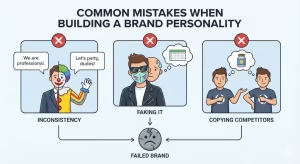
Even smart business owners stumble when trying to execute this. Here are the pitfalls you must avoid.
Inconsistency
This is the biggest killer of a brand. You cannot be a serious, corporate suit on LinkedIn and then a wild party animal on Instagram. It makes you look fake. Your brand personality must be the same everywhere. It is like meeting a person who changes their accent depending on who they are talking to. You would not trust that person. Do not let your business be that person.
Faking It
Do not try to be cool if you are not cool. Do not try to be funny if you are naturally serious. Customers can smell inauthenticity from a mile away. It is much better to have a Sincere brand personality that is quiet and kind than a fake Excitement personality that feels forced. Lean into your true strengths.
Copying Competitors
If your biggest competitor uses the color blue and talks about “trust,” do not do the same thing. You need to find a gap in the market. Maybe you can be the “fast” option or the “friendly” option. Building a brand personality is about standing out, not blending in. If you copy them, you are just advertising for them.
Common Questions about Brand Perception
These questions are the most common regarding this topic.
What are the 5 types of brand personality?
As we discussed with the Aaker model, the five types are Sincerity (honest, cheerful), Excitement (daring, spirited), Competence (reliable, intelligent), Sophistication (upper class, charming), and Ruggedness (outdoorsy, tough). Most businesses will have one primary type and maybe one secondary type.
How do you create a brand personality for a small business?
You create it by researching your audience, defining your core values, choosing an archetype that fits those values, and then applying a consistent tone of voice and visual style to all your marketing materials. It is a deliberate process of defining who you are.
Why is brand personality important in marketing?
It is important because it drives emotional connection. People make purchasing decisions based on emotion and justify them with logic later. A strong brand personality hooks the emotion. It also helps with brand recall; it is easier to remember a funny or kind character than a sterile business name.
What is the difference between brand identity and brand personality?
Brand identity is the collection of tangible elements like your logo, colors, and website design. Brand personality is the set of human traits and emotional connections associated with those elements. Identity is what you see; personality is what you feel. You need the identity to visually represent the personality.
Conclusion
In the competitive world of small business, you need every advantage you can get. You are not just fighting for dollars; you are fighting for attention. Building a brand personality is the most effective way to capture that attention and keep it.
By analyzing your audience, adopting a framework like the Aaker model, and remaining consistent across the internet, you transform your business from a sterile entity into a relatable character. This improves your SEO by increasing dwell time and engagement. It improves your sales by building trust. It turns casual browsers into loyal advocates who feel like they know you.