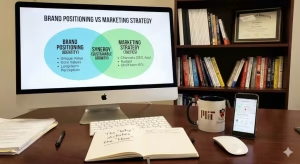
Why Messaging is Your Business Infrastructure

When we talk about brand messaging, many people think about logos, colors, or catchy slogans. However, we see brand messaging as the core infrastructure of your company. It is the data set that tells the world who you are, what you do, and why it matters. If your business were a computer program, your brand messaging would be the source code. If the code is messy, the program won’t run correctly.
In the world of local SEO and small business growth, having a clear brand messaging strategy is vital. It is not just about being “creative.” It is about precision and data integrity. When your message is clear, you reduce friction. Friction is anything that makes it hard for a customer to understand your value or make a purchase. By removing that friction, you make it easier for people in your community to find you and trust you.
A fragmented message, where you say one thing on your website and another on social media, is like a leak in a pipe. You are losing money and effort.
This guide is designed to help you build a solid foundation. We will use a technical approach to ensure your brand messaging is consistent, searchable, and effective. We will look at how to reach your audience, how to beat your competitors, and how to speak in a way that makes people listen.
Step 1: Audience Architecture and Persona Mapping
Before you can say the right thing, you have to know who you are talking to. In engineering, this is called defining the requirements. In business, we call it audience architecture. You cannot create effective brand messaging if you are trying to talk to everyone at once. If you try to please everyone, you end up interesting no one.
We start by identifying your Ideal Customer Profile, or ICP. Many businesses look at simple things like age or location. But to truly win, you need to look at psychographics. This means understanding their goals, their fears, and their daily struggles. What keeps your customer awake at night? What problem are they trying to solve when they search for a business like yours?
When you understand these customer pain points, you can map out the buyer journey. This journey is the path a person takes from not knowing you exist to becoming a loyal customer. Your brand messaging needs to change depending on where they are on that path. Someone just starting to look for a solution needs educational information. Someone ready to buy needs proof that you are the best choice.
Using data tools like Google Analytics can help here. You can see what terms people use to find you and which pages they stay on the longest. This gives you a clear picture of user intent. Are they looking for information, or are they looking to buy? When your brand messaging matches their intent, your conversion rates go up. This is the first step in building a strategy that actually works.
Step 2: The Competitive Audit and Entity Analysis
To stand out, you have to know what else is out there. This is where we perform a competitive audit. In the world of search engines, we call this entity analysis. We want to look at your local competitors as “entities” in a database. What are they saying? What are they missing?
Most small businesses make the mistake of saying the exact same thing as their competitors. If every plumber in town says they are “reliable and affordable,” then “reliable” and “affordable” lose their meaning. To develop a brand messaging strategy that wins, you need to find the content gaps. These are the areas where your competitors are silent.
Maybe your competitors focus on price, but none of them focus on speed or high-tech equipment. That is your opening. This is where you find your USP, or Unique Selling Proposition. Your USP is the one thing you do better than anyone else. It is your differentiator.
By looking at the market share and how others position themselves, you can find a “blue ocean,” a space where you aren’t fighting everyone else for the same words. We use a SWOT analysis (Strengths, Weaknesses, Opportunities, and Threats) to get a clear view of where you fit. This isn’t just a school exercise; it is a way to ensure your brand messaging is built on a solid market position.
Step 3: Crafting the Brand Positioning Statement
Once you know your audience and your competition, you need a positioning statement. This is a short, internal sentence that guides everything you do. Think of it as the “North Star” for your brand messaging. It isn’t a slogan for the public; it is a rule for your team.
A good framework for this is: (Target Audience) plus (Need) plus (Brand Name) plus (Benefit). For example, “For local homeowners who need fast repairs, Smith Plumbing provides 24/7 emergency service that guarantees a fix in under two hours.”
This statement is the source code for all your copy. If you are writing a blog post, an email, or a Facebook ad, you check it against this statement. Does it fit? If not, throw it out. This ensures that your brand messaging stays focused and powerful.
There is a big difference between internal positioning and external messaging. Positioning is how you want to be seen in the mind of the customer. Messaging is the actual words you use to get there. Without a strong positioning statement, your brand messaging will wander and become weak. You need that value-based positioning to show people why they should care about your business.
Step 4: Engineering Your Unique Brand Voice
How you say something is just as important as what you say. This is your brand voice. Think of your brand voice as the personality of your business. If your business were a person, how would they talk? Are they a serious expert, like a doctor? Or are they a fun, helpful neighbor?
In my work, I often use a voice that is technical and direct. It builds authority. For your business, you need to set parameters. These are the rules for your Tone of Voice, or ToV. You might decide your voice is “Professional but not stiff” or “Friendly but not silly.”
Once you pick a voice, you need to keep it the same everywhere. This is what we call a verbal identity. If your website sounds like a college textbook but your Instagram sounds like a teenager, people will get confused. Confusion kills sales. To prevent this, create a simple style guide. This guide lists words you use and words you avoid. It ensures that no matter who is writing for your business, the brand messaging always sounds like it is coming from the same place.
Step 5: Developing the Messaging Framework
Now we get to the heart of the story. A great way to organize your brand messaging is the StoryBrand model. In this model, you are not the hero of the story. The customer is the hero. Your business is the guide who helps the hero win.
Every good story has a hero with a problem who meets a guide. The guide gives them a plan and calls them to action, which helps them avoid failure and reach success. When you use this framework in your brand messaging, people listen because humans are hard-wired to pay attention to stories.
To do this, you need a problem/solution matrix. List every feature of your product or service. Then, next to it, write the benefit. A feature is “We have 24-hour service.” The benefit is “You can sleep soundly knowing your home is safe.” People don’t buy features; they buy solutions to their problems.
When you write your website content, make sure you use your brand messaging to lead the customer through this story. Show them you understand their pain, show them you have a plan, and tell them exactly what to do next. This makes your brand messaging feel natural and helpful, rather than pushy or salesy.
Step 6: Semantic Coverage: Value Propositions and Pillars
To make sure your brand messaging is deep and complete, we use brand pillars. These are three to five core values that support everything you say. For example, if you run a local bakery, your pillars might be “Freshness,” “Community,” and “Traditional Recipes.”
Every piece of content you create should relate back to one of these pillars. This gives your brand messaging “topical authority.” It shows both humans and search engines that you are an expert in your specific niche.
You also need proof points. In a world of “fake news” and endless ads, people are skeptical. You can’t just say you are the best; you have to prove it. Use data, local reviews, and case studies. These are the building blocks of a strong value proposition. If your brand messaging says you are the fastest, show a chart of your average response times. This adds integrity to your message.
When you cover all these aspects, you are creating a “semantic web” of information. This helps search engines understand that your brand messaging is relevant to what people are searching for. It moves you beyond simple keywords and into the realm of being a trusted authority.
Step 7: People Also Ask (PAA) and Answering Customer Questions
One of the best ways to improve your brand messaging is to look at what people are actually asking Google. This is the “People Also Ask” section. These questions are a gold mine for small businesses. They tell you exactly what is on your customers’ minds.
For example, people often ask, “What are the 4 elements of brand messaging?” In your strategy, you should answer this. The four elements are usually considered to be your brand voice, your brand story, your value proposition, and your target audience description. By answering these questions in your blog posts or FAQ sections, you provide immense value.
Another common question is, “How do you write a brand messaging strategy?” By breaking this down into a step-by-step process, just like we are doing in this article, you position yourself as a helpful guide.
Lastly, people often want to know the difference between brand positioning and brand messaging. Positioning is the “where” (where you sit in the market), and messaging is the “how” (how you communicate that spot). Answering these types of questions helps your brand messaging stand out as the most helpful resource in your local area.
Step 8: Local SEO Alignment: The Hyper-Local Connection
As experts in local SEO, we cannot stress this enough: your brand messaging must be local. If you are a small business in a specific town, you need to sound like it. This is about building community trust.
When people search for services “near me,” they are looking for someone who understands their specific area. Your brand messaging should include mentions of local landmarks, neighborhood names, and community events. This creates geo-relevance. It tells search engines like Google that you aren’t just a business; you are a local entity.
Check your Google Business Profile. Does the description there match the brand messaging on your website? It should. Do your local citations (mentions of your business name, address, and phone number) have a consistent tone? This consistency helps your ranking.
Your origin story is also a great place for local brand messaging. Why did you start your business in this city? What do you love about serving this community? When you share these details, you aren’t just a cold company; you are a neighbor. This is the “hyper-local” connection that big national brands can’t copy.
Step 9: Measurement and Iteration: The Feedback Loop
In engineering, we never just build something and walk away. We monitor it. We look for bugs. We make it better. Your brand messaging strategy should be no different. You need to create a feedback loop to see if your message is actually working.
One way to measure success is by looking at your bounce rate. If people come to your website and leave immediately, your brand messaging might be confusing or boring. They didn’t find what they were looking for. If your conversion rate is low, your value proposition might not be strong enough.
You can also use A/B testing. This is where you try two different versions of a headline or an ad to see which one performs better. Maybe one version of your brand messaging focuses on “saving money” and the other focuses on “saving time.” The data will tell you which one your audience cares about more.
Remember, your brand messaging is a living document. The world changes, and your business will grow. You should review your strategy at least once a year. Make sure it still aligns with your goals and your customers’ needs. Using data to refine your message is how you stay ahead of the competition.
Step 10: The Value of Integrity in Brand Messaging
At the end of the day, the most important part of your brand messaging is integrity. Innovation and data are great, but if people don’t believe you, none of it matters. Being competent means doing what you say you will do.
Your brand messaging is a promise. If you promise a “stress-free experience,” every part of your business must deliver that. If your messaging is high-tech but your office is full of old paper files, there is a disconnect. This disconnect creates a lack of trust.
When your brand messaging is honest and backed by real results, it becomes a powerful tool. It builds a reputation that lasts longer than any ad campaign. It creates loyal customers who will tell their friends about you. In the world of small business, word of mouth is still the most powerful form of marketing. Clear, honest brand messaging gives people the right words to use when they talk about you.
Creating a Brand Messaging Style Guide
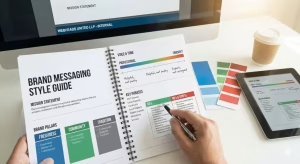
To keep everything organized, I recommend creating a simple document called a Style Guide. This doesn’t have to be long. It just needs to be clear. Start with your mission statement. Why does your business exist? Then, list your brand pillars. These are the big ideas we talked about earlier.
Next, define your voice. Use “This, Not That” examples. For instance: “Our voice is helpful, not pushy. It is expert, not arrogant. It is local, not corporate.” This gives anyone who writes for you a clear set of rules.
Finally, include a list of key phrases and terms that you want to be known for. This helps with SEO because it ensures you are using the same important words across all your pages. A Style Guide ensures that your brand messaging stays consistent as you hire new people or work with outside agencies.4 It is the blueprint for your brand’s communication.
The Role of Visuals in Brand Messaging
While we focus a lot on words, visuals are a big part of your brand messaging too. Your images should tell the same story as your text. If your message is about being “traditional and handmade,” you should use warm, natural photos, not cold, sterile stock images.
The colors you choose also send a message. Blue often feels professional and trustworthy. Green feels healthy and growth-oriented. Red feels energetic and urgent. Make sure your visual identity matches your verbal identity. When they work together, your brand messaging becomes much more memorable.
Think of your website layout as part of the message too. A clean, easy-to-navigate site says that you value your customer’s time. A cluttered, confusing site says that you are disorganized. Every design choice is a piece of brand messaging. Make sure those pieces are saying what you want them to say.
Brand Messaging for Social Media

Social media is a conversation, not a lecture. Your brand messaging on platforms like Facebook or Instagram should be more casual than on your main website, but it should still follow your core rules. It is like how you might talk a bit differently at a backyard barbecue than you would in a boardroom, but you are still the same person.
Use social media to show the “human” side of your brand messaging. Share behind-the-scenes photos. Highlight your employees. Talk about local events. This builds the “Friendly” and “Casual” parts of your brand voice that we mentioned in my own profile.
When people comment on your posts, respond in your brand voice. This shows that there are real, competent people behind the business. It turns your brand messaging from a one-way broadcast into a two-way relationship. This relationship is what builds long-term loyalty in a local community.
Content Marketing and Brand Messaging
Content marketing is the practice of creating helpful articles, videos, or podcasts to attract customers. Your brand messaging is the “soul” of your content marketing. Without it, you are just writing words. With it, you are building a brand.
Every blog post should solve a specific problem for your audience while reinforcing your brand messaging. If one of your pillars is “Innovation,” write about the new technologies you are using. If a pillar is “Customer Service,” share stories of how you went above and beyond for a client.
This approach helps you rank for more than just one keyword. It helps you rank for a whole topic. When Google sees that you consistently provide high-quality information related to your field, it rewards you with better visibility. This is how you use brand messaging to dominate local search over the long term.
Common Mistakes in Brand Messaging
Even the best businesses make mistakes. One common error is being too “inside-out.” This is when you talk about what you want to say, rather than what the customer wants to hear. Always put the customer’s needs first in your brand messaging.
Another mistake is being too vague. Words like “quality,” “excellence,” and “service” are used by everyone. They don’t mean anything anymore. Be specific. Instead of “excellent service,” say “we answer every phone call in three rings or less.” Specificity builds trust.
Finally, don’t be afraid to take a stand. Your brand messaging shouldn’t try to please everyone. It is okay if some people don’t like your style. Those people probably weren’t your ideal customers anyway. By being bold and clear, you will attract the people who are a perfect fit for what you do.
Brand Messaging and the Sales Funnel
Your brand messaging should guide people through every stage of the sales funnel. At the top of the funnel (Awareness), your message should be about the problem they are facing. You want them to feel understood.
In the middle of the funnel (Consideration), your message should be about why your solution is the best. This is where you use your USP and your proof points. You are building a case for why they should choose you over a competitor.
At the bottom of the funnel (Decision), your message should be a clear call to action. Tell them exactly what to do. “Click here to book,” “Call for a free quote,” or “Visit our shop today.” Your brand messaging should remove any last-minute doubts and give them the confidence to take the final step.
Keeping Brand Messaging Fresh
The world moves fast. Trends change, and new competitors arrive. Your brand messaging needs to stay fresh without losing its core identity. Think of it like a house. The foundation stays the same, but you might paint the walls or get new furniture every few years.
Keep an eye on the latest trends in your industry. If there is a new way of doing things, incorporate that into your messaging. But be careful not to jump on every fad. Only change things if they align with your core values and help your customers.
Regularly talk to your customers. Ask them what they like about your business. Ask them how they would describe you to a friend. Their answers are the best source of “real-world” brand messaging. Use their own words in your copy. This makes your message feel authentic and relatable.
The Technical Side of Brand Messaging: Metadata
As SEO experts, we have to mention the technical side. Your brand messaging doesn’t just live on the page; it lives in the “meta” data too. This includes your title tags and meta descriptions. These are the snippets people see on the Google search results page.
These small bits of text are your first chance to show off your brand messaging. They should be clear, enticing, and include your main keywords. Use ellipses (…) to create a sense of mystery or to show there is more to learn. This encourages people to click.
If your meta description sounds different from the page they land on, people will feel tricked and leave. Ensure that your technical SEO is perfectly aligned with your brand messaging strategy. This consistency helps both your search ranking and your user experience.
Conclusion: Building for the Future
Developing a brand messaging strategy is not a one-time task. It is an ongoing process of engineering and refinement. By focusing on your audience, understanding your competition, and speaking with a consistent, honest voice, you build a business that can stand the test of time.
In our years of develping websites, we have seen how much of a difference clear messaging makes. It turns a struggling business into a community leader. It makes your marketing more efficient and your sales team more confident.
Start today by defining your audience and your unique value. Build your messaging on a foundation of data and integrity. When you do, you aren’t just “doing marketing”—you are building a brand that people know, like, and trust. That is the secret to long-term success in any market.