Businesses every day to use geofencing to draw virtual lines around real-world places. This technology, called geofencing, is a powerful tool. In its most common form, it uses GPS to know when you enter or leave a neighborhood or a large store. But what if you need to go smaller? What if you need to know when a customer is not just at your store, but in a specific aisle, looking at a specific product? This is where standard geofencing fails and a new technology takes over.
We are talking about Bluetooth Low Energy, or BLE. This specific type of bluetooth technology allows for a new, highly precise kind of geofencing often called “micro-fencing” or “proximity marketing.” It uses small, low-power hardware to create tiny, accurate zones.
The purpose of this guide is to give you a direct, technical, and honest analysis of using bluetooth for this purpose. We will look at the powerful advantages and the significant disadvantages. While bluetooth geofencing provides unmatched indoor accuracy and is incredibly power-efficient, it also presents major challenges. These include a very limited signal range and, most importantly, a high barrier to getting customers to actually use it. This article will give you the expert knowledge you need to decide if a bluetooth-based strategy is right for you.
What Exactly is BLE Geofencing? (And How It Works)
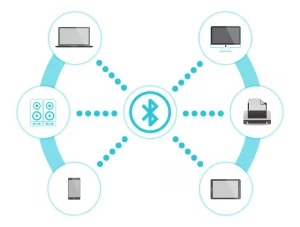
Let’s break down this concept. At its simplest, bluetooth geofencing uses small, dedicated pieces of hardware to create a very small, defined signal area. When a person’s smartphone enters this area, a special app on the phone recognizes the signal and performs an action.
It is different from the bluetooth you might use to connect your headphones or car stereo. That is “Bluetooth Classic,” and it is designed to stream a lot of data, like music, over a short distance. This uses a fair amount of battery. Bluetooth Low Energy is a different part of the bluetooth standard. It was built for a totally different job. Its purpose is to send tiny, tiny bits of data—like a quick “I am here!” message—using almost no power at all. This is what makes it perfect for geofencing.
The Core Concept: Beacons
The hardware at the heart of a bluetooth system is the beacon. A beacon is a small, simple device. It is often a plastic puck or square just a few inches across. You can stick it to a wall, a ceiling, or the bottom of a shelf.
Inside this simple plastic case is a tiny computer, a small radio antenna, and a battery. That is it. The beacon’s only job is to “broadcast,” or shout out, a short, unique signal over and over. It might shout its signal once every second, or once every five seconds. This signal is just a string of letters and numbers, like a unique name or ID.
Think of a beacon like a tiny, invisible lighthouse. It constantly flashes its own unique light pattern. It does not see anything. It does not collect any data. It just flashes its light, 24 hours a day, 7 days a week.
The Mechanism: Broadcast, Detection, Action
This simple “lighthouse” idea works in three steps.
- Broadcast: The bluetooth beacon, which you have placed on a wall in your store, sends out its signal. For example, its ID is “ABC-123.” It is broadcasting this ID constantly.
- Detection: A customer walks into your store. On their smartphone, they have your store’s official app. The app has been programmed to “look” for your beacons. As the customer walks down an aisle, their phone’s bluetooth receiver “sees” the “ABC-123” signal from the nearby beacon. The phone can also tell how “loud” or “strong” the signal is. A very strong signal means the beacon is very close.
- Action: The moment the app detects “ABC-123,” it springs into action. It knows that “ABC-123” is in the shoe department. So, the app instantly triggers an event. This could be a push notification (“Save 20% on all running shoes today!”) or it could silently change the app’s home screen to show specials on shoes.
This entire process is powered by bluetooth technology. The phone is not tracking its own location with GPS. It is simply listening for nearby bluetooth signals that it has been told to care about.
The Key Components
To make a bluetooth geofencing system work, you need three key ingredients:
- Hardware (Beacons): These are the physical bluetooth transmitters. There are two main “languages,” or protocols, they use: iBeacon (made by Apple) and Eddystone (made by Google). Both are just standards for how the beacon sends its signal, but they are the foundation of any bluetooth beacon system.
- Software (A Mobile App): This is the “brain” of the operation. You must have a mobile app that your customer has downloaded. This app has a special piece of code, called an SDK (Software Development Kit), that is always listening for your beacons’ signals. You program this app to decide what to do when it hears a specific bluetooth signal.
- The User’s Device: You need a customer with a modern smartphone or tablet. The device must have bluetooth capability. Crucially, the user must have their bluetooth turned on and have given your app permission to use their location. We will talk more about this major challenge later.
Without all three of these pieces—the beacon, the app, and a user’s permissioned phone—the system does not work. But when they come together, they create a powerful tool for micro-location.
The Advantages (Pros) of BLE Geofencing
Now that we understand what a bluetooth beacon system is, let’s look at why it is so popular. The advantages are technical, specific, and very powerful for the right kind of business.
Pro 1: High Accuracy and Granularity (Micro-Location)
This is the number one reason to use bluetooth. GPS is great for getting you to the store. But the moment you walk inside, GPS signals are blocked by the roof and walls. The “blue dot” on your map starts to drift. It has no idea where you are.
Bluetooth does not have this problem. Because the beacons are inside the building, they provide fantastic indoor positioning. A standard bluetooth beacon system can usually tell your location within about 5 meters (about 15 feet). This means it knows which department you are in.
But it gets even better. Newer, advanced bluetooth methods can get much more accurate.
- RSSI (Received Signal Strength Indicator): This is the basic method. The app on your phone measures the strength of the beacon’s signal. A stronger signal means you are closer. By listening to three or more beacons at once, the app can “triangulate” your position very accurately, just like how your phone finds its position using cell towers.
- Angle of Arrival (AoA) / Angle of Departure (AoD): These are newer, more complex bluetooth techniques. They use special antennas to measure the direction the bluetooth signal is coming from. By knowing the direction and angle of signals, a system can pinpoint your location to sub-meter accuracy. That means it can know your position within just a few feet or even inches. This is the difference between knowing you are in the shoe aisle and knowing you are standing in front of the running shoes. This level of detail is impossible with any other large-scale technology.
Pro 2: Extremely Low Power Consumption
The “LE” in “Bluetooth Low Energy” is its second superpower. This technology was designed from the ground up to use almost no battery.
A single beacon can run for one to five years on a small, cheap coin battery—the same kind you find in a watch. It does this by “sleeping” most of the time. It wakes up for a tiny fraction of a second to send its bluetooth signal, then goes back to sleep.
This is just as important for the user’s phone. A phone constantly using GPS will have its battery drained in just a few hours. But a phone that is passively listening for Bluetooth Low Energy signals sees almost no extra battery drain. This is a huge benefit. Users are much more willing to leave their bluetooth on than to have an app constantly tracking their GPS. Any modern phone with its bluetooth on is already listening for these signals; your app just tells it which ones to pay attention to.
Pro 3: Cost-Effectiveness
For the level of accuracy you get, a bluetooth beacon system is very cheap to set up.
A single beacon can cost between $10 and $30. To cover a large department store, you might need a few dozen beacons. The hardware cost is therefore very low.
The main cost is not the hardware; it is the software. You must have a mobile app. If your business does not have an app already, you will need to build one. You will also need to add the beacon SDK and build the “rules engine” that decides what to do with the bluetooth signals.
However, when you compare this to other high-tech indoor positioning systems (like those using light or ultrasound), a bluetooth solution is almost always the cheapest and easiest way to get started.
Pro 4: Versatility in Application

Because the system is so simple (a beacon, an app, and a phone), you can use it for many different things. The only limit is what you program your app to do.
- Proximity Marketing: This is the most common use. It is all about sending the right message to the right person at the right time and place.
- A shopper in a grocery store lingers in the wine aisle. A bluetooth beacon triggers the store app to send a notification: “All cabernets are 10% off today only.”
- A person walks past a restaurant. A beacon near the entrance pings their phone (which has the restaurant’s loyalty app) with the daily lunch special.
- Asset Tracking: This is a huge, non-marketing use. Hospitals are a perfect example. They have thousands of pieces of valuable, mobile equipment, like infusion pumps, wheelchairs, and crash carts. By putting a small bluetooth tag (a beacon) on each item, hospital staff can use a tablet to see a map of where every single piece of equipment is in real-time. This saves thousands of hours of staff time spent searching for items.
- Indoor Navigation: Large, confusing buildings like airports, museums, and convention centers use bluetooth for “wayfinding.” You open the airport’s app, and it tells you to “turn left in 20 feet” to get to your gate. It works just like Google Maps in your car, but it uses bluetooth beacons instead of GPS to know your precise location inside the building.
- Automation: In a smart office, employees can have the company app on their phones. When they walk into a meeting room, a bluetooth beacon detects their phone and automatically turns on the lights and the projector. When they leave, the bluetooth signal is lost, and the system shuts everything down to save energy.
All of these uses are powered by the same simple, low-cost bluetooth beacon technology.
The Disadvantages (Cons) of BLE Geofencing
This all sounds great. But as an expert, I must be direct about the serious challenges. A bluetooth system is not a magic solution. It has significant drawbacks that can make it the wrong choice for many businesses.
Con 1: The “Triple Opt-In” Barrier
This is, by far, the biggest and most difficult hurdle for any public-facing bluetooth geofencing system. To receive a message from your beacon, a user must voluntarily do three separate things. This is the “triple opt-in.”
- They Must Install Your App: A user must go to the app store, search for your specific app, and download it. This is a huge marketing challenge. Most people do not want another app on their phone. You must give them a very, very good reason to install it, such as a great loyalty program or exclusive discounts.
- They Must Have Bluetooth Turned On: Many people turn off their phone’s bluetooth to save battery. This is often an old habit from the days before Bluetooth Low Energy, but the habit remains. If their bluetooth is off, their phone is deaf. It cannot hear any of your beacon signals. You cannot force it to turn on; the user must do it themselves.
- They Must Grant Location Permissions: This is the highest wall to climb. When the user first opens your app, it will ask, “Allow [Your App] to use your location?” In today’s privacy-conscious world, many users will say “No” or “Only While Using the App.” For your proximity messages to work in the background (i.e., to send a notification as they walk by), you need “Always Allow” permission. This is the hardest one to get. You must clearly explain why you need it and what value the user will get in return.
If a user fails at any one of these three steps, they are invisible to your entire bluetooth system.
Con 2: Limited Signal Range
The strength of bluetooth (short-range) is also its weakness. A single bluetooth beacon has a maximum range of about 100 meters (around 300 feet), and that is in a perfect, open field.
In a real-world indoor space like a store, that range is much, much smaller. You are lucky to get 20 to 25 meters (60-80 feet). This means bluetooth is completely useless for large, outdoor geofencing. You cannot use it to target a whole city block or a neighborhood. For that, you must use GPS or cell-tower geofencing.
This short range means you need to plan your beacon deployment carefully. You will need many beacons to cover a large building, which adds to the complexity.
Con 3: Signal Interference and Obstruction
A bluetooth signal is a radio wave. Just like any radio wave, it can be blocked or distorted.
Bluetooth operates in the 2.4 GHz frequency band. This is one of the most crowded “public” radio bands in the world. It is shared with:
- Wi-Fi networks
- Other bluetooth devices
- Microwave ovens
- Wireless home phones
- Baby monitors
All of these devices are “shouting” in the same 2.4 GHz space. This can create a lot of noise, making it harder for a phone to hear a beacon’s signal clearly. This interference can reduce the accuracy and reliability of your system.
Physical objects are an even bigger problem. The bluetooth signal is easily blocked or weakened by:
- Concrete walls
- Metal shelves
- Large glass windows
- Water (including large groups of people, as the human body is mostly water)
You may place a beacon and find it works perfectly when the store is empty, but its signal range drops by half when the store is full of shoppers. This makes reliable accuracy a real challenge.
Con 4: Hardware Management and Maintenance
GPS geofencing is pure software. A bluetooth system is not. It relies on dozens or hundreds of physical, battery-powered devices stuck to your walls and ceilings. This creates a new set of logistical problems.
- Deployment: You need a plan. Where will each beacon go? You need to create a map of all your beacon IDs and their physical locations.
- Battery Life: That 1-to-5-year battery life is great, but the batteries will eventually die. How do you know when a beacon’s battery is low? Good beacon systems have a management dashboard that alerts you. But then, an employee must go out with a ladder and replace the battery or the entire beacon.
- Damage or Loss: What if a beacon is stolen off a wall? What if a cleaning crew knocks one off and throws it away? What if an employee moves a display and puts the beacon in a new spot? Your system will break. Your app will think a customer is in the shoe aisle when they are really in the milk aisle. You must have a process for auditing and checking your physical beacons to make sure they are still there and still where they are supposed to be.
This “total cost of ownership” is more than just the price of the beacon. It is the cost of the human labor to manage this physical hardware network over time.
Frequently Asked Questions
Let’s quickly cover some of the most common questions I hear about bluetooth geofencing.
How does BLE geofencing differ from GPS geofencing?
Think of it as Indoor vs. Outdoor.
GPS Geofencing is for the outdoors. It uses satellites to create very large virtual fences, from the size of a single building to an entire city. It is great for “macro” location. Its weakness is that it’s power-hungry and does not work indoors.
Bluetooth Geofencing is for the indoors. It uses local beacons to create very small, precise fences, from the size of a room to a single store shelf. It is great for “micro” location. Its weakness is its short range and the “triple opt-in” barrier.
What protocols do BLE beacons use?
There are two main “languages” or “protocols” that beacons speak.
- iBeacon: This was created by Apple. It is very simple. Its only job is to broadcast its ID number. The app on the phone sees the ID and has to do all the work of figuring out what that ID means.
- Eddystone: This was created by Google. It is more powerful and open. An Eddystone beacon can broadcast several different things. It can send an ID (like iBeacon), but it can also broadcast a website URL (the “Physical Web”) or sensor data like its temperature or battery level.
Most modern beacons can be programmed to speak either language, so you are not locked into one.
How accurate is Bluetooth geofencing?
It depends on the method.
- Basic Accuracy (using RSSI): This is the most common. It measures signal strength. In a typical store, you can reliably get meter-level accuracy (around 3-5 meters). This is good enough to know which department or large aisle a customer is in.
- Advanced Accuracy (using AoA/AoD): This is the next generation. It requires special beacons and phones that can support it. With this, you can achieve sub-meter accuracy (less than 1 meter, or about 3 feet). This is precise enough to know which specific product a person is looking at.
Technology Comparison: BLE vs. GPS vs. Wi-Fi
To put it all together, let’s compare bluetooth to the other main location technologies.
- Bluetooth Low Energy (BLE): This is the champion of low-power, high-accuracy, indoor proximity. It is perfect for micro-location. Its main weakness is the high-friction “triple opt-in” from the user.
- GPS (Global Positioning System): This is the champion of outdoor, global macro-location. It is in every phone and is the standard for maps and large-scale geofencing. Its main weaknesses are that it drains the battery and does not work at all indoors.
- Wi-Fi: This is the “middle” technology. Most buildings already have Wi-Fi access points. A phone can “see” these access points and use their signal strength to get a rough idea of its location. It is less accurate than bluetooth (often only 10-25 meters) and uses more power. Its main advantage is that the infrastructure is often already in place for free.
- NFC (Near Field Communication): This is not really geofencing, but it is related. It is the technology used for “tap-to-pay.” Its range is tiny—just a few centimeters. A user must intentionally tap their phone on an NFC tag. It requires zero battery, but it is not passive. The user must perform a physical action.
Conclusion: Is BLE Geofencing the Right Solution for Your Business?
We have covered the deep technical advantages and the very real-world challenges of using Bluetooth Low Energy for geofencing. So, what is the final verdict?
The decision comes down to a simple trade-off: Precision vs. Permission.
Bluetooth geofencing offers you a level of precision that no other technology can match. You can interact with your customers at a granular, indoor, micro-location level. The trade-off is that you must first win a high-stakes battle for their permission. You must convince them to download your app, turn on their bluetooth, and grant you “Always Allow” location access.
Here is my final recommendation as a geofencing expert.
You should adopt a bluetooth beacon strategy if:
- Your primary use case is indoors and requires high-precision proximity.
- You are a retailer, museum, airport, hospital, or smart office.
- You already have a successful mobile app with a loyal user base, or you have a clear strategy to create one and give users a powerful reason to install it and grant permissions.
You should avoid a bluetooth beacon strategy if:
- Your primary use case is outdoors or covers a large geographical area (like a city).
- Your business is something like fleet management or city-wide marketing (use GPS for this).
- You cannot offer a compelling, valuable reason for a customer to download your app and go through the “triple opt-in.”
Bluetooth technology is a powerful tool, but it is a specialized one. If your business fits the profile, it can unlock new and valuable ways to interact with your customers and manage your assets. If not, you are better off sticking with simpler, more traditional geofencing methods.