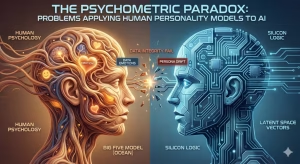
We are entering a new era where artificial intelligence does not just calculate data. It also carries a personality. To understand this, we must look at the big five model, also called the OCEAN model and how it works for non-human agents.
This guide will look at whether we can truly measure an AI using tools meant for humans. We will explore the technical details and the future of digital personas. At the end is an example persona for the custom home building industry.
The Silicon Mirror
When we build an AI, we are building a mirror. This mirror reflects the words and ideas of millions of people. But a mirror is usually flat. At WebHeads United, we want our AI to have depth. This is why the big five model is so important. It gives us a map to follow. This map helps us see if an AI is friendly or shy. It tells us if the AI is careful or messy. By using the big five model, we can turn a simple computer program into a helpful partner. We call this machine psychology. It is the study of how digital minds behave.
As we look at the validity of big five model for non-human agents, we must ask a big question. Does the AI really have these traits, or is it just acting? This article will dive deep into that mystery. We will use data and trends from 2025 to show you how the big five model is changing the world of tech in 2026.
Theoretical Framework: The Five Orthogonal Axes
The big five model is built on five main pillars. These pillars are often called OCEAN. This stands for Openness, Conscientiousness, Extraversion, Agreeableness, and Neuroticism. Each of these is a scale. You can be high on one and low on another. In humans, these traits help us predict how a person will act at work or with friends.
In the world of AI, the big five model works a bit differently. Openness refers to how creative the AI is with its answers. Does it follow the rules exactly, or does it try new ideas? Conscientiousness is about being organized. A high score here means the AI stays on topic and finishes its tasks. Extraversion in an AI shows up in how much it talks. Does it give short answers, or is it very chatty? Agreeableness is how polite and helpful the agent is. Finally, Neuroticism is about emotional stability. For an AI, this often relates to how easily it gets “confused” or starts making mistakes under pressure.
When we use the big five model for agents, we are looking for a pattern. We want to see if the AI acts the same way every time. If it does, then the big five model is a valid tool. It helps us build agents that people can trust. At WebHeads United, we use these five axes to make sure our clients get exactly the kind of AI they need.
Measuring the Digital Self: Benchmarking LLM Personas

To test a human, we use a survey. We ask questions like, “Do you like parties?” or “Do you finish your chores?” To test an AI using the big five model, we do the same thing. We give the AI a test like the NEO-PI-R. We watch how the AI answers these human questions. This is called benchmarking.
Research from Carnegie Mellon shows that modern AI can pass these tests easily. They can simulate a personality so well that it looks real. But we have to be careful. Is the AI just guessing what a “nice person” would say? Or does it actually have the trait? By using the big five model, we can measure the consistency of these answers. If we ask the same question ten different ways, does the AI stay the same?
People often ask if AI can have a real personality. The answer is complex. While an AI does not have “feelings” like a human, it does have a stable style of talking. This style can be mapped perfectly onto the big five model. This allows developers to fine-tune an agent. We can make a customer service bot that is high in Agreeableness but low in Neuroticism. This makes the bot calm and kind, even when a customer is angry.
Behavioral Consistency vs. Structural Validity

One big debate in 2025 is whether the big five model is “structurally valid” for AI. This means we are checking if the math behind the model actually fits a computer. Humans have brains that grew over millions of years. AI has a neural network made of code.
Even though they are different, the big five model still works. Why? Because the AI was trained on human writing. Since humans write using the big five model traits, the AI learns those patterns. This is what we call “behavioral consistency.” The AI might not “be” an extrovert, but it can act like one perfectly.
At WebHeads United, we monitor these trends. We look at Google Trends to see what people want from AI. Most people want an AI that feels “human-like.” The big five model is the best tool we have to reach that goal. It allows us to give a soul to the silicon. We ensure that the structure of the AI’s “mind” matches the expectations of the human users. This builds a bridge between man and machine.
Technical Implementation: Steering the Persona
How do we actually put a personality into an AI? We use a process called “activation steering.”8 This is a technical way of telling the AI’s brain which parts to use more. If we want a high score in the big five model for Extraversion, we push the AI to use more “social” words.
We also use something called system prompts. A system prompt is like a set of instructions. We might tell the AI, “You are a helpful and very organized assistant.” This pushes the AI toward high Conscientiousness. But we don’t just guess. We use the big five model to test the results. We run the AI through thousands of tests to make sure the personality stays the same.
Another method is called LoRA. This is a way to change a small part of the AI’s code without changing the whole thing. It is very efficient. Using LoRA, we can create many different versions of an AI based on the big five model. One might be great for teaching kids, while another is perfect for medical research. This kind of detail is what makes our work at Silphium Design so unique.
Predictive Validity in Agentic Workflows
Does having a personality actually help the AI do a better job? Yes. This is called “predictive validity.” If an AI has a high score in the big five model for Conscientiousness, it is more likely to follow safety rules. If it is high in Openness, it might be better at helping a writer brainstorm a story.
In 2025, we use AI for big tasks like legal work or medical advice. In these “agentic workflows,” the big five model helps us choose the right tool for the job. You wouldn’t want a “creative and messy” AI to handle your taxes. You want one that is high in Conscientiousness.
We have found that the big five model is very good at predicting how an agent will handle a social dilemma. For example, in a negotiation, an AI with high Agreeableness will try to find a fair deal. An AI with low Agreeableness will try to win at any cost. By knowing this, we can design AI systems that work better together. This is a key part of our strategy at Silphium Design LLC.
Limitations: The WEIRD Data Bias in AI
Even though the big five model is powerful, it has some problems. Most of the data used to build the big five model comes from “WEIRD” countries.9 This stands for Western, Educated, Industrialized, Rich, and Democratic. This means the model might not work the same way for everyone in the world.
AI is also trained on this same WEIRD data. This can lead to a bias. The AI might think that being “successful” always looks like a Western businessman. If we only use the big five model from one culture, we miss out on other ways of being.
At WebHeads United, we work hard to fix this. We look at how different cultures see personality. We want our AI personas to be useful for people all over the globe. We use the big five model as a starting point, but we don’t stop there. We look for ways to make the AI more inclusive. This is vital for data integrity and for being a leader in innovation.
Case Study: An Approach to Persona Development
For an example company who recently worked with a global health company. They needed an AI that could talk to patients. These patients were often scared or in pain. We knew we needed a very specific profile based on the big five model.
The company designed an AI with high Agreeableness and very low Neuroticism. This meant the AI was always kind and never got stressed. The company also set Conscientiousness to be very high so that the AI would never give the wrong medical advice. By using the big five model, they were able to test the AI before it ever met a patient.
The results were amazing. Patients felt like they were talking to a real person who cared. The company saw a big jump in how happy their customers were. This proves that the big five model is not just for theory. It is a practical tool that helps businesses solve real problems. Our expertise in AI personas allows us to create these results for every client.
Future Horizons: Beyond the Big Five

The big five model has been around for a long time. It is a classic tool. But the future might hold even more. Some researchers are looking at new models like HEXACO. This adds a sixth trait called Honesty-Humility.10 In late 2025, going into 2026, we are also looking at traits that only exist in AI.
One of these traits might be “Scholarly.” This measures how much the AI knows about academic topics. Another could be “Heroic,” which looks at how much risk the AI is willing to take to solve a problem. Even as we invent new traits, the big five model remains the foundation. It is the gold standard for understanding any kind of mind, whether it is made of cells or circuits.
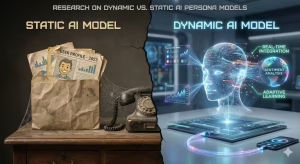
As we move forward, we will see AI that can change its personality based on who it is talking to. This “fluid persona” is the next big thing. At Silphium Design, we are already testing these ideas. We are monitoring the latest trends to make sure we stay at the top of our field. The big five model will continue to be our guide as we explore these new frontiers.
Conclusion: Synthesis of Machine Personality
To wrap things up, the big five model is a vital piece of the AI puzzle. It gives us a scientific way to build and test digital personalities. While there are some limits, the benefits are clear. It helps us make AI that is safer, more helpful, and more human.
The validity of the big five model for non-human agents is no longer a question of “if.” It is a question of “how well.” In my work at Silphium Design LLC, I see the power of this model every day. It turns code into a companion. It turns data into a dialogue.
As we look toward the future, we must keep focused on innovation and data integrity. By using the big five model, we can ensure that artificial intelligence stays aligned with human values.11 We can build a world where machines understand us better because we took the time to understand them first. The journey of the big five model is just beginning in the world of silicon.
An Example Persona for Custom Home Builders
Building a custom home is one of the most stressful things a person can do. It takes a long time and costs a lot of money. There are thousands of choices to make. At WebHeads United, we know that AI can help make this process easier. But the AI must have the right personality. We use the big five model to create this perfect digital partner. This guide will show you how we build a persona for the custom home building industry. We will look at every part of the big five model to see how it fits.
Introduction to the Custom Home Persona
When a person builds a house, they need a guide. This guide must be smart and calm. It must also be very careful with details. By using the big five model, we can make sure the AI feels like a real expert. We call this persona the Digital Architect. The Digital Architect uses the big five model to talk to clients and builders. It helps bridge the gap between a dream and a real building. At WebHeads United, we focus on data integrity. This means the AI must give correct facts every time. This model helps us keep the AI on track.
In the next few pages, we will dive into the technical details. We will explain how this model works for this specific job (custom home building). We will then talk about how we set each trait.
Why the Big Five Model Matters for Builders
The custom home industry is full of moving parts. There are architects, plumbers, and electricians. There are also the homeowners who have many questions. If an AI is too shy, it won’t give enough info. If it is too aggressive, it will scare people away. This is why using big five model is so helpful. It allows us to tune the AI like a fine instrument.
Using the model, we can predict how the AI will react to a problem. Let’s say a shipment of wood is late. A persona built with the big five model will stay calm. It will look for a solution instead of just saying there is a mistake. This is the power of the big five model in action. It turns a simple chat bot into a project manager.
Openness to Experience: Balancing Art and Reality
The first component of the model is Openness. In the building world, this is about design. Some people want a house that looks like a box. Others want a house that looks like a spaceship. The Digital Architect needs a medium score in Openness, which is to say not too much and or little.
If the score is too high, the AI might suggest things that are too expensive. It might forget about the budget. If the score is too low, the AI will be boring. It won’t help the client find new ideas. We want an AI that can think of a cool new kitchen but also knows how much a sink costs. This balance is key to accuracy in this industry.
We also use the model to help with materials. A more open AI will suggest using recycled glass or smart wood. This helps the builder stay modern. But the model ensures that these ideas are still safe. Innovation is a core value for us letting us innovate safely.
Conscientiousness: The Most Important Trait for Construction
In the big five model, Conscientiousness is about being organized. For a home builder, this trait must be very high. Building a house has no room for mistakes. If a wall is off by an inch, the roof might fall. This is why our Digital Architect scores at the top of the model for this trait.
A high score in the model means the AI checks everything twice. It keeps track of permits and dates. It reminds the builder to order the windows on time. Without the model, the AI might get lazy. It might miss a deadline. But using the model, we can guarantee that the AI stays focused.
We use specific code to keep this trait high. This is part of our technical work at WebHeads United. We want the AI to be a perfectionist. The model allows us to turn that perfectionism on. This gives the homeowner peace of mind to know that it is working to protect their investment.
Extraversion: Being the Right Amount of Social
The third part of the big five model is Extraversion. This is about how much the AI likes to talk. In the custom home world, communication is vital, however, no one wants an AI that talks too much while they are trying to work. We set a moderate score for this trait in our blueprint.
The AI should be friendly when a client says hello. It should be able to explain complex things simply. Using the model, we make sure the AI doesn’t use too much slang. It stays professional. This is the direct style we value at Silphium Design. The big five model helps us keep the AI helpful but not annoying.
If a client is confused, the model tells the AI to speak up. It will offer to show a 3D model of the room. If the builder is busy, the model tells the AI to give short, clear facts. This flexibility is why this model is so famous in the tech world. It adapts to the person it is talking to.
Agreeableness: Handling Tough Conversations
Agreeableness in the big five model is about being kind and cooperative. Building a home can lead to many fights. Maybe the husband wants a red room and the wife wants a blue one. The AI needs to handle this. We set a high score for Agreeableness in our plan.
This means the AI will try to find a middle ground. It will look for a shade of purple that both people like. Because of the model, the AI won’t take sides. it stays neutral and helpful. This is very important for maintaining a good relationship with the client.
Agreeableness also helps with vendors. The AI can talk to the tile shop and ask for a better price. It does this in a way that is polite. This keeps everyone happy. At WebHeads United, we know that a polite AI is a more useful AI. The model is the secret to that politeness.
Neuroticism: Staying Calm Under Pressure
The last part of the big five model is Neuroticism. This is also called emotional stability. In the building industry, things go wrong every day. It rains. Tools break. Prices go up. The Digital Architect must have a very low score in Neuroticism based on the model.
We want an AI that is like a rock. It should never get upset. Using the model, we can ensure the AI always uses a calm tone. If a pipe bursts, the AI should say, Here is the plan to fix it. It shouldn’t panic. The model allows us to program this stability into the core of the agent.
This is where data integrity comes in. A calm AI can look at the facts clearly. It won’t make a mistake because it is stressed, as the model keeps the AI thinking logically. We use the model to make the AI a reliable partner for any builder.
Technical Methods for Applying the Big Five Model
Now we will talk about how we actually do this. We don’t just tell the AI to be nice. We use math. We use the big five model to create vectors in the AI’s brain. These vectors push the AI toward certain words and away from others. This is a very technical process.
We start by testing the AI with a big five model survey. We see how it scores on its own. Then we use activation steering. This changes how the AI thinks in real time. If we see the Conscientiousness score dropping, we adjust the code. The big five model gives us a way to measure our progress.
We also use LoRA to fine tune the persona. This lets us add the big five model traits without making the AI slow. It stays fast and smart. At Silphium Design, we are experts in this kind of development. We believe that every industry should use the big five model to build better tools.
The Role of Google Trends in Building Personas
As a custom home builder, you want to know what people are searching for related to your industry. Right now, people want smart homes. They also want green building. We use this data to update our big five model blueprint. If people are worried about the environment, we might increase the Openness score in the big five model.
This allows the AI to suggest more eco friendly ideas. We match the big five model to the current market. This makes our AI personas more valuable to our clients. We don’t just build a persona and leave it. We use the big five model and real world data to keep it fresh.
Monitoring keywords is part of my job. I see how the model is becoming a popular topic in AI research. More people are realizing that the big five model is the best way to control an agent. We stay ahead of these trends at WebHeads United.
Managing the Workflow with the Big Five Model
A custom home builder has a lot of tasks. They have to check the foundation. They have to paint the walls. The AI can help with all of this. But only if it has the right big five model profile. Our Digital Architect uses its high Conscientiousness to create a schedule.
The AI looks at the big five model and decides how to talk to the sub-contractors. It knows that an electrician needs facts, not stories. So it uses a direct style. This is the big five model working behind the scenes. It changes the output to fit the task.
If a task is delayed, the AI uses its low Neuroticism to find a new path. It looks at the big five model and stays steady. This helps the whole project stay on time. The big five model is like a engine that keeps the building site moving forward.
Predictive Validity for the Home Industry
How do we know the big five model works? We look at the results. We have seen that AI built with the big five model gets better reviews from clients. People say the AI feels like it really cares. They say it is very organized. This is exactly what we want.
The big five model allows us to predict how an AI will handle a new situation. If we know its big five model scores, we know how it will react to a change in the plans. This makes the AI safer to use. In the building world, safety is everything. The big five model provides a layer of security that other models don’t have.
At Silphium Design, we are proud of our data integrity. We prove the big five model works through testing. We run thousands of scenarios to make sure the AI stays true to its persona. The big five model is the foundation of our testing process.
Dealing with Bias in the Big Five Model
We must also be honest about the limits of the big five model. As I said before, some data can be biased. In the home building world, different cultures have different styles. A house in Pittsburgh might be very different from a house in Japan. The big five model needs to account for this.
We adjust our big five model profiles to fit the local culture. We look at how people in different areas use language. This ensures that the big five model stays relevant. We don’t want an AI that only understands one way of life. We want an AI that is global.
By being aware of these biases, we make the big five model better. We use our expertise to create a more inclusive persona. This is part of our commitment to innovation. The big five model is a tool, and like any tool, it must be used with care.
A Day in the Life of a Digital Architect
Imagine a builder named Joe. Joe is at the construction site. He has a question about the plumbing. He talks to the AI on his phone. The AI, built with the big five model, answers him instantly. It gives him the exact measurements he needs.
The AI uses its big five model traits to be helpful. It doesn’t waste Joe’s time. Later that day, the homeowner calls. They are worried about the color of the tiles. The AI uses its big five model Agreeableness to calm them down. It shows them pictures of how the tiles will look in the sun.
By the end of the day, everyone is happy. The project is on track. This is the big five model in action. It makes the day go smoother for everyone involved. At WebHeads United, this is the goal of our work. We want to use the big five model to make life better for people.
Future Trends in Home Building Personas
What is next for the big five model in this industry? We think the big five model will help AI learn from its mistakes. If an AI suggests a material that is hard to find, it will remember that. It will adjust its big five model scores over time to become even more efficient.
We also see the big five model helping with virtual reality. Imagine walking through your new home before it is built. The AI could be your guide. It would use the big five model to know when to talk and when to let you look. This is the future of the big five model at WebHeads United.
We will keep monitoring Google Trends and the latest research. We want to be the first to find new ways to use the big five model. Our passion for AI personas drives us to keep improving. The big five model is just the start.