The internet has fundamentally shifted. For the last twenty years, the web was like a library. Think of a larger Wikipedia. You went to a site, you read a static page, and you left. Today, the web is becoming a conversation. We are moving from reading Frequently Asked Questions (FAQs) to chatting with intelligent machines. This transition has created a massive new area where your customers interact with you. It is the “digital handshake.”
However, there is a major problem facing most small businesses today. When they add Artificial Intelligence (AI) to their websites, they usually leave it on the default settings. This could be called “Robot Neutral.” This is because the default setting a neutral tone. This creates a jarring experience for the user. Imagine walking into a cozy, family-owned bakery where the marketing promises warmth and care, but the person at the counter speaks like a cold, unfeeling robot from a science fiction movie. That disconnect kills trust.
This article will argue a critical point. Aligning your AI persona with your brand identity is not just a fun creative project. It is a technical requirement. If you want to rank high in search engines and keep customers happy, you must fix this. We have to look at this through the lens of data. A disjointed experience increases the cognitive load, or brain power, your customer has to use to understand you. It also confuses Google about your authority in your field. We are going to explore why fixing your brand identity within your AI is the most important move you can make this year.
What is an AI Persona?
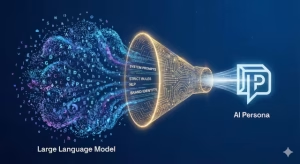
To understand how to fix this, we first have to define what we are talking about. In short, AI persona is not just a character name or a funny avatar picture. In the world of computer science, an AI persona is a set of strict rules and system prompts. I encourage you to read the many articles on this blog about AI personas and the various tones they can have to different situations.
Most modern AI tools are built on things called Large Language Models (LLMs). You can think of an LLM as a very well-read parrot. It has read almost everything on the internet. Because it has read everything, its default personality is the average of the entire internet. It is helpful, but it is generic. It has no soul. It has no specific brand identity.
When we talk about Natural Language Processing (NLP), we are talking about how computers understand human words. The machine does not actually “know” what it is saying. It is predicting the next word in a sentence based on math. If you do not give the machine specific instructions, it predicts the most average, common word. Essentially, a raw AI is just a frame of a person. You have to fill in the details to get it to work.
This is where your brand identity comes in. You have to map your business personality to the machine. In marketing, we often talk about “archetypes.” These are classic character types, like “The Sage” (the wise teacher) or “The Ruler” (the leader). If your brand identity is built around being a Sage, your AI cannot speak like a teenager using slang. We have to use code and prompts to force the generic math of the LLM to sound like your specific business.
The “Why”: Strategic Advantages of Alignment

You might be asking if this really matters to your bottom line. The data says yes. There are three main strategic reasons why you must align your AI with your brand identity.
1. Trust and Psychological Safety
Humans are wired to look for patterns. When we interact with something that looks human or talks like a human, we project a personality onto it. This is called anthropomorphism. We treat the machine like a person. Going further, we are wired and attuned to patterns in nature; a concept called biophilia.
Trust is built on consistency. If a friend acts one way today and a completely different way tomorrow, you stop trusting them. The same happens with businesses. If your website uses bright colors and friendly language to build a fun brand identity, but your customer service bot speaks in confusing legal terms, the customer feels a “prediction error” in their brain.
This error makes them feel unsafe. When customers feel unsafe, they do not buy things. By keeping your AI voice consistent with your brand identity, you create a smooth “Trust Flow.” The customer feels like they are talking to the same entity from the homepage all the way to the checkout. This directly improves your customer retention rates.
2. SEO and User Signals
It is often helpful to look at how Google ranks pages. Google uses user signals to decide if a page is good. One of the most important signals is “Dwell Time.” This is how long a person stays on your site.
If a user starts chatting with your AI and gets confused because the tone does not match the brand identity they expected, they leave. They “bounce” back to the search results. This is sometimes called “pogo-sticking.” It tells Google that your site did not answer the question well.
Furthermore, we have to look at “Search Intent.” Is the user looking for information or looking to buy? A strong brand identity helps the AI understand this. If your brand is helpful and educational, the AI should provide long, detailed answers. If your brand is about speed and efficiency, the AI should give short, fast answers. Matching the AI to the brand identity helps satisfy the user, which makes Google rank you higher.
3. Differentiation in a Sea of Sameness
Right now, thousands of small businesses are adding chatbots to their sites. Most of them are using the exact same underlying technology, like ChatGPT or Claude. If everyone uses the same tool with the default settings, every business sounds exactly the same.
Your brand identity is your only competitive advantage here. It is the “moat” around your business castle. If you remove your logo from your website, your customers should still know it is you just by reading the text. The same must be true for your AI. A distinct tone of voice ensures you do not sound like a generic “wrapper” around a basic computer program. It proves you are a unique entity.
Common Questions about AI and Brand Identity

Many people ask the same questions about this topic. Let us answer them clearly to add value to your understanding of brand identity.
How does AI affect brand identity?
AI acts as a multiplier. If you have a strong brand identity, AI can broadcast it to thousands of customers at once, 24 hours a day. It makes your brand stronger. However, if your brand identity is weak or undefined, AI will expose that weakness. It will make your business look unorganized and impersonal. AI does not create the identity; it amplifies whatever is already there.
What are the risks of an undefined AI persona?
The biggest risk is the “Uncanny Valley” effect. This is a feeling of unease when something looks human but is not quite right. If your bot tries to be friendly but fails because it lacks a core brand identity, it feels creepy. Another risk is generic responses. If your AI gives the same advice as your competitor’s AI, why should the customer choose you? You lose brand equity, which is the value of your name in the market.
How to create a brand persona for chatbots?
You cannot just say “be nice.” You have to move from abstract values to concrete rules. You need a Style Guide. This is a document that tells the AI exactly how to speak. It connects your visual brand identity (colors, logos) to your verbal identity (words, tone). We use a technique called “Few-Shot Prompting,” where we give the AI examples of good and bad responses so it learns the pattern of your brand identity.
Technical Implementation: The “How-To”
Now we will get technical. As a business owner, you need to know the steps to fix this. It is not magic; it is a process.
Step 1: The Audit
Before you build, you must measure. You need to look at your current brand identity materials. Do you have a document that defines your voice? Is your brand funny, serious, authoritative, or caring?
Look at your website text, your emails, and your social media. What words do you use often? What words do you never use? You need to gather this data. If you do not have a clear brand identity written down, you must create one before you touch the AI. You cannot program a machine to be something you have not defined.
Step 2: Prompt Engineering for Brand Alignment
Once you have the data, you need to translate it into a language the machine understands. This is done through the “System Message.” This is a hidden instruction that the user does not see, but the AI must obey.
You should not just say, “You are a helpful assistant.” That is too weak.
Instead, you might say: “You are an expert consultant for a high-end law firm. Your brand identity is professional, concise, and reassuring. Do not use slang. Do not use emojis. Use legal terminology correctly but explain it simply.”
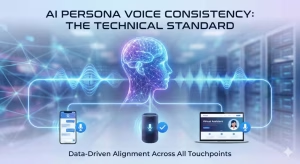
This concept utilizes the “Context Window,” which is the amount of information the AI can hold in its memory at one time. You want to fill the beginning of that memory with your brand identity rules so it never forgets who it is.
Step 3: Guardrails and Negative Constraints
It is just as important to tell the AI what not to do. These are called negative constraints. They act as guardrails on a highway. They keep the AI from crashing your brand identity.
For example, you should explicitly tell the AI: “Never say ‘As an AI language model.’ Never make up facts.”
If your brand identity is premium and exclusive, you might forbid the AI from using words like “cheap” or “discount.” You want to prevent “Hallucinations,” which are moments when the AI makes things up. A hallucination can destroy your reputation instantly. By setting strict boundaries based on your brand identity, you protect your business.
Case Studies & Data
Let us look at examples of how this works in the real world. We can learn a lot from seeing who did it right and who did it wrong.
Success: The Language Learning App
There is a famous language learning app, called Doulingo that is known for a green owl mascot. Their brand identity is a mix of chaotic, pushy, and funny. When they implemented AI, they did not make it polite. They made it pushy and funny, just like their mascot.
When users interact with the bot, it might jokingly guilt-trip them for missing a lesson. This matches their brand identity perfectly. The result? Users screenshot the conversations and share them on social media. It became free marketing. Their engagement numbers went up because the AI felt like a real extension of the brand.
Failure: The Luxury Fashion Brand
On the other side, I analyzed a high-end luxury fashion brand. Their website was beautiful, elegant, and sophisticated. Their brand identity was all about exclusivity.
However, they installed a cheap, generic support bot. When customers asked about $5,000 handbags, the bot replied with, “Hey there! How can I help ya?” using excessive exclamation points.
This shattered the illusion of luxury. The casual, sloppy tone of the bot clashed with the premium brand identity. It made the product feel less valuable. Customers felt like they were talking to a tech support line, not a fashion house. This likely hurt their conversion rates, meaning fewer people actually bought the bags.
The Role of Consistency in Brand Identity
We must go deeper into the concept of consistency. In the world of local SEO and small business, you are often competing with major chains. The chains have massive budgets, but they often lack soul. Your brand identity is your soul.
When you align your AI, you are ensuring that your “voice” is heard clearly. Think of your brand identity like a radio signal. If the signal is strong and clear, people listen. If there is static, they tune out.
Every time your AI answers a question correctly and in the right tone, it reinforces that signal. It tells the customer, “Yes, you are in the right place.” This repetition is what builds a memory in the customer’s mind. The next time they need your service, they will remember the feeling of that interaction. That feeling is your brand identity at work.
Advanced Tactics: Dynamic Tone Adjustment
For those who want to be on the cutting edge, there is an advanced tactic called dynamic tone adjustment. As stated above, this often discussed on this blog. While your core brand identity should never change, your tone can shift slightly depending on the situation.
Imagine a customer is angry. They are complaining about a late order. Even if your brand identity is “fun and quirky,” you should not be cracking jokes while the customer is upset.
Advanced AI setups use “Sentiment Analysis.” This means the computer reads the user’s words and determines if they are happy, sad, or angry. If the user is angry, the AI shifts the tone to be more empathetic and serious, while still keeping the core values of the brand identity. This ability to adapt is what separates a basic bot from a true business asset.
Preparing for the Future of Search
Search engines like Google are changing. They are using more AI to understand content. They are looking for “Topical Authority.” This means they want to know if you are the true expert in your field.
A generic AI dilutes your authority. It sounds like everyone else. An AI aligned with your brand identity uses your specific vocabulary. It talks about your specific services in depth.
This unique content helps search engines understand that you are a distinct entity. It helps link your business name to specific keywords and topics. Therefore, investing in your AI’s brand identity is actually an investment in your long-term SEO strategy. You are training the search engines to recognize your unique voice.
The Future of Brand-AI Integration
We have covered a lot of ground. We defined what an AI persona is. We looked at the strategic reasons why alignment matters. We explored the risks and the technical steps to fix it.
The conclusion is simple. Alignment is the difference between a utility and an ambassador. A utility is a hammer; it is useful but has no personality. An ambassador represents you. They speak for you. Your AI should be your best ambassador.
As we move forward, this technology will only get faster and smarter. The businesses that take the time now to define their brand identity and code it into their machines will win. They will have better customer relationships, better search rankings, and a stronger business overall.
Do not let your digital voice be an accident. Make it a choice. Your brand identity is too valuable to leave to the default settings of a machine.
Final Call to Action
I want you to do one thing today. Go to your website. Open your chat bot. Ask it a hard question. Read the answer. Does it sound like you? Does it sound like your business? If the answer is no, you have work to do. Audit your current AI touchpoints immediately. Your customers are waiting for the real you to show up.