Imagine a world where you know exactly what your customers want before they do. Imagine knowing that the price of coffee beans will spike three weeks from now because of a rainstorm happening today in Brazil. For decades, this kind of foresight was the stuff of science fiction or the “Holy Grail” for Wall Street elites screaming into telephones. But today, the trading floor is silent. The shouting has been replaced by the quiet hum of server farms, processing data at speeds the human brain cannot comprehend.
We are standing on the edge of a new era. The question isn’t just “can machines think?” It is Can AI predict market trends before they happen?
The short answer is yes, but not in the way a fortune teller looks into a crystal ball. Artificial Intelligence (AI) does not deal in magic; it deals in probability. It sees invisible threads connecting global events, a tweet in Tokyo, a shipping delay in the Suez Canal, a slight dip in consumer confidence in Ohio, and weaves them into a picture of the future.
This article will strip away the hype. We will look under the hood of this technology, explore the tools that major players and small businesses are using right now, and honestly discuss the dangerous blind spots where AI still fails.
The Mechanics of Prediction: How AI Sees the Future
To understand how computers predict the future, you have to stop thinking like a human. Humans look for stories. We see a line of people outside an Apple store and think, “Apple stock will go up.” AI does not care about the story. It cares about the data points that make up the story.
Machine Learning and Pattern Recognition
At its core, AI uses something called Machine Learning (ML). Think of ML as a student who never sleeps and has read every book in the library. By feeding the AI massive amounts of historical data, it learns to spot patterns. It notices that historically, when “X” happens, “Y” usually follows.
For example, an AI might notice a weird correlation that no human would ever spot: perhaps every time there is a specific weather pattern in West Africa, the price of chocolate bars in Europe rises four months later. The AI doesn’t know why this happens (maybe the weather affects cocoa harvest), but it knows it does happen. By recognizing these non-linear patterns, the AI can alert investors to a coming shift in market trends long before the news reports on a cocoa shortage.
Natural Language Processing (NLP) and Sentiment Analysis
Markets are driven by people, and people are driven by emotion. Fear and greed move prices more than facts do. AI has learned to read our emotions through a technology called Natural Language Processing (NLP).
Imagine a super-reader that can read every tweet, news headline, earnings call transcript, and Reddit post in the world in a single second. This is what tools like “sentiment analysis” do. They scan millions of words to gauge the “mood” of the market. If the AI detects a spike in nervous words like “uncertain,” “risk,” or “delay” across social media, it can predict a downturn in market trends before a single stock has been sold. It senses the crowd getting anxious before the crowd even realizes it is anxious.
Alternative Data: Seeing What Others Miss
Traditional analysts look at balance sheets. AI looks at everything else. This is called “alternative data.”
-
Satellite Imagery: AI analyzes photos of parking lots at major retailers like Walmart. If the lots are fuller than usual on a Tuesday, the AI predicts strong earnings revenue.
-
Shipping Containers: By tracking the GPS signals of cargo ships, AI knows if supply chains are slowing down weeks before products go out of stock.
-
Credit Card Scrapes: Aggregated, anonymous data from millions of credit card swipes tells the AI exactly what people are buying in real-time, allowing for incredibly accurate predictions of consumer demand market trends.
AI vs. Traditional Forecasting – The Battle for the Future
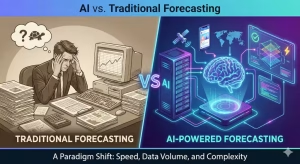
In the high-stakes world of business, being right is good, but being first is better. For decades, predicting market trends was a slow, manual process. It involved smart people in suits, staring at spreadsheets, drinking too much coffee, and making educated guesses. Today, that method is fighting a losing battle against algorithms that never sleep.
Here is a detailed breakdown of exactly how Artificial Intelligence (AI) is rewriting the rules of forecasting, point by point.
1. The Speed of Thought vs. The Speed of Light
The most obvious difference between a human analyst and an AI is speed. But it is hard to truly grasp just how big that gap is.
-
Traditional Forecasting: A human analyst might read a breaking news report about an oil spill. They have to read it, understand it, open their trading software, and click a button. In the absolute best-case scenario, this takes seconds. In the corporate world, updating a quarterly sales forecast might take a team of finance experts weeks of back-and-forth emails.
-
AI Forecasting: AI operates in microseconds (millionths of a second). In the time it takes you to blink, an AI can read the news headline, analyze its impact on market trends, check historical data, and execute a trade. For businesses, this means “continuous forecasting.” Instead of waiting for the end of the month to see if you are on track, AI updates your financial outlook every single day, automatically.
Key Stat: Recent reports from 2025 indicate that finance teams using AI tools save up to 40 hours per month on manual data entry and forecasting tasks.
2. The Data Ocean: Structured vs. Unstructured Reality
This is the hidden advantage that changes everything. Traditional methods are picky eaters; they only like “clean” data. AI will eat anything.
-
Traditional (Structured Data): Old-school forecasting relies on “structured data.” This is information that fits neatly into rows and columns—like sales figures, stock prices, or inventory counts. It is easy to put into Excel. But here is the problem: structured data is only about 20% of the information that exists in the world.
-
AI (Unstructured Data): The other 80% of data is “unstructured.” This includes messy things like emails, tweets, satellite photos, YouTube video transcripts, and customer reviews. Traditional tools cannot read this. AI can.
-
Example: A traditional model predicts a sales trend based on last year’s numbers. An AI model predicts sales by reading thousands of social media posts to see if people are complaining about your brand, or by analyzing weather satellite data to predict if a storm will keep shoppers at home.
-
3. The Battle of Biases: Emotional Humans vs. Biased Data
Everyone thinks machines are neutral and humans are biased. The truth is more complicated. Both have blind spots, but they are very different kinds of blind spots.
-
Human Bias (Cognitive): Humans are emotional creatures. We suffer from “Confirmation Bias” (only listening to news that agrees with us) and “Loss Aversion” (holding onto a losing investment because we don’t want to admit we were wrong). These emotions cause us to misread market trends constantly.
-
AI Bias (Historical): AI doesn’t have feelings, but it has a different problem. It learns from history. If the history is unfair, the AI will be unfair. For example, if a bank rarely gave loans to women in the past, the AI might look at that data and conclude “women are bad borrowers,” even though that is false. This is called “algorithmic bias.” While AI removes the fear and greed of the stock market, it can accidentally automate discrimination if we aren’t careful.
4. Accuracy in Chaos: Linear vs. Non-Linear Modeling
The world is messy. It does not move in a straight line. This is where old math fails and new math succeeds.
-
Traditional (Linear): Traditional forecasting usually assumes that the future will look somewhat like the past. It draws a straight line. If sales went up 5% last year, we assume they will go up 5% this year. This works great—until something crazy happens, like a global pandemic or a sudden war. When chaos hits, linear models break.
-
AI (Non-Linear): AI is designed for chaos. It uses “non-linear” modeling. It can handle wild swings and complex relationships. It can understand that A usually causes B, but if C happens, then A actually causes D. Because it can track these complex webs of cause-and-effect, AI is much better at navigating volatile market trends without crashing.
Recent Insight: Studies from 2025 show that AI-powered supply chain tools can reduce forecasting errors by 20% to 50% compared to traditional manual methods.
5. The “Black Box” Problem: Explainability
If there is one area where traditional methods still win, it is trust.
-
Traditional: When a human analyst makes a prediction, they can show you their work. “I think profits will rise because we cut costs by 10%.” It is simple and easy to understand.
-
AI: Deep Learning models are often “Black Boxes.” The AI says, “Sell this stock now!” The human asks, “Why?” and the AI essentially says, “Because the math says so.” It cannot always explain its “gut feeling” in plain English. This makes many business owners nervous. Would you bet your company’s future on a computer that won’t explain itself? This is why “Explainable AI” (XAI) is currently the hottest topic in the industry, trying to get the machines to show their work.
6. The Hybrid Solution: The “Centaur” Approach
So, who wins? The man or the machine? The answer is neither. The winner is the team.
In the world of chess, a “Centaur” is a team of a human player and an AI computer working together. These teams can beat the smartest computer solo and the smartest human solo.
The future of forecasting market trends is the Centaur model. The AI processes the billions of data points (the satellite images, the tweets, the spreadsheets) and presents a probability. Then, the human expert steps in to check for bias, apply ethical judgment, and make the final strategic call.
Entities and Giants: Who is Using AI Successfully?
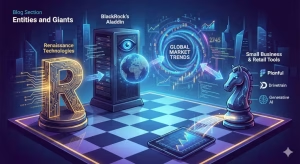
You might be wondering if this technology is actually working or if it is just marketing hype. The answer is that the biggest players in the world are already running their empires on it.
Renaissance Technologies and the Medallion Fund
This is the gold standard. Founded by mathematician Jim Simons, this fund employs scientists and code-breakers, not typical Wall Street types. Their Medallion Fund is famous for generating massive returns by using complex algorithms to find non-obvious patterns in market trends. They proved that math could beat the market.
BlackRock and Aladdin
BlackRock is the world’s largest asset manager, and they use a system called Aladdin. Aladdin is arguably the most powerful AI risk management system in history. It monitors trillions of dollars in assets. It runs thousands of “what if” scenarios every day. For example, it asks, “What happens to our portfolio if inflation hits 5% and a war starts in Europe?” By constantly simulating these futures, Aladdin helps BlackRock prepare for market trends before they become reality.
Tools for the Little Guy
It is not just for billionaires anymore. Small businesses and retail investors have access to powerful tools now.
-
Planful AI: This platform helps businesses forecast their finances. It looks at your historical accounting data to predict future cash flow gaps.
-
Drivetrain: This tool helps companies plan for different scenarios, like hiring new staff or launching a product, effectively predicting how those internal decisions will interact with external market conditions.
-
Generative AI: Even tools like ChatGPT are being used to summarize financial reports and brainstorm potential risks, giving the average person a research assistant that would have cost $100,000 a year a decade ago.
The Crystal Ball Limitations: Where AI Fails
If AI is so smart, why isn’t everyone rich? Why do markets still crash unexpectedly? It is important to understand that AI is not a god. It has serious flaws.
The Black Swan Problem
AI predicts future trends by looking at the past. It assumes that the future will rhyme with history. But sometimes, something happens that has never happened before. These are called “Black Swan” events.
Think about the global pandemic in 2020. There was no historical data in modern stock market history for “entire global economy shuts down for months.” When this happened, many AI models broke. They didn’t know what to do because they had never seen this pattern and could not predict the trends. AI is terrible at predicting the unprecedented. When entirely new market trends emerge from nowhere, humans are often better at adapting because we have common sense and imagination, while AI only has data.
The Feedback Loop (The Observer Effect)
This is a strange paradox. If an AI predicts that a stock will crash, it sells the stock. If all the AI systems use similar data, they all predict the crash and they all sell at the same time. This massive selling pressure causes the crash. In this way, AI doesn’t just predict market trends; it creates them. This can lead to “flash crashes” where the market drops huge amounts in seconds because algorithms are reacting to each other in a feedback loop.
Overfitting the Data
Sometimes, AI tries too hard. It looks for patterns so closely that it finds connections that aren’t really there. It might decide that “when the team in the Super Bowl wears red, the market goes up.” This might have been true in the past by coincidence, but it has no real predictive power. This is called overfitting. A model that is overfitted works perfectly on past data but fails miserably when you try to use it for real future predictions.
Can AI Predict Market Trends for Small Businesses?
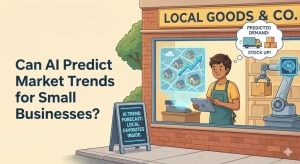
Local SEO and small business strategy is where this gets really practical. You don’t need to be trading stocks to use predictive AI.
Localized Trends and Demand
Imagine you own a hardware store. You can use predictive tools to analyze local search volume. If AI sees a rising trend in searches for “basement waterproofing” in your specific zip code, perhaps triggered by a weather forecast predicting heavy rain, it can tell you to order more sump pumps before the customers walk in the door. This is predicting market trends at a hyper-local level.
Inventory Management
One of the biggest costs for small business is holding inventory that no one buys. AI tools can analyze your past sales data, combine it with local events (like a festival or a school opening), and tell you exactly how much stock to order. This prevents “stockouts” (running out of popular items) and “overstock” (having cash tied up in dust-gathering products).
Integrating LSI Keywords for Growth
Small businesses can also use AI to predict which keywords will become popular. By analyzing LSI keywords, terms related to your main topic, you can write blog posts that answer questions people are about to ask. If you are a plumber, and AI shows a rising interest in “tankless water heaters,” you can write content about that now, so when the trend hits its peak, you are already ranking at the top of Google.
Common Questions on AI Prediction of Market Trends
How accurate is AI in stock market prediction?
It varies. In short term high frequency trading, it is incredibly accurate at spotting micro-trends. For long term investing (years), it is less accurate than a coin flip in some cases because too many random variables interfere. AI is about shifting the odds slightly in your favor, not guaranteeing a win.
What is the best AI for stock prediction?
There is no single “best” tool, but platforms like Trade Ideas or TrendSpider are popular for retail traders. For fundamental analysis, tools that use generative AI to summarize reports are very helpful. However, be wary of any “bot” that promises guaranteed returns.
Can AI predict stock market crashes?
It can predict risk. It can tell you that the market conditions look very similar to 1929 or 2008. It can flash a warning light that says “danger.” But it usually cannot give you a specific date or time for a crash. It identifies the accumulation of dry wood, but it cannot predict when the spark will land.
Is algorithmic trading legal?
Yes, it is legal and it makes up the majority of trading volume on US exchanges. However, there are strict rules against “spoofing” (placing fake orders to trick other computers) and insider trading. The SEC monitors these algorithms closely.
Future Outlook: The Symbiosis of Man and Machine
We are moving toward a “Centaur” model. In chess, a “Centaur” is a team of a human player working with an AI computer. These teams regularly beat solo AI computers and solo human grandmasters.
The future of predicting market trends belongs to this hybrid approach. The AI crunches the billions of numbers. It finds the correlations. It does the heavy lifting. Then, a human expert looks at that data and applies context, ethics, and judgment.
Generative AI’s Role
We are seeing a shift from simple number crunching to strategy generation. Future AI won’t just say “sales will drop.” It will say, “Sales will drop because of a competitor’s new product. Here are three marketing strategies you can launch next week to counter this.” This moves AI from a passive predictor to an active partner in business strategy.
Conclusion
So, [Can AI predict market trends before they happen?] The answer is that it can predict the probability of a trend with a level of accuracy that feels like magic. It gives businesses and investors a superpower: the ability to see around corners.
However, it is not a crystal ball. It cannot foresee the unforeseeable. It cannot account for the wild randomness of human life. The most successful people in the coming decade will not be the ones who blindly trust the machine, nor the ones who ignore it. The winners will be those who learn to speak the language of data.
If you are a small business owner or an investor, you do not need to build your own supercomputer. But you do need to start using the data you have. Whether it is looking at your local search trends or using a basic forecasting tool for your inventory, the future belongs to the prepared.