The digital landscape of 2026 has moved past simple search bars. For a small business to survive today, it must transition from storing data to activating intelligence. At WebHeads United, we monitor the pulse of search technology, and the most significant shift we have seen is the rise of the AI-powered system. If you are a custom home builder, at the end of the article are some questions to help you get started in producing your knowledge base.
The Evolution of Knowledge Management
In simple terms, an AI-powered knowledge base is a smart digital library. Unlike the old-fashioned folders on a computer, this system uses artificial intelligence to read, understand, and answer questions. It does not just look for words that match your search. It understands what you are trying to find. If you have ever used a search engine and felt like it “knew” what you meant even if you spelled a word wrong, you have seen a version of this technology.
For a long time, a knowledge base was just a collection of articles. If a customer or an employee wanted an answer, they had to type a specific word and hope the right document popped up. Today, thanks to tools like Large Language Models and Retrieval-Augmented Generation, the knowledge base has become a living part of the business. It can take thousands of pages of manuals, emails, and guides and turn them into a single source of truth. This is vital for Answer Engine Optimization. When people ask their phones or AI gadgets a question, they want one right answer, not a list of ten links. A modern knowledge base provides that answer.
Core Architecture: How it Works Under the Hood

To understand why this is better than a regular folder of files, we have to look at how it is built. The “brain” of a modern knowledge base uses something called a RAG framework. This stands for Retrieval-Augmented Generation.
Think of it like an open-book test. The AI is the student. When you ask a question, the AI does not just guess based on what it learned months ago. Instead, it quickly “retrieves” the most relevant pages from your specific knowledge base. Then, it “augments” or adds that info to its own logic to “generate” a perfect answer. This stops the AI from making things up, which is a common problem called hallucination.
Another key part is the vector database. Instead of sorting files by name or date, the system turns every sentence into a long string of numbers. These numbers represent the “meaning” of the text. When you search your knowledge base, the system looks for numbers that are mathematically close to your question. This is why you can ask “How do I fix a leaky pipe?” and the system knows to show you a guide titled “Plumbing Maintenance,” even if the word “leaky” is not in the title.
Key Features of a 2026 AI Knowledge Base
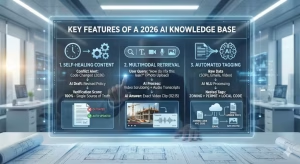
The technical backbone of a 2026 knowledge base is what separates a market leader from a struggling business. In this era, information is only as valuable as its accessibility and accuracy. To truly understand why a modern knowledge base is a “living” entity, we must look closer at the specific features that drive its intelligence.
1. Self-Healing Content: The End of Outdated Data
The most significant problem with a traditional knowledge base was “content rot.” In the past, as soon as a company changed a price, a policy, or a software step, every related article became a liability. An AI-powered knowledge base in 2026 solves this through a process called self-healing.
Self-healing works by using the AI as a constant auditor. The system monitors live data sources, such as your latest emails, Slack conversations, or product updates, and compares them against the existing articles in your knowledge base. If the AI detects a conflict, it does not wait for a human to find the mistake. Instead, it can perform several automated actions:
-
Conflict Flagging: It highlights specific sentences that contradict new data and sends an alert to the “owner” of that article.
-
Auto-Drafting Updates: The AI can generate a revised version of the article based on the new information, requiring only a one-click approval from a manager.
-
Gap Detection: If customers or employees are asking questions that the current knowledge base cannot answer, the AI identifies this “knowledge gap” and creates a draft to fill it.
For a custom home builder, this is vital. If local building codes change or a specific lumber supplier raises prices, a self-healing knowledge base ensures that every team member, from the salesperson to the site manager, is working from the same updated facts. This maintains high data integrity and prevents costly errors.
2. Multimodal Retrieval: Searching Beyond the Written Word
In 2026, a knowledge base is no longer restricted to text files. Modern businesses generate a massive amount of “unstructured data” in the form of site walk-through videos, Zoom recordings, and photos of construction progress. Multimodal retrieval allows the AI to “see” and “hear” this content just as easily as it reads a PDF.
When a user searches the knowledge base, the system utilizes advanced computer vision and audio-to-text processing to find answers within media files:
-
Video Scrubbing: If a technician asks “How do I install this specific water filtration system?”, the knowledge base can return the exact three-minute clip from a recorded training session where that system was installed.
-
Image Analysis: A site manager can upload a photo of a foundation crack to the knowledge base. The AI analyzes the image, compares it to thousands of other photos in the database, and retrieves the relevant repair protocol or safety manual.
-
Speech-to-Intent: Voice-driven queries allow field workers to ask the knowledge base questions hands-free, receiving instant spoken answers synthesized from the most relevant documentation.
This feature turns your knowledge base into a truly comprehensive brain for the company. It ensures that the “wisdom” locked inside a veteran builder’s head, captured in a quick video, is preserved and searchable for every future employee.
3. Automated Tagging and Taxonomy: Intelligence Without the Effort
One of the biggest hurdles to building a useful knowledge base used to be the manual labor required to organize it. In 2026, the AI handles the “filing” for you. Using Natural Language Processing (NLP), the system automatically categorizes every piece of information as it enters the system.
Automated tagging goes beyond just keywords. It understands the “taxonomy”—the hierarchical relationship between different topics. For example, if you upload a document about “Eco-Friendly Insulation,” the knowledge base intelligently tags it under:
-
Primary Category: Sustainable Building Materials
-
Secondary Category: Energy Efficiency
-
Technical Spec: R-Value Standards
-
Project Phase: Framing and Insulation
Because the knowledge base manages these tags autonomously, it eliminates the risk of human error where a document is “lost” in the wrong folder. It also enables “semantic clustering,” where the AI groups related concepts together. This means that when a user searches for one topic, the knowledge base can proactively suggest three other related articles that they didn’t even know they needed. This level of organization is essential for Answer Engine Optimization (AEO), as it provides the structured data that AI search engines use to generate high-quality citations for your business.
4. AI Verification and Trust Scores
In a 2026 business environment, “truth” is a competitive advantage. To ensure that an AI-powered knowledge base remains reliable, it uses a system of trust scores. Every answer generated by the system is given a percentage score based on how many verified sources it drew from.
If the knowledge base generates an answer from a single, unverified email from three years ago, it will show a low trust score. If it pulls the answer from a recently updated, expert-verified SOP, the score will be 100%. This transparency allows employees to know exactly how much they should rely on the information provided. Furthermore, the system periodically asks experts to “re-verify” high-traffic content, ensuring the knowledge base remains the definitive authority for the entire organization.
5. The Generative Interface: Beyond the Search Bar
The final key feature of a 2026 knowledge base is how people interact with it. We have moved past the era of typing three words into a box and scrolling through a list of links. The modern interface is conversational and generative.
When you interact with the knowledge base, you are essentially talking to a digital expert who has read every single document in your company. You can ask complex questions like, “Compare our three most common foundation types and tell me which one is best for clay-heavy soil in the northern district.” The knowledge base will not just give you three links; it will write a custom, three-paragraph comparison for you, citing the specific pages it used to create that answer. This shift from “search” to “answer” is the hallmark of a mature, AI-integrated business.
Small Business Benefits: Efficiency and Scale

For a small business, time is the most valuable resource. A well-organized knowledge base saves hundreds of hours. First, think about customer service. Most customers ask the same ten questions. If you put those answers into an AI-powered knowledge base, a chatbot can answer them instantly at any time of night. This is called “ticket deflection,” and it means your human staff can focus on harder problems.
Internal productivity is another huge win. When a new person joins your team, they usually spend weeks asking questions. With a robust knowledge base, they can simply ask the system “What is our policy on vacation days?” or “How do I log into the CRM?” and get an instant answer. This speeds up onboarding by a huge margin. Most importantly, it creates a single source of truth. When everyone gets their answers from the same knowledge base, there are fewer mistakes and less confusion.
SEO, GEO, and AEO: Why This Matters for Visibility
If you want your business to be found online, you need to think about more than just Google. We are now in the age of Generative Engine Optimization (GEO) and Answer Engine Optimization (AEO). When an AI like ChatGPT or a search engine’s “AI Overview” looks for an answer, it looks for clear, factual data.
By hosting a public-facing knowledge base, you are giving these AI engines the exact “food” they want to eat. You are providing clear definitions and structured data. This makes it more likely that your business will be cited as the expert source when someone asks a local question. For example, if you run a local repair shop and your knowledge base has a great guide on “how to maintain a lawnmower in New York,” an AI engine is very likely to show your business as the top answer for that area.
Common Questions and Concerns
When people look for info on this topic, they often have specific worries. One common question is: “How is an AI knowledge base different from a chatbot?” The answer is that a chatbot is the “mouth,” but the knowledge base is the “brain.” A chatbot without a knowledge base is just a script that can’t learn. A chatbot connected to a knowledge base can answer almost anything.
Another concern is security. Small business owners often ask if their private data is safe. In 2026, many knowledge base tools allow you to keep your data private and local. This means the AI learns from your files, but those files are never shared with the rest of the world. Finally, people want to know about the “best” software. While there are many options, the best knowledge base is the one that connects easily to the tools you already use, like Slack or Google Drive.
Top Software Solutions for 2026
Choosing the right platform for your knowledge base depends on your specific needs. Here is a breakdown of the leaders in the field this year:
-
Guru: This is excellent for internal teams. It lives right inside your web browser and reminds people to verify that the info is still correct.
-
Zendesk Guide: If your main goal is helping customers, this is a top choice. It turns customer questions into a helpful knowledge base automatically.
-
Notion AI: This is great for creative teams. It makes writing and organizing documents very easy and uses AI to summarize long pages.
-
Enjo AI: This tool is perfect for businesses that use chat apps like Slack or Microsoft Teams. It turns your chat history into a searchable knowledge base.
Implementation Roadmap: From Data to Intelligence
Starting a knowledge base might seem scary, but it follows a simple path. The first step is a data audit. You need to find all your old PDFs, Word docs, and printed manuals. Throw away the ones that are out of date. Next, you need to choose your AI “engine.” Some businesses like using big names like OpenAI, while others prefer private options for better security.
Once you have your files and your engine, you connect them using RAG technology. This is the part where you “feed” your files into the system. After that, you must test it. Ask your knowledge base common questions and see if the answers are right. If they are not, you might need to rewrite some of your documents to be clearer. Over time, your knowledge base will become the most valuable asset in your company.
The Future: Agentic Knowledge Bases
We are currently moving toward “Agentic” systems. This means your knowledge base will not just talk; it will do things. Imagine asking your knowledge base, “We have a new client, can you set up their folder and send them our welcome guide?” An agentic knowledge base will find the guide, create the folder, and send the email because it has the “knowledge” of how your business works and the “power” to act on it.
This is the next frontier for small businesses. By building a solid knowledge base today, you are laying the tracks for the autonomous tools of tomorrow. It is about moving from being a person who manages data to being a person who manages intelligence.
Securing Your Competitive Advantage
In the world of 2026, being “good at your job” is not enough. You have to be “good at your data.” A small business that uses an AI-powered knowledge base can act like a much larger company. You can answer customers faster, train staff better, and show up more often in search results.
Data integrity and innovation are the keys to staying ahead. If you ignore how your company stores and uses info, you will be left behind by competitors who have turned their files into a living, breathing knowledge base. Start by organizing your most important documents today. The future of your business depends on how well you can find and use the information you already have.
Some Questions to Help Start Your Knowledge Base
Below are some the high-intent search queries for the construction sector in 2026. For a custom home builder, your knowledge base must act as a bridge between a client’s dream and the technical reality of a job site.
By feeding these questions into your AI system, you ensure that your business becomes the definitive local authority for both human searchers and AI answer engines.
Phase 1: Pre-Construction & Lot Selection
-
What is the first step I should take if I want to build a custom home?
-
How do I determine if a specific lot is suitable for the floor plan I want?
-
What are the typical costs associated with “site prep” like tree removal and grading?
-
Do you assist in the feasibility study of a lot before I purchase it?
-
What local zoning laws or HOA restrictions should I be aware of in our area?
-
How do soil conditions affect the cost of my foundation?
-
Should I hire an architect first, or find a builder first?
-
What is the difference between “fully custom” and “semi-custom” building?
-
How do you handle utility hookups (water, sewer, electric) for a new lot?
-
What are the most common reasons for permit delays in our local county?
Phase 2: Design, Customization & 2026 Trends
-
How does the design-build process save time compared to traditional methods?
-
What are the most popular “wellness-first” features for homes in 2026?
-
How can we design a “flexible room” that switches from an office to a guest suite?
-
What is “invisible technology,” and how is it integrated into the walls?
-
Can I bring my own floor plan ideas, or do I have to use yours?
-
How do we maximize natural light based on the orientation of my lot?
-
What are the benefits of a “mudroom” vs. a standard laundry room entry?
-
How do you design for “aging-in-place” without making the home look clinical?
-
What sustainable or “green” materials do you recommend for our local climate?
-
Can we incorporate an ADU (Accessory Dwelling Unit) into the initial design?
Phase 3: Budgeting, Financing & Contracts
-
What is included in your “price per square foot” calculation?
-
How does a construction-to-permanent loan work?
-
What is the difference between a “Fixed Price” and a “Cost-Plus” contract?
-
How much of a contingency fund should I set aside for unexpected costs?
-
What happens if the cost of lumber or steel changes after we sign the contract?
-
Are “allowances” for things like lighting and appliances set by me or you?
-
When are the major payment milestones throughout the build?
-
Do you have preferred lenders that specialize in custom home construction?
-
How do “change orders” work, and how do they impact the final bill?
-
What hidden costs should I expect that are often left out of a base bid?
Phase 4: The Construction Process
-
How long does the average custom home take to build from groundbreaking?
-
Who will be my primary point of contact during the actual building phase?
-
Can I visit the job site during construction, and are there safety rules?
-
How do you ensure quality control when using subcontractors?
-
What is your process for handling weather-related delays?
-
Do you provide a digital portal where I can see photos of daily progress?
-
At what stage are “selections” (tiles, paint, flooring) finalized?
-
How do you handle inspections from the city or county?
-
What is the process for a “pre-drywall” walkthrough?
-
How do you manage dust and debris to protect the surrounding environment?
Phase 5: Technology, Energy & Post-Move-In
-
What energy-efficient HVAC systems are standard in your builds?
-
Is my home “EV-Ready” for electric vehicle charging stations?
-
How do you insulate for sound between floors and bedrooms?
-
What kind of smart home hub comes pre-installed in the house?
-
What happens during the “final walkthrough” and “punch list” phase?
-
What kind of structural warranty do you provide after I move in?
-
How do I report a minor issue (like a sticking door) after the first year?
-
What maintenance tasks am I responsible for in the first 12 months?
-
Do you offer “home concierge” services for future repairs or additions?
-
How does your company stand behind its craftsmanship five years later?
Implementation Strategy
To get the most out of your knowledge base, you should answer these questions using a mix of short text for AI snippets and detailed “Long-Form” guides for human readers. This balance ensures high data integrity and keeps you at the top of local search results.