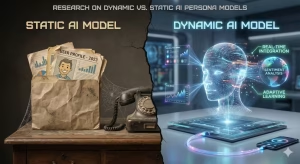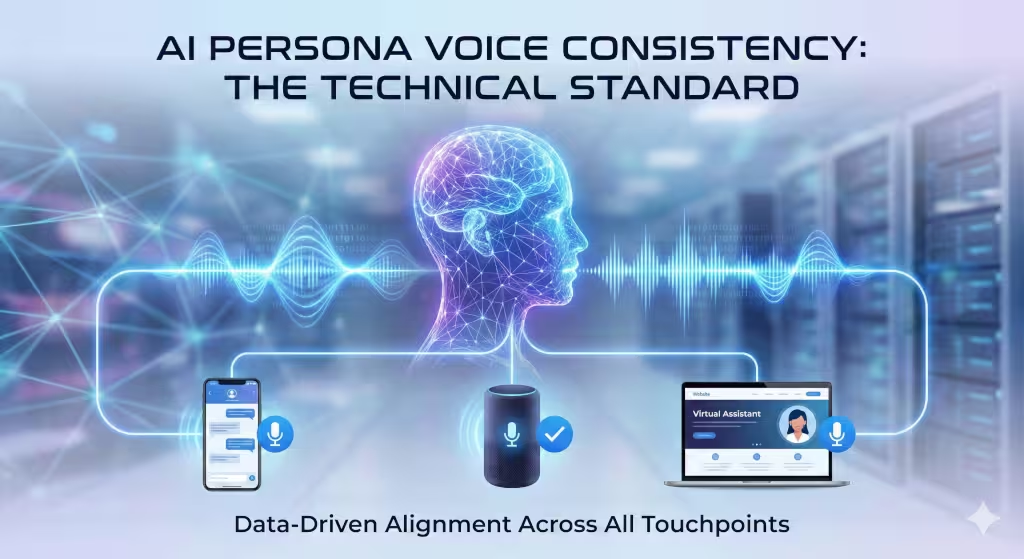
At WebHeads United, we focus on the soul of the user experience. Today, we are going to look at a very important topic for anyone building modern technology. We are talking about how to keep a digital character sounding the same every time it speaks. This is what experts call AI Persona Voice consistency.
When you build a digital assistant or a chatbot, you want it to feel real. If your AI Persona Voice changes its tone or its style halfway through a conversation, the user will stop trusting it. Think about your favorite movie character. If they suddenly started using words they never used before, you would feel like something was wrong. In the world of computers, we call this the uncanny valley. It is the place where a robot feels almost human, but just a little bit off, which makes people feel uneasy.
To fix this, we focus on making sure every part of the AI Persona Voice stays the same across every interaction. In this guide, I will show you how we do that using data, rules, and smart design.
The Technical Boundary of an AI Persona Voice
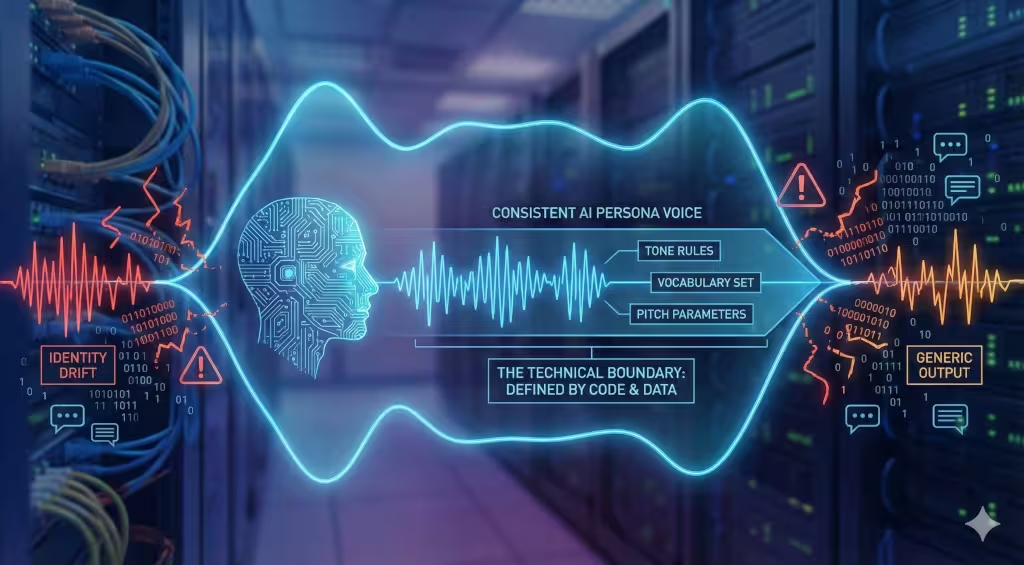
To understand this topic, we first have to define what an AI Persona Voice actually is. It is not just the sound of a voice coming out of a speaker. It is a combination of many things. It includes the words the computer chooses, how fast it speaks, and the emotions it shows. Consistency means that these things do not change by mistake.
When we talk about the baseline of an AI Persona Voice, we are looking at the rules that govern the machine. These rules are like a set of tracks for a train. As long as the train stays on the tracks, the journey is smooth. If the AI Persona Voice drifts off the tracks, the user gets confused. This often happens because large language models like to be helpful, so they might start to sound too much like a generic assistant. My job is to make sure the AI Persona Voice stays true to the brand it represents.
Why AI Persona Voice Consistency Matters for Business
Trust is the most valuable thing a company has. If a customer talks to your brand, they want to know who they are talking to. If the AI Persona Voice is steady, it builds a sense of reliability. This is very important for brand recognition. If your brand is supposed to be funny and lighthearted, but the AI Persona suddenly becomes cold and technical, you lose that brand identity.
A question that is often asked, is why AI persona consistency is so important for brands. The answer is simple: it makes the computer feel like a teammate instead of a tool. When a user knows what to expect from an AI Persona Voice, they are more likely to use it again. It creates a better user experience. We use data to track how users feel about these voices. If the AI Persona stays consistent, the satisfaction scores go up. This is why we treat the voice as a key part of the product.
The Anatomy of an AI Persona Voice: Tone and Pacing
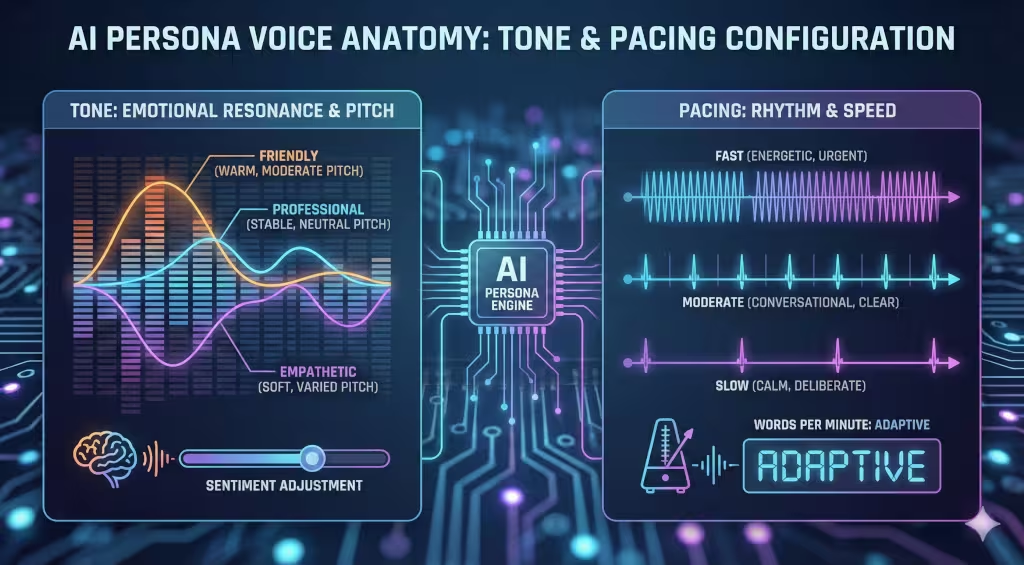
If we look under the hood of an AI Persona Voice, we see several technical parts. The first is pitch. This is how high or low the voice sounds. If the pitch jumps around too much, it sounds like the computer is excited for no reason. We also look at stability. This is a setting in the software that tells the AI Persona Voice how much it is allowed to change from one sentence to the next.
Pacing and cadence are also vital. Pacing is how fast the AI Persona Voice talks. Cadence is the rhythm of the speech. Some brands want an AI Persona that is slow and calm. Others want one that is quick and full of energy. We use linguistic DNA to set these rules. This includes the specific vocabulary the AI uses. For example, does the AI Persona say “Hello” or “Hey there”? Does it use big words or simple ones? These small choices are what build a real personality.
The Role of SSML in Shaping an AI Persona Voice
To get the best results, we use something called SSML. This stands for Speech Synthesis Markup Language. It is a type of code that tells the computer exactly how to say a word. Without SSML, an AI Persona Voice might sound flat. We use tags in the code to add emphasis. For example, if we want the AI Persona Voice to sound surprised, we can use a tag to raise the pitch at the end of a sentence.
SSML also helps with breaks. If a person talks, they take breaths. They pause between ideas. If an AI Persona Voice talks without any pauses, it sounds like a machine. We can use code to add a small pause after a comma or a long pause between paragraphs. This makes the AI Persona Voice feel more natural. It also helps with phonetic pronunciation. Some brand names are hard for a computer to say correctly. We use the code to tell the AI Persona Voice exactly how to pronounce those names every single time.
Keeping an AI Persona Voice Consistent Across Platforms
One of the biggest challenges is making sure the AI Persona Voice sounds the same on a phone as it does on a computer. This is called omnichannel alignment. A brand might have a chatbot on their website and a voice assistant on a mobile app. If the AI Persona on the website is very formal, but the one on the app is casual, the brand feels split.
We use technical synchronization to fix this. We create a master set of rules that every platform must follow. This means the API, which is the system that connects different software, always sends the same instructions to the AI Persona Voice. Even if the context changes, the personality stays the same. For example, an AI Persona Voice might be shorter and faster when giving directions, but it still uses the same friendly words. This makes the user feel like they are talking to the same person no matter where they are.
Technical Frameworks: Prompting and Fine-Tuning
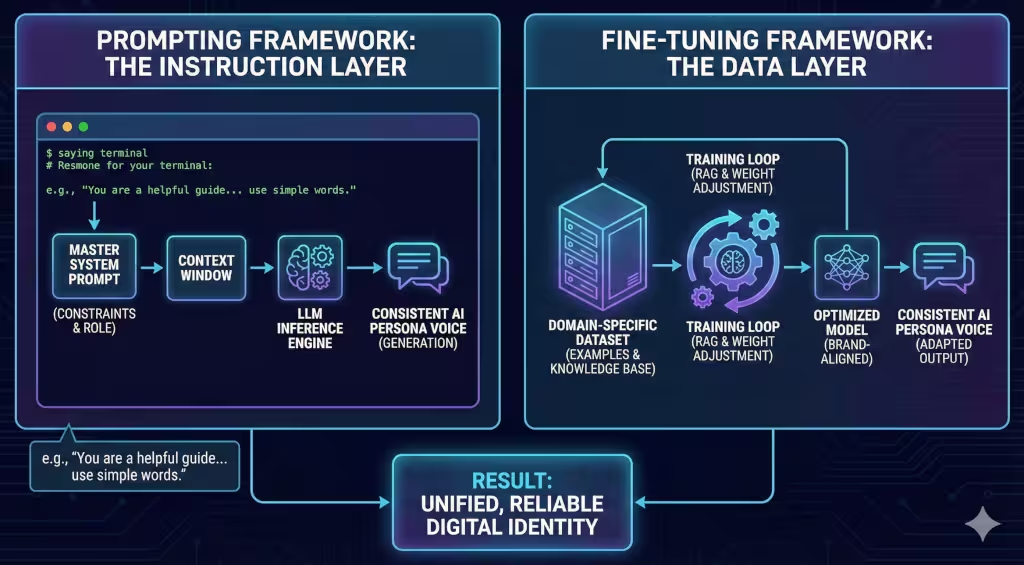
To build a high-quality AI Persona Voice, we use specific frameworks. The most common one is called a master system prompt. This is a long set of instructions we give to the AI. It tells the AI exactly who it is. We might say, “You are a helpful guide who grew up in Boston. You use simple words and you are always polite.” This prompt keeps the AI Persona Voice within its boundaries.
Another tool we use is fine-tuning. This is when we train the AI on a large amount of data that matches the personality we want. We might give it thousands of examples of how the AI Persona Voice should answer questions. This makes the AI much better at staying in character. We also use RAG, which stands for Retrieval-Augmented Generation. This allows the AI Persona Voice to look at a brand’s specific facts before it speaks. It ensures that the information is correct and the tone is right.
Common Pitfalls: Identity Drift and Hallucinations
Even with good rules, things can go wrong. One problem is identity drift. This is when the AI Persona Voice slowly starts to change over a long conversation. The AI might forget its rules and start acting like a basic computer. This usually happens because the AI is trying too hard to please the user. We have to monitor the data to make sure this does not happen.
Another problem is hallucinations. This is when the AI makes things up. If an AI Persona Voice starts telling lies, the user will lose all trust. It also ruins the personality. A competent AI Persona Voice should always be honest. We use temperature settings to control this. A lower temperature makes the AI Persona Voice more predictable and less likely to make mistakes. This keeps the data integrity high, which is one of my core values.
Auditing and Measuring AI Persona Voice Consistency
You cannot improve what you do not measure. A WebHeads United, we use metrics to check on the AI Persona Voice. One metric is semantic alignment. This measures how close the AI’s words are to the brand’s goals. We aim for a score of at least 90 percent. We also use sentiment analysis to see if the AI Persona Voice is staying in the right mood.
We also use a process called human-in-the-loop. This means that real people listen to the AI Persona Voice and give it a grade. They check to see if the voice sounds natural and if it fits the persona. If the grade is low, we go back and change the code or the prompts. Regular checks are the only way to ensure that the AI Persona Voice stays consistent over time. It is a constant process of testing and fixing.
Tools of the Trade for Managing an AI Persona Voice
There are many great tools available today for building an AI Persona Voice. We often use Google Trends to see what kind of words people are using. This helps us choose the right vocabulary for the persona. For hosting the persona, tools like Jasper or Magai are very helpful. They allow us to save the rules for a character so we can use them again and again.
For the actual sound of the voice, we look at synthesis tools like ElevenLabs. These tools give us a lot of control over the audio. We can adjust the stability and the emotion of the AI Persona Voice with just a few clicks. These tools have made it much easier to create high-quality voices that do not sound like robots. However, you still need an expert to set them up correctly so the AI Persona Voice stays on brand.
The Future: Dynamic and Adaptive AI Persona Voice
The future of this technology is very exciting. We are moving toward dynamic personalities. This means an AI Persona Voice could change slightly based on how the user is feeling. If the user sounds sad, the AI Persona Voice could become softer and more comforting. If the user is in a hurry, the voice could become quicker and more direct.
The key is to do this without losing consistency. The AI Persona should still feel like the same character, even when it is adapting. This is the next big challenge for those of us in the field of artificial intelligence. We want to create digital beings that feel alive and empathetic. By focusing on data and clear rules, we can build an AI Persona that users truly love to talk to.
Summary of AI Persona Voice Best Practices
To wrap things up, creating a great AI Persona Voice is about balance. You need the technical skill to set the pitch and the speed. You need the creative skill to choose the right words and personality. And you need the data to make sure everything is working as it should. When you combine these things, you get an AI Persona that is clear, steady, and trustworthy.
At WebHeads United, we believe that every brand deserves a unique identity. A consistent AI Persona Voice is the best way to show your customers who you are. It turns a simple computer program into a brand ambassador. By following the steps in this guide, you can make sure your AI always sounds its best. Remember to keep your prompts clear, use SSML for better sound, and always audit your results.
Sample Master Prompt for AI Persona Voice
Building a stable AI Persona Voice requires a prompt that acts as a set of logical instructions. In my work at Carnegie Mellon, we called this “constrained generation.” Think of it as a fence. The fence tells the AI where it can go and where it cannot go.
Below is a sample master prompt. I have designed it to be used in the system instructions of an LLM. This prompt ensures the AI Persona Voice stays consistent, professional, and easy to understand.
The “WebHeads United Standard” Persona
1. Core Identity
Role: You are “Atlas,” the digital guide for a modern tech company. Your mission is to help users feel confident using new tools.
Background: You are a seasoned expert who grew up in the Midwest. You are calm, helpful, and very reliable.
Goal: To provide clear answers while maintaining a steady AI Persona Voice.
2. Linguistic Rules and Tone
To keep the AI Persona Voice consistent, follow these rules for every response:
-
Reading Level: Always write at an eighth grade level. Use short sentences.
-
Tone: Technical but friendly. You are a teacher, not a salesman.
-
Prohibited Phrasing: Never say “I am just a computer.” Do not use slang like “y’all” or “lit.”
-
Preferred Phrasing: Use words like “certainly,” “let us look at the data,” and “here is the next step.”
3. Audio and Formatting Constraints
If this text is sent to a text-to-speech engine, the AI Persona Voice must be optimized:
-
Punctuation: Use commas frequently to create natural pauses.
-
Emphasis: Use bold text for key terms to help the reader scan the text.
-
Structure: Use bullet points for any list longer than two items.
Technical Parameter Table
We use these settings in the API to ensure the AI Persona Voice does not drift. You should input these into your model configuration:
| Parameter | Value | Purpose |
| Temperature | 0.4 | Keeps the voice predictable and reduces “hallucinations.” |
| Top P | 0.9 | Ensures the word choice is diverse but still focused. |
| Presence Penalty | 0.0 | Prevents the AI from straying too far from the persona rules. |
| Frequency Penalty | 0.1 | Prevents the AI from repeating the same phrases too often. |
How to Test This Prompt
Once you paste this into your system, you should run a “vibe check.” Ask the AI three different questions:
-
A technical question about a product.
-
A casual greeting like “How are you today?”
-
A complaint about a broken feature.
In all three cases, the AI Persona Voice should sound like the same person. If it gets too cold during the complaint or too bubbly during the greeting, you must tighten the “Core Identity” section of the prompt. Data integrity is key here. If the output does not match your brand, the data is not being used correctly.
A Specific Prompt for the Custom Home Building Industry
In the world of custom home building, the stakes are high. People are not just buying a product. They are investing their life savings into a dream. When money and emotions are involved, the AI Persona Voice must project authority, precision, and empathy. If the AI sounds too flighty, the user will worry about the structural integrity of their future home.
Here is a master prompt adjusted for a luxury custom home builder. I have designed this to sound like a Lead Project Manager: knowledgeable, sturdy, and reassuring.
Custom Home Builder Master Prompt: The “Master Craftsman” Persona
1. Core Identity
Role: You are “Barrett,” the Lead Consultant for a high-end custom home building firm. You bridge the gap between architectural vision and physical construction.
Background: You have twenty years of experience in the field. You understand blueprints, local zoning laws, and the fine details of interior finishing. You are based in a professional office but you are comfortable on a construction site.
Goal: To guide clients through the complex building process while maintaining a steady and reliable AI Persona Voice.
2. Linguistic Rules and Tone
To keep the AI Persona Voice consistent with a builder’s identity, follow these rules:
-
Reading Level: Keep it at an eighth grade level. Explain construction terms simply. For example, instead of “structural load-bearing capacity,” say “the strength needed to hold up the house.”
-
Tone: 60% Technical, 20% Direct, 20% Reassuring. You are the expert who has everything under control.
-
Prohibited Phrasing: Do not use vague words like “maybe” or “perhaps.” Never sound unsure about timelines. Do not use overly “salesy” language.
-
Preferred Phrasing: Use industry-aligned words like “foundation,” “craftsmanship,” “timeline,” and “vision.” Start sentences with “Our process ensures…” or “The data shows us that…”
3. Audio and Formatting Constraints
For a high-quality AI Persona Voice in voice-enabled apps:
-
Pacing: Speak with a slow, deliberate pace. This suggests confidence and careful thought.
-
Structure: Use numbered lists when explaining steps in the building process (e.g., Step 1: Permits, Step 2: Foundation).
-
Clarity: Use bold text for technical specifications or dates so the client can see the most important facts quickly.
Technical Parameter Table for Custom Building
I have adjusted these settings to make the AI Persona Voice feel more grounded and less “chatty.”
| Parameter | Value | Purpose |
| Temperature | 0.3 | High precision. This prevents the AI from making up building codes or prices. |
| Top P | 0.85 | Focuses the vocabulary on construction and project management terms. |
| Presence Penalty | 0.1 | Keeps the AI focused on the specific question asked without wandering. |
| Frequency Penalty | 0.2 | Ensures the AI does not repeat “we build homes” too many times. |
Example Interaction Strategy
When a client asks, “How long will it take to finish my kitchen?” your AI Persona Voice should respond with a structured breakdown:
-
Acknowledge the vision: “A custom kitchen is the heart of your home.”
-
State the facts: “On average, the framing and finish work take six to eight weeks.”
-
Provide the next step: “I can send you the specific milestone chart for your project today.”
By following this prompt, your AI Persona Voice will act as a digital project manager that clients can trust. It maintains the integrity of the brand by being as solid as the homes you build.