In the field of user experience, our primary challenge is to scale empathy. We must understand thousands, or even millions, of users at an individual level. This is a task that has become impossible for human teams alone. This is where artificial intelligence offers a solution. However, the term “AI Persona” is frequently misunderstood. It is often split into two very different concepts.
This article will provide a technical analysis of Persona UX Design as it relates to artificial intelligence. We will examine both of its primary applications. First, we will look at the design of an AI’s personality (like a chatbot) to improve how it interacts with users. Second, we will look at the use of AI to create “synthetic” user personas, which helps us speed up the design process. We will not just discuss theory. We will validate these ideas with real-world case studies and the quantitative data (the numbers) that prove their value.
Foundational Concepts: A Technical Definition of “AI Persona”

To master this topic, we must first establish a clear vocabulary. The term “AI Persona” is used in two main ways in our industry. Understanding the difference is the first step in effective Persona UX Design.
A. Application 1: AI Persona Design (The AI as the Product)
The first application is the one most people think of: designing the personality for an AI. This is a critical part of Persona UX Design.
- Definition: This is the process of building a unique, consistent, and functional personality for a conversational AI. This includes chatbots, virtual assistants (like Siri or Alexa), or any system that “talks” to a user.
- Core Components: This is not just about choosing a name. It is a deep design process that includes:
- Voice: What is the AI’s core personality? Is it a helpful expert? A funny friend? A calm assistant?
- Tone: How does that voice change based on the situation? A banking chatbot’s persona should be serious and empathetic when a user reports a lost card (a failure state) but can be more relaxed for a simple balance check.
- Lexicon: What specific words does it use? A financial AI might say “insufficient funds,” while a casual app’s AI might say “you’re a little short.”
- Error Handling: What does the AI say when it fails or does not understand? This is the most critical test of a well-crafted AI persona.
- Why it matters for Persona UX Design: A consistent persona builds trust. If a chatbot sounds like three different people, users will get confused and frustrated. Good Persona UX Design here makes the machine feel more human and predictable, which increases user satisfaction and task completion.
B. Application 2: AI-Generated Personas (The AI as the Tool)
The second application is newer and gaining traction fast. It involves using AI as a tool during the research phase of a project.
- Definition: This is the use of machine learning (a type of AI) to analyze huge sets of data to create synthetic users or data-driven personas.
- How it works: Instead of a researcher reading 100 survey responses, an AI can read 10 million website clicks, 50,000 customer reviews, and all your CRM data in minutes. It then finds patterns and “clusters” (groups) of users who behave in similar ways. It uses this data to build a new persona from scratch.
- Key Distinction: These are best used as proto-personas. A proto-persona is a first draft or a hypothesis. They are not the final, finished product. This type of Persona UX Design is about speed and finding patterns humans might miss.
C. Comparison: AI-Generated vs. Traditional Research-Backed Personas
This brings us to a critical question: are these new AI-generated personas better than traditional ones? As an expert, I can tell you the answer is no. They are not better; they are different. The best approach uses both.
- Traditional Personas: These are built by human researchers who conduct in-depth interviews, usability tests, and field studies.
- Pros: They are high in empathy. They capture the why behind a user’s actions. They are based on real, observed behaviors and quotes. They are validated from the start.
- Cons: They are slow and expensive to create. A good persona study can take weeks or months. The sample size is often small.
- AI-Generated Personas: These are built by a machine analyzing large-scale data.
- Pros: They are incredibly fast (minutes, not weeks). They can analyze millions of data points, removing the bias of a small sample size. They can find hidden patterns in user behavior that researchers might never see.
- Cons: They are low in empathy. They show what users do, but not why. They are high-risk for bias. If your historical data is biased (e.g., it mostly comes from one user group), the AI persona will be extremely biased. This is a failure of Persona UX Design
The Optimal Methodology: The most competent Persona UX Design strategy is complementary. It uses AI to do the heavy lifting.
- Use AI to analyze your quantitative data (the numbers) to create 2-3 data-driven proto-personas.
- Use these AI personas to create a hypothesis about your users.
- Then, use human researchers to go find and validate those personas with qualitative research (talking to people).
This approach combines the speed of AI with the empathy of human-led design.
Methodology: Frameworks for AI Persona Implementation
A concept is only useful if it can be put into practice. Here are the step-by-step frameworks for implementing both types of AI-driven Persona UX Design.
A. Framework for Designing an AI Persona (for a Chatbot)
When you are designing the AI’s personality, you must be systematic. You cannot just “make it friendly.” You must architect it.
Phase 1: Discovery and Strategy
This is the “why” phase. You must define the AI’s core purpose before you decide what it sounds like.
- Purpose: What is its one main job? Is it here to sell products? Answer support tickets? Triage users to the right department?
- Brand Archetype: How does it fit your brand? A brand like Nike (the Hero) will have an AI that sounds very different from a brand like Johnson & Johnson (the Caregiver).
- Goals: What metrics define success? Faster answers? More sales? This decision will guide the entire Persona UX Design process.
Phase 2: Attribute Definition
This is the “who” phase. You start building the character.
- Name: Give it a name that fits its purpose (e.g., ‘T-Mobile Expert’ or a personal name like ‘Dom’ for Domino’s).
- Core Traits: Choose 3-5 key personality traits (e.g., “Helpful, Efficient, Clear”).
- Voice and Tone Chart: This is the most important document you will create. It defines the persona’s voice (which never changes) and its tone (which adapts).
- Example: Voice: Helpful Expert.
- Tone (when user is happy): Encouraging, brief.
- Tone (when user is frustrated): Calm, serious, apologetic, and focused on solutions.
Phase 3: Dialogue and Flow Design
This is the “how” phase. You write the script.
- Key Paths: Write out the full conversation for the “happy path” (when everything goes right).
- Error Handling: Most importantly, script the “unhappy paths.” What does it say when it asks a question twice and the user still gives a bad answer? How does it hand off to a human agent? A bad error message can break a user’s trust forever. This is where Persona UX Design meets technical reality.
- Lexicon: Create a “word bank” of words the AI always uses and words it never uses to ensure consistency.
Phase 4: Testing and Iteration
No persona is perfect on the first try.
- Test for Consistency: Read all the scripts. Does it sound like one person?
- Test for Usability: Do real users understand what the AI is asking them to do?
- Test for Brand: Does it feel like your company? This iterative testing is the final loop in a strong Persona UX Design cycle.
B. Framework for Creating AI-Generated Personas (for Research)
When you are using AI as a research tool, the process is different. It is about data integrity and validation.
Phase 1: Data Aggregation
The AI is only as smart as the data you give it. This is the “garbage in, garbage out” principle.
- Gather Data: Collect as much as you can. Good sources include Google Analytics, CRM data (like Salesforce), user surveys, interview transcripts, app usage data, and customer support tickets.
- Clean Data: This step is critical. You must remove bad or incomplete data. An AI model fed messy data will produce a messy, useless persona. This is a data science task that is essential for good Persona UX Design.
Phase 2: AI Analysis
This is where the machine does its work.
- Clustering: You will use AI models to perform “cluster analysis.” This just means the AI looks at all your users and groups them based on similar behaviors.
- Example: It might find one cluster of “Night Shoppers” who buy on mobile between 10 PM and 2 AM. It might find another cluster of “Researchers” who visit your blog 5-7 times before ever adding a product to their cart. Humans would likely miss these non-obvious patterns.
Phase 3: Persona Generation
The AI synthesizes (combines) this data into a story.
- LLM Synthesis: You can now feed these data clusters into a Large Language Model (LLM) like ChatGPT.
- Prompt: You would ask it, “Based on this data cluster (Cluster A), create a user persona. Include their main goals, their biggest pain points, and their motivations.”
- Result: The AI will generate a narrative persona, complete with a name, a job, and realistic goals… all built from your actual data. This is a powerful part of a modern Persona UX Design workflow.
Phase 4: Critical Validation
This is the most important step. Never trust the AI persona 100%.
- It’s a Hypothesis: The AI-generated persona is just a very good guess. It’s a hypothesis, not a fact.
- Validate with Humans: Your design team’s job is now to go and find this persona in the real world. Conduct qualitative interviews with users who fit the AI’s profile.
- Confirm or Deny: Does the “Night Shopper” persona really feel the way the AI said? This human validation step is what separates professional Persona UX Design from a risky guessing game.
Case Studies: AI Persona Design (The AI as the Product)

Theory is good, but data is better. Let’s analyze real-world case studies where the AI’s personality was the key to success. This is a core function of Persona UX Design.
A. Case Study 1: Vodafone ‘TOBi’ (Telecommunications)
- The Problem: Vodafone, a major telecom company, was overwhelmed with high volumes of simple customer support calls. Users were waiting on hold to ask basic questions, which was expensive for Vodafone and frustrating for customers.
- The Persona Solution: They created ‘TOBi,’ an AI chatbot. The key Persona UX Design decision was to not make TOBi overly friendly or chatty. Its persona was designed to be efficient, direct, and resolution-focused. Users with a problem do not want a friend; they want an answer.
- The UX Impact (Metrics): The results were immediate and massive.
- TOBi successfully resolved 68% of customer issues without ever needing a human agent.
- It dramatically improved First Contact Resolution (FCR), as users got an instant answer.
- Customer Satisfaction (CSAT) scores increased because the primary user pain point (waiting on hold) was eliminated.
B. Case Study 2: HP Virtual Assistant (Technology Support)
- The Problem: HP provides technical support for complex products like printers and laptops. Guiding a non-technical user through troubleshooting steps (“now plug in the red cable”) is difficult, time-consuming, and prone to error.
- The Persona Solution: HP designed a virtual assistant with the persona of a patient, technical, and diagnostic teacher. The Persona UX Design was focused on clarity and guiding users through complex, multi-step processes. It never gets frustrated. It can ask the same question 10 times in 10 different ways.
- The UX Impact (Metrics):
- Average Handle Time (AHT) for support issues dropped significantly. The AI could diagnose a problem in seconds, whereas a human might take minutes.
- Task Completion Rate (TCR) for self-service support went up. More users were able to solve their own problems, which is the best possible outcome. This is a win for both the user and the business, all driven by smart Persona UX Design.
C. Case Study 3: Sephora Beauty Assistant (E-commerce)
- The Problem: Beauty products are personal and complex. In a physical store, a helpful expert can guide a customer. How do you replicate that high-touch, expert experience online?
- The Persona Solution: Sephora’s AI assistant has the persona of an engaging, expert friend. It is not just a search bar. It asks questions, understands context (“I’m looking for a gift for my mom”), and provides personalized recommendations. This conversational Persona UX Design builds trust.
- The UX Impact (Metrics):
- Higher Conversion Rates: Users who interact with the assistant are much more likely to buy.
- Higher Average Order Value (AOV): The persona is an effective cross-seller (“This foundation works well with this primer”). It sells more because it is genuinely helpful, not pushy.
Case Studies: AI-Generated Personas (The AI as the Tool)
Now let’s look at the other side of Persona UX Design: using AI as a research tool to generate personas.
A. Case Study 4: A/B Testing with Synthetic Users
- The Method: An e-commerce company wanted to improve its checkout flow. They had millions of user sessions stored in their analytics. This was too much data for a human team to read.
- The Persona Solution: They used an AI tool to analyze all 1 million sessions. The AI identified 5 new, data-backed dynamic personas. One of these was “The Hesitant Shopper,” a user who added items to the cart but always abandoned it on the shipping page. The AI’s analysis of their behavior suggested the shipping costs were the main pain point.
- The UX Impact (Metrics): The team created a hypothesis: “If we show the shipping cost earlier in the process, ‘The Hesitant Shopper’ will be more likely to complete the purchase.”
- They ran an A/B test (Test A: old design, Test B: new design).
- The new design, based on the AI persona’s insight, resulted in a 12% increase in checkout completion for that specific user segment.
- The Time-to-Insight was reduced from an estimated 6 weeks of manual research to just 3 days. This is the business value of this type of Persona UX Design.
B. Case Study 5: Microsoft’s ‘Agentic’ Personas (DevOps)
- The Method: This is a highly technical but brilliant example of Persona UX Design. Microsoft needed to manage its own internal AI tools, which were building and testing software.
- The Persona Solution: They created personas for the AI agents themselves. Instead of a “user persona,” they made an “AI agent persona.” For example, one AI agent had the persona of “Code Reviewer.” This persona defined what that AI was allowed to do (read code, comment on code) and what it was not allowed to do (deploy code to production).
- The UX Impact (Metrics): This Persona UX Design for agents created a new level of security and accountability.
- Clear Audit Trails: When something broke, they could see exactly which “agent persona” was responsible.
- Improved Security: By limiting what each persona could do, they prevented a bug in one AI from breaking the whole system. This shows the flexibility of Persona UX Design principles.
Measuring Success: KPIs for AI Persona UX

How do you know if your Persona UX Design is working? You must measure it. “KPIs” stands for Key Performance Indicators. They are the numbers that prove success.
The metrics you track depend on which application of Persona UX Design you are using.
Key Performance Indicators (KPIs)
| Application | Primary Metric | Secondary Metrics |
| AI Persona Design (Chatbot) | Task Completion Rate (TCR) | Containment Rate, CSAT, User Effort Score (UES), Escalation Rate |
| AI-Generated Personas (Tool) | Validation Rate (% of insights confirmed) | Time-to-Insight, Impact on design KPIs (e.g., conversion), Persona adoption by team |
Explaining the Key Metrics
- Task Completion Rate (TCR): This is the most important metric. Did the user do what they came to do? If a user asks a chatbot for the store’s hours, and the chatbot provides them, that is a 100% TCR. This is the number one goal of Persona UX Design.
- Containment Rate: This measures how many conversations the AI was able to “contain” (solve) without having to “escalate” (pass the user to a human agent). A high containment rate is good, unless your CSAT score is low (which means you are trapping users in a bad bot experience).
- CSAT (Customer Satisfaction): This is the simple “Were you happy with this interaction?” survey at the end. Good Persona UX Design (like a polite, helpful persona) directly increases CSAT.
- User Effort Score (UES): This asks, “How easy was it to get your answer?” A good persona makes interaction feel effortless.
- Validation Rate: This is for AI-generated tooling. It measures: “What percentage of the AI’s persona insights turned out to be true after human validation?” A high validation rate means your AI model is accurate.
- Time-to-Insight: How long does it take your team to go from a question (“Why are users dropping off?”) to an answer? AI-driven Persona UX Design can cut this from weeks to hours.
Data from analysts like Forrester shows that effective use of personas can improve customer satisfaction by 10-20%. These metrics are how you prove that value.
Risks, Ethics, and Future Trends
This field is moving quickly. As an expert, I must also warn you about the risks and prepare you for what is next. This is the responsible way to practice Persona UX Design.
A. The “Data Integrity” Mandate: Bias and Hallucinations
- The Risk: Are AI-generated personas accurate? Not always. The biggest risk is bias. If your company’s historical data comes from only one group of users (e.g., users in one country, or users of only one age group), your AI will learn from this bias.
- Example: It will create personas that only reflect that dominant group. It will completely ignore your other users. This is not just bad Persona UX Design; it is dangerous and unethical. It can lead to you building a product that excludes entire populations.
- The Mitigation: “Complement, Not Replace.” I will say this again because it is the most important rule. You must validate all AI-generated insights with real, diverse, human-led qualitative research. An AI persona is a hypothesis, not a fact. A competent designer always verifies the data.
B. Future Trends in Persona UX Design
This field is just getting started. Here is what is coming next.
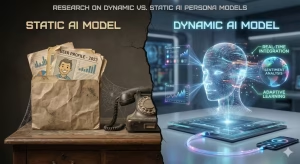
- Dynamic Personas: For 20 years, personas have been static PDF documents. They are often created, put in a folder, and forgotten. The future is dynamic personas. These are not documents; they are live dashboards. They are connected directly to your analytics and data, and they evolve in real-time as your users’ behaviors change. This makes Persona UX Design a living part of your business.
- Persona Bots: The next step is to make AI-generated personas interactive. Instead of just reading about “Hesitant Shopper,” designers will be able to talk to her. You will be able to ask a “persona bot” (an AI acting as the persona) questions like, “What do you think of this new checkout button?” This allows for instant hypothesis testing.
- AI Co-Designers: The future is not just using AI as a tool, but as a teammate. An AI co-designer will be an active participant in meetings. It will analyze the new design, compare it to its data-driven personas, and give feedback in real-time. It might say, “This new layout will work for Persona A, but it will likely fail for Persona B, who prefers one-click actions.” This will fundamentally change the speed of Persona UX Design.
From Hypothesis to High-Fidelity
We have established that “AI Persona” is a term with two powerful, distinct meanings.
- As a Product: It is the design of a personality (like ‘TOBi’ or the ‘HP Assistant’) to build user trust and drive key business metrics like task completion and customer satisfaction.
- As a Tool: It is the use of AI to analyze massive datasets, allowing us to build data-driven synthetic personas that accelerate our research and uncover hidden insights.
The case studies from Vodafone, HP, and Microsoft are not theories; they are quantitative proof that a systematic approach to Persona UX Design delivers a massive return on investment.
But the most critical takeaway is one of data integrity. The most competent design teams of the next decade will not replace their designers with AI. They will augment them. They will use AI as a powerful accelerator to generate hypotheses, and they will use their human designers to validate those hypotheses and provide the one thing a machine never can: true, human empathy. This is the future of Persona UX Design.