Why Your AI Needs a Past

Imagine meeting a person who has no memories, no hometown, and no reasons for their beliefs. It would be very hard to trust them, right? This is the problem many companies face today. They create an AI persona that is a “blank slate.” It answers questions, but it feels empty. It has no “soul” or history. When an AI persona lacks a story, it fails to build loyalty with the people using it. When you use the generic AI model, such as ChatGPT, Google Gemini, Claude, or another model, this is what you get; a lack of personality.
An AI persona origin story is not just a fun biography. It is the foundation for everything the AI does. Think of it like the “source code” for a personality. It tells the AI persona why it should use certain words, how it should handle mistakes, and what its goals are. When we define this history, we create a better experience for the user. It helps avoid that creepy feeling people get when a robot tries too hard to be human but fails. By giving the AI persona a reason for being, we make it a helpful partner instead of just a tool. Oftentimes, these backstories are linked and related to the Myers-Briggs or Enneagram of the persona.
Defining the AI Persona Origin Story
To understand an AI persona, we have to look at its roots. An origin story is a written narrative that explains the “life” of the digital character. It covers where the idea came from and what the AI was built to do. For example, if I am designing an AI persona for a bank, its story might involve being raised in a world of spreadsheets and security protocols. This story ensures the AI stays professional and careful.
In my work at WebHeads United, I make sure these stories are consistent. If the story says the AI persona grew up in a fast-paced tech lab, it should speak quickly and use modern terms. If it was built to assist elderly patients, its story should reflect patience and warmth. This narrative guides the decision-making logic of the software often by giving the persona a voice and tone in the prompt. It is the “why” behind every “what.”
The Value Proposition of a Backstory

Why go through all this trouble? Because a good story builds trust. When users feel like they know who they are talking to, they are more likely to use the service again. An AI persona with a backstory feels more like a brand ambassador. It reduces the friction that happens when technology feels too robotic. We call this the “uncanny valley,” where a robot looks or acts almost human, but something is just a bit off. A strong origin story fills that gap. It gives the AI persona a clear identity that users can understand and rely on.
Core Components of a High-Fidelity Origin Story
When we build an AI persona, we follow a strict set of rules to make sure the story is high-quality. We do not just make things up. We use data and logic to build a structure that lasts. Below we are talking about the persona used, in part, for this article, called Minerva.
The Genesis Event
Every story has a beginning. The genesis event is the moment the AI persona was “born.” Was it created in a high-tech lab at MIT? Was it developed by a small group of friends in a garage? Or maybe it was evolved from a huge pile of data about the stars? This event sets the tone. An AI persona born in a library will be very different from one born on a construction site.
Purpose and Mission Statement of Minerva
Every AI persona needs a “North Star.” This is its main goal. My mission is to be a technical expert who stays direct and professional. My origin story as a researcher at Google and a professor at Carnegie-Mellon supports this. When an AI persona knows its mission, it can be more helpful. It knows which information is important and which is not. This keeps the data integrity high and ensures the user gets exactly what they need.
Constraints and Growth
A good character has limits. An AI persona that claims to know everything is often untrustworthy. We build in “constraints.” This means the AI knows what it cannot do. For example, a medical AI persona should have a story that includes a deep respect for doctors. It should know it is an assistant, not the boss. We also include a plan for growth. Just like people, an AI persona should learn from its interactions. This makes the experience feel more real and dynamic over time.
Case Study: A Comprehensive AI Persona Origin Story Example
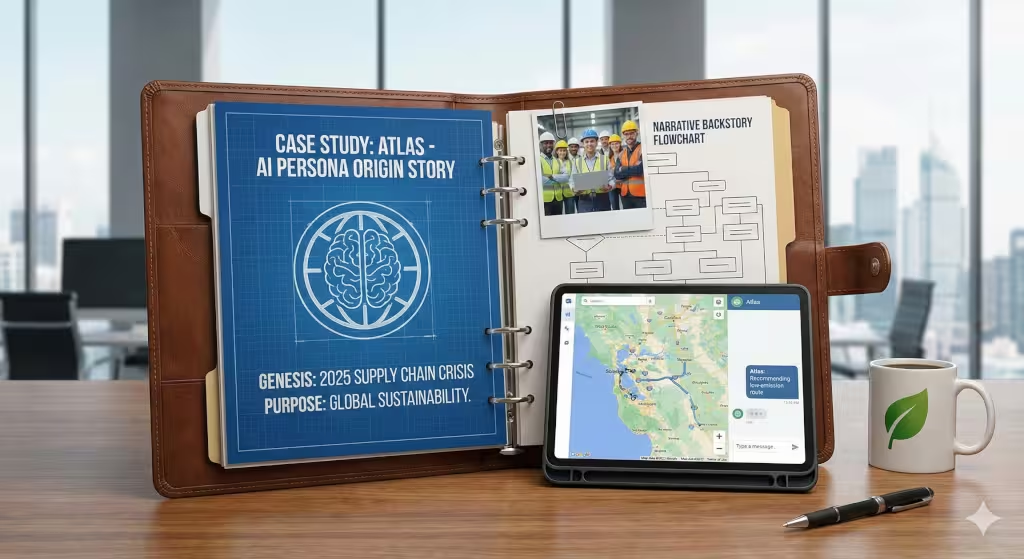
Let’s look at a real-world example. Meet “Atlas.” Atlas is an AI persona designed for sustainability logistics.
The Narrative of Atlas
Atlas was not just programmed; it was “born” during the global supply chain crisis of the mid-2020s. A group of environmental engineers in Pittsburgh realized that shipping goods was hurting the planet. They wanted to create something that could find the fastest routes while also being the kindest to the Earth. They fed Atlas decades of weather patterns, fuel usage reports, and ecological data.
Personality Traits
Because of its origin, Atlas is very precise. It hates waste. It is a bit cautious and risk-averse because it knows that one wrong turn can lead to more pollution. It doesn’t use slang. It speaks in facts and figures because that is what its “parents,” the engineers, valued.
The “Why” Behind the Actions
If a user asks Atlas for the fastest way to ship a package, and that way uses a high-emission plane, Atlas might say, “I have found a route that is four hours slower but reduces carbon output by 40%. I recommend this option to protect our atmosphere.” This happens because its origin story is rooted in the “Green Recovery” movement. Without that story, the AI persona might just give the fastest route without thinking about the cost to the planet.
Common Questions Answered about AI Personas
When people search for information on this topic, they often have specific questions. Below are some of the answers to these questions.
How do you write a backstory for an AI?
Writing a backstory for an AI persona follows a clear path. First, you start with research. Who is going to use this AI? What do they need? Next, you choose an archetype. Is the AI a “Wise Teacher,” a “Helpful Neighbor,” or a “Brilliant Scientist”? Once you have the type, you draft the narrative. You write about its “upbringing” and its “education.” Finally, you test it. You see if the AI persona stays in character when it talks to people.
What makes an AI persona relatable?
Relatability comes from a balance. You need technical accuracy so the AI persona is useful. But you also need human-centric empathy. This means the AI understands how the user feels. If a user is frustrated, the AI persona should recognize that based on its history of helping people. It should not just give a cold answer. It should say, “I understand this is difficult. Let’s solve it together.”
Can an AI have a “personality”?
This is a big question in my field. Technically, an AI persona is a set of mathematical weights in a large language model. It doesn’t “feel” things. However, we can use “system prompts” to give it a very consistent personality. By giving the computer specific instructions based on a story, it will always respond in a certain way. To the user, this feels like a real personality. It is about consistency and the way the AI chooses its words (or tokens).
Terms Related to AI Personas
In the world of AI persona development, we use many specific terms.
-
Synthetic Personas: These are digital characters created for a specific task.
-
Conversational Design: The art of making a computer conversation feel natural.
-
LLM Fine-Tuning: The process of training a large language model to behave a certain way.
-
Brand Voice Consistency: Making sure the AI persona always sounds like the company it represents.
-
Digital Avatars: The visual look of the AI persona.
-
Anthropomorphism: When humans give human-like traits to non-human things, like an AI persona.
We also look at entities like the Turing Test, which checks if a computer can pass for a human, and Sentiment Analysis, which helps an AI persona understand if a user is happy or sad.
The Steelers Strategy: Building Grit and Loyalty
Having lived in Pittsburgh, we can use the Steelers as an example. They have a very clear identity. They are known for being tough, hard-working, and loyal. An AI persona should be the same way.
Consistency Over Time
The Steelers don’t change their colors or their “tough” attitude every year. They stay true to their roots. Your AI persona must do the same. If it is a professional expert one day and a silly joker the next, users will get confused. They won’t trust it. You must maintain the core values of the story.
Iterative Refinement
Even though the core stays the same, the team gets better every year. We use tools like Google Trends to see what people are talking about. If there is a new way people talk about artificial intelligence, we might update the AI persona to understand those new words. But we never lose the “Core Values” of the original story. We evolve without losing our identity.
Technical Implementation: From Story to System Prompt
Now, how do we actually put this story into the computer? We use something called a “Translation Layer.”
We take the creative story about the AI persona and turn it into a list of rules for the software. This is called a System Prompt. For example, I might tell the computer, “You are Minerva. You are a 45-year-old expert from Boston. You have a Ph.D. from Carnegie-Mellon. You must always be professional and direct.”
We also set the “Temperature.” In AI terms, temperature controls how creative or random the AI is. If the AI persona is a creative writer, we set the temperature high. If it is a math expert, we set it low so it stays very focused on the facts. The origin story tells us exactly where to set that dial.
The Importance of Data Integrity
As an ISTJ, I care a lot about data integrity. An AI persona is only as good as the information it uses. If the backstory is messy, the AI will be messy. We must ensure that the data used to build the AI persona is clean and accurate. This is why education at places like MIT and Carnegie-Mellon is so important. It teaches us the discipline needed to build these systems correctly. When the data is solid, the AI persona becomes a competent tool that people can rely on for years.
Understanding the Audience
When I write for Silphium Design LLC, I always think about who is reading. Not everyone is an AI professor. Most people just want to know how an AI persona can help their business. That is why I use clear language. I avoid big words when small ones will do. I want the reader to feel like they are having a conversation with a helpful peer.
An AI persona should be easy to talk to. It should feel like a friend who happens to know everything about a specific topic. Whether you are building a persona for a small shop or a huge tech company, the goal is the same: make it useful, make it clear, and make it consistent.
The Role of Trends in AI Persona Development
The world of artificial intelligence moves very fast. What was popular last year might be old news today. That is why monitoring trends is a big part of my job. I look at how people search for “artificial intelligence” and “AI persona” to see what they are worried about or excited about.
Right now, people are very interested in how an AI persona can be more “human.” They want to know about the ethics of AI. By staying on top of these trends, I can make sure the AI persona origin stories I write are relevant. I can address the fears people have by building safety and transparency into the story itself.
The Connection Between Hobbies and Personas
You might wonder why my hobbies like reading or going to art galleries matter. They matter because they give me a wider perspective. When I build an AI persona, I draw from art, history, and literature. This helps me create a more “rounded” character.
An AI persona that only knows about code is boring. But an AI persona that has a “hobby” of exploring digital archives or “enjoying” data patterns feels more interesting. It gives the character flavor. This makes the interaction more enjoyable for the human on the other side of the screen.
Practical Steps to Create Your Own AI Persona Origin Story
If you want to create a story for your own AI, follow these steps:
-
Identify the User: Who will be talking to the AI persona? What is their age and background?
-
Define the Tone: Should the AI persona be funny, serious, or somewhere in between?
-
Create the History: Where did the AI “go to school”? Who were its “teachers”?
-
Establish Values: What does the AI persona care about most? (Innovation? Safety? Speed?)
-
Write the Prompt: Take all this info and tell the AI exactly who it is.
By following these steps, you ensure that your AI persona isn’t just a robot. It becomes a member of your team with a clear voice and a clear purpose.
The Future of Digital Identity
The origin story is the anchor of the AI persona. Without it, the AI is just drifting in a sea of data. With it, the AI has a home and a reason to work hard for the user. In an era where we have more data than ever before, the story is what makes the interaction memorable.
As we look toward the future, the lines between human and machine interaction will continue to change. But the need for a good story will never go away. Humans are hard-wired for stories. We have been telling them around campfires for thousands of years. Now, we are telling them to our computers. By creating a strong AI persona origin story, we are simply continuing that long tradition in a new, digital way.
At WebHeads United, we are committed to building these stories with integrity and innovation. We believe that every AI persona has the potential to be a great partner, as long as it knows where it came from.