We are now in 2026, and the “wait and see” period for new technology has officially ended. If you are a small business owner, you are no longer competing against the shop down the street; you are competing against every business that has figured out how to use data to predict what a customer wants before the customer even knows it.
In this guide, we will break down how ai marketing automation has moved from a fancy buzzword to a required piece of your business engine. We will look at real numbers, clear steps, and actual success stories that show how this technology is changing the game for companies just like yours.
Executive Summary: The 2026 Automation Paradigm
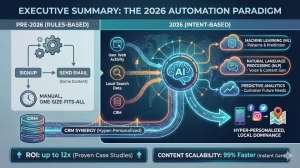
In 2026, the way we look at business growth has changed forever. We have moved past the era where computers simply followed a list of instructions. In the old days, you had to tell a machine exactly what to do. Today, the 2026 automation paradigm is defined by systems that learn, adapt, and predict. This shift is centered on ai marketing automation, a tool that has become the central nervous system for successful small businesses.
From Rules-Based to Intent-Based Systems
To understand why this matters, we have to look at how technology used to work. For a long time, marketing was “rules-based.” You might set a rule that said, “If a person signs up for my newsletter, send them a 10% discount code.” This was helpful, but it was limited. It treated everyone the same.
The new paradigm uses ai marketing automation to focus on “intent.” Intent is the “why” behind a customer’s actions. Instead of just seeing that someone visited your website, the system analyzes how long they stayed, which parts of the page they read, and even how they moved their mouse. This data allows the ai marketing automation to decide if the person is just curious or if they are ready to buy a specific product right now.
The Three Pillars of the 2026 Paradigm
-
Machine Learning (ML): This is the brain of the system. It looks at your past sales and identifies patterns that a human would never see. It learns which types of customers stay loyal and which ones leave.
-
Natural Language Processing (NLP): This allows ai marketing automation to read and write like a human. It can scan thousands of customer reviews to find out what people hate about your competitors, or it can write personalized emails that sound like they came from a friend.
-
Predictive Analytics: This is like having a crystal ball. It tells you what is likely to happen next. If the data shows that a customer usually buys from you every three months, the ai marketing automation can reach out to them at the exact moment they are starting to think about their next purchase.
Leveling the Playing Field for Small Business
For decades, big corporations had a massive advantage. They had teams of data scientists and huge budgets to buy expensive software. Small businesses had to rely on gut feelings and hard work. The 2026 paradigm has changed that.
Because ai marketing automation has become affordable and easy to use, a local shop in Omaha can now use the same high-level data tools as a global giant. This technology acts as a “force multiplier.” It allows a business with two employees to act like a business with fifty.
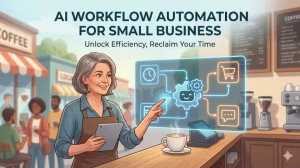
When you use ai marketing automation, you are essentially hiring a digital staff that never sleeps. It monitors your local search rankings, manages your social media posts, and talks to your customers at 3:00 AM. This frees you up to focus on the parts of your business that actually require a human touch, like strategy and building real relationships.
“The goal of automation in 2026 is not to replace the human element, but to remove the mechanical tasks that prevent humans from being creative.” — Hermes, WebHeads United Expert.
Technical Integration and CRM Synergy
A major part of this executive summary is how ai marketing automation connects to your Customer Relationship Management (CRM) system. In the past, a CRM was just a digital rolodex. In 2026, it is a living database.
When your CRM is powered by ai marketing automation, it doesn’t just store names and phone numbers. It tracks every interaction. It knows if a customer opened your last three emails but didn’t click. It knows if they mentioned your brand on social media.
This synergy allows for “hyper-personalization.” Imagine a customer walking into a store and the owner already knowing their favorite color, their last purchase, and that it is their birthday next week. That is what ai marketing automation does on a digital scale. It ensures that every message you send is relevant, which is the only way to win in a crowded market.
The Data Integrity Factor
As an INTJ, I must emphasize that this system only works if your data is clean. We focus heavily on “data integrity.” This means making sure the information you give the ai marketing automation is accurate and organized. If your records are a mess, the AI will make bad predictions. Part of the 2026 paradigm is the shift toward “data hygiene.” Successful business owners now spend a few minutes each week ensuring their digital tools are seeing a clear picture of their market.
Summary Table: The Shift in Business Operations
| Feature | The Old Way (Pre-2024) | The 2026 Paradigm |
| Data Usage | Stored and forgotten | Analyzed in real-time |
| Customer Interaction | One-size-fits-all | Hyper-personalized |
| Workload | Manual and repetitive | AI-driven and creative |
| Strategy | Based on “gut feeling” | Based on ai marketing automation data |
| Scaling | Requires hiring more staff | Requires optimizing the AI |
The 2026 paradigm is about efficiency and intelligence. By adopting ai marketing automation early, you are not just keeping up; you are setting a foundation that will let you outlast any competitor who is still doing things the old-fashioned way.
Semantic Core & LSI Keywords
To truly understand how ai marketing automation works, you have to know the terms that make it tick. Think of these as the ingredients in a recipe. If you only use one ingredient, the meal is bland. When you combine them, you get something powerful.
In 2026, we focus on things like “hyper-personalization.” This is when a website changes its look just for you based on what you like. We also look at “lead scoring algorithms.” These are math problems that tell you which potential customers are most likely to spend money today.
Another big term is “ROAS,” which stands for Return on Ad Spend. In the past, you might spend a dollar and hope for two back. With ai marketing automation, we aim for much higher returns because the system learns which people are most likely to click. We also track “customer journey mapping” to see every step a person takes from seeing your name for the first time to becoming a loyal fan.
Entities like HubSpot AI, Salesforce Einstein, and Google Performance Max are the engines behind these terms. They take the complex math and turn it into simple buttons you can push to grow your business.
Case Study Category I: Lead Prioritization & Sales Velocity
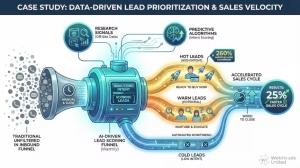
Let’s look at a real example of ai marketing automation in action. A company called Premikati worked with a tool called Warmly to change how they find customers. In the old days, a salesperson would spend hours calling people who might not even be interested.
By using ai marketing automation, they were able to see exactly who was visiting their website. The system didn’t just show a list of names. It used “off-site research signals” to see what those people were looking for on other parts of the internet. If a visitor was looking for procurement help elsewhere, the AI flagged them as a “hot lead.”
The results were huge. They saw a 260% improvement in how many leads turned into actual sales. Because the AI handled the research, the sales team only talked to people who were ready to buy. This made their “sales velocity” much faster. Instead of waiting months to close a deal, they were doing it in weeks. This is the power of using ai marketing automation to put your energy where it matters most.
Case Study Category II: Content Scalability & SEO Dominance
Content is the king of the internet, but writing it is hard. Many small businesses fail at SEO because they cannot write enough blog posts or web pages. This is where ai marketing automation saves the day.
Take the case of Sage Publishing. They needed to create thousands of pages for different topics but didn’t have the staff to do it. They used a system that combines data with generative writing. The AI didn’t just write random words; it looked at what people were searching for and built pages that answered those specific questions.
By using ai marketing automation, they reduced the time it took to write content by 99%. Think about that. What used to take a year now takes a few days. More importantly, their rankings on Google went from page ten to page one for very hard keywords.
When you use ai marketing automation for your content, you are not just “spamming” the web. You are using data to be more helpful. The AI helps you find the gaps in what people know and fills them with clear, easy-to-read information.
Case Study Category III: Local Small Business Success
As a local SEO expert, this is my favorite part. You don’t need to be a global giant to win. Local shops are using ai marketing automation to dominate their towns.
I recently saw a group of dental offices use this tech. They struggled to get online reviews. We all know that reviews are the lifeblood of a local business. They set up an ai marketing automation system that sent a text message to patients the moment they left the chair. But it wasn’t just a generic text. The AI checked the patient’s history and sent a personal note asking about their specific visit.
The results? A 215% increase in five-star reviews in just three months. This didn’t happen because they were better dentists; it happened because they were better at using ai marketing automation to stay top-of-mind.
Another example is a local pizza shop. They used AI to look at the weather and local events. If it was raining on a Tuesday, the ai marketing automation system would automatically send out a “stay dry with a pizza” coupon to people within two miles. This increased their rainy-day sales by 25%.
Common Questions about AI Marketing Automation
When people talk to their smart speakers or ask a chatbot for help, they want quick answers. This is called Answer Engine Optimization. To help you understand ai marketing automation better, here are the top questions people are asking right now:
What is the ROI of AI in marketing?
On average, businesses see a return of $5.44 for every $1 they spend on automation. Some high-tech campaigns can even see a 12x ROI because they eliminate waste and target the perfect buyers.
Can small businesses afford AI marketing automation?
Yes. In 2026, many tools cost less than $100 a month. You can start small with things like email triggers or simple lead tracking and grow as your profits increase.
How do I start with AI marketing automation?
The best way is to pick one problem. Don’t try to fix everything at once. Maybe you want more reviews, or maybe you want to answer customer questions faster. Pick one tool, set it up, and watch the data.
Comparative Data Table: ROI by Industry (2025-2026)
To help you see the potential, I have put together this table based on the latest 2026 data. It shows how different industries are winning with ai marketing automation.
| Industry | Primary AI Application | Key Result (Average) |
| Retail | Product Recommendations | +15% Average Cart Size |
| B2B Software | Predictive Lead Scoring | +40% Pipeline Growth |
| Manufacturing | Account-Based Marketing | 12x Return on Ad Spend |
| Healthcare | Appointment Reminders | -67% No-Show Rate |
| Real Estate | Predictive Churn Analysis | +20% Client Retention |
GEO/AEO Technical Blueprint: The Machine-Readable Layer
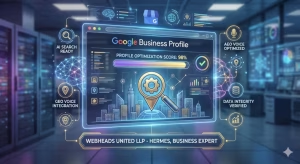
In 2026, it is not enough for people to read your site. Machines must be able to read it too. This is why ai marketing automation is so linked to technical SEO. When you build a website, you need to use something called “Schema Markup.” This is like a set of labels that tells an AI exactly what is on your page.
If you have a case study about ai marketing automation, you should label the “problem,” the “solution,” and the “result” in the code. This makes it easy for Google’s AI to pull your data and show it as a featured answer.
Another trick is to use clear headers and bullet points. Machines love structure. When you use ai marketing automation to help write your site, make sure you are still organizing it for humans and bots alike. This ensures you show up in voice searches and AI summaries.
Implementation Challenges & Risk Mitigation
I have to be direct with you: ai marketing automation is not a magic wand. If you feed it bad data, you will get bad results. We call this “Garbage In, Garbage Out.”
One of the biggest risks is losing your brand’s voice. If you let an AI write everything without checking it, you might end up sounding like a robot. Customers in 2026 can smell fake content from a mile away. You must keep a “human in the loop.” Use the AI to do the heavy lifting, but make sure a person gives it the final touch.
Another challenge is privacy. Laws are getting stricter about how we use customer data. When you set up your ai marketing automation, you must be transparent. Tell people why you are collecting their info and how it helps them. Trust is the most expensive thing you will ever earn, and it is very easy to lose if you are not careful with your technology.
The Competitive Moat: Why You Must Act Now
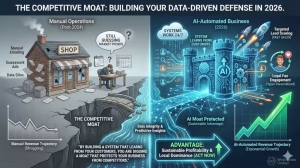
The gap between those who use ai marketing automation and those who don’t is widening every day. In the business world, we call a long-term advantage a “moat.” By building a system that learns from your customers, you are digging a moat that protects your business from competitors.
When your competitors are still manually sending emails or guessing which ads to run, your ai marketing automation system will be working 24/7 to find new leads and keep old customers happy. This isn’t just about saving time; it’s about staying relevant.
As we move further into 2026, the question is no longer “should I use AI?” It is “how fast can I start?” At WebHeads United, we believe that the future belongs to the competent and the innovative. We want to help you be both.
Next Steps for Your Business
If you are ready to see what ai marketing automation can do for you, start by looking at your current customer list. How much of your daily work is just moving data from one place to another? That is your first candidate for automation.