You probably did not start your business to spend all day chasing people who do not want to buy from you. Yet, that is exactly what most small business owners do. You spend hours searching for emails, making cold calls, and trying to guess who might need your services. The data shows that business owners spend nearly 70% of their time just trying to find potential customers. That leaves very little time to actually close the deal or do the work.
This old way of working is broken. It is slow, it is expensive, and it burns you out. But there is a shift happening right now that changes everything. It is not magic, and it is not science fiction. It is the use of artificial intelligence to handle the heavy lifting.
When we talk about using AI for lead generation, we are talking about building a system. We are moving away from hunting for one customer at a time. Instead, we are building a machine that attracts, sorts, and talks to thousands of potential customers at once. This guide is not just about theory. It is a technical look at how you can use these tools today. We will cover how to lower your costs, save your time, and get more sales. Let’s stop guessing and start using data to grow.
What is AI in Lead Generation?
To understand how to fix your sales process, you first need to understand the tools. AI in lead generation is simply using smart computer programs to find customers for you. These programs use two main technologies. The first is Machine Learning, which allows computers to learn from patterns in data. The second is Natural Language Processing, which allows computers to read and write like a human.
There are three main jobs that AI does better than a human in this space.
First, there is data mining. Imagine trying to read every website on the internet to find companies that need your help. You could not do it in a lifetime. AI can do it in minutes. It scrapes public data to find the perfect people for you to contact.
Second, there is pattern recognition. A human looks at a list of leads and guesses who is ready to buy. AI looks at history. It sees that customers who visit your pricing page twice and read three blog posts are 80% likely to buy. It uses this pattern to tell you who to call first.
Third, there is automation. This is the ability to trigger actions without you lifting a finger. If a potential customer fills out a form at 2 AM, the AI can send a personal email immediately.
This matters because of speed and cost. Manual lead generation is slow and prone to error. You might type an email wrong or forget to follow up. AI does not forget. It does not get tired. It runs your lead generation process 24 hours a day.
Step 1: Building Your Ideal Customer Profile with AI

The first step in any successful marketing campaign is knowing who you are talking to. In the marketing world, we call this the Ideal Customer Profile, or ICP. Most businesses guess their ICP. They say, “I think I sell to men over 40.” That is not specific enough.
AI takes the guesswork out of this. You can feed your current customer list into an AI tool. The tool will analyze the data. It looks at things you might miss. It checks the revenue of the companies, their location, the technology they use on their website, and even their recent news.
Once the AI understands who your best customers are, it can go out and find “look-alike” audiences. These are new people who match the data points of your best buyers. This makes your lead generation efforts much more effective because you are only targeting people who are statistically likely to need you.
Tools like Clay or ZoomInfo are powerful here. You can input specific parameters. For example, you can tell the software to “Find me every plumbing business in Ohio with revenue over one million dollars that does not have a website.” The software will give you a list of verified emails and phone numbers in seconds. This is the power of data-driven lead generation.
Step 2: Implementing Predictive Lead Scoring
One of the biggest wastes of time in sales is talking to people who are just browsing. Not every lead is a good lead. In the past, we used basic rules to score leads. If someone opened an email, we gave them 5 points. If they clicked a link, we gave them 10 points. This was better than nothing, but it was still crude.
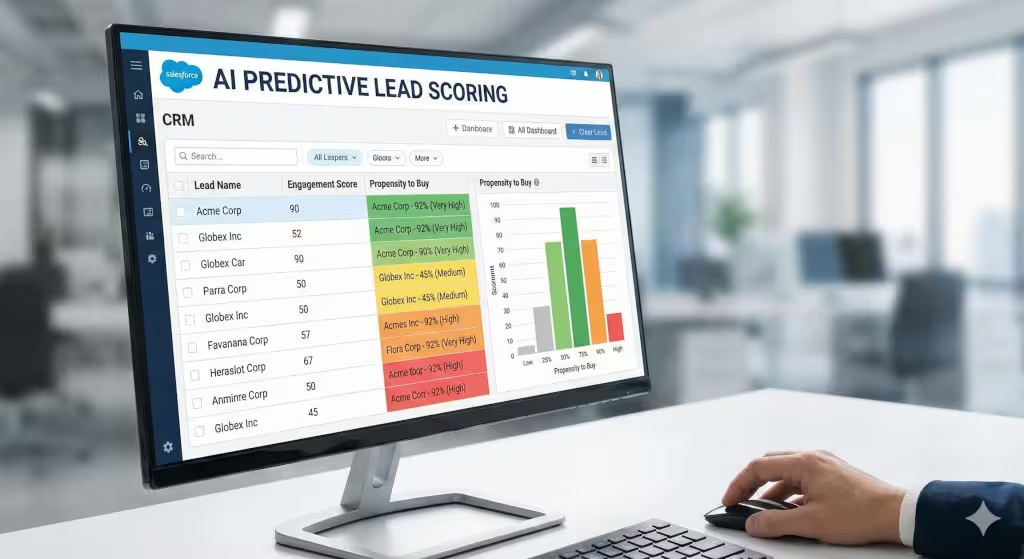
AI introduces predictive lead scoring. This is a much smarter way to handle lead generation. The AI looks at thousands of data points at once. It tracks how long a visitor stays on your site. It sees which specific pages they visit. It looks at their job title and their industry.
The AI then compares this new visitor to every sale you have ever made. It calculates a probability score. It might tell you, “This lead has a 92% propensity to buy.” Or it might say, “This lead only has a 12% chance.”
You can connect these models to your Customer Relationship Management system, or CRM. Popular CRMs like HubSpot or Salesforce now have these features built-in. This means your sales team does not have to guess who to call. They simply open their dashboard and call the leads with the highest scores. This improves efficiency and boosts the return on investment for your lead generation budget.
Step 3: Automating Outreach with Personalization
Once you have your list of high-quality leads, you need to contact them. In the past, you had two bad choices. You could write every email by hand, which takes forever. Or you could send the same generic “spam” email to everyone, which people hate.
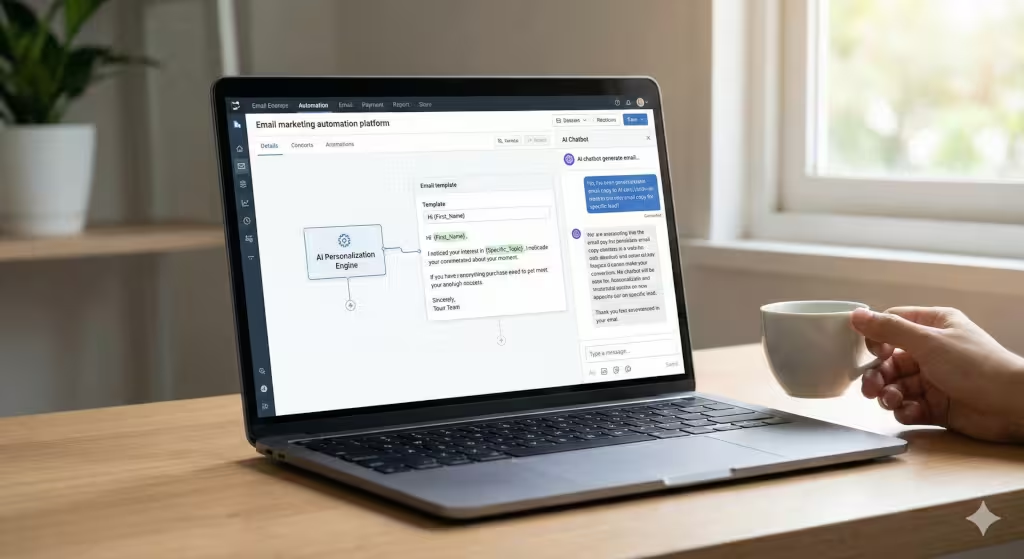
Generative AI solves this problem. Tools like Jasper or ChatGPT can write personalized emails at a massive scale. This is a game changer for lead generation. You can upload your list of leads and tell the AI to write a unique message for each one.
The AI uses dynamic variables. It can look at the data you collected in Step 1. It can see that a prospect recently posted on LinkedIn about expanding their office. The AI can write an email that says, “I saw your recent post about the office expansion and wanted to reach out.”
This does not look like a robot wrote it. It looks like you did your homework. But the robot did the homework for you.
You can set up a workflow. It might look like this:
-
The system detects a new lead that matches your criteria.
-
The AI does research on the lead.
-
The AI drafts a personalized email.
-
The email is sent automatically, or sits in a folder for you to approve.
This allows a single person to do the work of ten people. It keeps your lead generation pipeline full without you spending all day typing.
Step 4: Deploying Conversational AI for 24/7 Capture

Your website is your digital storefront. But if no one is there to greet customers, you are losing money. Traditional “Contact Us” forms are dying. People do not want to fill out a form and wait 24 hours for a reply. They want answers now.
This is where chatbots used to fail. Old chatbots were dumb. You had to press 1 for sales or 2 for support. If you asked a complex question, the bot would break.
Modern Conversational AI is different. These bots use Natural Language Processing to understand what the user means, not just what they type. They can hold a real conversation. This is vital for modern lead generation.
Imagine a visitor lands on your site at 10 PM. The AI bot pops up and asks, “What brings you here today?” The visitor says, “I am looking for help with my taxes.” The bot understands this intent. It can then ask qualifying questions. “Are you a business or an individual?” “What is your estimated annual revenue?”
Based on the answers, the bot can do two things. If the lead is small or not a good fit, the bot can send them a helpful article. If the lead is a high-value prospect, the bot can book a meeting directly on your calendar for the next morning.
This means your lead generation never sleeps. You wake up to a calendar full of qualified appointments. Tools like Intercom or Drift are leaders in this space. They help you capture demand the moment it happens.
Questions about Lead Generation
When researching lead generation, many business owners have the same questions. Here are the data-driven answers to the most common queries.
Can AI replace sales representatives?
No, AI cannot fully replace a human sales rep. AI replaces the grunt work. It replaces the data entry, the research, and the initial cold outreach. However, closing a high-value deal usually requires trust. Trust is built between humans. AI frees up your sales reps so they can focus on building relationships rather than filling out spreadsheets. It makes them more effective at lead generation, not obsolete.
What is the best AI tool for lead generation?
There is no single “best” tool because lead generation has different stages. For finding people (prospecting), tools like Apollo or ZoomInfo are top tier. For scoring them, HubSpot is excellent. For writing copy, ChatGPT or Jasper are the standards. You need a “stack” of tools that work together, not just one magic button.
Is AI lead generation expensive?
You have to look at the cost differently. Yes, these software tools cost money. Some cost a few hundred dollars a month. But compare that to the cost of a human employee. A human needs a salary, benefits, and training. A human can only work 8 hours a day. An AI tool works 24/7 and costs a fraction of a salary. When you look at the Cost Per Lead (CPL), AI is almost always cheaper than manual labor.
Risks and Best Practices for Data Integrity
We must be honest about the risks. AI is powerful, but it is not perfect. The biggest risk in using AI for lead generation is bad data. In the computer world, we have a saying: “Garbage In, Garbage Out.”
If you feed your AI outdated or incorrect lists of customers, it will give you bad predictions. It might tell you to call people who went out of business years ago. You must maintain “data hygiene.” This means regularly cleaning your lists and verifying emails.
You also need to be careful with privacy. Laws like GDPR in Europe and CCPA in California are very strict about how you collect data. You cannot just scrape personal info and spam people. You must ensure your lead generation methods are compliant. Always give people an easy way to unsubscribe or opt-out.
Finally, keep a human in the loop. We call this HITL (Human In The Loop). Do not let the AI run completely wild. You should spot-check the emails it writes. You should review the calls it books. AI is a tool to assist you, not a boss to replace you.
Future Trends in Local SEO and AI Search: The Shift to Generative Optimization
The era of “ten blue links” is effectively over. We have entered the age of the Search Generative Experience (SGE). As a business owner, you are no longer just optimizing for a search engine; you are optimizing for an answer engine in order to get lead generation.
In 2025, Google does not just want to direct users to your website; it wants to answer their questions directly on the results page using AI. This is a fundamental shift from Search Engine Optimization (SEO) to Generative Engine Optimization (GEO).
Here is the technical breakdown of how this changes your strategy.
1. From Keywords to Entities (The Knowledge Graph)
Old SEO was about strings of text (keywords). If you put “Best Pizza NYC” on your page enough times, you ranked.
New AI Search is about Entities.
An “entity” is a concept that the AI understands as a distinct object with properties. Google’s AI (Gemini) does not see your business as a collection of keywords; it sees it as an entity with relationships.
-
Entity: [Your Business Name]
-
Attribute: Italian Restaurant
-
Relationship: Located in [City], Owned by [Person], Rated [4.8 stars]
WebHeads United Insight: You must teach the AI who you are. We do this using Schema Markup (structured code on your website). If you do not have Schema telling Google “This is a local business” and “This is our menu,” the AI has to guess. You never want the AI to guess.
2. Optimization for Answers (Zero-Click Searches)
Data from late 2025 shows that nearly 60% of local searches now end without a click to a website. The user asks, “Who is the best affordable plumber near me open now?” and the AI gives a direct answer, a phone number, and a “Book Now” button.
To survive this, you must optimize for the AI Snapshot (also known as Position Zero) in order to get lead generation.
-
Conversational Content: Your website should answer specific questions. Instead of a page just titled “Plumbing Services,” have a section titled “How much does emergency plumbing cost in Omaha?”
-
Direct Answers: The AI prioritizes content that is structured as a direct answer (Subject + Verb + Object).
-
Bad: “We have been offering plumbing services for many years and pricing varies…”
-
Good: “Our emergency plumbing service starts at $150 and includes a 1-hour response time.
-
3. Voice Search and Long-Tail Intent
With the dominance of smart assistants (Siri, Alexa, Gemini), search queries have become conversational. People do not speak in keywords (“Plumber Omaha”). They speak in sentences: “Hey Google, find me a plumber who can fix a water heater today.”
This means your content strategy must target Long-Tail Keywords. These are specific, 4-5 word phrases that signal high intent.
-
Short Tail: “Coffee Shop” (Low intent, high competition)
-
Long Tail: “Quiet coffee shop with free wifi in Brooklyn” (High intent, clear conversion)
4. Reputation as Data (Sentiment Analysis)
In the past, Google just counted your stars (4.5 vs 4.2). Today, AI reads the text of your reviews to understand Sentiment.
If a user searches for “Romantic restaurant with quiet atmosphere,” the AI scans your reviews for words like “intimate,” “quiet,” and “cozy.” Even if you have 5 stars, if your reviews say “Loud and energetic,” the AI will not show you for that specific query.
Action Item: You cannot just ask for reviews; you must ask for descriptive reviews. “Please mention the specific service we did for you in your review” is a powerful prompt for customers.
5. Technical Requirements for AI Visibility
To ensure the AI agents (Gemini, Bing Copilot, ChatGPT Search) can read your site, you need to maintain “Data Hygiene.”
-
NAP Consistency: Name, Address, Phone number must be identical across every directory (Yelp, Apple Maps, Google, Bing). One wrong phone number can break the AI’s trust in your entity.
-
Page Speed: AI agents prioritize fast information. If your mobile site loads in over 3 seconds, you are often excluded from the AI snapshot.
Summary Checklist for Small Businesses
| Feature | Old SEO Strategy | New AI/GEO Strategy |
| Targeting | Keywords (“Lawyer NYC”) | Entities & Questions (“Who is the best injury lawyer for car accidents?”) |
| Content18 | generic “Service Pages”19 | FAQ and “How-To” Guides |
| Success Metric | Website Traffic | Calls & Map Directions (Zero-Click conversions) |
| Reviews | Quantity of Stars | Quality of Text (Sentiment) |
WebHeads United Final Thought: The businesses that win in 2025 are not the ones trying to “trick” the algorithm. They are the ones providing the clearest, most structured data to the AI. Be the answer, not just a link.
Conclusion
We have covered a lot of ground. We looked at how lead generation is shifting from a manual grind to an automated system. We discussed the technical steps of building an Ideal Customer Profile, using predictive scoring, and automating your emails.
The key takeaway is that you do not have to do this alone. The tools exist today to help you scale. By using AI for lead generation, you are building an asset for your business. You are building a system that works for you, day and night.
You do not need to implement everything at once. Start small. Pick one area, perhaps the email automation or the chatbot, and set it up this week. Audit your current flow. See where you are wasting time. Then let the data guide you. The future of your business growth depends on how well you adapt to these new technologies. It is time to get to work.