The digital economy runs on data and intent. When analyzing data at Google and Ahrefs, there is often a repeating pattern. Business owners look at their traffic reports and smile because the numbers are high. But when they look at their bank accounts, they frown. This is the “Traffic vs. Revenue” paradox. It happens when you optimize your website for traffic volume instead of value. The root cause is almost always a misunderstanding of search intent and how you select your keywords.
To fix this, we must look at the data with clear eyes. We have to separate the “Know” queries from the “Do” queries. In the industry, we call these Informational Keywords and Transactional Keywords.
Informational terms are used by people who are learning. They want answers. Transactional terms are used by people who are buying. They want products. If you treat a learner like a buyer, you scare them away. If you treat a buyer like a learner, you bore them. In both cases, you lose money.
This article will serve as a comprehensive analysis of the buyer’s journey. We will look at how to select the right keywords to ensure you are not just getting clicks, but getting customers. We will also touch on the other stages of the journey to ensure your strategy is complete.
Decoding the Four Types of Search Intent
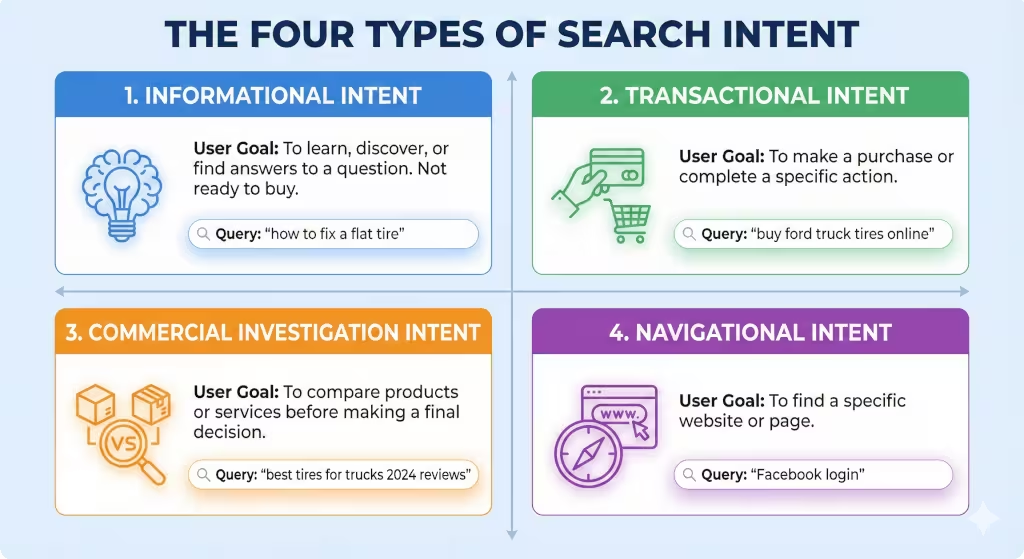
1. Informational Intent
This is the most common type of search. The user has a question. They are not looking to spend money yet. They are looking to spend time learning. They search for things like “how to fix a flat tire” or “what is seo.” They want a guide or a definition.
2. Transactional Intent
This is the money bucket. The user knows what they want. They are ready to trade their money for a product or service. They search for “buy ford truck tires” or “hire seo expert san francisco.” These users are at the finish line.
3. Commercial Investigation
This is the hybrid stage. It sits between the first two. The user knows they have a problem and they know there are solutions. Now they are comparing them. They might search for “best tires for trucks 2024” or “ahrefs vs semrush review.” They are close to buying, but they need one last push.
4. Navigational Intent
This is simple. The user knows exactly where they want to go. They type “Facebook login” or “New York Times” into the search bar. They are using the search engine like a phone book. You cannot really target these keywords unless you own the brand.
You must view these four types as a map. Your job is to create content that matches the specific signposts on that map. If you use the wrong keywords at the wrong time, the user gets lost.
Informational Keywords (The “Know” Phase)
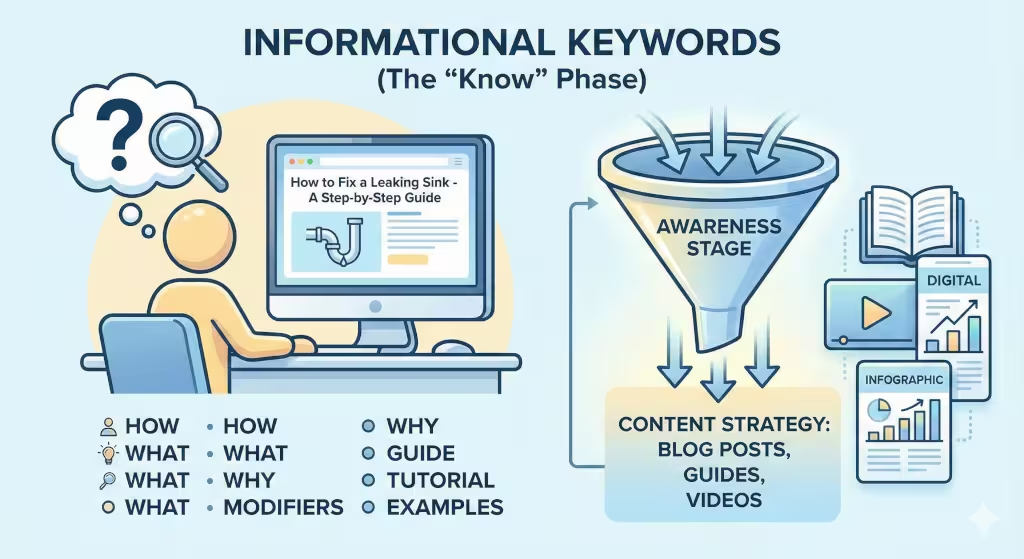
Let us look closer at the first group. Informational searches make up the vast majority of the internet traffic. You might ask why you should care about people who are not buying yet. The answer is trust.
User Psychology
When a user types informational keywords into Google, they are in the “Awareness” stage. They have a pain point. Maybe their sink is leaking. Maybe their computer is slow. They are problem aware, but they are not solution aware. They feel frustrated or curious. They do not want a sales pitch. They want a helpful friend.
Identifying the Modifiers
You can spot these keywords by looking at the words that surround the main topic. We call these modifiers. Look for question words.
-
How
-
What
-
Why
-
When
-
Who
-
Guide
-
Tutorial
-
Examples
-
History of
For example, if you sell coffee, an informational search would be “how to brew french press coffee.” The user just wants a good cup of coffee. They are not looking for a credit card form.
Content Strategy
To rank for these keywords, you need to build a library of resources. This is where blogging comes in. You should write long articles that answer the question completely. If the user asks “how to fix a sink,” your article should have step by step photos. It should be 1,500 words or more. You can also use video tutorials or infographics.
The SEO Value
Ranking for these keywords builds “Topical Authority.” This tells Google that you are an expert in your field. If you answer one hundred questions about coffee, Google will trust you when you finally try to sell coffee beans. These pages also attract backlinks. Other websites like to link to helpful guides. They rarely link to product pages. These backlinks pass power to your whole domain.
Transactional Keywords (The “Do” Phase)
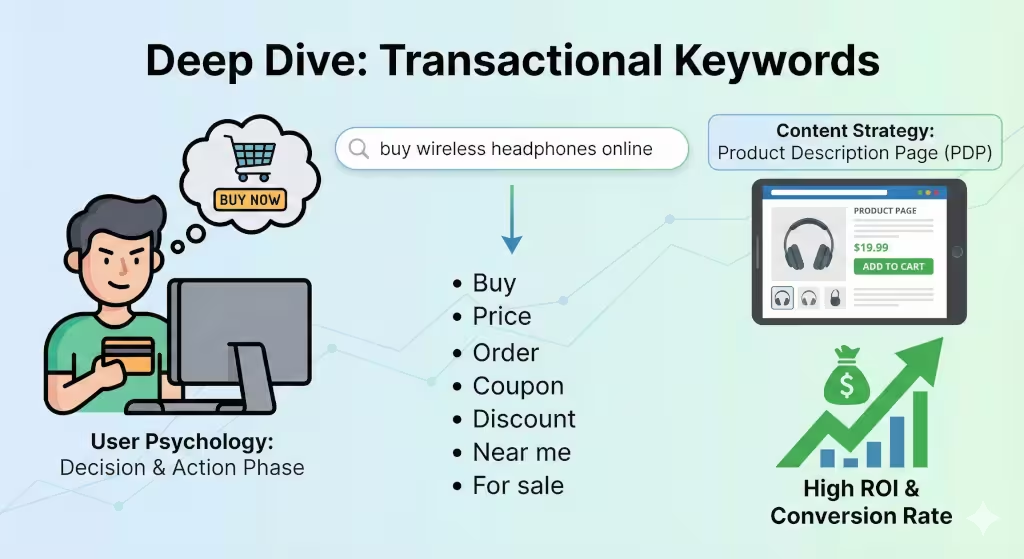
Now we move to the bottom of the funnel. This is where the revenue is generated. Transactional keywords are the most competitive because they lead directly to sales.
User Psychology
The user is now in the “Decision” or “Action” stage. They have done their research. They know they need a new coffee maker. They have their credit card sitting on the desk. They are looking for the best deal or the easiest checkout process. They have very little patience. If they land on a page that talks about the “history of coffee beans,” they will leave. They want a “Buy Now” button.
Identifying the Modifiers
These keywords signal urgency and ownership.
-
Buy
-
Price
-
Coupon
-
Discount
-
Shipping
-
Near me
-
For sale
-
Order
-
Reserve
Continuing our example, the search would be “buy stainless steel french press online.” This user is not browsing. They are hunting for the perfect product at the right price for their needs.
Content Strategy
You do not use blog posts for these keywords. You use Product Description Pages (PDPs) or Service Landing Pages. The page should be clean. It should have a clear image of the product. The price should be visible. The “Add to Cart” button should be a bright color. You should include trust signals like reviews and security badges. The goal is to remove the friction that prevents them from making a purchase.
The ROI Factor
These keywords usually have lower search volume. Fewer people search “buy ferrari” than “pictures of ferrari.” But the conversion rate is much higher. You might only get 100 visitors, but 10 of them might buy. That is a high Return on Investment (ROI). This is why these are the most valuable keywords in your list.
Strategic Mapping: Aligning Keywords to the Sales Funnel
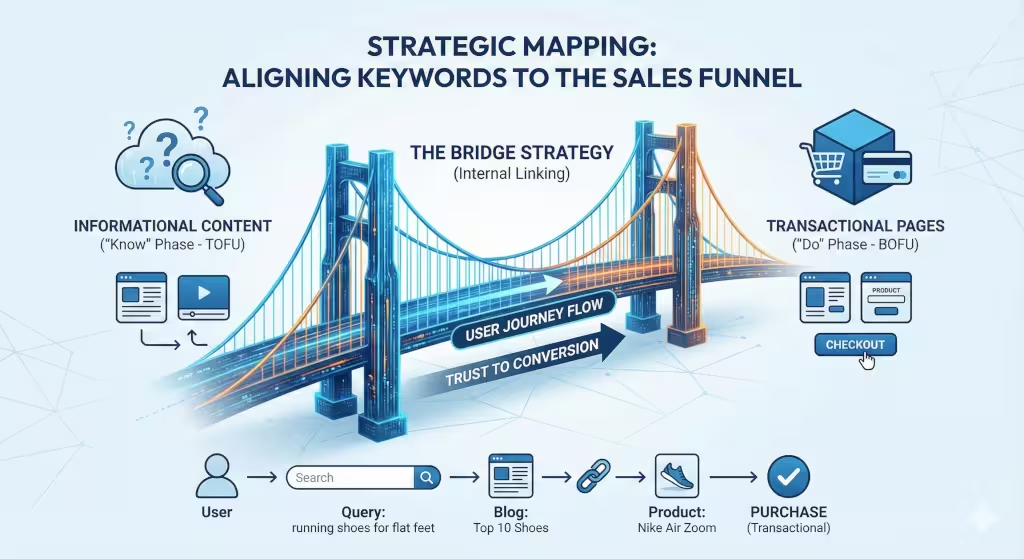
The magic happens when you connect these two concepts. You cannot rely on just one type. If you only use informational terms, you get traffic but no money. If you only use transactional terms, you get no traffic because you have no authority. You need a bridge between the two.
The Bridge Strategy
You use internal links to move the user from the “Know” phase to the “Do” phase. Here is how the workflow should look in your data strategy:
-
The Hook: The user searches for one of your informational keywords. Example: “best running shoes for flat feet.” This is a commercial investigation query.
-
The Entry: They land on your blog post titled “Top 10 Running Shoes for Flat Feet.” You give them value. You explain why arch support matters.
-
The Bridge: In the paragraph talking about the Nike Air Zoom, you place a text link. The link uses the anchor text “Nike Air Zoom Structure 24.”
-
The Destination: The user clicks the link. They land on your product page optimized for transactional keywords. They see the price and the size chart.
-
The Conversion: They buy the shoes.
The Danger of Cannibalization
A common mistake is keyword cannibalization. This happens when you confuse the search engines. You might write a blog post and a product page that target the same keywords. Google does not know which one to rank. Usually, it ranks neither.
You must be strict. Assign your informational keywords to your blog. Assign your transactional keywords to your store. Never cross the streams. Do not optimize a blog post for “Buy Nike Shoes.” That phrase belongs only on the product page.
Common Questions Answered
Google provides a cheat sheet for us. The “People Also Ask” box is a goldmine of data. It tells us exactly what related keywords people are using. We must answer these to be comprehensive.
“Can a keyword be both informational and transactional?”
Yes, this is called “fractured intent.” Sometimes a search term is vague. If someone types “iPhone 15,” they might want to read a review, or they might want to buy it. When this happens, look at the search results. Does Google show mostly articles or mostly shopping ads? If the results are mixed, the intent is fractured. You should usually create a comprehensive guide that links to your product to cover both bases.
“Which keywords have the highest CPC?”
Transactional keywords almost always have a higher Cost Per Click (CPC). This is simple economics. Advertisers are willing to pay more for a click that leads to a sale. They will not pay high prices for someone who is just reading a history article.
“How do I find keyword intent?”
You can use tools, but the best way is to look at the SERP (Search Engine Results Page). Type your keywords into Google to see what appears with the search.
-
Do you see a “Featured Snippet” or a definition box? It is informational.
-
Do you see “Google Shopping” ads and a map pack? It is transactional.
- Do you see comparison tables and “Top 10” lists? It is commercial investigation. Your eyes are the best tool for this analysis.
LSI Keywords & Semantic Entities to Include
Search engines have evolved. They no longer just count how many times you use a specific word. They look for context. This is where LSI (Latent Semantic Indexing) comes in. These are words that are conceptually related to your main topic.
If you are writing an article about “Apple,” Google needs to know if you mean the fruit or the tech company. If you include words like “pie,” “orchard,” and “granny smith,” Google knows it is a fruit. If you include “iPhone,” “MacBook,” and “Cupertino,” Google knows it is the company.
For an article about SEO and intent, you should include these semantic entities:
-
Search Engine Results Page (SERP)
-
User Experience (UX)
-
Conversion Rate Optimization (CRO)
-
Lead Generation
-
Click-Through Rate (CTR)
-
Long-tail keywords
-
Short-tail keywords
You should also mention specific entities like “Google Trends” or “Zero-click searches.” This adds depth. It signals to the algorithm that your content is comprehensive. You are not just stuffing keywords into the text; you are covering the topic as a whole.
Optimization Techniques for Your Keyword List
We have discussed the theory. Now let us look at the technical execution. How do you actually place these keywords on the page?
Placement Matters
You cannot just throw your keywords at the bottom of the page. Google reads from top to bottom. Your main keyword should appear in:
-
The Title Tag.
-
The H1 Header.
-
The first 100 words of the content.
-
At least one H2 subheading.
-
The final paragraph.
Density and Flow
The days of “keyword stuffing” are over. You should not write “shoes buy shoes best shoes.” That is spam. You should aim for a natural flow. However, you still need to use the word enough times for the bot to see it. A density of around 1% to 2% is usually safe. If you write 1,000 words, you should use your target phrase about 10 to 20 times. But always prioritize the human reader. If the sentence sounds clunky, rewrite it to sound more natural.
Variations are Key
Do not use the exact same phrase every time. Use variations. If your main term is “dog food,” you should also use “food for dogs,” “canine nutrition,” and “puppy kibble.” This helps you rank for a wider net of keywords. It also makes the writing less repetitive.
Industry Examples of Keyword Pairs
To make this practical, I have compiled a list of examples across different industries. You can see how the intent shifts from learning to buying.
Industry: Software / SaaS
-
Informational: “how to track project time”
-
Transactional: “best time tracking software for agencies”
Industry: Real Estate
-
Informational: “pros and cons of living in florida”
-
Transactional: “buy 3 bedroom house in miami”
Industry: Plumbing
-
Informational: “why is my water heater making noise”
-
Transactional: “emergency water heater repair near me”
Industry: Fitness
-
Informational: “exercises to lose belly fat”
-
Transactional: “hire personal trainer downtown”
In every single example, the first query is an opportunity to educate. The second query is an opportunity to sell. Your website needs pages for both.
The Role of Long-Tail Keywords
We cannot talk about intent without talking about length. Generally, shorter keywords are broader. “Shoes” is a short-tail keyword. It has huge volume, but the intent is messy. The user could want anything.
Long-tail keywords are phrases that contain three or more words. “Red nike running shoes size 10” is a long-tail keyword. The volume is low, but the intent is crystal clear. This person knows exactly what they want.
For a new website, you should focus on long-tail keywords. It is too hard to rank for the short terms against giant competitors like Amazon or Wikipedia. But you can win the battle for the specific, long-tail questions. This is where the qualified traffic lives and why it is so valuable.
Conclusion: The Hybrid Approach
In the world of marketing and computer science, we look for systems that are robust. A system that relies on a single point of failure is bad design. Your SEO strategy is the same. If you rely only on high-volume informational keywords, you will have a busy server but an empty bank account. If you rely only on transactional keywords, you will have a great product that nobody sees.
A healthy domain uses a hybrid approach. You must be a teacher and a merchant. You must create value before you extract value.
Audit your current website. Look at your sitemap. Does every page have a clear job? Is it there to teach (Informational) or is it there to sell (Transactional)? If a page tries to do both at the same time, it will fail. Split them up. Build the bridge.
By mastering the intent behind your keywords, you stop guessing. You start acting on data. That is how you innovate. That is how you win.