If you are like most small business owners, you are sitting on a goldmine. You have customer lists in your email system, sales numbers in your point-of-sale (POS) machine, and visitor traffic on your website. You are data-rich. But you are also insight-poor. Your data is everywhere, trapped in different programs, or what we call data silos. It doesn’t talk to each other, and it doesn’t tell you what to do next. This is precisely why you need a data strategy.
So, what is a data strategy? Let’s clear this up. A data strategy is not just about buying fancy software. It is a simple, long-term plan. It outlines the people (who will manage it), the processes (the rules for using it), and the technology (the tools you need) to manage and use your data. A good strategy turns your data into a strategic asset that helps you achieve your business goals. A complete data strategy is essential for any business.
Why is this data strategy so important for a small business? You might think a data strategy is only for “Big Data” companies like Amazon or Google. This is a critical mistake. A clear strategy is your key to a real competitive advantage. It helps you stop guessing and start making decisions based on facts. This leads to better efficiency, happier customers, and real ROI (Return on Investment). In fact, research from McKinsey & Company shows that organizations using data effectively can see their profits increase by up to 60%. A data strategy is what makes that possible. A working data strategy is your path to that profit.
The problem is, most owners don’t know where to start. The idea of a data strategy can feel overwhelming. This guide will change that. We are going to give you a practical, 7-step framework. This is the exact blueprint you need to build a data strategy that turns your raw, messy data from a liability into your single most valuable asset. This is the complete guide to your small business data strategy.
The 7-Step Framework to Build Your Data Strategy

This framework is designed to be followed in order. Each step builds on the last, creating a solid foundation for your data strategy.
Step 1. Align with Business Objectives (Start with “Why,” Not “What”)
This is the foundation. A data strategy that is not tied to your real-world business goals will fail. It will become a collection of data and reports that no one uses. Your data strategy must be built to answer your most important questions.
Before you look at a single piece of software, you must look at your business plan. What are you trying to achieve this year?
-
Are you trying to increase customer retention by 15%?
-
Are you trying to reduce the cost of acquiring a new customer?
-
Are you trying to improve your inventory management to reduce waste?
These are business goals. A good data strategy starts here.
Action Plan:
-
Conduct Stakeholder Interviews: This sounds formal, but it just means “talk to your people.” Ask your sales manager, your marketing lead, and your operations manager (even if all those people are you) these questions:
-
“What are the top 3 problems you are trying to solve this quarter?”
-
“What questions do you wish you could answer with data?”
-
“If you had a magic wand, what information would help you do your job better?”
-
-
Define Your Goals: Take those problems and turn them into data questions.
-
Goal: “Increase customer retention by 15%.”
-
Data Question: “What behaviors do my most loyal customers share? What products do they buy together? At what point do customers stop buying from us?”
-
Your data strategy will now be built to answer that question.
-
-
Translate Goals to KPIs: Translate your goals into Key Performance Indicators (KPIs). These are the specific numbers you will measure.
-
Goal: “Improve customer retention.”
-
KPI: “Customer Churn Rate” (the percent of customers you lose).
-
Your data strategy will now focus on collecting the data needed to track this KPI.
-
This first step ensures your data strategy is a business tool, not a science project. A data strategy that is aligned with your business objectives is a data strategy that will get used and deliver value. This is the most critical step of your entire data strategy.
Step 2. Audit Your Current Data Landscape (Assess Your “Data Maturity”)
Now that you know your destination (your goals), you need to figure out your starting point. You cannot plan a route without knowing where you are on the map. This step is about taking a simple, honest inventory of the data you already have.
Most small businesses are shocked to find out how much data they already have. It’s just messy and disconnected. This part of your data strategy is about discovery.
Action Plan:
-
Identify All Data Sources: Make a simple spreadsheet. List every single place your business data lives. This includes:
-
Financial Data: QuickBooks, Xero, spreadsheets.
-
Sales Data: Your Point-of-Sale (POS) system, your e-commerce platform (like Shopify), your CRM (Customer Relationship Management) tool.
-
Marketing Data: Google Analytics, your email marketing platform (like Mailchimp), your social media accounts.
-
Operations Data: Inventory logs, employee timesheets.
-
“Hidden” Data: Customer feedback forms, notepad lists, the spreadsheet on your manager’s desktop. Write it all down.
-
-
Evaluate Data Quality: This is the “be honest” part. Look at your main data sources.
-
Is the data accurate? (Are email addresses spelled correctly?)
-
Is it complete? (Do you have first names for only half your customer list?)
-
Is it consistent? (Is “New York” sometimes entered as “NY” or “NYC”? This makes data hard to group.)
-
Is it timely? (Is your sales data a month old?)
-
Poor data quality is the number one reason a data strategy fails. Your data strategy must include a plan for cleaning your data.
-
Identify Your Technology: What tools and software are you already using? What are the gaps? If your CRM doesn’t talk to your email system, that’s a gap. If you have no way to see your website traffic, that’s a gap. This assessment will inform your technology choices in the next step. A good data strategy is built on a clear understanding of your current state.
This audit gives you a clear picture of your “data maturity.” Are you a beginner (reactive, messy data) or are you further along (proactive, somewhat clean data)? This is a vital step for your data strategy.
Step 3. Define Your Data Architecture & Technology (The “Modern Data Stack”)
This part sounds technical and expensive, but for a small business, it doesn’t have to be. “Data architecture” is just a plan for how your data is collected, stored, and accessed. Think of it as building the library, not just having messy piles of books.
For a small business, the goal is simple: create a “single source of truth.” You want one place where everyone on your team can go to get the same correct number. You want to end the arguments about “whose sales report is right.”
Action Plan:
-
Define Your Central Hub: You need one place to serve as your main data hub. For many small businesses, this is not a complex “data warehouse.” It might be:
-
A robust CRM that can hold all your customer and sales data.
-
A Business Intelligence (BI) tool that can connect to all your different sources.
-
A simple cloud database (like AWS or Google Cloud) if you are more tech-savvy.
-
-
Select Your Tools (Start Small): Your data strategy from Step 1 (your goals) will tell you what tools you need. Do not buy an expensive, all-in-one platform you don’t need.
-
Data Integration: How will you move data? It could be a simple, automated tool (like Zapier) that connects your Shopify to your Mailchimp.
-
Data Visualization (BI): How will you see the data? This is crucial. A simple BI tool lets you build dashboards.
-
Examples: Google Looker Studio (free and powerful, connects to Google Analytics and Sheets), Microsoft Power BI (has a free version, great with Excel), or Tableau.
-
-
The key principle for your technology is this: let your business goals (Step 1) drive your technology choices, not the other way around. Your data strategy is a business plan, and the technology is just the tool to get it done. A smart data strategy is built on smart, focused technology choices.
Step 4. Establish a Data Governance Framework (The Rules of the Road)
This is the most critical and, unfortunately, the most skipped step in any data strategy.
Data governance is the official name for your rulebook. It is a set of policies and standards for how your data is managed, used, and protected. If your data architecture is the library, governance is the librarian and the card catalog system. Without it, you have chaos.
A data strategy without governance is not a data strategy. It is a data mess that can lead to bad decisions, wasted time, and even legal trouble.
Action Plan:
-
Define Key Policies: You don’t need a 100-page book. Start with a 1-page document that covers these basics:
-
Data Quality: How will you keep data clean?
-
Rule: “All new customer entries must include a first name, last name, and valid email.”
-
Rule: “All state names must use the 2-letter abbreviation.”
-
-
Data Security & Privacy: This is non-negotiable. Who gets to see what data?
-
Rule: “Only the finance manager can see detailed profit and loss data.”
-
Rule: “Customer personal information (like credit cards) is masked and only accessible by X.”
-
This is also how you comply with legal rules like GDPR (General Data Protection Regulation) or CCPA. Protecting your customer data is a core part of your data strategy
-
-
Data Lifecycle Management: You can’t keep all data forever.
-
Rule: “We will delete anonymous web visitor data after 24 months.”
-
Rule: “Old customer invoices will be archived after 7 years.
-
-
-
Assign Data Ownership: A plan with no owner is a plan that fails. One person must be in charge of your data strategy.
-
In a small business, this is probably the owner or a trusted manager. This “Data Owner” is responsible for making sure the governance rules are being followed.
-
This is the most important part of your data governance plan and a key pillar of your data strategy.
-
This step turns your data from a wild, untamed resource into a reliable, well-managed asset. A strong data strategy is built on a strong data governance foundation.
Step 5. Plan for People & a Data-Driven Culture (The Human Element)
You can have the best tools, the cleanest data, and the best rules. But if your team doesn’t use the data, your entire data strategy is worthless. The human element of your data strategy is just as important as the technical one.
Your goal is to build a “data-driven culture.”
This is a fancy term for a simple shift in mindset. It means moving your team’s decision-making from:
-
“I feel like we should run a sale…”
-
“I think our best customers are…”
…to:
-
“The data shows that sales drop on Tuesdays, so let’s run a sale then.”
-
“The data shows our best customers buy 3 times a year, so let’s create a loyalty program for them.”
This is the real-world payoff of your data strategy.
Action Plan:
-
Define Roles and Responsibilities: You do not need to hire an expensive, full-time “Data Scientist.”
-
Small Business Reality: Your “data person” is probably already on your team. It’s the office manager who is a wizard with Excel. It’s the marketing junior who loves digging into Google Analytics.
-
Upskill, Don’t Just Hire: Identify this “Data Champion” and invest in them. Send them to an online course for Power BI or data analysis. This is a much cheaper and more effective part of your data strategy than hiring a new expert.
-
-
Foster a Data-Driven Culture:
-
Lead by Example: As the owner, you must use the data. Start your team meetings by looking at the key dashboard from Step 3.
-
Share Insights: Don’t keep the data hidden. Share the good and the bad. “Guys, our data shows the new ad campaign is not working. Let’s figure out why.”
-
Train Your Team: Show them how to use the data. This is called data democratization, which just means giving people the data they need to do their jobs better (while following your governance rules from Step 4).
-
The people on your team are the ones who will make your data strategy come to life. A data strategy that ignores people is a data strategy that is doomed to fail.
Step 6. Define Your Data Analytics & Insights Plan
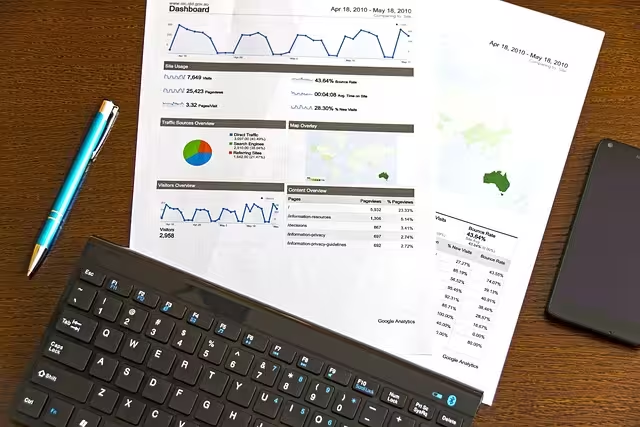
This is the fun part. This is where you finally get answers to the big questions you wrote down in Step 1. Your data strategy is now in place to deliver insights.
“Analytics” is just the process of turning your raw data into answers. There are three main types of analytics. A good data strategy will help you move up this ladder.
Action Plan:
-
Start with Descriptive Analytics (What happened?):
-
This is the starting point for 99% of businesses. It’s about looking in the rearview mirror.
-
Examples: A dashboard showing “Total Sales This Week vs. Last Week.” A report showing “Top 10 Best-Selling Products.”
-
This is the foundation of your data strategy. You must know what happened before you can know why.
-
-
Move to Diagnostic Analytics (Why did it happen?):
-
This is where you drill down. This is where your data champion shines.
-
Example: Your descriptive dashboard shows sales dropped 20% last week. You use diagnostic analytics to find out why. You “drill down” and see that all of the drop came from your website. You look deeper and see your website was down for 4 hours on Tuesday.
-
Problem found. Your data strategy just gave you a specific, solvable problem.
-
-
Aim for Predictive Analytics (What is likely to happen?):
-
This is the future. This is where your data strategy gives you a crystal ball.
-
Examples: “Based on the last 3 years of sales, we predict we will sell 40% more of Product X in December.” “This customer ‘looks’ like other customers who have churned, so let’s reach out to them.”
-
This is more advanced and may involve tools for Artificial Intelligence (AI) or Machine Learning (ML), but it’s built on the exact same clean data you prepared in the earlier steps.
-
Your analytics plan is the “action” part of your data strategy. It connects your data directly back to the business goals you defined in Step 1.
Step 7. Create Your Data Strategy Roadmap & Monitor (The Action Plan)
You now have all the pieces. Your goals, your audit, your technology plan, your rules, your people, and your analytics plan.
A data strategy can feel huge. You cannot do it all at once. If you try, you will fail.
The final step is to create a data strategy roadmap. This is a simple timeline that breaks your big data strategy into small, manageable, 90-day chunks. It’s an action plan.
Action Plan:
-
Create a Phased Roadmap: Don’t try to build a skyscraper in a day. You are building a foundation first.
-
Phase 1 (Months 0-3: The Quick Win):
-
Goal: Solve one business problem and build momentum.
-
Actions:
-
Complete data governance basics (Step 4).
-
Clean your main customer list (from Step 2).
-
Build one simple dashboard (from Step 6) for your one top KPI (from Step 1).
-
-
This is a realistic, achievable start to your data strategy.
-
-
Phase 2 (Months 3-9: The Connection):
-
Goal: Connect your key data sources.
-
Actions:
-
Use a tool to connect your sales data (POS) to your marketing data (Mailchimp).
-
Train your “Data Champion” (Step 5).
-
Build your second and third dashboards.
-
-
-
Phase 3 (Months 9-18: The Optimization):
-
Goal: Start using data to predict.
-
Actions:
-
Explore diagnostic analytics (Step 6).
-
Review and refine your data strategy.
-
-
-
-
Monitor and Iterate: Your data strategy is not a “set it and forget it” document. It is a living document.
-
Set a meeting every 6 months to review your data strategy.
-
Ask: “What’s working?” “What’s not?” “Are our business goals from Step 1 still the right goals?”
-
A good data strategy is flexible and adapts as your business grows.
-
This roadmap makes your data strategy real. It turns a big, scary idea into a simple, step-by-step checklist.
Common Data Challenges for Small Businesses (and How to Solve Them)

This 7-step framework is solid, but you will hit roadblocks. Every business does. Here are the most common challenges and how your data strategy can solve them.
Challenge 1: Limited Budget & Resources
-
The Problem: “I can’t afford expensive software or a team of analysts.”
-
The Solution: Your data strategy is not about how much you spend; it’s about how you think.
-
Start small: Focus your data strategy on solving one high-impact, high-cost problem, like “Why are so many customers returning Product X?”
-
Use free tools: You can build an amazing data strategy using tools that are free or low-cost. Google Analytics, Google Looker Studio, and Google Sheets are a powerful, free combination. Your strategy is the plan, not the price tag.
-
Challenge 2: Overwhelming Data Silos
-
The Problem: “My data is in 10 different places that don’t talk to each other.”
-
The Solution: Do not try to boil the ocean.
-
Your data strategy roadmap (Step 7) is the solution here. Don’t try to connect all 10 sources at once.
-
Your data strategy should prioritize. Ask: “Which two data sources, if connected, would give me the most valuable insight?”
-
Start there. Connect your sales data to your customer list. That’s it. That’s a huge win. Your data strategy will grow from there.
-
Challenge 3: Lack of In-House Expertise
-
The Problem: “No one on my team knows how to do this. I’m not a ‘data person.'”
-
The Solution: You don’t need a “data person”; you need a “curious person.”
-
As we covered in Step 5, your data strategy should plan to upskill your existing team. Find the employee who is good with Excel and has a curious mind.
-
Invest $500 in an online data analysis course for them. This is far more effective than trying to hire an expert you can’t afford. A good data strategy can be run by a “Data Champion,” not a Ph.D. Data Scientist.
-
Challenge 4: Poor Data Quality
-
The Problem: “Our data is a total mess. It’s full of typos and duplicates. It’s useless.”
-
The Solution: This is a symptom of not having a data strategy.
-
Governance is the key: Your data strategy, specifically Step 4 (Data Governance), is the only solution to this.
-
Phase 1: Your data strategy must include a “clean-up” phase. Accept that it will take time.
-
Phase 2: Your data strategy must include “keep-it-clean” rules (governance) for all new data.
-
You cannot build a house on a rotten foundation. A good data strategy forces you to fix your data quality.
-
Your Data Strategy Is Your Business Strategy
We have covered the entire 7-step framework:
-
Goals
-
Audit
-
Architecture
-
Governance
-
People
-
Analytics
-
Roadmap
Building a data strategy is no longer optional, even for a small business. It is the definitive framework for making better decisions, optimizing your operations, and securing a real competitive advantage.
A data strategy is not a complex IT project. It is a core business function. It is the plan that moves your company from “guessing” to “knowing.” A strong data strategy is your plan for sustainable, intelligent growth.
Do not be overwhelmed by the 7 steps. Your journey starts with one simple action. Go back to Step 1. Write down one business goal and one question you wish you could answer.
That’s it. You have just laid the first stone for your data strategy.