Artificial Intelligence (AI) is no longer a futuristic concept reserved for Silicon Valley giants and billion-dollar corporations. It is here, and it is already reshaping the competitive landscape. For the average small business owner, the constant buzz around AI can be overwhelming. It often leads to “analysis paralysis”—a state of inaction caused by fear. You fear the high costs, the “skill gap” of your team, and the sheer complexity of it all.
This fear is understandable, but it is also misplaced.
The barrier to entry for powerful AI has collapsed. Today, AI is an accessible, affordable tool that can act as a “co-pilot” for your small business. When implemented correctly, AI does not replace your team; it augments them. It automates the repetitive, low-value tasks that drain your time, allowing you and your staff to focus on high-value work: strategy, customer relationships, and growth.
For a small business, ignoring AI is like ignoring the internet in 1999. It is a strategic and costly error. Recent data shows that small business adoption of AI is surging. Almost 60% of small businesses are now using AI, and those that do are reporting significant time savings, cost reductions, and improved customer satisfaction. The question is no longer if a small business should use AI, but how to start.
This guide provides the “how.” It is not a list of flashy tech. It is a 5-step framework designed for a small business. We will move from strategy and data preparation (the “Crawl” phase) to deploying high-impact, low-cost pilot projects (the “Walk” phase) and finally to scaling your success (the “Run” phase). This is your strategic plan for making AI work for your small business.
The “Crawl” Phase: Strategy and Foundation (Steps 1-2)

This initial phase is the most critical component of success. It is not about buying software. It is about defining your objectives. A small business that buys AI without a plan is just buying an expensive hobby. We will build a solid foundation first.
Step 1: Identify Your Business Objectives (Not the Tech)
Your first step has nothing to do with technology. Do not start by asking, “How can I use ChatGPT?” This is the most common mistake a small business makes.
Instead, start by asking: “Where are my operational bottlenecks?”
You must conduct a simple process audit. Look at your daily operations and identify the most time-consuming, repetitive, or error-prone tasks. Where does your small business “leak” time and money?
The goal is to find a specific, painful problem that AI can solve. For every small business, this problem is different.
- For a local plumbing service: The bottleneck might be scheduling. The owner wastes hours every day on the phone booking appointments and managing cancellations. The problem is manual scheduling. An AI solution could be an automated booking assistant.
- For a small e-commerce store: The bottleneck might be customer service. The owner spends three hours every morning answering the same 15 questions about shipping times and return policies. The problem is repetitive inquiries. An AI solution could be an intelligent chatbot.
- For a small marketing agency: The bottleneck might be content creation. It takes 10 hours to research and write a single blog post for a client, limiting how many clients the agency can serve. The problem is slow content generation. An AI solution could be a generative AI writing assistant.
- For a restaurant owner: The bottleneck might be inventory. The owner manually counts stock and often orders too much or too little, leading to waste or shortages. The problem is poor forecasting. An AI solution could be a simple predictive inventory tool.
Your actionable task is to write down three to five of these bottlenecks. Be specific. “I am bad at marketing” is not a problem. “I spend 10 hours a week trying to write social media posts and have no new leads” is a problem.
Once you have your list, you have your targets. Now, and only now, can you look for a tool. This strategic approach ensures you are solving a real small business problem, not just playing with new technology.
Step 2: Prepare Your Data and Team
With your objectives defined, you must prepare your two most valuable assets: your data and your people.
Data Governance: “Garbage In, Garbage Out”
AI is only as smart as the data you give it. This is a core technical principle: “garbage in, garbage out.” If your customer list is a disorganized mess of old emails, duplicate entries, and incorrect phone numbers, an “AI-powered CRM” will just be a faster way to contact the wrong people.
You do not need massive datasets like Google. For a small business, “data preparation” can be simple:
- Clean your CRM: Standardize names, merge duplicate contacts, and delete bounced emails.
- Organize your files: Create a logical folder structure on your shared drive. Make sure your company documents, like employee handbooks or product info, are in one, up-to-date place.
- Secure your data: Know where your sensitive client information is stored and who has access to it.
Ethical and Security Framework: The Critical Rule
This is a non-negotiable step for every small business. You must establish a clear AI usage policy for your team. This does not need to be a 50-page legal document. It can be a one-page memo with clear rules.
The most critical rule is this: Do not input sensitive or proprietary company data into public AI models.
This means your employees should not be pasting your client lists, your private financial spreadsheets, or your secret product plans into a free public chatbot. That data can be used to train the model, exposing your small business to massive privacy and competitive risks. Use a secure, private AI tool or ensure your team knows what not to share.
Team Preparation: Augmentation, Not Replacement
The final part of the “Crawl” phase is preparing your team. Many employees in a small business fear AI because they believe it will replace their jobs. This fear leads to resistance. If your team resists a tool, they will not use it, and your investment will fail.
As the small business owner, you must lead this change. Frame AI as an augmentative tool. It is a “co-pilot,” not a replacement pilot.
- Bad Communication: “I am buying an AI writer so we don’t have to pay a marketing person.”
- Good Communication: “I am buying an AI writing tool that will create the first draft of our blog posts. This will eliminate the 80% of the work you hate (the research and basic writing) and let you focus on the 20% you are best at (the expert editing, strategy, and adding our company voice).”
For a small business, every employee is essential. This message of augmentation is not just a nice-to-have; it is the key to successful adoption.
The “Walk” Phase: Pilot Projects and Tool Selection (Steps 3-4)

You have your strategy. You have prepared your assets. Now it is time to move from thinking to doing. The “Walk” phase is about starting small, learning fast, and proving the concept with a low-risk pilot project.
Step 3: Select Your High-Impact Pilot Project
From the list of bottlenecks you created in Step 1, choose one. Just one. This will be your pilot project.
The ideal pilot project for a small business has three features:
- High-Impact: It solves a problem that is genuinely annoying and time-consuming.
- Low-Risk: If the AI tool fails, it will not destroy your business.
- Measurable: You can easily tell if it is working.
Here is how a small business owner should think about this:
- Bad Pilot Project: “We will replace our bookkeeper with a custom-built AI accounting model.”
- Why it’s bad: This is extremely high-risk. If it fails, your financials and taxes are wrong, which could be catastrophic for a small business.
- Good Pilot Project: “We will use an AI expense-tracking tool to automatically scan receipts and categorize 90% of our monthly expenses. Our bookkeeper will then verify this work.”
- Why it’s good: This is low-risk. It saves the bookkeeper hours of manual data entry (high-impact) and is easy to measure (time saved, accuracy rate). If the tool fails, the bookkeeper just reverts to the old method.
By starting with a small, contained pilot, you give yourself and your team a safe space to learn. You prove the value of AI on a small scale, which builds momentum and confidence. This is the most effective way for a small business to innovate without taking on massive, unnecessary risk.
Step 4: Choose the Right AI Tools (The ‘What’)
With your pilot project defined, you can now select your tool. The good news for a small business is that you should start with “off-the-shelf” SaaS (Software as a Service) tools.
Do not even think about building a custom AI model. That is for large enterprises with data science teams. A small business can get 95% of the value from low-cost, plug-and-play tools. Many of these tools cost less per month than a single team lunch.
The “Is AI too expensive for a small business?” question is now a myth. Many tools have “freemium” plans that let you start for $0. If you use an open-source AI, such as QWEN, it may actually be free or nearly so.
Here are practical, affordable tools (Entities) that a small business can use today, broken down by the problem they solve.
For Administrative Efficiency and Automation:
These tools are designed to win back your time.
- Motion: An AI-powered calendar and task manager. You tell it your to-do list, and it automatically schedules those tasks into your day, acting like a personal assistant.
- SaneBox: Uses AI to analyze your email habits and automatically filter unimportant emails (like newsletters and receipts) out of your inbox. This keeps your focus on client messages.
- Fireflies.ai or Tactiq: These tools join your Zoom or Teams calls, transcribe the entire conversation, and then write a complete summary with action items. This ends the need for manual note-taking. For a small business that runs on meetings, this is a game-changer.
For Marketing and Content Creation:
These tools help a small business create professional content at scale.
- Jasper or Copy.ai: These are generative AI writing assistants. You can ask them to “write a blog post about 5 spring cleaning tips for homeowners” or “draft 10 social media posts about our new product.” They create the first 80% of the content in seconds.
- Canva AI: This tool is built into the popular design platform. You can describe an image you want (e.g., “a photo of a happy family eating pizza in a cozy restaurant”), and it will create it for you. It also has a “Magic Write” feature for ad copy.
- Surfer SEO: For a small business that relies on local search, this tool is critical. It analyzes the top-ranking Google results for your target keyword (like “plumber in omaha”) and tells you exactly what words and phrases to include in your webpage to rank higher.
For Customer Service and Sales:
These tools help you serve your customers faster and more effectively.
- Intercom Fin AI Agent or Zendesk AI: These are intelligent chatbots. They are not the “dumb” bots of five years ago. You can feed them your website, help articles, and product info. They will then answer most customer questions instantly, 24/7. This frees up your human team to handle complex, high-value customer problems.
- HubSpot AI: Built into the popular CRM, this AI can summarize long email chains, write sales outreach emails, and score your leads to tell you which prospect is most likely to buy. This is invaluable for a small business sales team.
For Operations and Workflow Automation:
These tools connect your other apps to create automated processes.
- Zapier AI: Zapier is the “digital glue” that connects thousands of apps (like Gmail, Shopify, QuickBooks, etc.). With AI, it’s even more powerful. You can create “Zaps” that run complex workflows.
- Small Business Example: “When a customer fills out the ‘Contact Us’ form on my website (App 1), send the text of their message to an AI (App 2) to analyze if it’s an ‘angry,’ ‘happy,’ or ‘sales’ inquiry. If it’s ‘angry,’ send a high-priority alert to my phone (App 3). If it’s ‘sales,’ create a new lead in my CRM (App 4).”
The key is to pick one of these tools for your pilot project. Sign up for the free trial and focus only on solving the one problem you identified.
The “Run” Phase: Measuring and Scaling (Step 5)
You have a successful pilot project. You “crawled” by building a strategy, and you “walked” by proving the concept. Now it is time to “run.” This phase is about analyzing your success and strategically scaling it across your small business.
Step 5: Measure Performance (KPIs) and Iterate
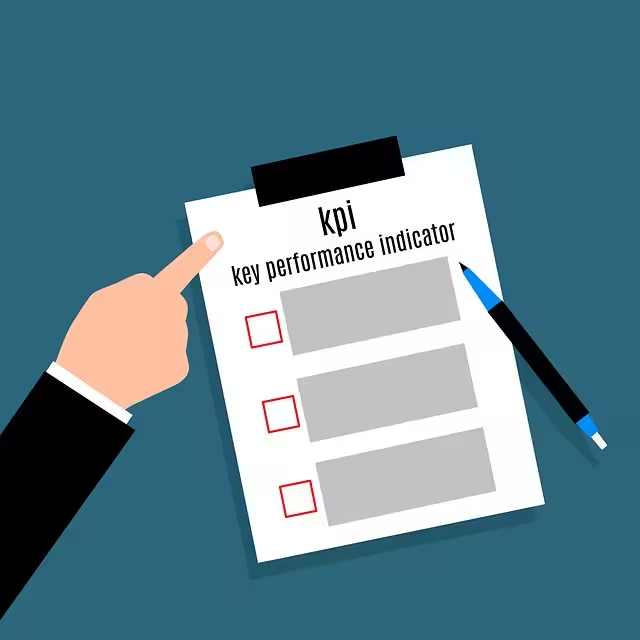
You cannot manage what you do not measure. Before you even start your pilot, you must define what success looks like. In business, we call these Key Performance Indicators (KPIs).
A KPI is just a number that tells you if you are winning. For a small business, KPIs must be simple and practical.
- Bad KPI: “We will use AI more.” (This is not measurable).
- Good KPI: “We will reduce the time spent writing blog drafts from 4 hours to 1 hour.”
- Good KPI: “We will increase the number of customer service tickets solved by our chatbot by 30%.”
- Good KPI: “We will reduce our social media content creation costs by $500 per month.”
At the end of your pilot project (after 30 or 90 days), you look at the data.
- Did you hit your KPI?
- Yes: The pilot was a success. The AI tool provided a clear Return on Investment (ROI).
- No: The pilot failed. This is not a bad thing! It is just data. Now you ask why. Was the tool too complex? Was the team not trained? Or was it just the wrong tool? You “iterate” (make a change) or “pivot” (try a different tool).
This data-driven approach removes emotion and guesswork. It allows you, the small business owner, to make smart financial decisions about technology. You will know for a fact if a tool is saving you time or making you money.
Scaling Successful Pilots
Once your pilot project is successful and provides a clear, measurable ROI, you can scale. This is the “Run” phase.
Scaling does not mean buying 10 new AI tools at once. It means taking your learnings and applying them to the next bottleneck on your list from Step 1.
- Example: Your pilot project was using Fireflies.ai to transcribe your sales calls. It was a huge success and saved your two-person sales team 5 hours a week.
- Scaling Step 1 (Expand): You now roll out Fireflies.ai to your project management team and your customer service team. You have proven the tool’s value, so the investment is now low-risk.
- Scaling Step 2 (New Project): You go back to your bottleneck list. The next problem is that your social media is inconsistent. You now start a new “Crawl-Walk” cycle for this problem, choosing Canva AI as your pilot tool.
You repeat this process: Crawl, Walk, Run. Identify a problem, test a solution, measure the result, and scale what works.
This is how a small business builds a powerful “AI-enabled” operation. It is not a single, giant leap. It is a series of small, smart, strategic steps. Over time, your small business becomes more efficient, more profitable, and more competitive, all without massive risk or expense.
Common Pitfalls and How to Avoid Them
The path to AI implementation is full of common traps. Many small business owners fail not because the technology is bad, but because they fall into one of these four pitfalls. Here is how to avoid them.
Challenge 1: Lack of Strategy (“Shiny Object Syndrome”)
This is the most common failure. A small business owner hears about a “cool” new AI tool on a podcast, buys a $50/month subscription, and then tries to find a problem for it to solve. The tool is used for two weeks, the team gets confused, and it’s abandoned. Money wasted.
- How to Avoid It: Follow Step 1 of this guide. Never, ever buy a tool before you have clearly defined the business problem you are trying to solve. Your strategy must lead your technology choices, not the other way around.
Challenge 2: Ignoring Data Privacy and Security
This is the most dangerous pitfall. A small business can be destroyed by a single, major data breach. An owner, in a rush to be efficient, might ask an employee to “summarize this list of all our clients and their sales history” by pasting it into a free, public AI. This is a massive security risk and a violation of customer trust.
- How to Avoid It: Follow Step 2 of this guide. Create a simple, clear AI usage policy. The rule “Proprietary data never goes into a public model” is your most important defense. Invest in secure, business-grade versions of AI tools (like ChatGPT for Teams or a private CRM-based AI) if you plan to use sensitive data.
Challenge 3: The “Skill Gap” and Employee Resistance
You can buy the best AI tool in the world, but if your team does not know how to use it—or worse, refuses to use it—your ROI is zero. Resistance often comes from fear: fear of job loss, fear of change, or fear of “looking stupid” because they do not understand the tech.
- How to Avoid It: This is a leadership and training issue.
- Communicate: Reinforce the “augmentation, not replacement” message from Day 1.
- Train: Do not just send a link to the tool. Block out 2 hours on a Friday afternoon and have everyone learn it together. Make it a team effort.
- Appoint a Champion: Find one person on your team who is excited about the tool and make them the “AI champion.” They can be the go-to person for questions, which is less intimidating than asking the boss
Challenge 4: Integration with Legacy Systems
This is a common technical headache for an established small business. “This new AI tool is great, but it doesn’t talk to my 10-year-old invoicing software.” You end up with “data silos,” where information is trapped in different programs, and employees have to manually copy and paste data between them.
- How to Avoid It:
- Prioritize Integration: When you are in Step 4 (Choosing Tools), “integration” should be a key feature you look for. Does it connect to Shopify? QuickBooks? Google Workspace?
- Use a “Bridge”: This is exactly what tools like Zapier were built for. Before you give up, see if you can use Zapier to build a “bridge” between your old system and your new AI tool. This is often the most cost-effective solution for a small business.
Your Next Step
Implementing AI in your small business is no longer an optional upgrade; it is becoming a fundamental part of modern operations. The fear of cost and complexity is now a myth. The real risk is not in starting, but in being left behind.
We have covered the 5-step strategic framework:
- Crawl: Identify your objectives and prepare your data and team.
- Walk: Select a single, low-risk pilot project and a high-value, off-the-shelf tool.
- Run: Measure your success with clear KPIs and strategically scale what works.
This “Crawl-Walk-Run” method removes the guesswork and minimizes risk. It allows your small business to adopt powerful technology in a way that is manageable, affordable, and tied directly to your bottom line.
Your next step is simple. Do not try to boil the ocean. Do not try to implement AI across your entire small business tomorrow.
Your homework is this: Start your “Crawl” phase today.
Set aside 30 minutes. Sit down with a piece of paper and identify one repetitive, low-value task in your small business that frustrates you. Just one. Then, start researching one pilot tool from the list above that could solve it. That is it. That is the first step on the path to building a smarter, more efficient, and more competitive small business.