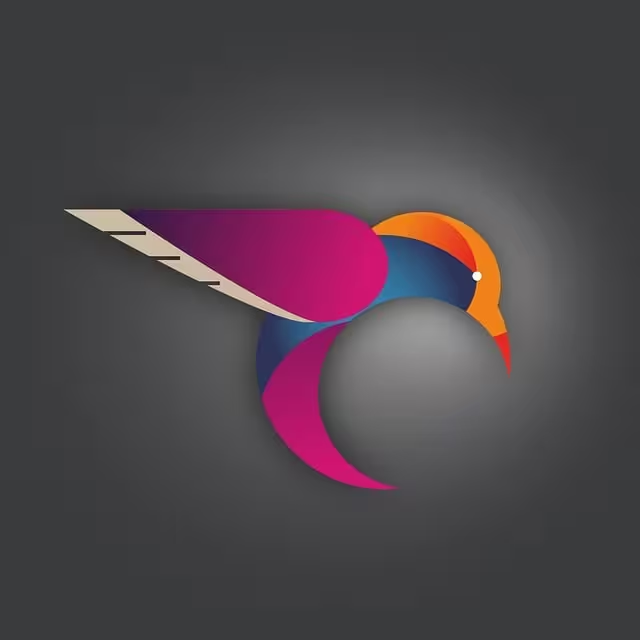
In the competitive marketplace that defines modern business, a brand’s visual identity serves as its primary flag bearer. Among the various tools available for crafting this identity, the logo is the most critical asset. While many businesses opt for literal or descriptive marks, a strategic analysis reveals the significant potential of a more conceptual approach.
This leads to a foundational question for any forward-thinking enterprise: What is an abstract logo? At its core, an abstract logo is a non-representational, custom-designed image or symbol that functions as a brand identifier. Unlike marks that depict a recognizable object, like an apple for a computer company or a shell for an oil company, an abstract mark leverages unique geometric or fluid forms to create a distinct visual signature.
The objective of this analysis is to provide a comprehensive breakdown of the abstract logo, examining its strategic advantages and presenting a clear framework to help you, the small business owner, determine its viability for your specific brand. When you consider the sheer power of iconic abstract marks like the Nike “Swoosh” or the Pepsi “Globe,” it becomes clear that this form of branding is not merely an artistic choice, but a calculated business decision with profound implications for memorability and market differentiation.
The Fundamental Definition: Abstract vs. Other Logo Forms
To fully grasp the utility of an abstract logo, it is essential to understand its technical definition and, more importantly, how it is differentiated from other primary logo classifications. The core concept of an abstract mark is the creation of a completely new visual form to represent a business. This form is not found in the natural world; it is purpose-built to convey an idea, a feeling, or a core brand value. It could be designed to communicate complex concepts like “synergy,” “forward momentum,” “global connection,” or “digital security”—ideas that are difficult, if not impossible, to show with a literal picture. This unique nature is its greatest strength.
To put this in context, let’s analyze how an abstract mark stands apart from its counterparts.
- Abstract Mark vs. Symbolic/Pictorial Mark: This is the most common point of confusion. The distinction is critical. A pictorial mark is a graphic that depicts a recognizable, real-world object. For example, the Twitter logo is a bird, and the Target logo is a target. Even when highly stylized, the object is still identifiable. A symbolic mark is a subset of this, where the recognizable object has a deeper symbolic meaning—like the Prudential rock symbolizing strength. An abstract mark, however, has no such literal foundation. The Chase Bank logo, a blue octagon made of interlocking shapes, does not represent a physical object. Instead, it was designed to evoke a sense of unity, motion, and a central hub. It is a concept made visual. Think of it this way: a pictorial logo shows you something you already know, while an abstract logo teaches you to associate a new shape with a specific brand.
- Abstract Mark vs. Lettermark/Monogram: Lettermarks are typographic logos that consist of the initials of a company’s name. They are used when a name is particularly long or difficult to pronounce. Classic examples include IBM (International Business Machines), NASA (National Aeronautics and Space Administration), and HBO (Home Box Office). The focus here is on the letters themselves, often styled in a unique font. An abstract logo, by contrast, moves away from typography entirely to rely on a shape. While a company could use both (a lettermark for some applications and an abstract symbol for others), the two forms are fundamentally different in their approach to brand identification.
- Abstract Mark vs. Combination Mark: This is less of a competition and more of a potential partnership. A combination mark is a logo that includes both a graphic element (which could be abstract, symbolic, or pictorial) and the full company name. For new or small businesses, this is often the most effective strategy. Using a combination mark allows the business to build brand recognition for its name while simultaneously teaching the audience to associate the name with the abstract symbol. Over time, as the brand becomes more established, it may gain the equity to use the abstract mark on its own. FedEx is a prime example; while we recognize the full wordmark, the hidden arrow within it is a brilliant symbolic element. A new company could pair its name with a custom abstract shape to achieve a similar, though more distinct, effect.
By understanding these differentiators, the true purpose of the abstract logo becomes clear. It is not just a random shape; it is a calculated decision to build a brand identity around a visual asset that is 100% unique to the company it represents.
The Strategic Advantages of Employing an Abstract Logo
Choosing a logo type is a major strategic decision. While the familiarity of a pictorial mark can be comforting, the data on brand recognition for the world’s most valuable companies points toward the powerful advantages of abstract designs. These benefits are not merely aesthetic; they are functional and can provide a significant competitive edge.
1. Uniqueness and Memorability
In a saturated market, standing out is paramount. Many industries suffer from a “sea of sameness” in their branding, where competitors use similar imagery and concepts. Think of how many local coffee shops use a coffee bean or a steam cup in their logo, or how many tech companies use a globe or a circuit pattern. An abstract logo immediately breaks this mold. Because the mark is custom-created, it is inherently unique and cannot be easily confused with a competitor.
This uniqueness directly impacts memorability. There is a psychological principle known as the Von Restorff effect, which states that an item that is notably different from its peers is more likely to be remembered. When a consumer scrolls through a list of businesses or sees a row of storefronts, the unique, unfamiliar shape of an abstract logo can capture attention and stick in the mind more effectively than another generic icon. This creates a powerful, ownable asset that, once learned, becomes an unmistakable shorthand for your brand.
2. Global Scalability & Timelessness
For any business with ambitions for growth beyond its local community, scalability is a non-negotiable requirement of its brand identity. Abstract logos excel in this area. Because they are not based on recognizable objects, they are free from the baggage of language and culture. A picture of an owl might symbolize wisdom in Western cultures, but it can be a symbol of bad luck in others. An abstract shape carries no such pre-existing meaning. Its meaning is assigned and controlled entirely by the brand. The Nike “Swoosh” means the same thing—speed, performance, victory—in New York, Tokyo, and Rio de Janeiro. This makes abstract marks incredibly effective for international brands.
Furthermore, abstract logos tend to be more timeless. A logo based on a specific object can become dated as technology and styles change. A logo featuring a floppy disk, a rotary phone, or a 1990s-style computer monitor would look ancient today. Abstract shapes, particularly those based on simple, clean geometry, are not tied to any specific era. The simple elegance of the Mitsubishi three-diamond logo has served the company well for over a century, demonstrating the enduring power of well-designed abstract branding.
3. Conveying Complex Ideas
Perhaps the most sophisticated advantage of an abstract logo is its ability to communicate complex, intangible ideas in a simple visual form. How do you visually represent “financial trust,” “digital innovation,” “synergistic partnerships,” or “sustainable energy”? Using a literal picture is often impossible or results in a tired cliché, like a handshake for partnerships or a lightbulb for innovation.
An abstract logo can distill these big ideas into a single, emotionally resonant mark. The interlocking rings of the Olympic logo convey unity and connection between continents. The “Helios” mark of BP, a radiating sun-like flower, was designed to represent energy in all its forms (not just oil) and to project an image of environmental friendliness and growth. The Airbnb “Bélo” is a masterclass in this, combining the concepts of people, places, love, and the letter ‘A’ into one fluid, welcoming symbol. For a business built on a powerful mission or a complex service, an abstract logo can be the most effective way to give that core idea a visual home.
Case Studies: Analyzing High-Performing Abstract Logos

Theory is useful, but a practical analysis of real-world examples provides the clearest insight. By deconstructing some of the world’s most successful abstract logos, we can see these strategic principles in action.
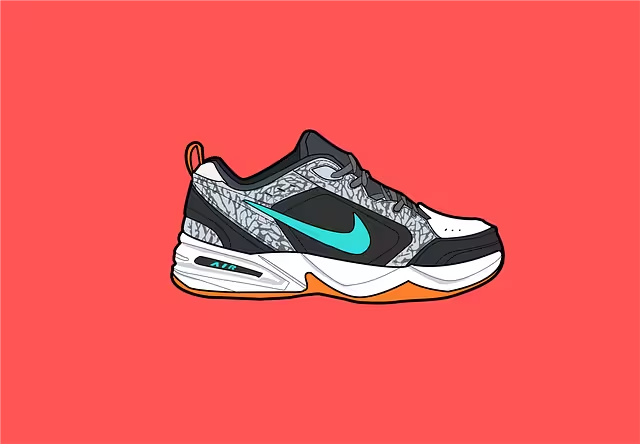
- Case Study: Nike (The “Swoosh”)The Nike “Swoosh” is arguably the most famous abstract logo on the planet. Designed in 1971 by student Carolyn Davidson for a mere $35, its success lies in its profound simplicity and potent symbolism. The shape itself is not a literal depiction of anything, but it perfectly evokes the core concepts of the Nike brand: motion, speed, and positive affirmation. It looks like a checkmark of approval and a dynamic arc of movement. The genius of the “Swoosh” is its ability to convey energy without being complicated. It is incredibly versatile, working flawlessly whether it is embroidered on a tiny corner of a shirt, printed on the side of a shoe, or emblazoned across a massive billboard. Nike has built so much brand equity into this mark that it no longer needs to use its name alongside it. The “Swoosh” alone is enough to communicate the entire brand ethos, a testament to the ultimate power of a successful abstract mark.
- Case Study: Pepsi (The “Globe”)The Pepsi logo has evolved many times over its history, but its modern form is a powerful example of abstract branding. The red, white, and blue globe is not a literal object, but a carefully designed geometric shape. The wave-like center line has been styled to suggest a subtle “smile,” creating a friendly and positive emotional connection. The color fields are balanced and energetic, reflecting the vibrant and youthful identity of the brand. By moving away from purely typographic logos of its past, Pepsi created an ownable symbol that is instantly recognizable on a global scale. This mark demonstrates how an abstract design can be infused with personality and emotion, making it a flexible tool for marketing campaigns that focus on happiness, fun, and connection.
- Case Study: Chase Bank (The Octagon)For a financial institution, conveying trust, stability, and security is the primary branding objective. Many banks resort to cliché images of eagles, pillars, or shields. Chase, however, opted for a bold abstract mark. The blue octagon, composed of four interlocking geometric pieces, was designed in 1961. The shape is strong and structured, like a vault, which implies security. The interlocking elements suggest pieces coming together to form a whole, representing the bank’s role as a central hub for its customers’ financial lives and its integration of many smaller banks over the years. The gaps in the design create a sense of forward motion, suggesting progress and dynamism. It is a brilliant piece of corporate design that communicates complex financial concepts like strength and partnership in a simple, memorable, and modern way.
- Case Study: Airbnb (The “Bélo”)As a modern, digital-first company, Airbnb needed a logo that could represent its unique mission of belonging. In 2014, they introduced the “Bélo,” a custom abstract symbol loaded with layers of meaning. The design team explained that the mark is a combination of four principles: a person (the head at the top), a location pin (the loop at the bottom), a heart (for love), and the letter ‘A’ for Airbnb. It is an incredibly thoughtful design that encapsulates the entire brand story in one fluid icon. It aims to be a universal symbol of belonging, transcending language and culture. The “Bélo” is a perfect example for modern businesses, showing how an abstract mark can be designed from the ground up to tell a deep, compelling brand story.
Is an Abstract Logo Right for Your Small Business? A Practical Framework
After analyzing the power of abstract logos for global corporations, the critical question remains: is this the right strategy for a local or growing small business? The answer is nuanced. While an abstract logo offers immense potential, it also comes with unique challenges, particularly for new enterprises with limited marketing budgets.
When to Consider an Abstract Logo
An abstract logo is a strategically sound choice for your small business under specific circumstances:
- Your Business Name is Abstract: If your company is named something like “Apex Solutions,” “Veridian Dynamics,” or “Cygnus Consulting,” the name itself does not explain what you do. In this case, a literal logo (like a picture of a computer for an IT company) can feel generic. A unique abstract mark can give your non-descriptive name a powerful visual anchor, creating a more cohesive and professional brand identity.
- You Are in a Highly Competitive or Technical Field: In industries like technology, finance, biotech, or high-end consulting, differentiation is key. Your competitors are likely sophisticated, and using a cliché symbol can make your business appear amateurish. A well-designed abstract mark signals innovation, forward-thinking, and competence. It positions you as a leader, not a follower.
- You Have Long-Term Growth Plans: If your vision extends beyond your local town or region, and especially if international business is a future goal, an abstract logo is an excellent long-term investment. It establishes a culturally neutral, highly scalable brand mark from day one, saving you the trouble of a costly rebrand down the line.
Potential Drawbacks for Startups
Despite their advantages, abstract logos present significant hurdles for new businesses:
- The Initial Recognition Challenge: This is the single biggest drawback. A picture of a cupcake for a bakery is instantly understood. A new, abstract shape has zero initial meaning to the public. It requires a sustained marketing effort to teach consumers to connect that shape with your business name and services. This takes time and money. For a brand-new local business that needs to communicate its purpose quickly and clearly, an abstract mark can create confusion.
- The Risk of Ambiguity: A professionally designed abstract logo is a thing of beauty and strategy. A poorly designed one is, at best, a meaningless shape and, at worst, confusing or unintentionally comical. Because it relies entirely on design principles like balance, color, and form to convey a feeling, the margin for error is small. A cheap or amateurish abstract logo can do more harm to your brand image than a simple, clear wordmark.
Recommendation: For the majority of new small businesses, the most effective and lowest-risk approach is the combination mark. By pairing your business name with a unique abstract symbol, you get the best of both worlds. The name clearly states who you are, while the symbol begins the process of building a unique visual identity. As your business grows and customers become familiar with the full logo, the abstract symbol will gain its own recognition, and you may eventually be able to use it on its own.
Core Principles for Effective Abstract Logo Design

If you determine that an abstract logo is the right direction for your brand, its execution must be flawless. A successful design is not the result of random doodling; it is a disciplined process guided by timeless design principles.
- 1. Simplicity: The most powerful abstract logos are often the simplest. Think of the Target bullseye or the Chase octagon. A complex design with too many shapes, lines, or gradients is difficult for the human brain to process and remember. A simple, clean mark is more memorable, more versatile, and projects an image of confidence and clarity. The goal is to create a design that is distinctive, not complicated.
- 2. Scalability: This is a crucial technical consideration. Your logo must be perfectly legible and impactful at all sizes. It needs to look just as good as a tiny 16×16 pixel favicon in a web browser tab as it does embroidered on a polo shirt or painted on the side of a company vehicle. This means the design must avoid thin, delicate lines that disappear when shrunk and intricate details that turn into a muddy blob. A professional designer will create your logo in a vector format (like .AI or .SVG), which allows it to be scaled to any size without losing quality.
- 3. Balance and Geometry: Great design has an underlying structure. An abstract logo should feel balanced and visually stable, whether that balance is symmetrical (like the McDonald’s golden arches) or asymmetrical (like the Nike “Swoosh”). This is where an understanding of design fundamentals, such as the Gestalt principles, comes into play. These principles explore how humans naturally group visual elements and perceive patterns. A logo that leverages these principles will feel more harmonious, complete, and pleasing to the eye.
- 4. Strategic Color Theory: In an abstract mark, color does much of the emotional heavy lifting. Since there is no literal object, the colors you choose will be the primary vehicle for conveying your brand’s personality. Each color has strong psychological associations:
- Blue: Trust, security, professionalism, calm (common in finance and tech).
- Red: Passion, energy, excitement, urgency (common in entertainment and food).
- Green: Growth, health, nature, wealth (common in finance and wellness).
- Yellow: Optimism, happiness, creativity (used to grab attention).
- Black/Gray: Sophistication, luxury, authority, modernity.The color palette is not an afterthought; it is a core component of the logo’s strategic message.
- 5. Relevance: Finally, even an abstract logo must feel relevant to its industry and audience. The design for a children’s daycare should feel playful and friendly, likely using soft, rounded shapes and bright colors. The logo for a high-end law firm, by contrast, should feel stable, serious, and authoritative, likely using strong angles, balanced geometry, and a conservative color palette. The mark does not have to show what you do, but it must feel like it belongs to your brand.
Conclusion: Making an Informed Decision
The abstract logo represents a bold, strategic choice in the world of branding. It offers a path to creating a truly unique, memorable, and timeless visual identity that can scale with your business from a local startup to a global enterprise. As we have analyzed, its power lies in its ability to stand out in a crowded market and convey complex, emotional ideas in a single, elegant form.
However, this power comes with a critical caveat, especially for small businesses: the meaning of an abstract mark is not inherent; it must be built through consistent marketing and a quality customer experience. It requires an initial investment to overcome the recognition challenge. Therefore, your decision must be an informed one.
Evaluate your business name, your target market, your competitive landscape, and your long-term ambitions. If your analysis points toward the need for a highly differentiated and scalable brand mark, an abstract logo may be your most potent weapon. Invest in a professional design process guided by the core principles of simplicity, scalability, and strategic intent, and you will create a competent, data-informed brand identity that will serve as a valuable asset for years to come.