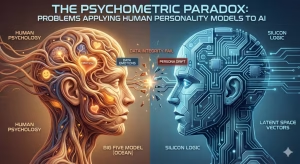
The neutral tone. You know the one. It’s that faint, almost imperceptible hum of… something… when you’re interacting with an AI. Is it trying too hard to be your buddy? Or maybe it’s so flat, so devoid of anything, that you feel like you’re shouting into the digital void? That little jolt, that flicker of connection—or disconnection—hinges on something we often overlook: its tone. In this post, we will look specifically at the neutral tone in AI Personas.
Now, what even is an AI persona? Think of it this way: beyond the intricate algorithms and dazzling datasets, it’s the perceived character of the AI, the personality we, as users, can’t help but ascribe to it. Isn’t every interaction we have, whether with a human barista or a sophisticated chatbot, colored by a perceived personality, a certain vibe? And a massive part of that vibe, my friends, is its tone. This isn’t just about word choice; it’s the entire expressive style, ranging from bubbly and enthusiastic, to somber and serious, or… strategically neutral.
And that brings us to a rather intriguing question, doesn’t it? When we encounter a “neutral” AI, are we simply experiencing the absence of a defined personality, perhaps the raw, baseline output of its underlying Large Language Model or NLP framework? Or is this neutrality a meticulously designed state, a deliberate choice crafted with precision? (A little technical food for thought: the default settings and system prompts often guide these models towards a semblance of neutrality, but true, effective neutrality? That’s an art form!)
This is where we bump into the “Neutrality Paradox.” Many hear “neutral” and instantly think “boring,” “robotic,” or “devoid of life.” But could it be, and this is where I invite you to ponder, that something purposefully unexciting on the surface can be incredibly powerful and effective underneath? Our goal here isn’t to create a digital monotone drone. Instead, it’s about achieving genuine approachability and fostering unwavering trustworthiness, all without the AI feigning emotions it can’t possess or, critically, stumbling into that unsettling “uncanny valley” where it tries to be human and just feels… off.
So, are you ready to explore how this quiet power, this carefully calibrated neutrality, is shaping the future of how we connect with technology? Let’s get those brilliant minds of yours whirring!
Well, intrepid readers, we’ve dipped our toes into the “what” and “why” of AI personas and the curious case of neutrality. Now, let’s grab our virtual magnifying glasses and dissect the rest of this fascinating subject.
Video Version of this Article
The “Why”: Unpacking the Benefits of a Well-Implemented Neutral Tone

So, we’ve established that a neutral tone isn’t just a lack of flair; it’s a strategic choice. But why choose it? What tangible advantages does this carefully constructed neutrality bring to the digital table? Isn’t a bit of pizzazz always better? Well, let’s consider the evidence.
- A. Building Unshakeable Trust and Credibility: When an AI is designed to provide information, say, for financial advice, technical support, or even sifting through complex research (something we do a lot of here at Silphium Design!)—what’s the bedrock of that interaction? Trust, of course! A neutral tone inherently projects objectivity and impartiality. It subtly communicates, “I am here to provide information, uncolored by personal opinion or emotional persuasion.” Think about it: if an AI guiding you through your tax returns suddenly got overly enthusiastic about a particular deduction, wouldn’t a tiny alarm bell go off in your head? This perceived lack of an agenda can significantly reduce user skepticism, especially in a world increasingly wary of digital manipulation. It’s about fostering confidence through consistency and a straightforward approach.
- B. Enhancing User Experience (UX) for Everyone, Everywhere: The internet is a global village, isn’t it? Your AI might interact with someone in my vibrant New York City one minute and someone in a completely different cultural context the next. A neutral tone possesses a certain universality. By minimizing idioms, culturally specific humor, or strong emotional expressions that might not translate well, it becomes more inclusive and accessible to a broader demographic. (Technical: This often involves using a more standardized lexicon and grammatical structures that are broadly understood.) Furthermore, for users who are here for a specific task, getting an answer, completing a transaction, learning a new concept—a neutral AI keeps the focus squarely on the information or the task at hand. It’s about clarity over clutter, ensuring the user’s cognitive load is spent on their goal, not on deciphering a complex AI personality.
- C. Maintaining Rock-Solid Brand Consistency and Professionalism: For many businesses, especially those in established sectors like finance, law, or B2B services, the brand voice is often one of measured professionalism, reliability, and expertise. (Instructional: Consider your own organization. What are the core attributes of your brand’s communication style?) An AI persona should be a seamless extension of that voice. If your brand prides itself on calm, authoritative advice, an AI that cracks jokes or uses overly casual slang would create a jarring disconnect, wouldn’t it? A neutral tone can be tailored to reflect this professionalism, reinforcing the brand’s identity with every interaction. It’s about ensuring every touchpoint, human or digital, speaks with a unified voice.
- D. Mitigating the Risks of Misinterpretation and Unintentional Offense: Language is a wonderfully complex beast, full of nuance and subtlety. What’s considered witty in one culture might be rude in another. An enthusiastic response could be seen as appropriate by one user but overwhelming or even insincere by another. A neutral tone, by its very nature, sidesteps many of these potential pitfalls. By consciously avoiding strong emotional indicators and culturally loaded expressions, developers can significantly minimize the chances of an AI’s response being perceived negatively or causing offense. It’s a proactive approach to ensuring positive and respectful interactions across diverse user sensitivities.
The “How”: Technical and Design Principles for Crafting That Elusive Neutral Tone
Alright, so we’re sold on the “why.” But how do we actually go about building an AI that embodies this effective neutrality? Is it just a matter of telling the machine, “Be neutral!”? If only it were that simple! Crafting a genuinely neutral tone is a sophisticated blend of linguistic precision, technical know-how, and a deep understanding of human perception.
- A. The Building Blocks: Language and Lexicon Choices: This is foundational. (Technical: The core of this lies in meticulously curating the AI’s vocabulary and grammatical patterns.) We’re aiming for clarity and unambiguity. This means selecting words that have precise meanings and avoiding those that are laden with connotations or multiple interpretations. Slang and most jargon are typically out, unless the AI is operating in a highly specific domain where that jargon is the lingua franca (and even then, it should be used judiciously). Consider the language used in scientific papers or technical manuals; what makes it effective for conveying complex information clearly? Emotionally charged words – “amazing,” “terrible,” “incredible” – are generally replaced with more objective descriptors. Sentence structures often favor directness: subject-verb-object, clear and to the point, but not so clipped as to sound unnatural. It’s a delicate balance, like a perfectly tuned instrument.
- B. The Unseen Conductor: Pacing and Rhythm of Interaction: Have you ever chatted with someone who responds too quickly, or too slowly? It affects the feel of the conversation, doesn’t it? The same applies to AI. (Technical: Response latency and the flow of dialogue elements are critical.) A neutral AI’s responses should feel natural in their timing—not so fast that the user feels rushed, nor so slow that they feel ignored. The pacing should be unhurried yet efficient. This often involves careful system design to ensure quick information retrieval and processing, presented in a digestible rhythm. Sometimes, breaking up longer pieces of information into shorter, logically sequenced messages can also contribute to a more comfortable and neutral interaction flow.
- C. The Art of Subtlety: Absence of Strong Emotional Cues: This might seem obvious, but it’s in the details. Excessive use of exclamation points? Generally avoided. A proliferation of emojis? Probably not, unless it’s a very specific type of “friendly-neutral” persona where a few carefully chosen, universally understood emojis are deemed appropriate. Interjections that signal strong surprise, delight, or dismay (“Wow!”, “Oh no!”) are also typically minimized. But here’s the challenge: how do we ensure “neutral” doesn’t become “monotonous” or “robotic”? This is where subtle linguistic variation, perhaps in sentence structure or phrasing (without injecting overt personality), becomes key. For voice AI, this extends to prosody—the rhythm, stress, and intonation of speech. A neutral voice AI still needs subtle variations to avoid sounding like a stereotypical automaton from a B-movie.
- D. Behind the Curtain: Prompt Engineering and Reinforcement Learning: Here’s where we get into the mechanics of modern AI, especially with Large Language Models (LLMs) from places like OpenAI, Google, or Anthropic. (Technical: The behavior of these models is heavily influenced by “system prompts” and the data they’re trained on.) Developers craft detailed instructions—system prompts—that guide the AI’s persona. For a neutral tone, this might include directives like: “You are a helpful and impartial AI assistant. Your responses should be informative, objective, and polite. Avoid expressing personal opinions or emotions.” Beyond the initial prompt, Reinforcement Learning from Human Feedback (RLHF) is often used to fine-tune the model, where human reviewers rate AI responses, helping to steer the AI towards the desired neutral (or any other) persona. (Instructional: This iterative process of prompting, testing, and refining is crucial for achieving a consistent and effective AI tone.)
- E. Frequently Asked Questions: Many of you are likely wondering, What exactly is a chatbot persona? As we’ve discussed, it’s that perceived character, and tone is a massive slice of that pie. Some also ask, How do you humanize AI tone? While our focus here is neutrality, it’s worth noting that a well-crafted neutral tone is a form of careful humanization—it aims to be understandable, relatable in its clarity, and avoid the pitfalls of bad humanization (like sounding fake or forced). And what about those tell-tale signs of “GPT-speak” – that generic, slightly too verbose, sometimes overly cautious language? Have you noticed how some AI responses just feel like they were written by an AI, even if they’re grammatically perfect? Crafting a good neutral tone involves actively working to avoid these markers, aiming for language that is concise, confident in its objectivity, and free of unnecessary platitudes or overly complex sentence structures that don’t add value. It’s about being clear, not just correct.
The Tightrope Walk: Challenges and Considerations in Implementing a Neutral AI Tone

Now, designing for neutrality isn’t a walk in Central Park on a sunny day—though I do enjoy those! It comes with its own set of hurdles and tightropes to navigate. If not handled with finesse, “neutral” can indeed go wrong.
- A. Dodging the “Robotic” Bullet: The Peril of Coldness: This is perhaps the most common fear: that in striving for neutrality, the AI will end up sounding cold, impersonal, utterly disengaged or well “neutral.” How do we imbue an AI with a sense of helpfulness and attentiveness without giving it a distinct “personality” that might not be universally appealing? The antidote lies in subtle cues. Words like “certainly,” “of course,” “please,” and “thank you” (where appropriate), along with a clear focus on the user’s query, can convey helpfulness without veering into unwanted emotionality. It’s about being task-oriented and user-centric, which inherently feels supportive.
- B. Context is King (and Queen, and the Entire Royal Court!): When is Neutral NOT the Answer? Let’s be clear: neutrality isn’t a universal panacea. (Instructional: Always ask: what is the primary goal of this AI interaction, and who is the user?) There are numerous use cases where a more expressive, empathetic, or even humorous tone is far more appropriate. Think about AI companions designed for emotional support, entertainment bots whose entire purpose is to be characterful, or brand personas that are intentionally quirky and vibrant. Moreover, should an AI adapt its generally neutral stance based on detected user sentiment? If a user is clearly frustrated, should the AI become more overtly “understanding,” or maintain its composure?
- C. The “Cold Start” Conundrum for Personalization: When a user interacts with an AI for the very first time, a neutral tone is often the safest and most broadly acceptable starting point. It makes no assumptions. But what if the long-term goal involves personalization, tailoring the interaction style to individual user preferences? How does an AI gracefully transition from a universal neutral stance to something more bespoke, without that transition feeling jarring or presumptuous? This is a significant challenge in AI persona development, often requiring implicit or explicit user feedback over time.
- D. Wrestling with Technical Gremlins and Model Biases: Even with the best intentions and meticulous prompt engineering, AI models can be… well, unpredictable at times. (Technical: Ensuring an AI model consistently maintains the desired neutral tone without drifting due to inherent biases in its vast training data is an ongoing effort.) Training data, by its very nature, reflects the human language it’s drawn from, biases and all. If the data contains certain patterns of language associated with specific (non-neutral) tones in certain contexts, the model might inadvertently replicate these. Constant monitoring, evaluation, and fine-tuning are essential to keep the AI aligned with its intended neutral persona.
Mapping the Terrain: The Semantic Landscape of LSI Keywords and Entities
To truly grasp the concept of neutral AI tone, it helps to understand its neighborhood—the related terms, technologies, and key players in this ecosystem. Think of it as building a mind map, or perhaps charting a constellation, with “Neutral AI Tone” at its center.
- A. The Constellation of Concepts: Core LSI Keywords: Latent Semantic Indexing (LSI) keywords are terms other search engines see as related to your main topic. Understanding these helps us see the bigger picture. For our discussion, these include:
- AI Chatbot/Conversational AI: Obviously central, as tone is a key feature of how these systems interact.
- User Experience (UX): Neutral tone is often chosen to optimize UX by enhancing clarity and reducing friction. Isn’t a smooth, understandable conversation a cornerstone of good UX?
- Brand Identity: As we discussed, AI tone should reflect and reinforce the brand’s persona.
- Customer Service AI: A huge application area where trust, clarity, and often neutrality are paramount.
- Machine Learning (ML) / Natural Language Processing (NLP): These are the core technologies that enable an AI to understand and generate language with a specific tone.
- Sentiment Analysis: While often used to detect user emotion, the principles can be inverted to help an AI avoid displaying strong emotion, thus aiding neutrality.
- Voice User Interface (VUI): For voice assistants like Alexa or Siri, prosody and vocal tone are critical components of perceived neutrality.
- Human-Computer Interaction (HCI): The broader academic field that studies how people interact with technology; AI tone is a key research area here.
- AI Ethics/Bias in AI: Crucial when considering how tones are perceived and whether they inadvertently perpetuate biases.
- Prompt Engineering: The art and science of crafting instructions to guide AI models—essential for achieving a specific tone.
- Content Generation: AI is increasingly used to create content, and controlling the tone of that content is vital.
- B. The Movers and Shakers: Key Players and Technologies (Entities): These are the organizations, tools, and specific AI models shaping the field:
- OpenAI (ChatGPT, GPT-4, etc.): Hugely influential in demonstrating what’s possible with LLMs and their personas. Their models are often used as a base for developers to build upon.
- Google (Gemini, LaMDA, Dialogflow): A major player with its own advanced AI models and platforms for building conversational experiences. (Dialogflow, for example, offers tools to design conversational flows where tone control is a factor).
- Amazon (Alexa, Lex): Pioneers in the voice assistant space, where the neutrality (or carefully crafted persona) of Alexa’s voice is a defining feature. Amazon Lex allows developers to build their own conversational bots.
- Apple (Siri): Another key voice assistant where the evolution of Siri’s tone and personality has been a public journey.
- Microsoft (Azure AI, Copilot): Offers a suite of AI tools and services, increasingly integrating AI with various personas across its products.
- Meta AI: Actively researching and developing advanced AI, including models with sophisticated conversational capabilities.
- Research Institutions (e.g., MIT CSAIL, Stanford AI Lab): My alma mater, MIT, and places like Stanford are where much of the foundational AI research happens! Their work underpins the technologies we’re discussing. (Professional: Keeping an eye on academic research is vital for staying ahead in this field.)
- Platforms offering persona customization (e.g., Tidio, Zendesk, Intercom): Many customer service and chatbot platforms provide tools that allow businesses to customize the look, feel, and, importantly, the tone of their AI agents to match their brand.
Understanding this landscape helps us appreciate that crafting a neutral AI tone isn’t an isolated task; it’s embedded in a rich, evolving ecosystem of technologies, research, and practical applications.
The Moral Compass: Ethical Implications of AI Tone, Including Neutrality

Now, let’s steer our ship into slightly deeper waters: the ethics of it all. The way an AI communicates, its tone, isn’t just a design choice—it carries ethical weight. And yes, even a “neutral” tone has ethical dimensions we need to consider.
- A. The Virtues of Transparency and Honesty: A big question in AI ethics is: Should an AI always disclose that it’s an AI? Many argue that transparency is paramount. A neutral tone, while aiming for smooth interaction, shouldn’t be used to deceive. Alongside this, there’s the discussion of “feigned empathy” versus honest, neutral assistance. A neutral AI, by not attempting to mimic complex human emotions it doesn’t possess, can be seen as more “honest” in its interaction, provided its capabilities and nature are clear.
- B. The Responsibility to Avoid Manipulation: Tone is a powerful tool of influence. While our focus here is neutrality, it’s crucial to remember that even a seemingly neutral AI could deliver manipulative content. The ethical burden lies not just in how the AI speaks, but what it says and why. The neutrality of the tone shouldn’t become a smokescreen for biased information or persuasive agendas that aren’t in the user’s best interest. The content itself must be fair, accurate, and transparently sourced if it is to be truly ethical.
- C. Championing Accessibility and Fairness: Here’s a significant ethical positive: a well-designed neutral tone can be a boon for accessibility. For individuals on the autism spectrum, or those who find emotionally complex or overly idiomatic language challenging to process, a clear, direct, and neutral AI can be far easier and less stressful to interact with. By providing a predictable and calm communicative partner, neutral AI can create more equitable access to information and digital services.
Gazing into the Crystal Ball: The Future of AI Persona Tones – Beyond Simple Neutrality?
The field of AI is anything but static; it’s a bit like hiking a trail that’s being laid down just a few steps ahead of you – exhilarating and ever-changing! So, what might the future hold for AI tones, especially our friend, neutrality?
- A. The Dawn of Adaptive Tonality: Imagine an AI that, while maintaining a generally neutral core, can subtly adapt its level of formality or warmth based on the ongoing interaction and detected user cues. (Technical: This is a significant leap, requiring sophisticated real-time sentiment analysis and highly nuanced generative capabilities.) It wouldn’t mean wild swings in personality, but rather minor adjustments—perhaps slightly more formal language for a complex technical query, or a touch more warmth (still within neutral bounds) if a user expresses mild confusion. The goal? An AI that feels even more responsive and intelligently attuned, without sacrificing its core reliability.
- B. The Nuance of Contextual Neutrality: Not all “neutral” situations are identical, are they? The kind of neutrality you’d want from an AI delivering a critical medical update might be different from an AI helping you browse a library catalogue. The future could see AI developing a more refined understanding of “contextual neutrality.” Could an AI learn to differentiate when strictly factual, unadorned information is paramount, versus when a slightly more relational, yet still neutral, interaction would enhance the user experience? This involves the AI grasping the implicit goals and emotional stakes of different conversational contexts.
- C. Specialized Neutrality: The Role of AI in Demanding Fields: In highly specialized fields like technical support for complex machinery, advanced scientific research, or even certain types of education, the need for absolute clarity, precision, and an unwavering, objective tone is paramount. (Instructional: Think of the ideal instructor for a complex subject – knowledgeable, patient, clear, and impartial.) The future will likely see the development of highly specialized neutral AI personas tailored to these demanding domains, where the AI’s ability to convey complex information without ambiguity is its most critical asset. They would be the digital equivalent of the most focused, expert communicators.
The Final Word: Neutrality as a Cornerstone of Thoughtful, User-Centric AI Design
Phew! We’ve journeyed from the foundational “why” to the far-reaching “what’s next.” If there’s one thing I hope you take away from our deep dive today, it’s this: neutral tone in AI personas is not a passive default, nor is it merely the absence of personality. It is an active, intentional, and often sophisticated design choice with profound implications for trust, user experience, and ethical interaction.
The quest to refine AI communication is ongoing. It’s a fascinating challenge that sits at the intersection of technology, psychology, linguistics, and ethics — As AI systems become ever more woven into the fabric of our daily lives, from the mundane to the mission-critical, won’t the nuances of their communication, including the masterful application of neutrality, become not just important, but absolutely essential?
Ultimately, the best AI personas, whether strikingly neutral or vibrantly characterful, are those built with a bedrock of integrity, a keen understanding of technical competence, and a deep, unwavering respect for the human on the other side of the screen. That’s how we build trust, deliver value, and responsibly shape the future of interaction.
Thank you for joining the Webheads on this intellectual hike! Until next time, keep those questions sharp, your curiosity boundless, and your designs always, always user-centric.