In today’s world, we face a serious challenge. Industrial accidents and workplace injuries are not just numbers on a spreadsheet; they represent real people and families.
This is to say, the old way of managing safety is broken. We used to rely on clipboards, manual check-ins, and hoping that everyone remembered the rules. That is reactive. It waits for something bad to happen before we fix it. The future of safety is proactive. It stops the accident before it starts. This is where geofence alerts come in.
Think of a geofence not just as a line on a map, but as a digital shield. When I advise small businesses or large industrial sites, I tell them that geofence alerts are the eyes and ears that never sleep. They watch over your team when you cannot.
In this article, we will walk you through the benefits of geofence alerts for mobile workforce safety. We will move beyond the basics and look at the real science behind it. I will explain how these invisible barriers can prevent heavy machinery accidents, find missing workers in seconds, and save your company from costly lawsuits. We will look at the data, the hardware, and the laws you need to know. By the end of this, you will see why this technology is not just a “nice to have,” but a necessity for a modern, safe workplace.
The Shift from Reactive to Proactive Safety
For years, safety managers have operated in a reactive mode. A reactive approach means you look at an accident report after an injury occurs and try to figure out what went wrong. You might add a new sign or hold a training meeting, but the damage is already done. This method relies too much on human memory and perfect behavior, which are both prone to error.
Geofencing changes this dynamic entirely. It creates a proactive system. Instead of waiting for an incident, the system constantly scans the environment for risks. It is like having a digital guardian angel on the shoulder of every worker.
The National Safety Council has an initiative called “Work to Zero.” Their goal is to eliminate workplace fatalities through technology. Their data shows us that workplace injuries cost billions of dollars every year. In 2023 alone, preventable injury costs reached over one trillion dollars. Motor vehicle crashes are among the most expensive claims, often costing over ninety thousand dollars per incident.
When you use geofence alerts, you are deploying a system that acts instantly. It does not get tired, and it does not get distracted. It simply monitors the location of your people and assets against a set of safety rules. If a rule is broken, the alert goes out immediately. This shift from reacting to preventing is the single biggest leap forward in industrial safety in the last twenty years.
Technical Architecture of Safety-Critical Geofencing

To understand why these alerts work, we have to look under the hood. How does the signal get from the worker to the manager? In safety scenarios, speed is everything.
We rely on signal triangulation. Outdoors, we use GPS from satellites. It is good, but it can be off by a few meters. Indoors, GPS does not work well. So, inside warehouses or factories, we use Bluetooth Low Energy (BLE) beacons or RFID tags. These are like small lighthouses that send out a signal to a worker’s phone or badge.
The architecture determines if the system is “safety-critical” or just “informational.” For a safety system, we cannot afford delays. We use protocols like MQTT. This is a lightweight way to send messages that travels very fast, often in less than half a second.
We also have to decide where the “thinking” happens. Does the phone decide to send the alert (client-side), or does the server decide (server-side)?
-
Client-Side: The worker’s device has the map saved on it. If they step into a danger zone, the device knows immediately and buzzes. This is the fastest method. It works even if the internet cuts out.
-
Server-Side: The device sends its location to a central computer. The computer checks the map and sends a message back. This is better for complex data, but if the network is slow, the warning might come too late.
For the best safety, I always recommend a hybrid approach, but with a strong focus on client-side processing for immediate threats.
Polygonal vs. Radial Fences
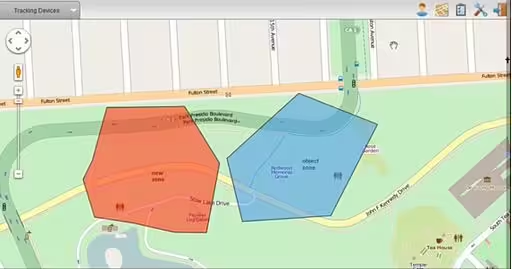
Not all geofences are created equal. When you buy a basic tracking service, they often give you “radial” geofences. This is a simple circle. You pick a point, and you draw a circle around it.
Radial fences are fine if you just want to know if a truck is near a city. But in a complex industrial site, circles are dangerous. A chemical storage tank is rarely shaped like a perfect circle. A loading dock is usually a rectangle. If you use a circle to mark a square building, you will have gaps where the alert does not trigger, or areas where it triggers falsely.
This is why we use polygonal geofencing. A polygon is a shape with many sides. We can draw a geofence that traces the exact outline of a hazardous area. We can map a winding road, a specific aisle in a warehouse, or an irregular blast zone in a mine.
Using polygonal fences requires better software and more precise data points, but it eliminates “false positives.” You do not want workers getting geofence alerts when they are safe, or they will start ignoring them. Precision builds trust.
Automated Hazard Zone Notifications

One of the most immediate benefits of geofence alerts is keeping people out of places they should not be. Every job site has “Red Zones.” These are areas with high voltage, toxic chemicals, or active blasting.
In the past, we used yellow tape and plastic signs. But signs fade, and tape gets torn down. A digital geofence never fades.
When a worker carries a mobile device or a smart badge, the system tracks their path. If they cross the invisible line into a Red Zone, two things happen instantly. First, their device vibrates or makes a loud sound. This is the haptic warning. It tells them, “Stop! Look around.”
Second, a notification is sent to the safety manager. This creates a record of the near-miss. If you see that ten workers walked into the high-voltage area this week, you know you have a problem. Maybe the physical signage is poor, or maybe the walkway is blocked. The data allows you to fix the root cause.
This geofence automation removes the need for a supervisor to watch every door. The geofence watches the door for you, twenty-four hours a day.
Lone Worker Protection and Dead Man’s Switch Integration
Working alone is one of the biggest risks in any industry. If a utility worker is fixing a line in a remote area and gets hurt, no one might know for hours. This is where the concept of “situational awareness” becomes critical.
Geofence technology can be paired with what we call a “dead man’s switch” or an inactivity monitor. Modern devices have accelerometers—the same sensor that tells your phone which way is up.
Here is how it works: The system creates a geofence around the remote work site. When the worker enters, the system logs them as “on site.” If the worker’s device stops moving for a set time—say, five minutes—the system gets suspicious.
It sends a prompt to the worker: “Are you okay?” If the worker does not tap “Yes,” the system escalates. It sends an emergency geofence alerts message to the command center with the worker’s exact coordinates.
This saves lives. It turns a potential tragedy into a rapid rescue mission. The rescuers do not have to search the whole county; they go exactly to the pin on the map.
Heavy Machinery and Traffic Separation
In warehouses and construction sites, forklifts and people often occupy the same space. This is a recipe for disaster. Vehicle-to-Pedestrian (V2P) accidents are common and often fatal.
We can use geofence alerts to create a “safety halo” around heavy machinery. Imagine a dynamic bubble that moves with a forklift. If a worker on foot breaches that bubble, the forklift driver gets an alarm, and the worker’s badge vibrates.
Some advanced systems can even slow down the vehicle automatically. If a forklift enters a pedestrian-heavy zone, like a break area or a walkway, the geofence can trigger a speed limiter. The driver cannot speed even if they try.
This separation of traffic is crucial. It relies on ultra-low latency. The alert must happen in milliseconds. If the alert comes two seconds late, the forklift has already moved several feet. This is why high-quality, industrial-grade geofencing is so different from the GPS app on your phone.
Emergency Mustering and Evacuation Efficiency
When a fire alarm rings, chaos often follows. The goal is to get everyone to the “Muster Point”—the safe gathering spot. In the old days, a manager would stand there with a clipboard, trying to shout names over the noise of sirens. It was slow and inaccurate.
With geofencing, the Muster Point is a digital zone. As workers arrive at the safe spot, their devices check in automatically. The safety manager looks at a tablet and sees a list of names turning green in real time.
The system also shows who is not in the safe zone. It shows their last known location. If John Smith is still in Building B, the fire rescue team knows exactly where to look.
This drastic reduction in “accounting time” is vital. OSHA regulations often require efficient evacuation plans. Using geofence alerts for mustering can cut the time it takes to account for everyone by more than fifty percent. In a real emergency, those minutes are the difference between life and death.
Compliance and PPE Verification
Compliance is not just about avoiding fines; it is about following the rules that keep us safe. Insurance companies and auditors love data. They want proof that you are enforcing safety rules.
Geofencing can help with Personal Protective Equipment (PPE) compliance. We can set up a geofence at the entrance to a specialized work zone. When a worker crosses the line, their device flashes a message: “Hard Hat and Respirator Required Beyond This Point.”
The worker might have to click “Confirm” to silence the alarm. This creates a digital audit trail. If an accident happens later and the worker claims they did not know they needed a mask, you have a record that they acknowledged the warning at 8:03 AM.
This immutable digital log protects the company from liability. It proves that you provided the warning. It also helps you identify workers who habitually ignore safety protocols so you can retrain them before an injury occurs.
Strategic Implementation and Hardware Considerations
Choosing the right hardware is the foundation of a successful system. You cannot just use any old smartphone and expect industrial-grade safety.
You have to balance battery life with precision. GPS is power-hungry. If you track a worker’s location every second, their battery will die by lunch.
We use “gating” strategies to save power. The device might use a motion sensor (accelerometer) to see if the worker is moving. If they are sitting in the breakroom, the GPS turns off. When they stand up and walk, it wakes up.
For the most critical safety zones, we often use dedicated hardware—rugged badges or tags that don’t run apps like Facebook or YouTube. These devices are purely for safety. They have long battery lives and loud speakers for alerts.
You also need to decide between cellular, Wi-Fi, or private radio networks. If you are in a mine or a remote oil field, cell service might be weak. In these cases, we use “Store and Forward” technology or localized mesh networks. This ensures the geofence alerts still work locally between devices, even if the connection to the main office is down.
Privacy, Legalities, and Trust

This is the topic that makes everyone nervous. Privacy. “Is my boss tracking me to the bathroom?” “Is this legal?”
When deploying a geofence, trust is your most valuable asset. If workers think you are spying on them, they will leave the devices in their lockers or wrap them in foil.
The legal landscape is strict. In California, the CCPA (California Consumer Privacy Act) defines location data as sensitive personal information. In Europe, the GDPR (General Data Protection Regulation) has very high standards for “purpose limitation.”
This means you can only collect data that is necessary for the specific purpose of safety. You cannot use safety data to track how many times someone takes a smoke break. That is a violation of trust and potentially the law.
Best practices involve “privacy by design.” The system should only track workers when they are physically on the job site and only during their shift hours. As soon as they clock out or leave the geofence, the tracking must stop.
Geofence transparency is key. You must tell employees exactly what is being tracked, why it is being tracked, and how long the data is kept. When workers understand that the device is there to save their life, not to micromanage them, they will accept it.
Common Questions
How accurate are geofence alerts for safety?
It depends on the technology. Standard GPS is accurate to within about 5 to 10 meters outdoors. For higher precision, we use RTK (Real-Time Kinematic) GPS, which can get down to centimeters. Indoors, using UWB (Ultra-Wideband) or BLE beacons can provide accuracy within a few feet.
Can geofencing work without cellular service?
Yes. Critical alerts should happen on the device (client-side). The map is downloaded to the device. So, even if the phone has no signal, it still knows the coordinates of the danger zone and will alert the worker. The manager might not see the alert until the device reconnects, but the worker is warned instantly.
Is it legal to track employees using geofencing?
Generally, yes, provided it is for a legitimate business purpose like safety or asset management. However, you must comply with local labor laws and privacy regulations. You usually need to notify employees and, in some jurisdictions, get their consent. You should never track employees off-duty.
Conclusion
We have covered a lot of ground. We looked at the shift from reactive to proactive safety. We explored the technical details of signals and polygons. We discussed the life-saving potential of automating hazard zones, protecting lone workers, and separating people from machines.
The benefits of geofence alerts for mobile workforce safety are clear. They reduce the human error that leads to accidents. They speed up emergency response times. They provide the data you need to prove compliance and protect your business from liability.
But geofence technology is only a tool. It requires a human commitment to use it. It requires a management team that values safety enough to invest in the right systems.
As we look to the future, we will see Artificial Intelligence merging with these systems. The AI will not just report that a worker entered a zone; it will predict when an accident is likely to happen based on movement patterns.
For now, the next step is yours. You need to look at your facility map. Where are the blind spots? Where are the “near misses” happening? Those are the places where a digital shield can make the difference.
Safety is not an accident. It is a choice. By choosing to implement these smart technologies, you are choosing to bring your workforce home safe every single day.